
For most local businesses in Fife, the map result decides more of the week’s enquiries than the website does. It is driven by a Google Business Profile that was usually set up once, years ago, by whoever had the login. It runs on rules Google publishes in full.
This is a practical account of what those rules actually say, the four places local businesses most often fall foul of them, and what a profile and a website should be doing for each other. We have written separately about why you rank in your own town but not the next one; this piece is about the profile itself rather than about ranking factors.
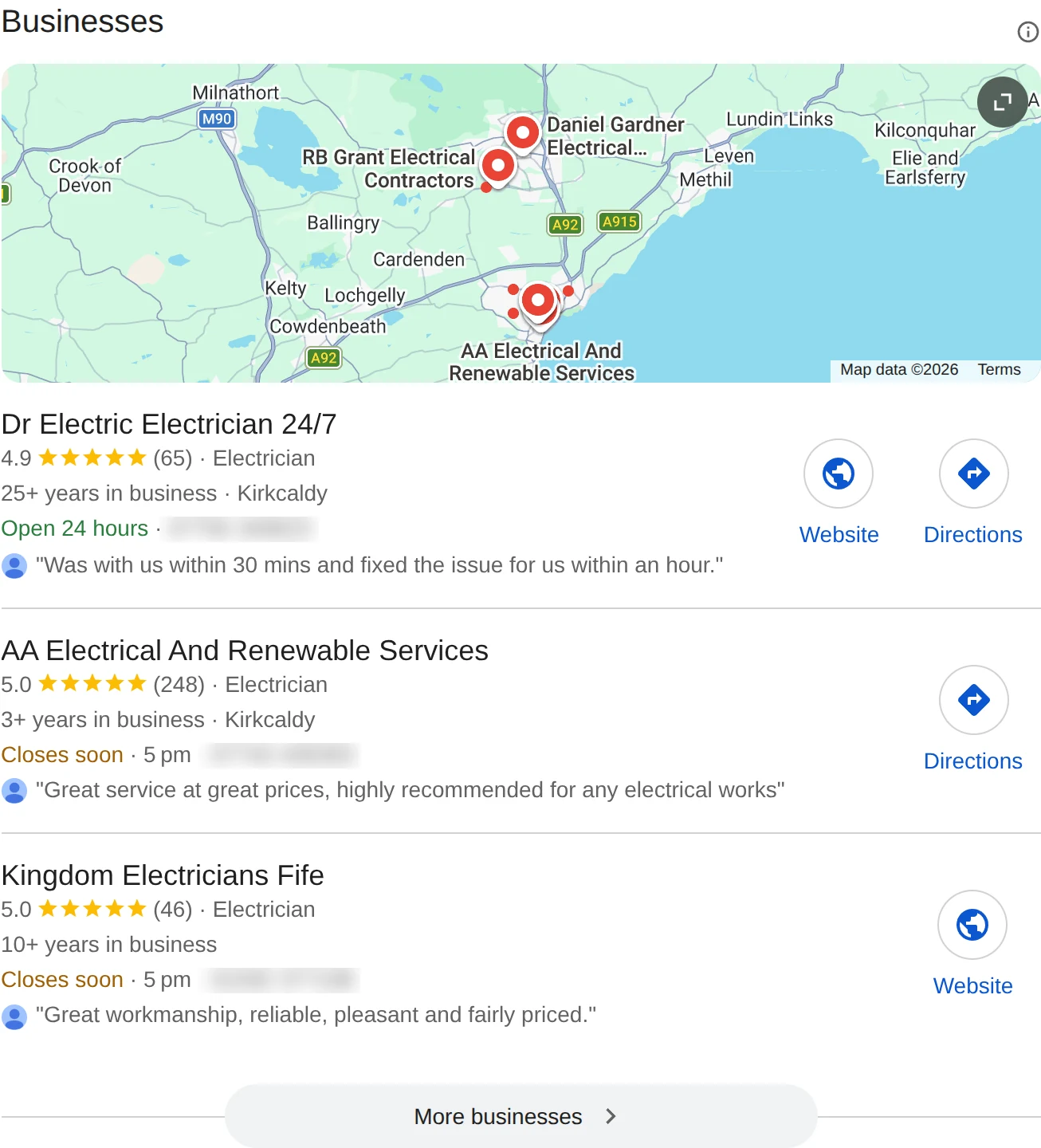
The name is the rule most often broken
Google’s guidelines for representing your business are unambiguous:
“Your name should reflect your business’s real-world name, as used consistently on your storefront, website, stationery, and as known to customers.”
The same guidance rules out marketing taglines, phone numbers, URLs, store codes, service or product information and location details inside the name field. So a joinery firm’s profile should carry the name above its door and nothing else, not that name followed by “| Kitchens & Bespoke Fitted Wardrobes Kirkcaldy Fife”.
The reason firms do it is straightforward: a town and a service in the name appear to help. The reason not to is equally straightforward, and Google states it plainly: it “reserves the right to suspend access to Business Profiles” where the guidelines are violated. A suspension does not trim the name back. It removes the profile, along with the reviews and the map presence that came with it, and getting it reinstated is a process with no service-level agreement attached.
It is also the single easiest thing for a competitor to report, and in a small market, competitors notice.
Service areas have limits, and they are published
For a business that travels to customers (a joiner, an electrician, a mobile groomer, a removals firm), the service area is the part of the profile that gets fantasised about. Google’s service area guidance sets real constraints:
- “You can set up to 20 service areas based on the cities, postal codes, or other areas you serve.” Twenty. Not every town in Scotland.
- “The boundaries of your overall area shouldn’t be more than about 2 hours of driving time from where your business is based.”
- “When you set your service area, be as specific and accurate as possible.”
- A business with no permanent signage at its address is a service-area business, and the guidance says to “remove your address and only enter your service area”.
That last point catches a lot of Fife trades working from home. Leaving a residential address visible on a profile is both a privacy problem and a guidelines problem; the fix takes two minutes.
The more useful thing to understand is what a service area does not do. Listing Dunfermline as a service area does not place you in Dunfermline for somebody searching there. Distance is still one of the three factors Google names, and it does not respond to a setting. The service area tells Google and customers where you are willing to travel; it does not move your van.
Reviews: what you may ask for, and what will cost you
Reviews feed prominence, which is one of the two factors that does respond to work. They are also where well-meaning businesses cross a line. Google’s contribution policies prohibit:
- Reviews “that have been paid for, directly or in kind”, and offering “payment, discounts, free goods and/or services — in exchange for posting any review or revision or removal of a negative review”.
- “Content that is not based on a real experience.”
- Content based on “a conflict of interest”, which expressly includes “current or former employment”. So staff reviewing their own employer is out, and so is reviewing a competitor.
- “Content that has been posted from multiple accounts by or at the request of one person.”
A prize draw for reviewers is an incentive. A discount for a five-star review is an incentive. Asking every satisfied customer, plainly, at the moment the job is finished, is not. It is also what actually works, because the constraint on most small businesses is not willingness but timing. The request that arrives while the customer is still standing in a tidy garden gets answered; the one sent a fortnight later does not.
Responding matters too. Google’s own local ranking guidance notes that responding to reviews shows you value feedback and can help a business stand out in local search.
The unglamorous settings that do the work
Google’s ranking guidance asks for complete and accurate information (full address where applicable, hours, category and attributes), and it is worth being methodical about a few of them:
- The primary category is a ranking decision, not an administrative one. It is the strongest statement of what the business is. Secondary categories add reach; a wrong primary category quietly caps everything.
- Hours have to be true, including the ones over Christmas and the local trades holiday. A profile that says open when the phone is off produces exactly the review you do not want.
- Photographs of the actual business. Your vans, your crew, your finished work, not stock images of somebody else’s.
- Services and products listed properly, because that is where the detail belongs that people try to force into the name field.
And the line worth quoting to anybody selling you a shortcut: Google states there is “no way to request or pay for a better local ranking on Google”.
What the profile and the website owe each other
A profile does not sit on its own. The two are read together, and the joins are where most of the value is lost:
- Point the profile at the right page. A profile for a Kirkcaldy electrician that links to the home page makes the visitor do the work again. If you have a page about the service and the town, that is the destination.
- Keep the name, address and phone number identical across the profile, the website and any directory listing. Not nearly identical.
- Let the site carry what the profile cannot. The profile is a summary with hard limits. Detail, proof, prices and the questions customers actually ask belong on pages you own.
- Own the accounts. The profile, Search Console and analytics should be in the business’s name, whoever does the work. An agency arrangement that leaves you locked out of your own profile is a bad arrangement, whatever the reporting looks like.
Our SEO in Fife page sets out how this fits into a full programme: the technical repairs first, the service and area structure, and measurement against enquiries rather than rankings.
What we would not do to a profile
- Put keywords or a town in the business name. It risks the whole listing for a marginal gain.
- Add service areas nobody intends to travel to. Twenty is the limit, two hours is the boundary, and accuracy is the instruction.
- Solicit reviews with an incentive, or write them internally.
- Create a second profile for the same business to cover another town.
- Hold the login. The profile belongs to the business, and we work inside your access rather than instead of it.
Sources and method
- Guidelines for representing your business on Google: the real-world name rule, prohibited name content, and suspension.
- Service area guidance: the 20-area limit, the two-hour boundary, accuracy, and removing the address where there is no signage.
- Google Maps contribution policies: fake engagement, incentives, conflicts of interest and multiple accounts.
- Improve your local ranking on Google: relevance, distance and prominence; complete information; responding to reviews; and that no ranking can be requested or paid for.
What this post does not do. It is not affiliated with or endorsed by Google, and it is not a complete statement of the guidelines, which are longer and change without notice. It does not cover Google Ads, Local Services Ads, or the rules for specific sectors that have extra requirements. Nothing here can promise a position, a map placement or a citation in any AI-assisted result. The quotations were taken from Google’s published help pages on the date above; check those pages rather than relying on this one.
Questions local businesses ask us
Our competitor has the town in their business name. Why can they do it?
Usually because nobody has reported it and the profile has not been reviewed. It is against the guidelines whether or not it has been noticed, and the risk sits with them. Whether their trading name genuinely includes the town is a different matter. If it is their real-world name, it is allowed.
We work from home. Do we have to show our address?
If there is no permanent signage, the guidance is to remove the address and set a service area instead. Customers see where you work, not where you live.
Can we ask customers for reviews?
Yes. Ask plainly, ask everyone, and ask at the moment the work is finished. What you cannot do is pay for them, incentivise them, or have them written by people who were not customers.
Should we have a profile for each town we cover?
No. One profile per real business location. Extra profiles for coverage are the map equivalent of doorway pages, and they tend to end with the wrong one being suspended.
Does the profile matter more than the website?
For some searches, yes, particularly urgent local ones, where the map result is the whole decision. The website is what converts the click and what carries anything the profile has no room for. They are not alternatives.
How do we know if the profile is doing anything?
Set up Search Console and analytics for the site, and read the profile’s own performance data alongside them. The number worth watching is enquiries, not views. A profile can rack up impressions and produce nothing if the categories and the destination page are wrong.
Is your profile helping or quietly holding you back?
Send us the business name and the towns you cover. We will tell you what your profile says now, whether anything in it breaches the guidelines, and which of it is worth fixing first.