


New: Try our free Website Audit tool. Run your free audit →Run it free →

Electricians & electrical contractors

Websites that win fault callouts and certification work.

Central Systems builds premium websites for electricians and electrical contractors. Sites that get a worried caller to your number in seconds, give landlords a booking route of their own, and put your registration where it can be checked. New builds, and rebuilds of sites that only ever catch the emergencies.

Fault calloutsLandlord EICRsEV chargersLocal search
An electrician in work overalls standing in a customer’s living room, pointing at a wall switch and explaining it to the homeowner beside him, a clipboard in his other hand.

Who actually arrives

Three customers want different things from the same website.

Nearly every electrician’s site is built for the first one and quietly ignores the other two — which is a problem, because they are the ones you can plan around. We wrote this up at length in your website is built for one customer, electricians have three.

21:40, Tuesday

The kitchen sockets have just gone dead.

A homeowner in a dark hallway with a phone. Not price-shopping — frightened, and working out whether this can wait until morning.

What wins them: a number that is tapped, not typed, and one sentence telling them what to switch off before you arrive.

15:20, Sunday

We have ordered the car. Where does the charger go?

A homeowner with a fortnight to decide and no urgency at all. Reading properly, comparing three firms, and working out whether their supply will even take it.

What wins them: the technical answer before the sales pitch — supply, distance, grant — from whoever explains it best.

08:15, Monday

Fourteen flats, and three reports run out this quarter.

A portfolio landlord or letting agent at a desk. Not frightened at all, and barely comparing on price — comparing on turnaround and whether the paperwork lands.

What wins them: a route into your diary built for a portfolio, and evidence the certificate arrives without chasing.

The whole page

What that looks like, built.

Three routes off one homepage: help for the caller who is standing in a dark hallway, a charger check for the one reading on a Sunday, and a landlord route that goes to a booking rather than a contact form. Same site, same header, three different jobs.

Homepage — desktop
The homepage of an electrician’s website designed by Central Systems. A dark header carries the firm’s name, five navigation links, a phone number and a get-a-price button; below it an orange strip shows availability and the areas covered. The hero reads fuse boxes, sockets, EV chargers, done right and certified, with two buttons — something’s tripping and get a fixed price — beside a photograph of an electrician working in a consumer unit. The next section, headed what’s it doing, begins underneath.
The same homepage on a phone. The header collapses to the logo, a call button and a price button; the hero headline, the two buttons and the reassurance list stack in a single readable column, with the photograph below them.

A concept build, not a client’s site. PrimeWire Electrical is our own demonstration firm, designed and built here to show how the three routes sit together on one page. Where a real site would carry its reviews, this one carries nothing — we would rather leave the space empty than fill it with invented ones.

The callout

Twenty seconds to answer one question.

Is this safe to leave until morning? Whoever answers the Tuesday-night caller first usually gets the job, and nobody is reading a services page to find out.

  • 01
    Answer it on the pageWhat a dropped breaker means, what a burning smell means, when to stop using a socket. Written plainly, above everything else.
  • 02
    The number, not a formAt half nine at night nobody completes six fields. On a handset the number has to be one tap.
  • 03
    Say what happens next ninety secondsWhole street dark means the network, and 105 is free from any phone. Sending that caller somewhere else is what makes the rest of the page believable.
  • 04
    Built for the handsetFault searches happen standing up, one-handed, in poor light. A site that is merely stacked, not designed, loses them to whoever loads faster.
Interface by Central Systems
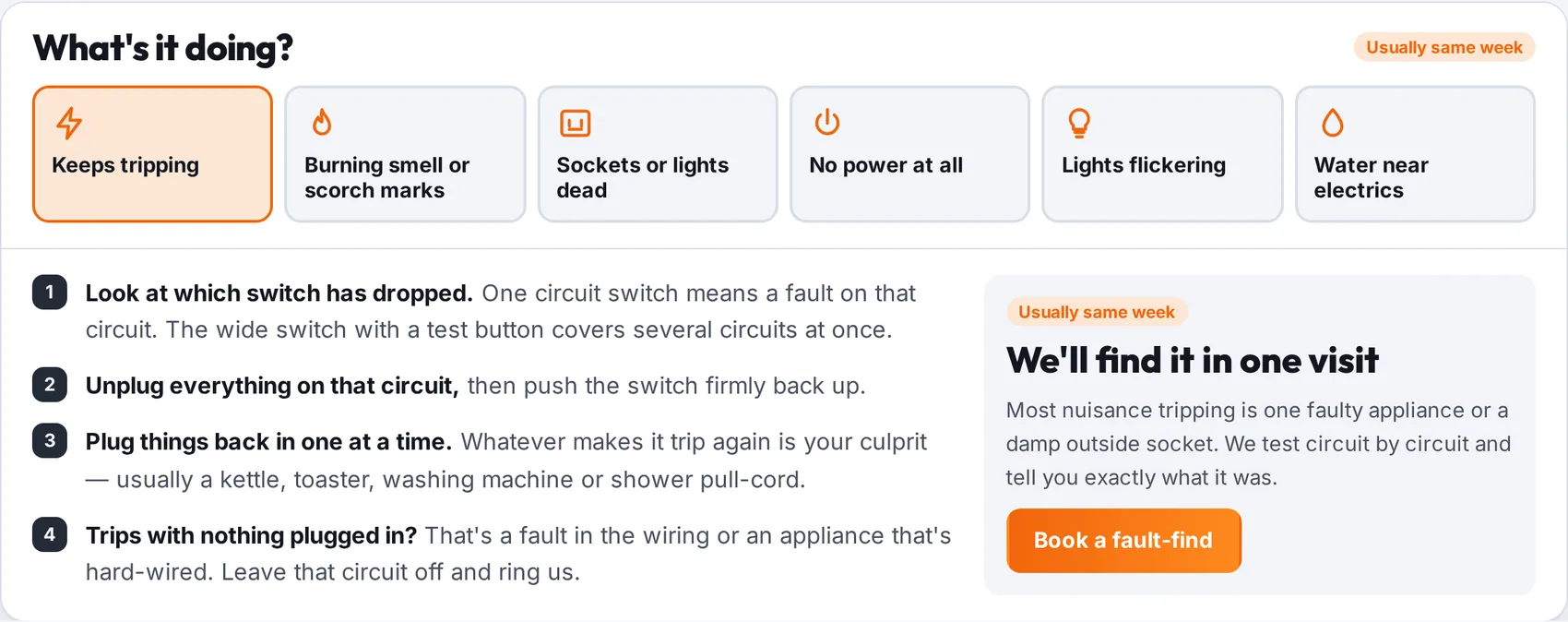
Fault help — what is it doing?
A fault-help panel designed by Central Systems. Six symptoms run across the top, from keeps tripping to water near electrics; selecting one opens four numbered steps explaining what to look at and when to stop, beside a panel offering to book a fault-find.

Designed by us, not a template. The advice is yours, checked with you before it goes live, and written so it never implies a fault is safe.

The half you can plan

A renewal date is a booking you already know about.

In Scotland a rented home needs an electrical safety inspection at least every five years and before a new tenancy. That is not a lead to chase. It is a diary entry, years ahead, for every property you have ever certified.

Interface by Central Systems
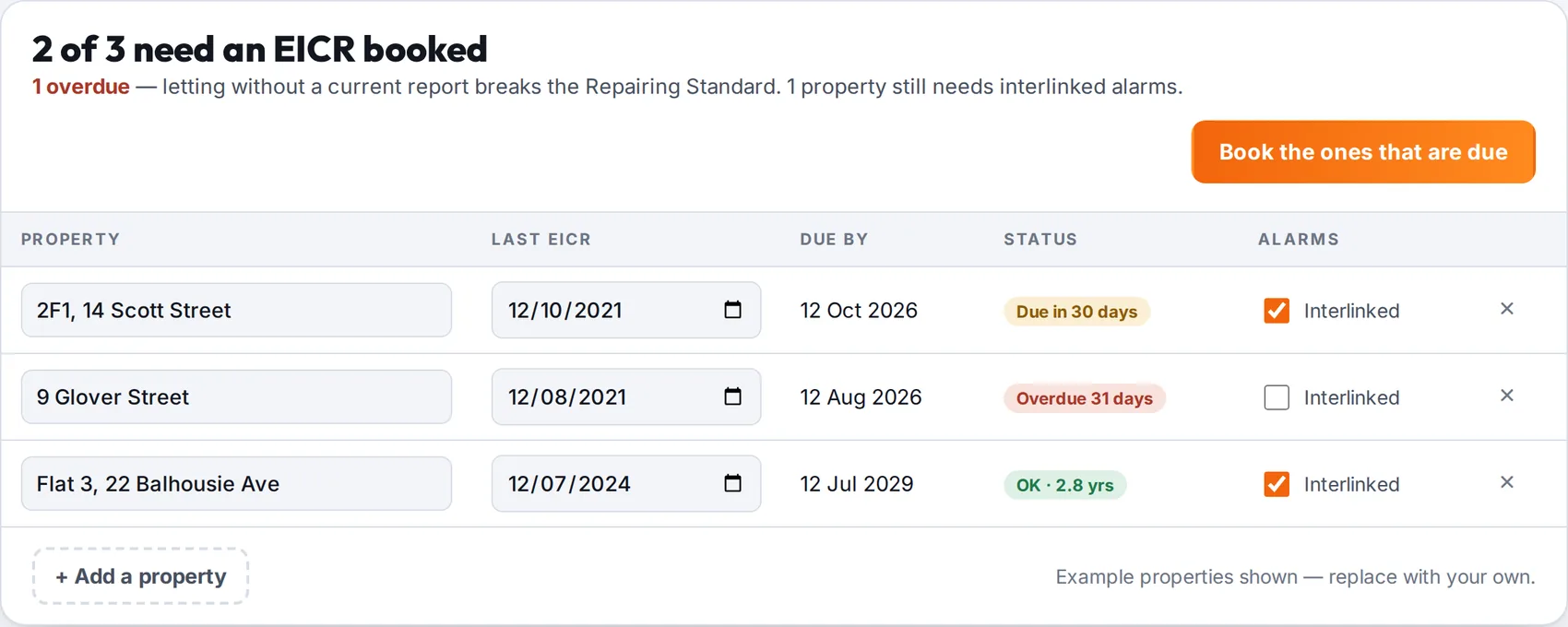
Landlords — every flat, every date
A landlord compliance panel designed by Central Systems, listing example properties with the date of the last inspection, the date the next one falls due, a status showing overdue or in date, and a column recording whether interlinked alarms are fitted.

Example properties, not a client’s portfolio. The dates above are illustrative. A landlord who adds their own flats leaves having seen exactly which ones you need to book.

  • 01
    Give them their own way inA page that talks to somebody holding a portfolio, not to a homeowner with one broken socket. Most firms send both to the same contact form and wonder why agents go elsewhere.
  • 02
    Explain the standard in plain wordsWhat the inspection covers, what a C1 or C2 code obliges them to do, how long it takes per flat. They are buying certainty about a legal duty, not an hourly rate.
  • 03
    Name the alarms in the same breathInterlinked smoke and heat detection, and carbon monoxide where there is a fuel-burning appliance. The other thing they are asked for, and the reason one visit becomes two jobs.
  • 04
    Treat the certificate as the productEmailed the day of the visit and kept where it can be sent again. The firm that never has to be chased for paperwork keeps the whole portfolio.

Trust

Nothing stops anyone calling themselves an electrician.

There is no single licence to practise, and customers know it. Whatever marks you out as the real thing has to be visible on the page itself, because nothing outside it will vouch for you.

An electrician in a hard hat and safety glasses working inside an open consumer unit, tightening a connection on one breaker in a row of them.
  • 01
    The scheme you actually belong toNICEIC, NAPIT, SELECT — whichever it genuinely is, with your number and a link to the register so it can be checked in ten seconds. We will never write a credential onto your site that you do not hold.
  • 02
    Who signs off notifiable workMost homeowners have never heard of Part P and every one of them worries about selling a house later. One paragraph removes the objection.
  • 03
    Insurance, with the figure on itPublic liability stated as an amount and an insurer. “Fully insured” on its own reads like everybody else.
  • 04
    Photographs of your own boardsA labelled, tidy consumer unit you actually installed says more about your standards than any paragraph about them.

The work worth winning

Three jobs worth more than a morning of fault-finding.

This is the Sunday-afternoon customer. Chargers, boards and rewires get searched for deliberately, days or weeks ahead, by somebody willing to read — the one moment a website can genuinely out-argue a recommendation.

EV chargersThe questions are always the same: will my supply take it, how far from the board, do I qualify for the grant. Answer those and the survey is booked before anyone rings.
Consumer unit upgradesHalf the people searching do not need one. Saying so — and showing the test results either way — wins more boards than warning everybody their fuse box is dangerous.
Rewires and part rewiresA fortnight of disruption that people put off for years. What gets lifted, what gets made good, which rooms stay usable — set out honestly, it stops being frightening.
Interface by Central Systems
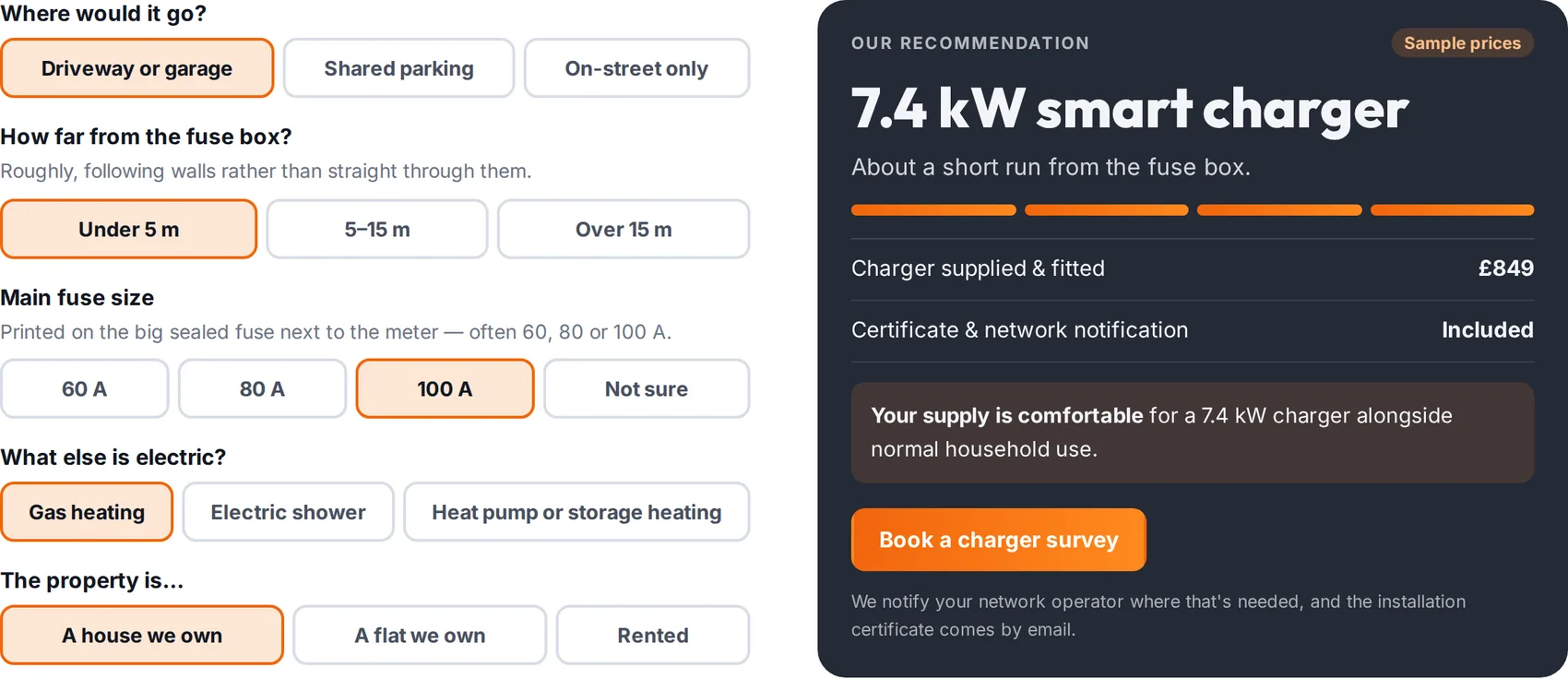
EV charging — can your house take one?
An EV charger checker designed by Central Systems. Five questions about parking, distance from the fuse box, main fuse size and other electric appliances produce a recommendation panel headed seven point four kilowatt smart charger, with a sample price clearly labelled as sample.

Sample figures, labelled on the page. A tool like this prices nothing on its own — it tells somebody whether their house is suitable, and books the survey while they are still interested.

New build or rebuild

Most electricians already have a site. It usually catches one customer.

If yours brings in fault calls and nothing else, that is not a failed website — it is half a website. The rebuild is mostly the half nobody wrote.

A new site

Built around both customers from the start

Structure, copy and photography planned around the emergency path and the compliance path as two separate journeys. Written with you, and yours outright when it goes live.

A rebuild

Keeping the rankings you already have

Your existing pages hold search history worth protecting. We audit what ranks, keep those URLs working, and rebuild the design, the speed and the missing landlord route around them rather than starting the clock again.

Not sure which you need? The free website audit reports on speed, mobile, structure and what your site currently asks a visitor to do — before anybody discusses a quote.

Beyond the website

The renewal dates are probably in a spreadsheet.

The website is the job. But compliance work is recurring by nature, and firms that win a lot of it eventually hit the same wall: nobody actually knows which certificates expire next month. If that is where you have got to, this is worth building. If it is not, we will tell you to put the money into the website instead.

Kept working

Ongoing care

Updates, backups, security and the small changes a working site needs, so it does not quietly decay between jobs. Ongoing care.

Only where it earns

Renewal tracking and reminders

Certificates, expiry dates and reminders that go out before a landlord has to ask. Worth building once the portfolio is big enough to lose track of. Business automation.

Local search

Proximity decides the fault call. It barely touches the compliance job.

Somebody with a dead ring main wants the nearest firm who will answer. An agent placing four EICRs will book forty miles away if the dates work. Two different pieces of search work, and most sites attempt only the first.

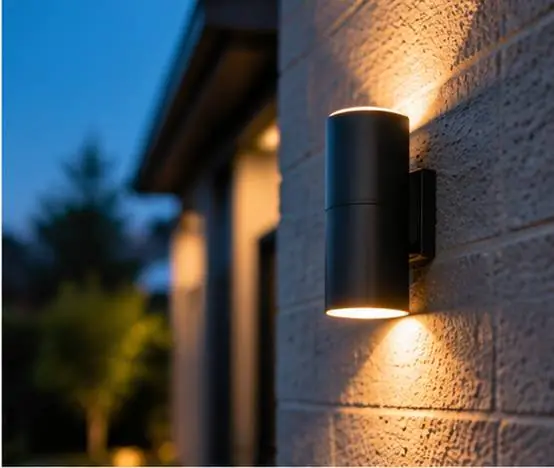
An outdoor wall light throwing warm light up and down a brick wall at dusk, with the garden behind it in blue evening shadow.
  • 01
    Win your own town firstBusiness profile, service area, reviews and the pages behind them, so a firm from the next county stops outranking you on your own doorstep.
  • 02
    A page per town you actually serveWritten about that place, not the same paragraph with the name swapped. Search engines have been penalising the second approach for years, and readers spot it faster.
  • 03
    Chase the compliance searches widerLandlord and agent enquiries are worth pursuing across a much bigger radius than emergencies, because they are scheduled rather than urgent.
  • 04
    Be legible to the machines reading youClear structure and honest markup help search engines and AI assistants describe what you do and where. Nobody can promise a ranking; we can make sure you are understood.

Questions

What electricians ask us

Will you put my NICEIC number on the site?

Only the registrations you genuinely hold, with the number shown and a link to the register so anyone can verify it. We will not write a scheme name onto a page on the assumption you are a member — it is checkable in seconds, and being caught overstating it would cost you more than it ever gained.

Can the site take emergency calls out of hours?

It can make the number unmissable, state your hours plainly, and tell an out-of-hours caller what to do meanwhile — including sending them to the network operator when it is a power cut rather than your problem. What it cannot do is imply somebody is answering when nobody is.

Do I have to publish prices?

No, and for fault work a fixed price is usually dishonest anyway. A band, or a worked example marked as one, does the job: it puts off the enquiries you did not want and settles the ones you did. We would rather show a range than invent a number.

I mostly subcontract to builders. Is a site still worth it?

Usually, though not for the reason you would expect. It stops being about enquiries and starts being about credibility when a main contractor checks you out, and about not depending on two or three relationships. We would build you something much smaller than a domestic-facing site, and say so rather than sell you the big one.

Who owns it afterwards?

You do — domain, hosting, content and code. No licence, nothing that stops working if you stop paying us, and no part of it held hostage. Ongoing care is there because sites need maintaining, not to keep you locked in.

Next step

Let’s build you the half that is missing.

Tell us how the work arrives now — the callouts, the landlords, the chargers — and we will tell you plainly what a site should be doing about each of them. No obligation, and no pitch for anything you do not need.

Also for the trades: plumbers & heating engineers, roofers, tree surgeons · all trades & construction · every industry we work with