New: Try our free Website Audit tool. Run your free audit →Run it free →

Financial advisers & planners

Your website is a financial promotion. Most agencies do not know that.

Which is why so many adviser sites end up as a page of stock photography, a paragraph about “bespoke solutions” and a contact form — nothing that could get anybody into trouble, and nothing that brings an enquiry in either. We build sites for advice firms that say something useful, qualify the people who get in touch, and go through your compliance sign-off without a fight.

Adviser websitesSite rebuildsPlanning toolsEnquiry qualificationCompliance sign-offLocal searchOngoing SEOAutomationMaintenance
Interface by Central Systems
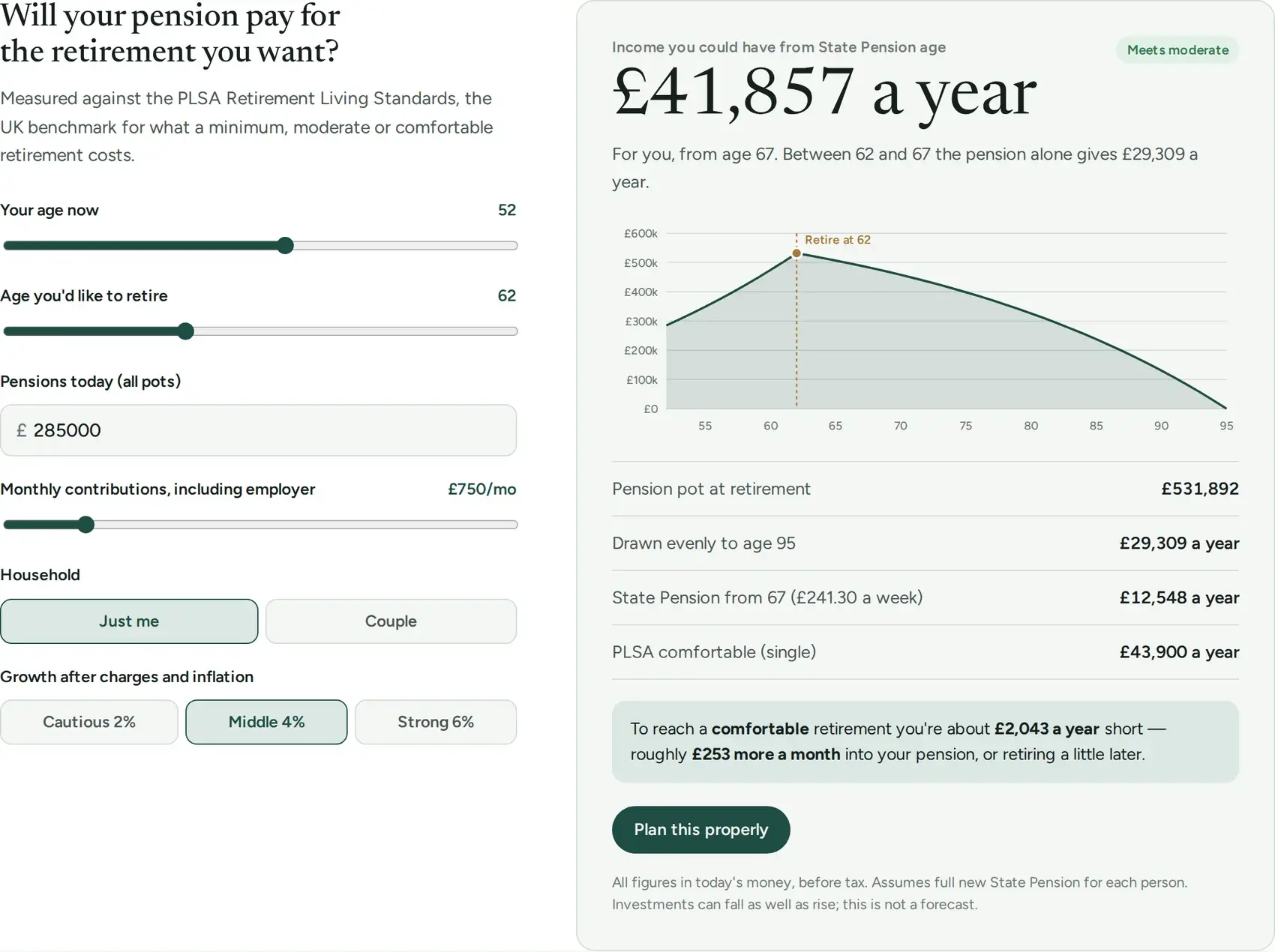
Retirement planning tool
A retirement planning tool designed by Central Systems: sliders for age, retirement age, pension pot and monthly contributions on the left, and a projected pot chart with a year-by-year income breakdown on the right.

The bind

Say nothing and you are safe. Say nothing and nobody calls.

In short

Advice firms end up with vague websites for an understandable reason: every specific thing you might say is a financial promotion, and the safest promotion is the one you never make. The result is a sector full of interchangeable sites that could each belong to any of the others.

The way out is not to be braver about claims. It is to be specific about everything that is not a claim — who you work with, what the process is, what it costs, what happens at the first meeting, which situations you handle often. None of that needs a risk warning, and all of it is what somebody is actually trying to find out.

The list opposite is what we tend to find instead.

What we usually find
  • Copy that avoids saying anything. “Tailored solutions for your financial journey” — true of every firm in the country, useful to nobody.
  • No indication of who you are for. Minimum portfolio, typical client, the situations you see weekly — none of it stated, so unsuitable enquiries arrive and suitable ones do not.
  • Fees nowhere on the site. The first question every prospect has, and the one thing the industry is most reluctant to put in writing.
  • The advisers barely present. People hand over their pension to a person, not a limited company, and the site introduces nobody.
  • Risk warnings bolted on afterwards. Retrofitted in eight-point grey at the bottom, because compliance saw the site after it was built rather than while it was being designed.
  • Nothing between reading and phoning. No tool, no guide, no qualified enquiry route — so the only visitors who convert are the ones already certain.
  • Accessibility not considered. On a site whose audience is disproportionately over sixty, and where Consumer Duty expects communications people can actually understand.
  • A form that disappears into a mailbox. Nothing logged, nobody accountable, and no trail to point at afterwards showing how the enquiry was dealt with.

What we build

Sites that say something, and still pass sign-off

Building and rebuilding adviser websites is the work. Everything after it exists because a site that survives compliance but generates nothing has solved the wrong problem.

Primary

Adviser & planner websites

Built around what a prospect is actually trying to establish: whether you work with people like them, what the process is, what it costs, who they would be dealing with, and what the first meeting involves.

  • Who you are for
  • Adviser profiles
  • Process & fees
  • Accessible by design
Primary

Website rebuilds

Dated or template-built adviser sites rebuilt properly, retaining the domain, any reviews and the local standing already earned, with spend going into clarity and the enquiry route.

  • Address preservation
  • Speed
  • Accessibility
  • Enquiry repair
Tools

Planning tools & calculators

Interactive tools that give somebody a genuine reason to engage and a genuine reason to call — built so the assumptions are visible, the output is clearly an illustration, and nothing reads as a personal recommendation.

  • Retirement modelling
  • Tax relief
  • Allowance trackers
  • Estate estimates
Enquiries

Qualified enquiry journeys

Structured routes that establish topic, stage, rough asset band and preferred contact before anybody picks up a phone — and that point people elsewhere when advice is not what they need.

  • Topic routing
  • Asset banding
  • Meeting booking
  • Signposting
Compliance

Built for sign-off from the start

Risk warnings, regulatory statements and disclosure treated as design elements from day one, not retrofitted in grey at the bottom — with a review pass built into the schedule rather than discovered at the end.

  • Promotion layout
  • Where disclosure sits
  • Sign-off stages
  • Version history
Operations

Automation & integrations

Automatic replies, triage, chasing and a logged history of every enquiry — together with links into your diary or client-management tooling, wherever a workable and appropriate interface is published.

  • Auto-acknowledgement
  • Triage rules
  • Enquiry log
  • Diary integration

Also worth reading: how we design a site · what a rebuild involves · connecting the back end · keeping it maintained.

Sign-off

Design for the compliance review, not around it.

The usual sequence is: agency builds a site, compliance sees it a week before launch, and three weeks of argument follow. It happens because the constraints arrived after the design did. Bringing them in at the start costs nothing and removes the fight.

Risk warnings with somewhere to liveDesigned into the layout at the point of the claim, at a size somebody can read. Not appended in grey after the fact, which is both worse design and weaker as a warning.
Regulatory detail, published properlyFirm name, FCA reference, registered details and status statements in the places people and checkers look for them. It comes from you and goes up verbatim; checking the register, deducing scope or vouching for permissions is not something we do.
Communications people can followPlain language, real headings, sensible reading length and genuine accessibility. Consumer Duty expects communications a customer can understand and act on, and most of what that asks for is simply good writing and good markup.
A review pass in the scheduleCompliance sees structure and copy before build, and again before launch, as two booked stages. That is the single change that stops a project stalling in its final fortnight.
A record of what changed and whenContent changes tracked, so if anybody asks what the site said on a given date there is an answer rather than a guess.
Room for people who need more timeLarger targets, clear contrast, no forced timers, an obvious phone route. A meaningful share of this audience is older or dealing with bereavement, and the site should not be the hard part of their week.
We are not a compliance consultancy, and we will not pretend to be.

Central Systems is not authorised by the Financial Conduct Authority, gives no financial or regulatory advice, and does not approve financial promotions. Your compliance function — internal or outsourced — decides what the site may say. Our part is building it so that what they approve still works as a website, and so the approval conversation happens early rather than late.

Planning tools

Give someone a reason to stay, and a reason to call.

A calculator is the one thing on an adviser site that a visitor will actually use, and the one that tells you what they came for. It has to be built carefully, because a tool that reads as a recommendation is a problem rather than an asset.

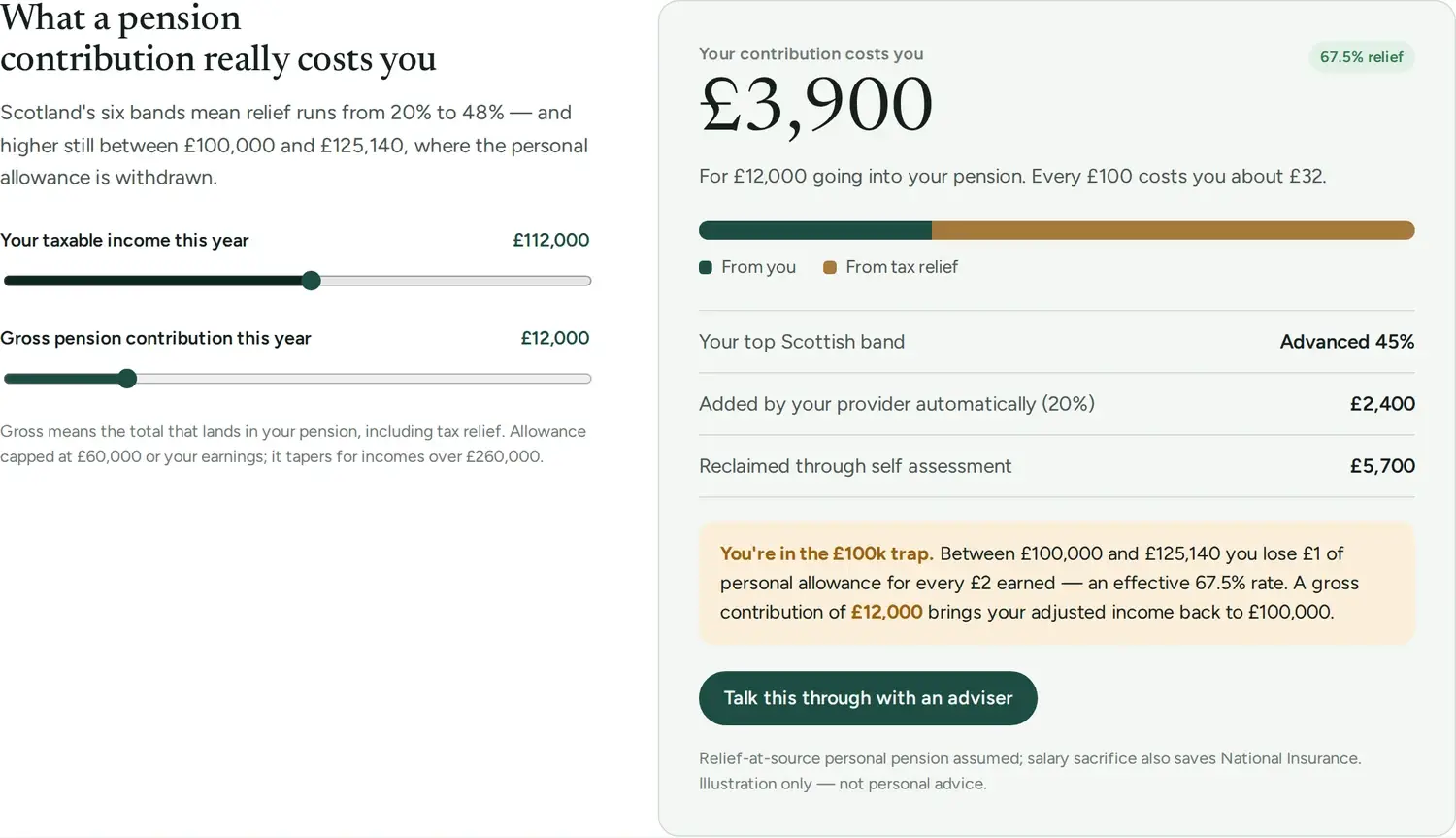
Pension tax relief calculator
A pension tax relief calculator designed by Central Systems, with income and contribution sliders on the left and a breakdown on the right showing the net cost, the relief rate, the tax band and a warning about the personal allowance taper.

An interface from our own design work. Inputs on the left, a result that shows its workings on the right — the tax band used, what the provider adds automatically, what has to be reclaimed, and a flag when the visitor is in the personal-allowance taper.

  • The assumptions go on the screenWhich tax year, which bands, what is being ignored. A tool that hides its workings is asking to be misread, and an adviser is the last person who can afford that.
  • The output is an illustration, and says soClearly labelled, never framed as a recommendation, and always ending in a conversation rather than a conclusion. The rules and rates come from your firm.
  • Scotland is not England with different numbersSix income tax bands rather than three changes the answer materially for Scottish taxpayers. A calculator using UK-wide bands is quietly wrong for every client you have.
  • It tells you what the enquiry is aboutSomebody who has just modelled an estate is a different conversation from somebody checking a contribution. Knowing which, before the call, is worth more than the tool itself.

Enquiries

Qualify before the meeting, and say so when advice is not the answer.

An enquiry route that establishes topic, stage and rough asset band does two useful things: the first meeting starts on the situation rather than on a form, and the enquiries that were never going to fit find that out on the page.

  • A few questions, not an application formWhat it is about, roughly where they are, roughly what they hold, how they would like to meet. Four or five steps, each one a single decision.
  • Signpost rather than harvestWhere somebody would be better served by free guidance — Pension Wise and MoneyHelper exist and are genuinely useful — the page can say so. It costs you an enquiry you did not want and earns a referral you would not otherwise get.
  • A booked time, not a callback promiseReal availability, a confirmed slot, and a note of what to bring. A first meeting somebody has prepared for is worth considerably more than one they turned up to cold.
  • It arrives as a recordWith an owner, a status and the answers attached, so the enquiry can be followed up and so there is something to look back at later.
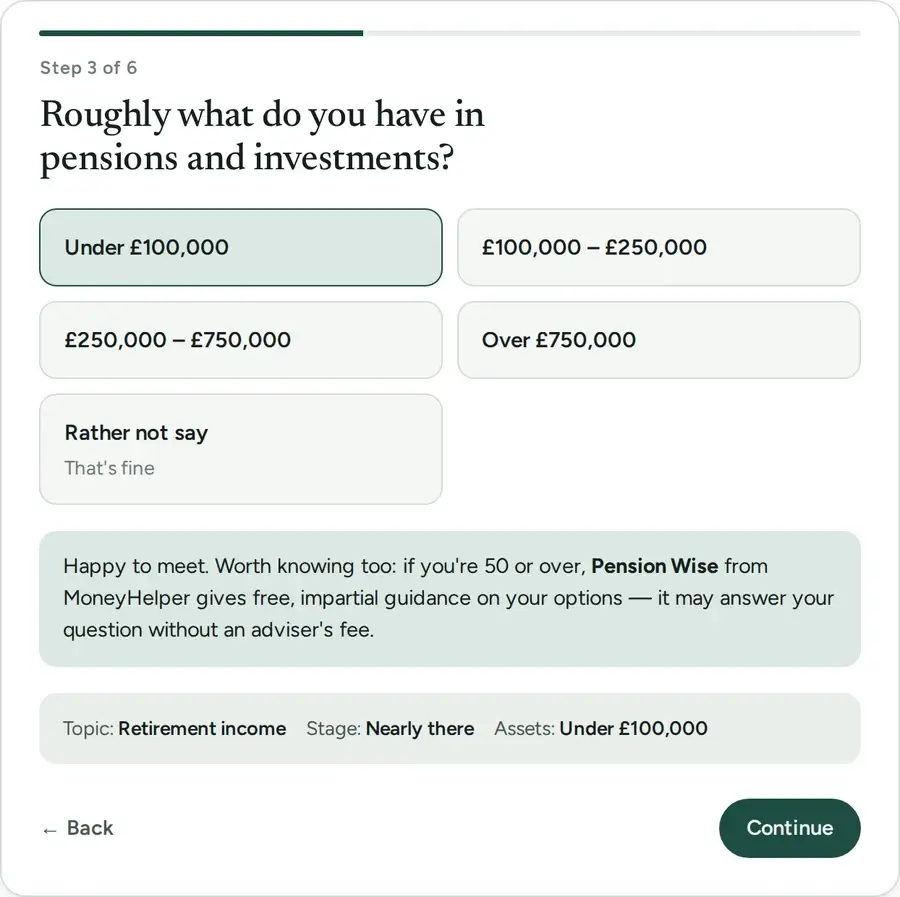
Enquiry qualification, step 3
An enquiry qualification step designed by Central Systems, asking roughly what the visitor holds in pensions and investments, with a note pointing people with smaller amounts towards free Pension Wise guidance, and a running summary of their answers.

Signposting, built in. Selecting the smallest asset band surfaces free guidance rather than pushing towards a paid meeting — the kind of detail that costs nothing to build and is noticed by both prospects and reviewers.

Structure

Be findable for the situation, not the job title.

Very few people search for “independent financial adviser”. They search for the thing that has happened to them — a pension they have lost track of, an inheritance, a business sale, a retirement date. The structure should meet those.

  • /Home
  • /advice/What you are actually asked about
    • /advice/retirement-income/Written around a situation, not a product
    • /advice/pension-consolidation/A different reader, a different worry
    • /advice/…/Estate planning, business owners, lump sums — as applicable
  • /team/Who somebody would be dealing with
    • /team/<name>/Qualifications, experience, the work they take
  • /how-it-works/The process, stage by stage
  • /fees/Whatever the firm is willing to publish
  • /tools/The calculators, each with its own page

Indicative only. Treat the routes above as a sketch rather than a specification — a one-adviser practice and a multi-adviser firm want quite different shapes. What things are called, and how far the structure goes, is decided jointly before design starts.

The structural argument is the same one as everywhere else, but it bites harder here because the searches are so situational. Somebody who has just been made redundant at 58, or has inherited a house, is not looking for a firm. They are looking for an answer, and whoever has written that answer properly gets the call.

  • Useful content earns the visibilityGenuinely helpful writing on the situations you handle often, approved by the people who are allowed to approve it. It is slow, it compounds, and it is the only durable advantage in this sector.
  • Names get searched tooEspecially following a personal recommendation. Giving each adviser a profile means that search reaches your site instead of a third-party listing.
  • Fewer pages, done properlyA single substantial page on the work you actually want outperforms a scattering of shallow ones. Our bias is towards building less and building it well — and you will hear it when something you have asked for would land in the shallow category.
  • Positions are not ours to promiseGuaranteeing a search placement is beyond anyone's power, and whoever offers it is selling something else entirely. We build the architecture and the writing correctly, then give you a straight account of the result.

The structure is the starting position rather than the result — what it earns is built up month by month afterwards, covered under after launch below and in full on SEO & growth.

Enquiry to first meeting

From a search to a prepared client, in six steps.

Typically an adviser site manages the opening pair and hands the remainder to whoever happens to be closest to the phone. Every stage listed is optional and has to justify itself.

1Finds the situationOn a page written for what has actually happened to them.
2Uses a toolModels their own numbers, and sees roughly where they stand.
3Answers a few questionsTopic, stage, rough asset band, how they would like to meet.
4Books a real slotFrom live availability, with a confirmation rather than a promise to ring back.
5Gets told what to bringStatements, forecasts, the paperwork that makes the meeting useful.
6Reaches the right adviserWith the answers attached, logged against an owner so nothing goes quiet.
Nothing here gives advice, and nothing here assesses suitability.

Everything collected is administrative — what the enquiry is about, roughly where somebody is, when they can meet. No fact-find, no attitude-to-risk questionnaire, no output that could be read as a personal recommendation. Suitability is your job, done properly, after the meeting.

Digging further into that layer: business automation and AI integrations.

Website rebuilds

Keep the domain. Replace what is costing you enquiries.

Almost all the adviser sites we look at contain assets worth protecting: a domain with history behind it, ratings already gathered, copy that took compliance a fortnight to wave through. The job is patching what loses money and touching nothing else.

  • PreservedYour domain and any URLs already pulling traffic, reviews and directory presence, approved copy still worth keeping, and the existing identity unless a change is wanted.
  • RebuiltCredibility of the design, the menu and advice-area architecture, behaviour on a phone, speed, the enquiry forms and where their submissions land, and the presentation of the writing itself.
  • Brought up to standardAccessibility above all: colour contrast, tap-target sizes, properly labelled fields, keyboard operation, sensible heading order. Given who reads an adviser site, that affects more of your visitors than it would almost anywhere else.
  • MeasuredAnalytics configured correctly, making it visible which advice areas pull people in, where they drop out, and how many enquiries genuinely arrived.

Secondary capability

When the admin around the advice outgrows the spreadsheet.

Advice firms run a great deal of non-advisory process — onboarding, document collection, review cycles, referral tracking. With a real commercial argument for it, whatever is absent can be constructed — after the site is sorted.

Enquiry pipelinesClient onboardingDocument collectionAnnual review cyclesReferral trackingInternal dashboardsReportingApproval workflows
We do not build back-office or advice systems, and we will not pretend to.

Client files, fact-finds, suitability reports, cashflow engines, platform links and anything bound by regulatory record-keeping rules belong inside the specialist products written and regulated for that purpose. Supplying or displacing them is not something we do. Anything we produce runs beside those: the commercial and administrative tier around them. Anything touching client data has to satisfy your own information-security and record-keeping requirements at the scoping stage, not mid-project.

Should that be the requirement — CRM & business systems, or software written for one industry.

Who this is for

The firms this suits

Needs vary widely here. Plenty of what appears above will be irrelevant to any single firm, and pinning down the relevant portion takes up most of a first conversation.

IFAIndependent Financial AdvisersWhole-of-market firms competing on judgement and relationship, where being specific about who you are for does most of the qualifying.
PlanningFinancial Planning PracticesCashflow-led, plan-first firms, where the value is in the process — and the process is the thing almost no site explains.
WealthWealth ManagersHigher minimums and a considered buyer, where credibility and clarity about the service matter more than volume of enquiry.
RetirementRetirement & At-Retirement SpecialistsA dated, situational audience with a hard deadline, and the segment where planning tools earn their keep fastest.
MortgageMortgage & Protection AdvisersFaster cycles, higher volumes and a younger audience, where the enquiry route and mobile behaviour carry the site.
EmployeeEmployee Benefits ConsultantsA corporate buyer with a procurement process, where capability, capacity and credentials matter more than a calculator.
NetworkNetwork & Appointed Representative FirmsOperating within a principal’s framework, where the site has to work inside somebody else’s approval process as well as your own.
Multi-officeMulti-Office PracticesSeveral locations and adviser teams, where enquiries have to reach the right office and the structure has to reflect that.
We build the technology, not the advice.

Central Systems is a technology firm and is not authorised or regulated by the Financial Conduct Authority. We give no financial, investment, tax or regulatory advice, we do not approve financial promotions, and nothing we build does any of those things. Regulatory status, permissions, fees, risk warnings and all advisory content come from the firm, are published exactly as given, and remain the firm’s responsibility.

Straight answers

Questions advice firms ask us

Will our compliance team sign this off?
That is their decision, not ours, and we would be wary of anybody who promised otherwise. What we can do is make it likely: compliance reviews the structure and copy before the build starts and again before launch, as two booked stages rather than a surprise at the end. Most of the friction we see comes from constraints arriving after the design, not from the constraints themselves.
Can you build calculators without them counting as advice?
A calculator can show what a set of inputs produces under stated assumptions, label the output as an illustration, and direct the visitor to a conversation. Where the line falls between that and a personal recommendation is a judgement for your compliance function, using your permissions and your risk appetite — we build to what they specify. Every rate, rule and line of wording inside a tool originates with your firm and carries your firm's approval ahead of launch.
Who writes the copy?
Structure is ours, and we will draft from what you supply — but anything bearing on products, tax, suitability, outcomes or your regulatory standing must be authored or endorsed by a person at the firm with the authority to do so. Regulated content is not ours to compose, and no page goes live unsigned.
Is the SEO work a one-off or a monthly thing?
Both exist, and they do different jobs. The build gets the structure, the writing and the technical groundwork right, which is a fixed piece of work with an end. Growing what that structure earns is monthly by nature — new situational pages through your approval process, figures refreshed as allowances move, the calculators kept in step with them, the Google Business Profile maintained, and a report each month on enquiries rather than positions. Firms take the build on its own and do perfectly well; the monthly arrangement is offered as a continuation, and is set out on SEO & growth and ongoing care.
Can the site connect to our back-office system?
Occasionally, and it rests entirely on which product you run. A documented interface is something we can work with; a fair number of back-office and platform systems publish nothing usable, and some forbid it by contract. Anything carrying client data also has to clear your information-security and record-keeping requirements before it is scoped. We establish what is actually possible while pricing, not afterwards.
We are an appointed representative. Does that change things?
It usually means an extra approval layer and sometimes a house style or a template you are expected to work within. That is workable, but it needs to be on the table at the first conversation rather than discovered at sign-off, because it affects what the structure and the schedule can be. Tell us who your principal is and what they require, and we will build inside it.
Budget and timescale?
Driven by the count of advice areas, advisers and offices the architecture must hold, plus whether planning tools form part of it — those are real software and get priced accordingly. A written, mutually agreed scope produces the figure; nothing is improvised during an introductory call. Between eight and twelve weeks from approval to launch is realistic, and it is the compliance review, not the engineering, that governs the tempo.

After launch

Launch day is when the search work starts, not when it finishes.

A new site inherits none of the standing the old one had, and the situational pages that win advice enquiries take months to settle. Firms that treat launch as the finish line usually spend the following year wondering why the phone sounds the same. Our ongoing work is a monthly retainer that keeps the structure earning — and, in this sector, keeps it accurate.

  • Writing, at a pace compliance can absorbA steady stream of situational pages beats a burst of them, because each one has to go through the same approval you use for everything else. We draft, you approve, it publishes — and the queue is sized so nobody at the firm is handed ten sign-offs in a week.
  • Figures go out of date on a scheduleAllowances, bands, thresholds and State Pension amounts move, and a page quoting last year's is worse than no page at all. Anything numeric is logged at publication with a review date, and revisited when the figures change rather than when somebody happens to notice.
  • The calculators are software, and software driftsEvery planning tool on the site carries the same rate tables your pages do. When those change the tools change with them, and the assumption notes printed underneath change too.
  • Local and map visibilityThe Google Business Profile, the details that sit behind it, and the pages it points at — kept current, because a good deal of adviser search still resolves to a map before it resolves to a website.
  • Technical ground that stays solidSpeed, crawlability, schema and the boring plumbing that quietly caps everything else. It is checked continuously rather than looked at once a year when something breaks.
Reported as enquiries, not rankingsA monthly account of what came in, which advice area it was about, and which pages were involved. Position charts are included because people like them, but they are not the measure — a page that ranks and produces nothing is a page we would rather rewrite than celebrate.
Assistants quote pages tooSummaries and chat assistants increasingly answer the question before anybody reaches a website, and they lift that answer from whoever wrote it clearly. The same discipline that makes a page useful to a reader is what gets it quoted, so we write for both and watch where the firm is being cited.
One backlog, ranked, visible to youImprovements, fixes and new pages sit on a single list in priority order, and the month's work is drawn from the top of it. You can see what is queued and reorder it — a partner's new specialism can jump ahead of a technical tidy-up if that is the better use of the month.
The maintenance underneath itUpdates, backups, uptime and security are part of the same arrangement rather than a separate conversation, so there is one team accountable when something needs attention.

The search side is set out on SEO & growth; the maintenance and monthly-improvement side, including what each level of support covers, is on ongoing care. Plenty of firms take the build alone — it is offered as a continuation, not a condition of working with us.

Next step

A site that says something useful, and still gets approved.

Replacing something dated, adding planning tools, or finally getting the enquiry route to qualify properly — the build can aim at wherever the firm is heading. Tell us which advice areas you want more enquiries in, and what your approval process looks like.

No charge for that first conversation, and no invoice before a written price has been agreed.