New: Try our free Website Audit tool. Run your free audit →Run it free →

Pest control & prevention

They are not putting off the job. They are putting off the phone call.

Central Systems builds and rebuilds websites for pest control firms. The wasp nest rings you the same morning, and most sites handle that part well enough. The mice in a spotless kitchen and the bedbugs in a rented flat do not ring for a fortnight, because ringing means saying it out loud to a stranger. We build the route that lets somebody work out what they have, see what it costs and book a visit without speaking to anyone.

Discreet bookingIdentification contentCommercial contractsLocal search
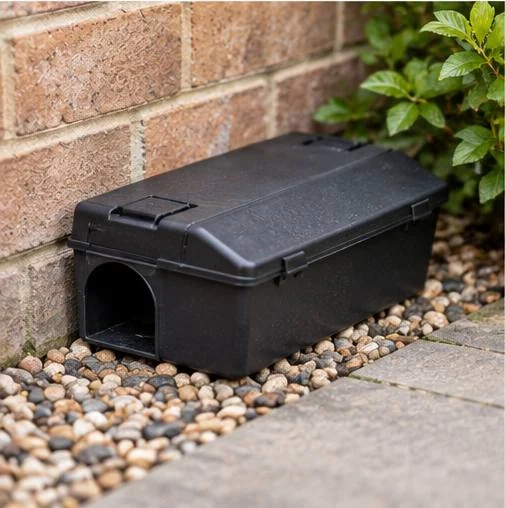
A black tamper-resistant bait box sitting tight against a brick wall on a gravel border, its entry tunnel facing along the run of the wall.

The weeks before the phone rings

By the time they ring, the job is a fortnight old and twice as hard.

Pest control is the one trade where the customer’s first instinct is to hope it goes away and the second is to fix it quietly. Both of those happen on a phone, at night, without anybody being told. Your website is either in the room for that or it is not, and the firm that was useful during it is usually the firm that gets rung.

  1. Stage one

    They see one

    And decide it was probably a one-off. Nobody rings a pest controller over a single mouse, and most people would rather have seen nothing at all.

  2. Stage two — the long one

    They start checking

    What the droppings mean. Whether the bites are bedbugs or the cat. What that noise in the loft is at four in the morning. This stage runs for days and it is entirely private.

  3. Stage three — where it gets expensive

    They try it themselves

    A supermarket poison, a bug bomb, a plug-in. Half-dosed bait makes rodents wary of the real thing, and a fogger pushes bedbugs into three more rooms. The job you eventually get is bigger than the one that existed a fortnight ago.

  4. Stage four

    They ring

    Only now, and not for long — they ring two firms at most.

You are not competing on the call. You are competing during the fortnight nobody tells you about.

Answering before being asked

Every question they would have rung to ask, answered on the page.

A list of pests — rats, mice, wasps, bedbugs, fleas — tells somebody nothing they did not already know when they arrived. What they actually want is what it costs, how many visits it honestly takes, and whether there is anything they can do before somebody turns up. Answer those three and most of the reason to keep putting it off disappears.

What have you got — desktop
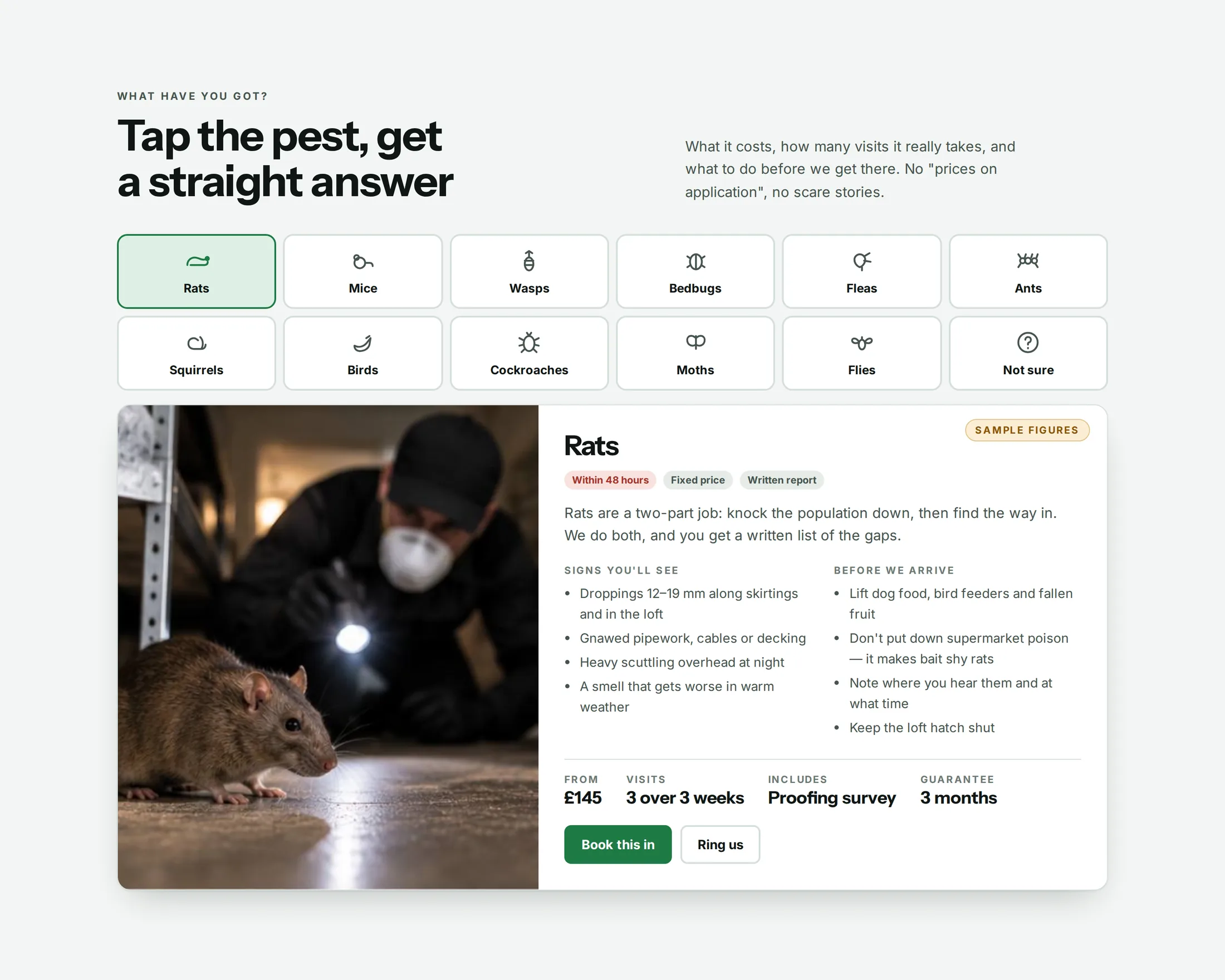
A section of a pest control website designed by Central Systems, headed tap the pest, get a straight answer. Twelve pests run across a grid including a not-sure option; the selected one opens a panel marked sample figures that gives the signs to look for, what to do before the visit, a from-price, the number of visits, what is included and the guarantee.

Four answers, and the middle two matter more than the price. A figure stops somebody assuming the job is out of reach. A visit count is the one most firms avoid publishing, because “one visit” sells better than “three over three weeks” — and it is also the sentence that prevents an argument on the second visit. The preparation list is the quiet one: it tells a person who has been hesitating for a fortnight that there is something useful they can do tonight.

  • Publish a figure you would honour. If a from-price assumes a two-bedroom flat with one obvious entry point, the page says so where the number appears rather than in a footnote nobody opens.
  • Be honest about the visit count. Bedbugs and rodents are not one-visit jobs. The firm that says so on the page is the firm that is not being argued with a fortnight later.
  • Treat the prep list as marketing. Strip the beds, hoover the edges, lift the dog bowl. It reads as competence, it makes the treatment work better, and it gives a hesitating customer a first step.

Our trades and construction page makes the same point about the sector generally: customers want some idea of what it costs, and most trade sites answer with “contact us for a free quote”. Pest control is where that silence costs the most, because the reader was already looking for a reason not to ring.

Before they have decided they need anyone

The first search is not for a pest controller. It is for whatever is on the kitchen floor.

“Small black droppings under the units.” “Bites in a line on my arm.” “Scratching in the loft at night.” None of those contain the words pest control, all of them are typed by somebody a fortnight away from booking, and a website made of six service pages appears in none of them.

Rat or mouse — desktop
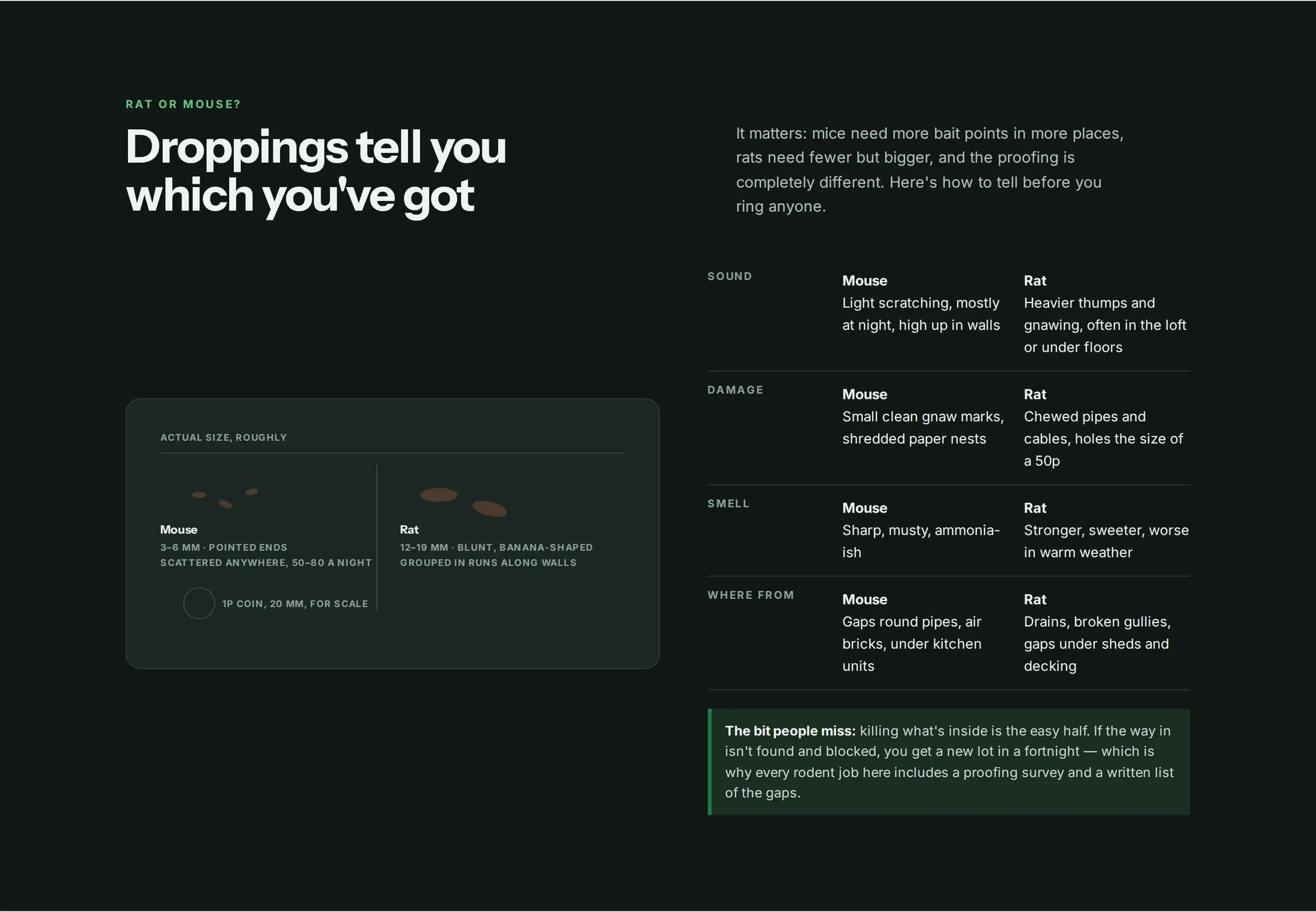
An identification guide on a pest control website designed by Central Systems, headed droppings tell you which you have got. A dark panel draws mouse and rat droppings at roughly actual size against a penny for scale, and a table beside it compares the two on sound, damage, smell and where they get in.

This is the page that gets found, and it is the one almost nobody builds. Rat or mouse is a real question with a real answer, and answering it properly does three things at once: it earns the search, it shows a reader you know the difference, and it explains why the two jobs are not priced the same. The identification content comes from you — we build the place it goes and publish it as you write it.

Writing a question out properly and then answering it is how a search engine — or one of the assistants people now ask before they search — works out that your site is about mice in Bathgate. That is a mechanism, not a result. Anyone selling you the result is selling something they do not own.

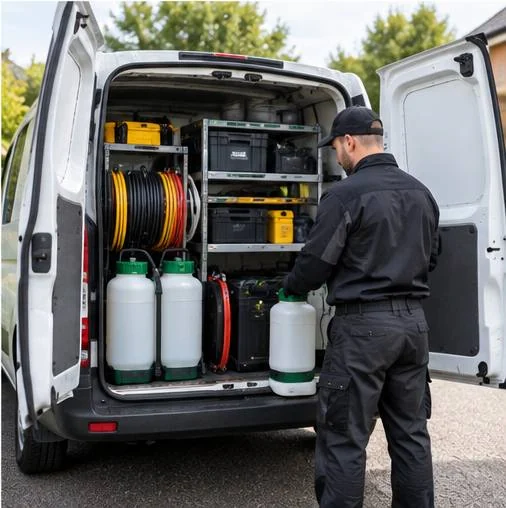
The open back doors of a plain white van on a residential street, its racking loaded with sprayers, hose reels and labelled cases, and a technician in unbranded black workwear lifting one out.

Discretion is a specification

A plain van is a design decision. So is a form that never asks anybody to explain themselves.

Nobody is embarrassed about a broken boiler. A large share of this trade’s domestic work is bought by people who have not told the neighbours, have not told the landlord, and are half-convinced the whole thing reflects on how they keep the house. That feeling is the single biggest reason a job sits for a fortnight, and almost nothing on a typical pest control website acknowledges that it exists.

Most of the reassuring can be done before anybody speaks. Say plainly that the van is unmarked on request. Say plainly that bedbugs turn up in spotless houses and usually arrive in a suitcase. Take the booking without a phone call, and ask who else is in the house — children, a dog, a fish tank — because the answer genuinely changes what gets used and where it goes.

Book a visit — desktop
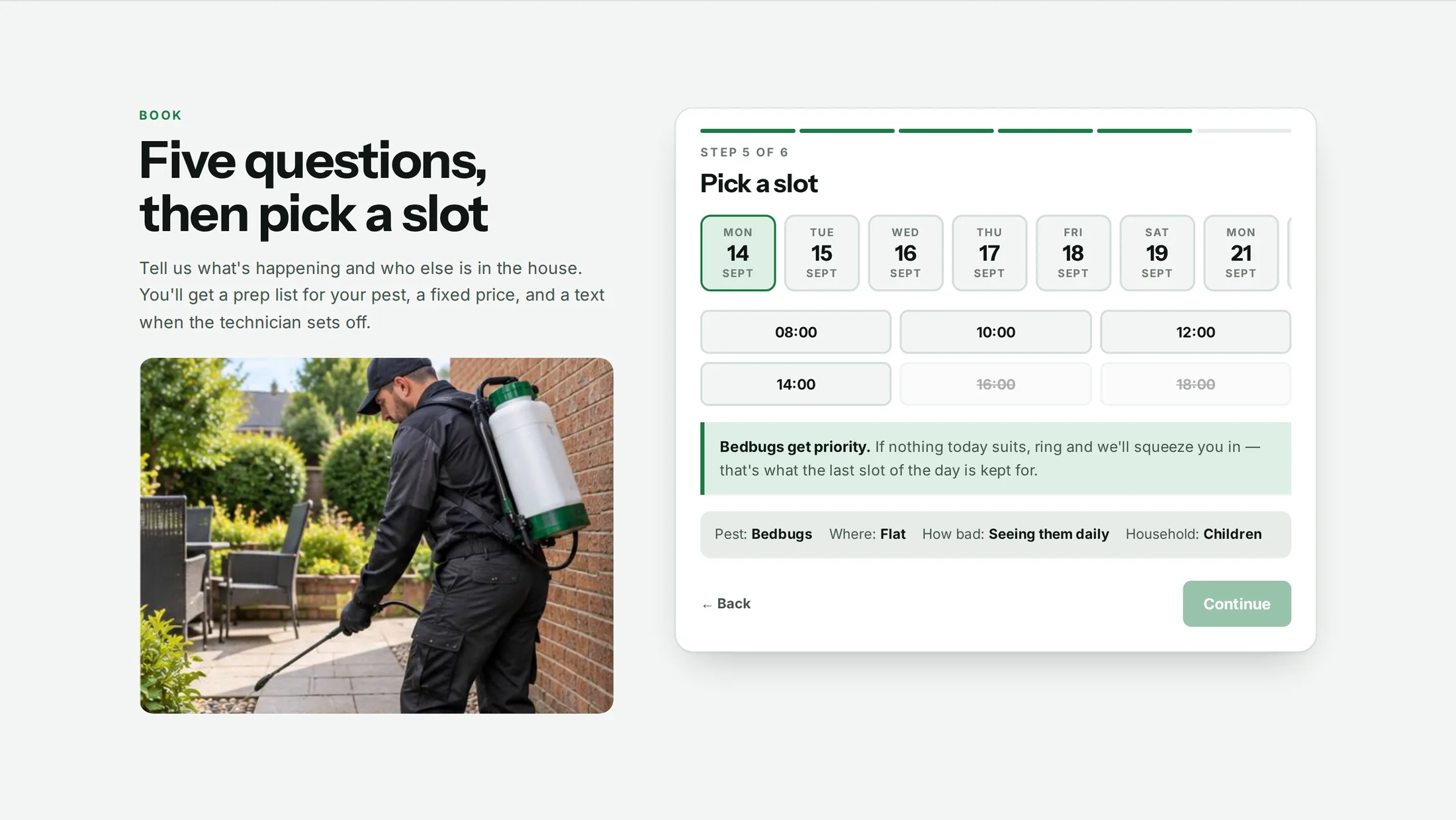
A booking section of a pest control website designed by Central Systems, headed five questions, then pick a slot. Beside a photograph of a technician treating around the outside of a house, a panel shows the fifth step: a row of dates, a grid of times with two already crossed out, and a running summary reading pest bedbugs, where flat, how bad seeing them daily, household children.

Five questions and a slot, and not one of them asks for an explanation. What it is, where, how bad, who else lives there — then a time, and a name. By the end you have a job you can price and a household you can plan around; the customer has never had to say the word out loud to anybody. The awkward information arrives because the form asked for it in a list, not because somebody had to volunteer it down the phone.

The customer with nothing to be embarrassed about

A restaurant is not buying pest control. It is buying a folder the inspector will accept.

The commercial side of this trade is the opposite of the domestic side in every way that matters. Nobody is ashamed, nobody is delaying, and nobody is buying a treatment. They are buying dated reports, numbered bait points and a record that makes an inspection short. And unlike almost everything else in this trade, it renews itself: one signature is still producing visits three years later.

  • A route built for them, not a bullet underneath domestic. A manager wants to know inside a few seconds whether contracts are something you run weekly or something you have done twice. Landlords and letting agents arrive by the same door and want the same answer.
  • The paperwork named as the product. A dated report after every visit, bait points mapped and numbered, a folder that survives an inspection. That is what is actually being bought.
  • A price shape rather than a price. Monthly, by premises type and size, so somebody can work out whether the conversation is worth having before they start it.
A technician in a white coverall and respirator crouching at the end of a warehouse racking aisle, setting a bait box down against the base of the shrink-wrapped pallets.
Business contracts — desktop
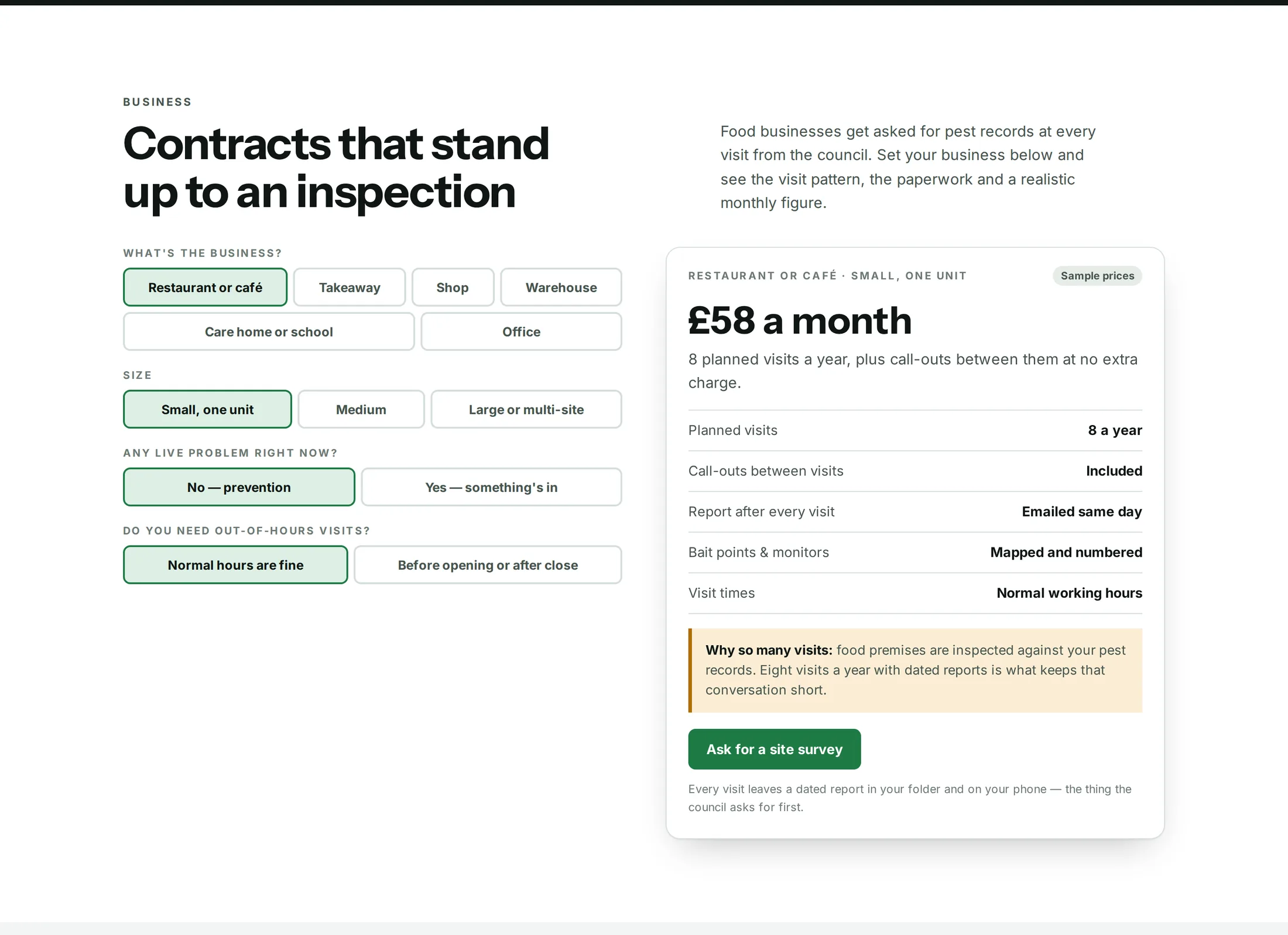
A commercial section of a pest control website designed by Central Systems, headed contracts that stand up to an inspection. Four questions set the premises type, size, whether there is a live problem and whether out-of-hours visits are needed; a panel labelled sample prices returns a monthly figure with the visit pattern, the reporting and the bait-point records listed beneath it.

The figure is the least interesting number on it. What persuades a food business is the line underneath — the visits a year, a dated report every time, call-outs in between at no extra charge. That is a description of an audit trail, and the audit trail is what the buyer came to shop for.

Plenty of firms already run something that schedules the rounds and produces the reports. If it works, we leave it alone and connect to it. The site’s job here is to win the survey and put the record-keeping where a prospect can see it. If there is a real gap — reports still being typed up on a Sunday evening — that is worth its own conversation, and it is the smaller half of this one.

The finished site

All of it on one site, in the order somebody actually needs it.

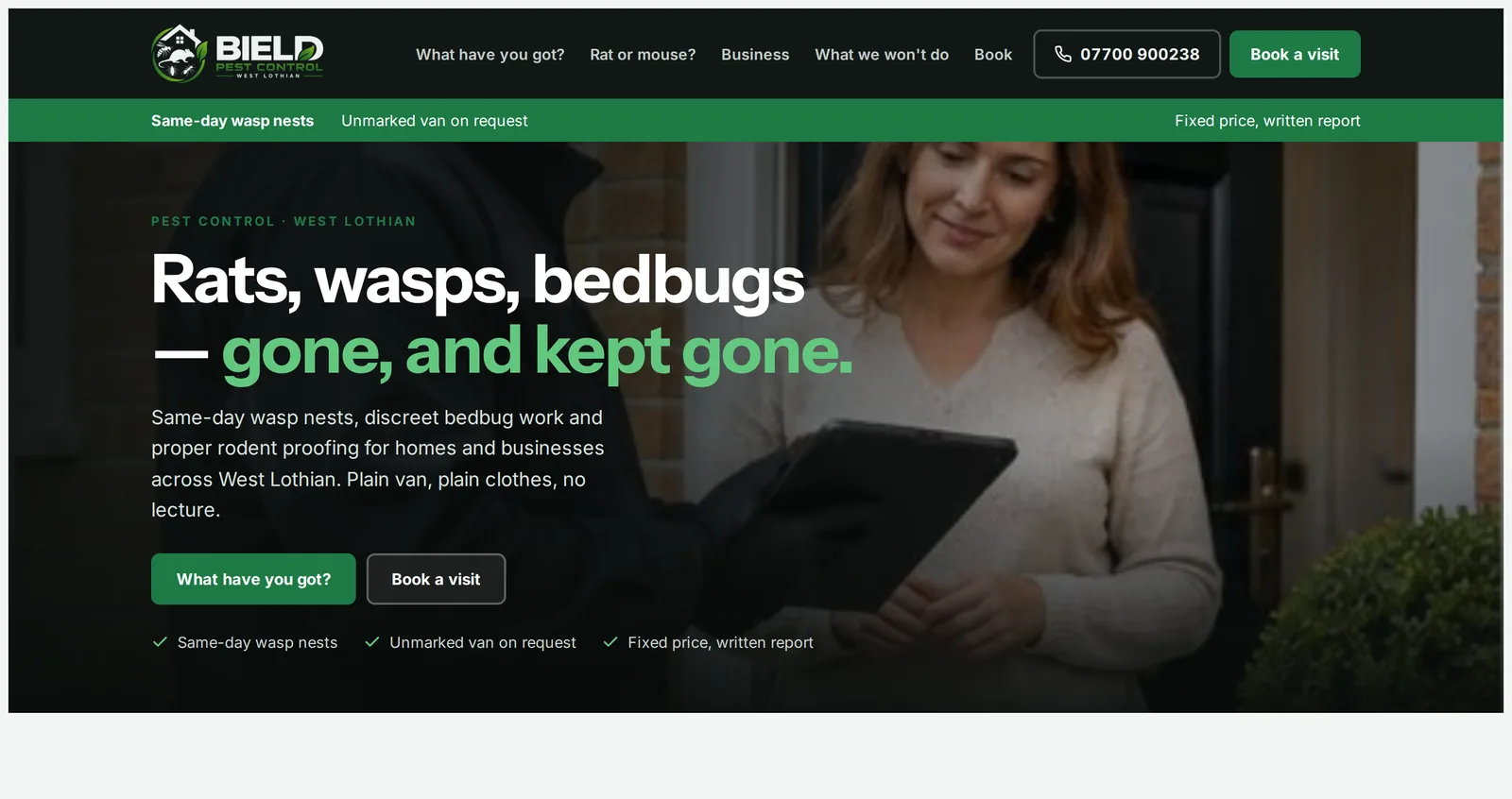
The same-day number stays where it has to be, at the top, because the wasp customer is real and in a hurry. Everything underneath it is built for the person who has not decided to ring yet — which is most of the people reading.

Homepage — desktop
The homepage of a pest control website designed by Central Systems. A dark header carries the firm name, five navigation links, a phone number and a book-a-visit button, above a green strip promising same-day wasp nests and an unmarked van on request. The hero reads rats, wasps, bedbugs — gone, and kept gone, over a photograph of a technician at a customer’s door.
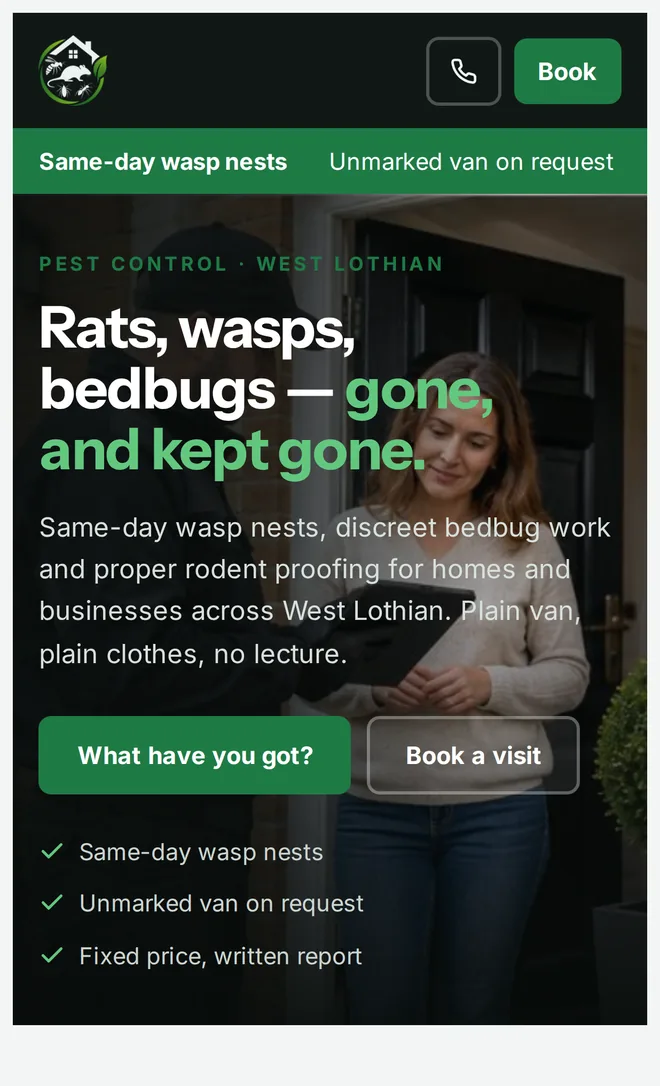
The same homepage on a phone. The header collapses to the logo, a call button and a book button, and the headline, the two buttons and the three reassurance lines stack into one readable column.

Bield Pest Control does not exist. We made the firm up so that everything above could be shown working together rather than explained a piece at a time — the guide, the answers, the booking, and a homepage that has to serve the wasp call and the fortnight-long hesitation at the same moment. It shows no customer reviews, which a real firm’s site would. We are not going to invent evidence to improve a picture, and that holds for a demonstration exactly as it holds for a live site.

Trust, by subtraction

The quickest way to be believed is to publish what you will not do.

The credibility problem in this trade is plain enough: you are asking somebody to let a stranger put poison in their house, and the stranger is also the person deciding how much of it is needed. Naming the work you turn down does more for that than any amount of describing the work you take.

Species

The ones you have to refuse

Bats and their roosts are protected, and a honey bee swarm is a beekeeper’s job that is usually collected for nothing. A site that says so is a site that has read the rules — and it costs you nothing to publish, because that was never paid work.

Method

Where the poison goes, and where it does not

Boxed, recorded, and collected at the end of the job rather than left in a loft. Somebody with a toddler, a terrier or an owl in the garden wants that answered before they book, not on the doorstep with the van already outside.

Honesty

The call-outs that are not jobs

One moth. A single ant. Something in a jar that turns out to be harmless. “Send a photograph and we will tell you whether it needs treating at all” wins more work than it turns away, and it is remembered.

Every line of that is yours. The species you turn down, the schemes you belong to, the qualifications behind them and the limits you set are things only you can state. We give each of them somewhere to sit and publish them exactly as written — never sourced, never checked, never tidied up on your behalf, because a credential we improved would be one you had to defend.

The reasonable objections

What pest controllers usually say when we suggest this.

“Publish prices and I just get beaten on price.”

This work is rarely bought on price. It is bought on whether somebody can come and whether they will be discreet about it. What a from-price actually costs you is the reader who assumed a bedbug job ran into four figures and never rang to find out, and that reader never turns up in any figure you can look at, which is why the risk only ever appears to run one way.

“Most of my work is emergencies. They just ring.”

The wasp customer does, and the number belongs where their thumb already is. This is about everything else — and for most domestic firms the everything else is the bigger half. It simply arrives quietly enough that nobody counts what did not arrive.

“There is nothing to photograph.”

True, and it is why the usual trade advice about galleries only half works here. The equivalent evidence is the written report, the numbered bait points, the proofing list and the identification writing. Less photogenic, same job.

“I already have a website.”

Almost everybody does, and almost all of them come down to a number, a list of pests and a contact form. Rebuilding keeps the address, the reviews and whatever standing you have earned in search; what changes is whether anything on it is any use during the fortnight beforehand.

“Commercial work comes through tenders and word of mouth.”

A lot of it does. The site is what a manager looks at after your name has been mentioned and before you go on a list. A page showing what your reporting actually looks like is the difference between being considered and being searched for once and forgotten.

“I do not want a load of software.”

Nor should you. This is a website. The moving parts are a price table your own team can edit, an identification guide and a booking form — and if the diary and the reporting you run now do their job, they stay exactly where they are.

Let’s build the part that works before they ring.

Tell us what you treat, which towns you cover and the jobs you would take more of. We will walk you through what your own site looks like once the guide, the prices and the booking are inside it.