Recruitment agencies
Central Systems builds and rebuilds websites for independent recruitment agencies. The roles you advertise are on the job boards the same week, under your name and four other people’s. They go stale in a fortnight. They prove nothing about you, because anybody can list a job. What is actually yours is the judgement: who you would send, who you would not, and why. That is the thing both of your readers are trying to work out, and on most agency websites it is the one thing that never made it onto the page.
Who is actually reading
A recruitment website is the only kind we build where the buyer and the thing being bought read the same page. The employer pays you. The candidate is what the employer is paying for — and is also somebody you have to win, cannot charge, and who can walk away at offer stage after six weeks of work. No other page on this site has that shape, because nothing else we sell for is capable of withdrawing.
So there are two readers with opposite anxieties, arriving on the same site, often on the same page, and one set of sentences has to satisfy both.
Those are the same promise read from opposite ends. A shortlist is short because you were selective, and short because you did not waste anybody. One sentence, if it is written properly, answers both of them — which is why splitting the site into a thin For Employers page and a thinner For Candidates page is the wrong shape for the problem.
You cannot win the employer by being careless with the candidate. Both of them can see the page.
We make a version of this argument on the page for estate and letting agencies, where the seller and the landlord are two separate audiences arriving at one site. Recruitment is the harder case, because there the second audience is not another customer — it is the inventory, and it reads everything you wrote for the first one.
The vacancy page
It is also, almost always, the page that got the most attention and the most money. Three things are wrong with it at once. It decays — a board still carrying roles that were filled in March tells every visitor in September that nobody is minding the site. It is the page with the least of you in it, because those same roles are on four job boards under your name and somebody else’s. And a candidate has usually arrived at it from one of those boards, which they already trust more than they trust you.
None of which is an argument for taking your roles off your site. It is an argument for making the list do the thing a board structurally cannot.
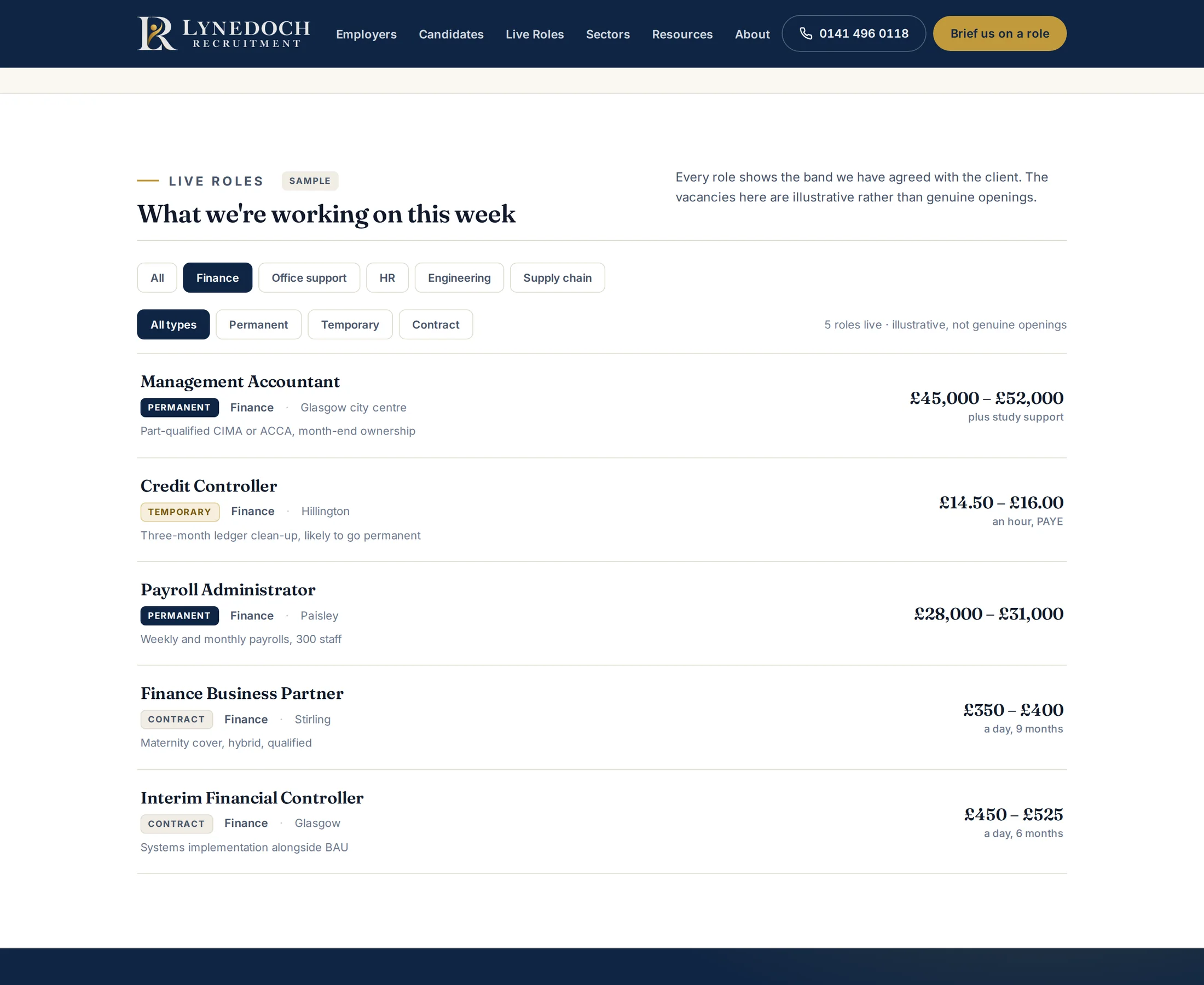
The band, the type, and the one thing that would rule somebody out — on the row itself. A job board shows a title and a town because a title and a town is all it has. You know the salary you agreed with the client, whether this is a permanent hire or a three-month ledger clean-up, and the single requirement that makes half the applicants a waste of everybody’s afternoon. Putting that on the row loses you applications and wins you candidates, which is the same trade every decent consultant already makes on the phone.
The number both of them are guessing at
Here is a thing neither of your readers can work out on their own, and which both of them need settled before they will commit to anything. The employer does not know what the hire really costs: the advert says thirty-eight thousand and the number that has to go to the board is not thirty-eight thousand. The candidate does not know what lands in their bank, and in Scotland, on the same salary, it is not what somebody doing the identical job in Manchester takes home.
You already know both. You do this arithmetic most weeks, on the phone, from memory. Publishing it is the closest thing to free credibility an agency has — it is the one page an employer bookmarks, and the one that tells a candidate you are not hiding the money.
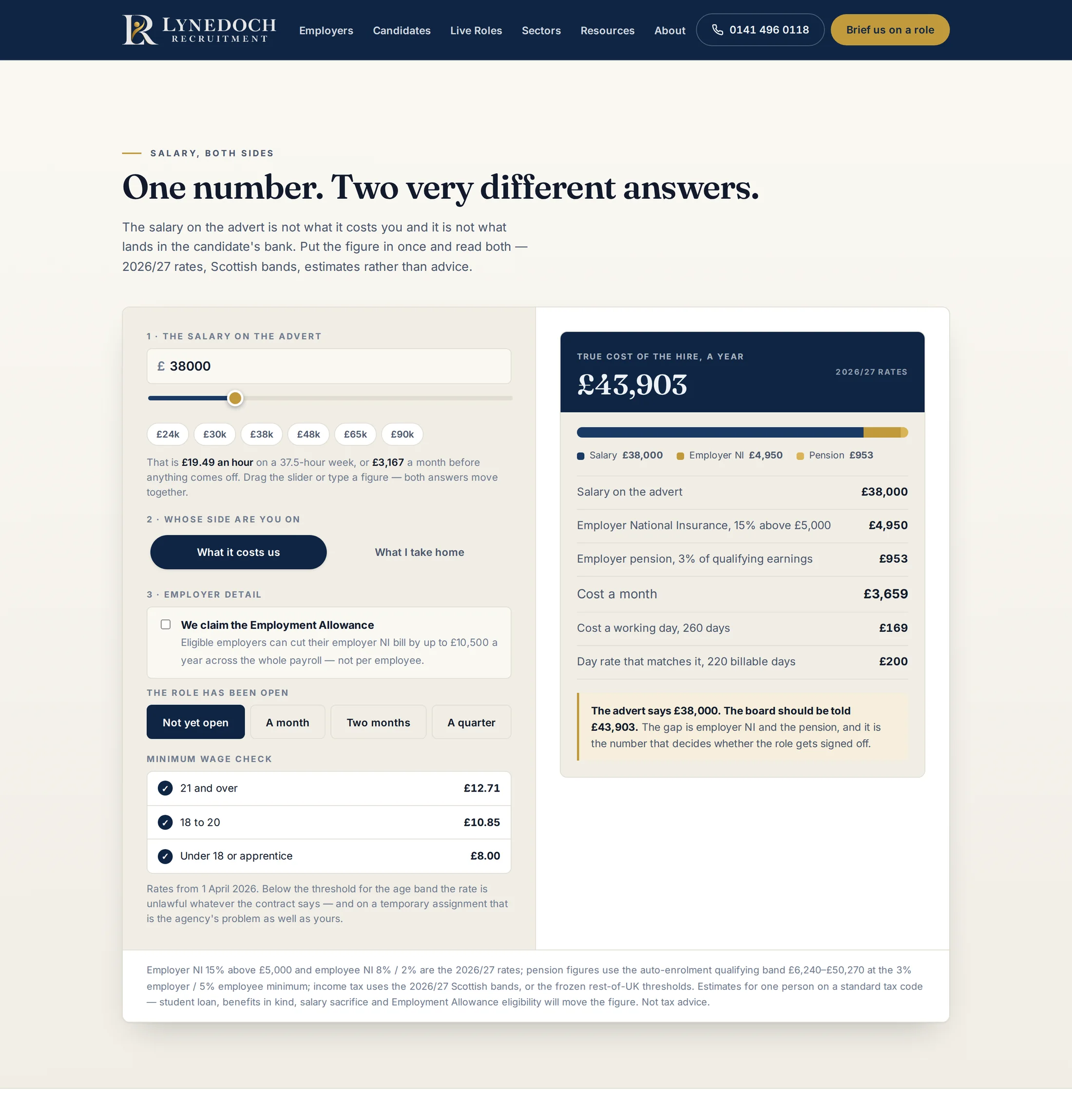
£38,000 on the advert is £43,903 on the payroll. What it costs us
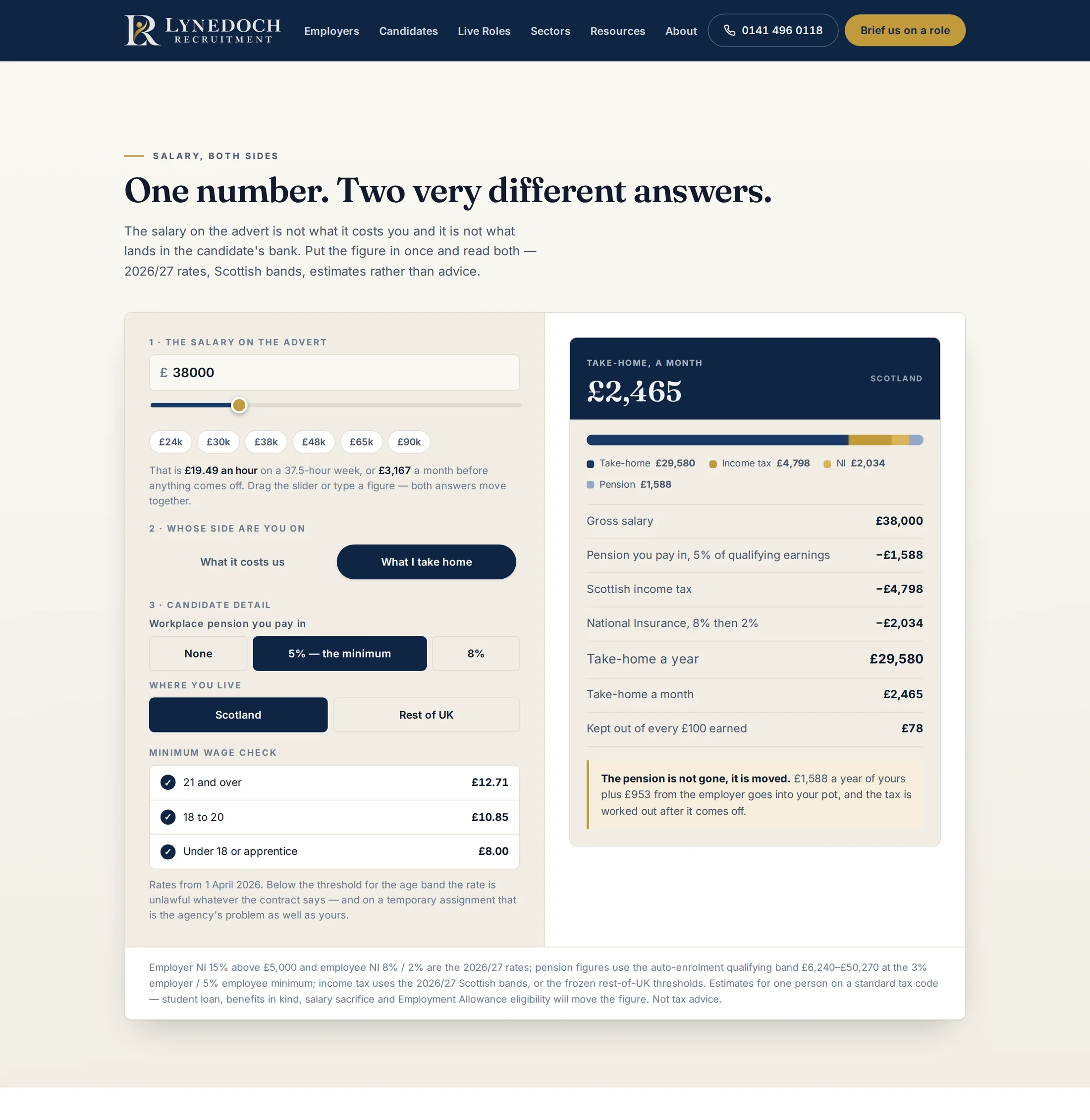
The same £38,000 is £2,465 a month in the hand. What I take home
One box, one figure, two answers — and the gap between them is the conversation. The employer’s number carries employer National Insurance and the pension, which is what turns a salary into a budget line. The candidate’s number carries their own pension, income tax on the Scottish bands and National Insurance, which is what turns an offer into a decision. A tool that only does one of those is a tool built for one of your two readers, and the other one will notice.
The rates behind those figures are published ones: employer National Insurance at 15% above £5,000 and employee contributions at 8% then 2% are the 2026/27 thresholds, the pension figures use the auto-enrolment qualifying band of £6,240 to £50,270, and the tax uses the 2026/27 Scottish bands. The minimum wage rates shown are those that applied from 1 April 2026. A calculator like this produces estimates, not advice, and the page it sits on should say so where a reader will actually see it.
What you know that a job board does not
An agency carries a set of obligations a job board has never had to think about: right-to-work checks before a first shift, a key information document for every temporary worker, terms agreed in writing before anybody is introduced, and since April 2026 the PAYE position in an umbrella chain sitting with the agency rather than the umbrella.
You handle all of it. The problem is that an employer ringing three agencies cannot tell which of the three handles it properly, because all three will say they do. Showing the working is the only version of that claim a stranger can check before they commit.
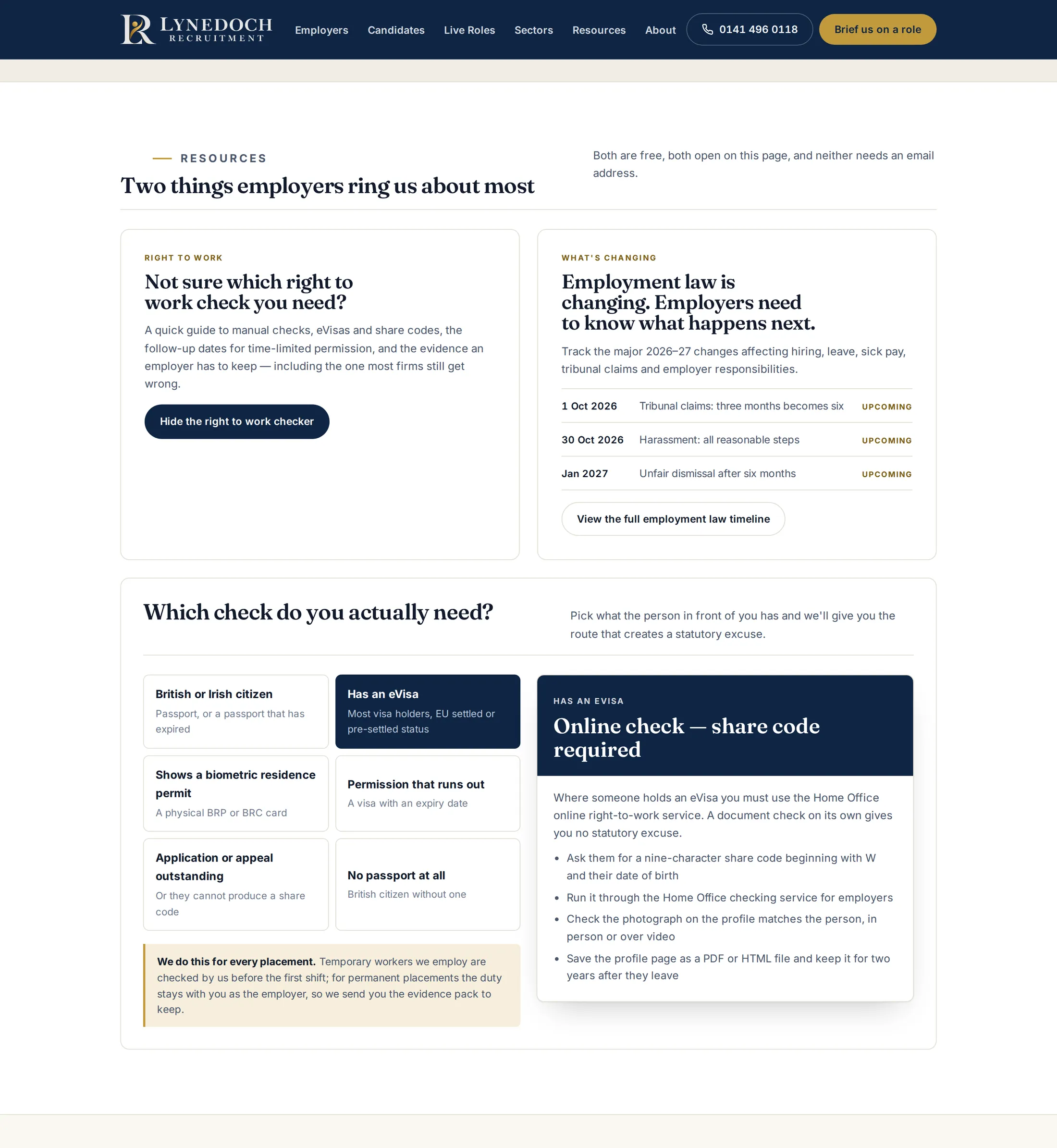
The check most firms still get wrong is the one that changed. Where somebody holds an eVisa, the physical card in their hand is not the check any more — and a page that says so, with the share code route set out beside it, is doing something no job board and no competitor’s brochure page is doing. It is also the page an office manager sends to their own finance director, which is a link you did not have to ask for.
Every temporary worker gets one before terms are agreed: who employs them, the rate, the deductions, what reaches the bank. Publishing a plain example of it answers the candidate question you get asked most and never get to answer until they are already on the phone.
The single term clients most want to understand and least want to raise. A page that states the period plainly — and that an extended period of hire is the alternative — removes the suspicion that it is buried somewhere in your terms on purpose.
Tribunal time limits, harassment duties, the unfair dismissal qualifying period. Dated, sourced, and updated when they move. It is the least glamorous page on the site and reliably one of the most visited.
To be plain about what this is and is not: none of it is legal advice, and a website is not the place to give any. It is a description of the things you already do, written down where somebody can read them before they ring — and dated, so a reader can tell whether it has been kept up. Anything that goes further than that belongs with your own advisers, not on a marketing page.
The enquiry
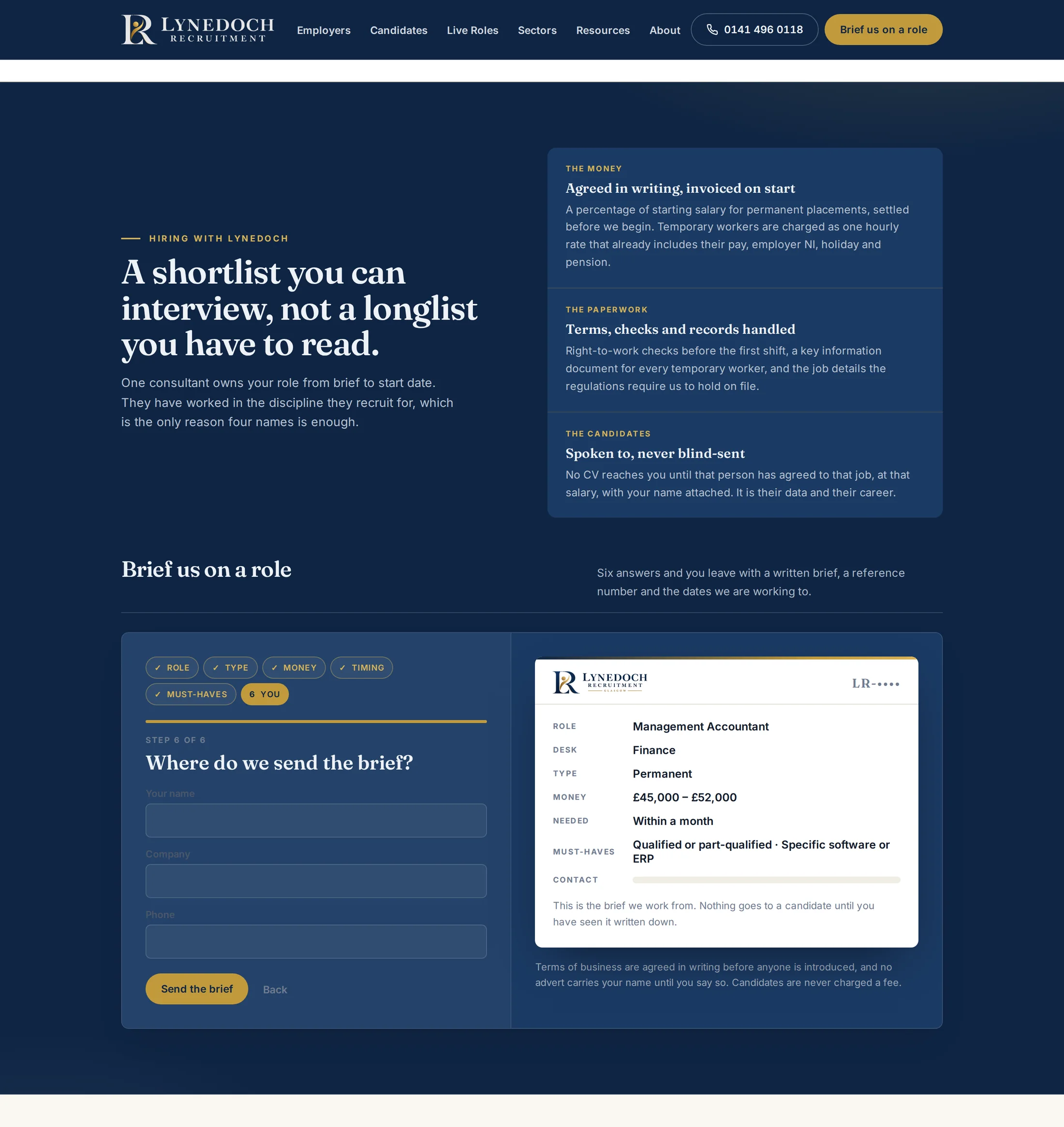
Name, email, message. An employer with a role to fill types four lines into it and waits. You ring back the next morning and the conversation that actually matters — the money, the two things that would rule a CV out, the date they need somebody — happens then, from a standing start, with nothing written down anywhere. The form cost you a day and captured none of it.
The fix is not a longer form. It is a form that asks the questions you were going to ask anyway, in the order you would have asked them, and hands back something the employer can see.
Six answers, and the employer watches the brief being written as they give them. The document on the right is the point: by the time they reach the last step they have seen the thing you will work from, and they have committed to a band in writing rather than in a conversation neither of you can quote back later. Nothing is sent to a candidate until they have approved it — which is also the sentence the other half of your audience needs to read.
An enquiry that arrives already qualified is worth more than three that arrive blank, and it costs the sender less to send.
The demonstration
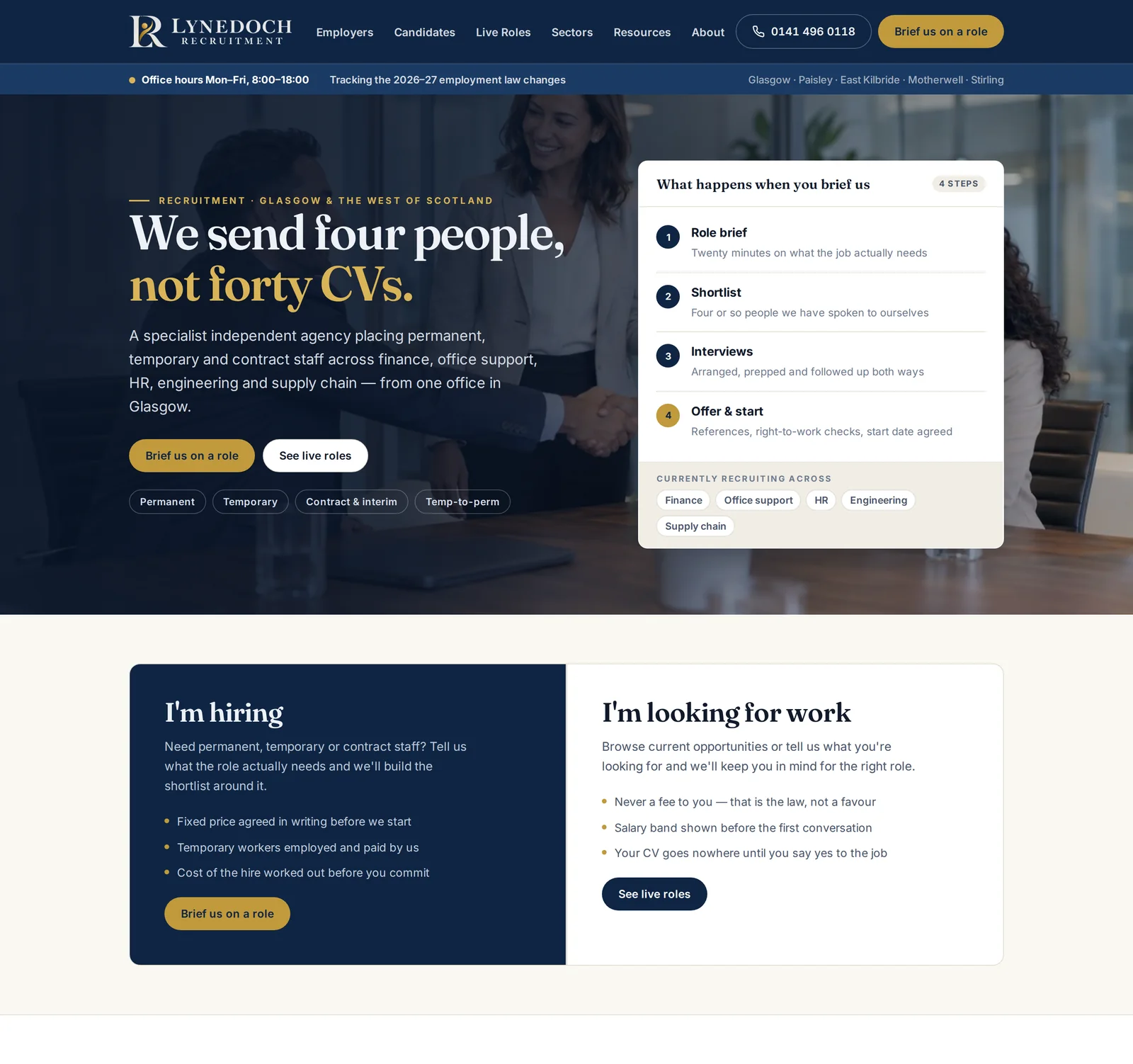
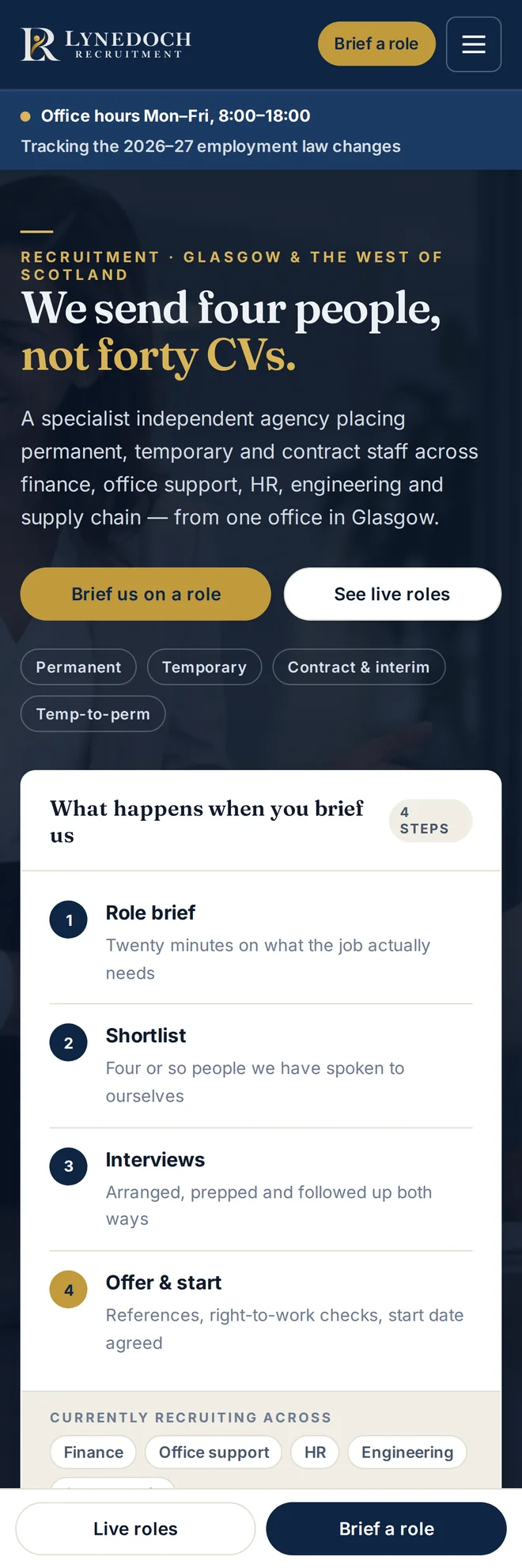
Building one was the only honest way to test the argument. Four of the things above — the vacancy board, the salary tool that answers twice, the right-to-work checker and the brief builder — only prove anything when they sit on one site and have to share a header, a navigation bar and a reader. It was also the only way to find out whether a single home page can face a hiring manager and somebody quietly looking for a new job without either of them feeling handled.
There is not a single review, rating or placement statistic anywhere on it. A real agency’s site would carry all three, and yours should. We will not invent evidence to make a demonstration look better, which is the same reason we would not invent any for you. The telephone number on it is one of the numbers reserved for fiction, so that nobody ever rings a stranger by accident.
The split at the bottom of that screen is the whole argument in one component. Two doors, equally weighted, neither of them the poor relation — because the day you make the candidate door smaller is the day your shortlists get worse, and the employer is the one who finds out.
Before you ask
Usually, yes — most recruitment systems will publish a feed of live roles, and where one does we take it and build the page around it so your consultants carry on working in the tool they already use. Where a system exposes nothing usable we will tell you that plainly rather than quoting for an integration that cannot be built.
Less than people expect, because the hard part is not the code — it is deciding which rates it uses, saying so on the page, and agreeing who checks them each April. That last one is the question worth asking before anybody builds anything, and it is the one that gets skipped.
The opposite. A national can win on spend and on brand recognition; you cannot, so the only ground left is being visibly better at the part that needs judgement. Everything above is cheaper for a small agency to do well than it is for a large one, because it needs a point of view rather than a committee.
Almost never, and we will usually argue against one. Candidates do not want an account with a recruiter; they want the salary band, a straight answer about where their CV goes, and a way to register interest in under a minute. A portal adds a login to a decision nobody wanted to make.
If you place into the trades, the professions or property, the sector pages on this site describe how those businesses buy — the accountancy practices and agencies you recruit for are reading their own versions of this argument.
Tell us which desks you run, whether the money is permanent fees or temporary margin, and where your roles get published today. What comes back is this argument applied to your disciplines, your rates and the questions your consultants already answer twenty times a week on the telephone.