New: Try our free Website Audit tool. Run your free audit →Run it free →

Scaffolding & access

Nobody wants scaffolding. They want the job it holds up.

Central Systems builds and rebuilds websites for scaffolding contractors. Most of your enquiries arrive from somebody already standing in the middle of their own promise — a roofer with a customer waiting, a builder whose programme has slipped a fortnight. The rest come from a householder who has never hired scaffold in their life and has no idea it might need permission from anyone. We build the route that answers both before the phone goes.

Priced by the weekPermits and groundInspection recordsTrade enquiries
A tube-and-fitting scaffold wrapped around the gable and front elevation of a detached house, three lifts high with boards and guardrails on each, under a pale sky.

Who is actually on the phone

The roofer is not comparing your price. He is deciding whether he can promise a day.

In nearly every other trade the person ringing is the person paying, and what they are buying is the finished thing. Scaffolding is the exception on both counts. A large share of your work arrives through another trade, and none of it is the thing anybody actually wanted — it is the condition attached to the thing they wanted. That changes what a website has to do, because a dependency gets judged on certainty a long time before it gets judged on cost.

  1. Step one

    A roof starts leaking

    The householder rings a roofer. A rough week is discussed. At this point nobody in the conversation has given scaffolding a single thought.

  2. Step two

    The roofer works out he cannot reach it

    Now there is a scaffolding enquiry — and the week it has to happen in was settled before anyone spoke to you, by two people who were not thinking about access at the time.

  3. Step three — the one you inherit

    His promise becomes your deadline

    He has to give his customer a start day, and he will set it from whatever your site told him. Vague, and he pads it by a fortnight and prices the risk in. Specific, and he rings you first next time because the last one landed when you said it would.

You get quoted, chosen and blamed for a job that was never yours.

Two scaffolders on a boarded lift passing a length of tube between them, one braced against a standard with the ground several storeys below.

It is worth reading your own site the way that roofer reads it. He is not browsing. He has a customer waiting on an answer, he is looking for two things — can you be there, and roughly what does it cost to keep it there — and if he cannot find either within about a minute he moves on to the next result, because the next result might have them. Our page on websites for roofers looks at the same moment from the other side of it.

Before anything goes up

The hold-up is almost never the scaffold. It is whose ground it stands on.

On the customer’s own drive it is nobody’s business but theirs. Put one standard on the pavement and it becomes an application to the council, with a fee and a notice period attached to it. Put one in next door’s garden and it becomes a conversation with a neighbour who has no particular reason to say yes. Three completely different answers to a question most enquiries never think to ask — and you are the only person in the chain who already knows that.

Where will it stand — desktop
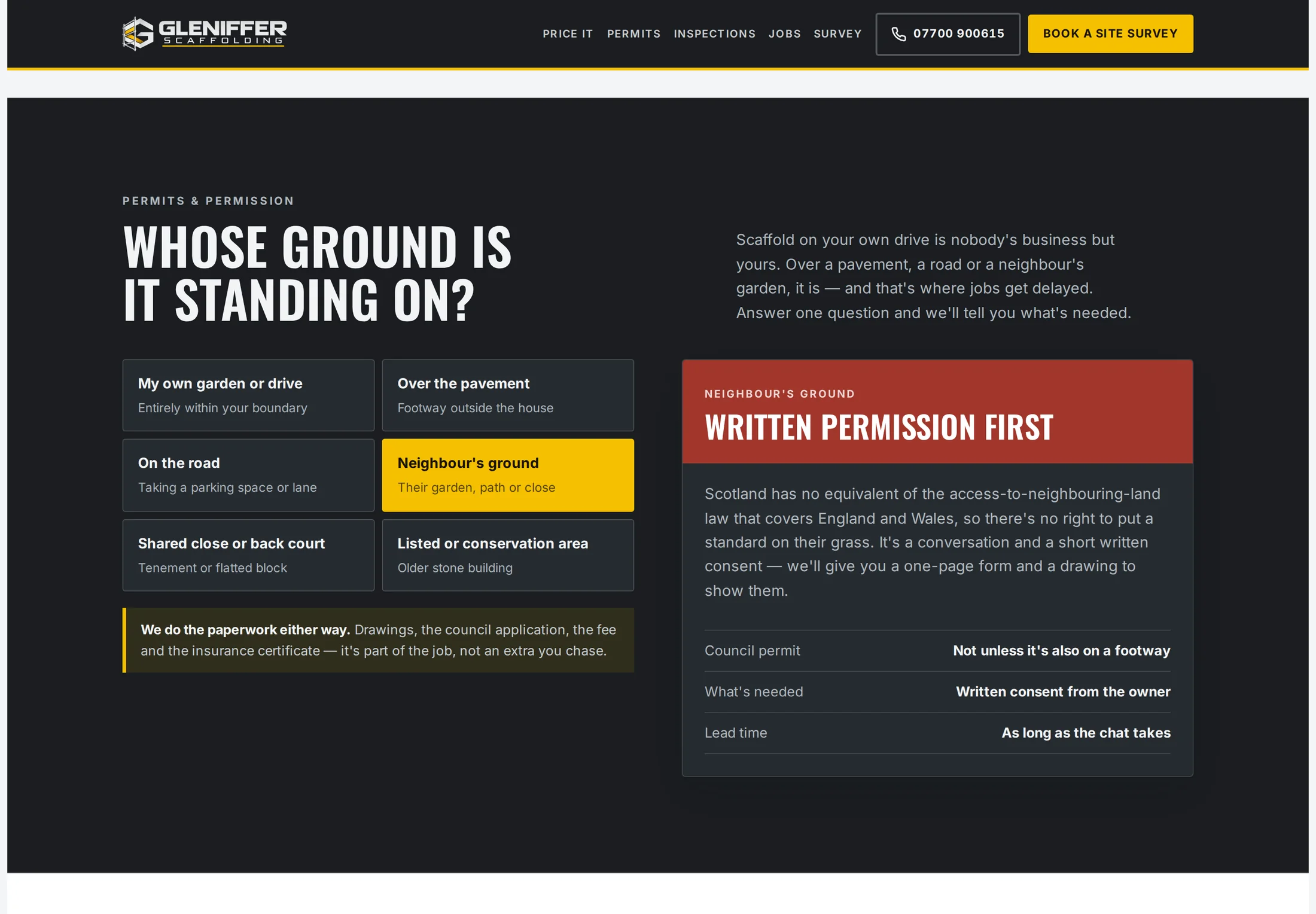
A scaffolding website designed by Central Systems, its navigation bar across the top, scrolled to a section headed whose ground is it standing on. Six options are listed — my own garden or drive, over the pavement, on the road, a neighbour’s ground, a shared close or back court, and a listed or conservation area. The neighbour’s ground option is selected, and the panel beside it returns written permission first, explaining that Scotland has no equivalent of the access-to-neighbouring-land law covering England and Wales, above three lines giving the council permit position, what is needed, and the lead time.

Three questions, and the third is the one nobody expects. Where it stands, how long it needs to stand there, and whether any part of it crosses somebody else’s boundary. Asking that on the page rather than at the survey does two things at once: it stops a job stalling in its first week, and it quietly tells a householder that the firm asking has been here before.

  • Pavement and road belong to the council. An occupation permit, applied for in advance, with a fee and a notice period that is not open to negotiation. Publishing the lead times for the councils you actually work in saves you the same phone call twice a week and rules you out of nothing.
  • In Scotland, a neighbour’s ground is consent or nothing. In England and Wales a homeowner refused access can apply to a court under the Access to Neighbouring Land Act 1992. That Act closes by saying it extends to England and Wales only, and there is no Scottish equivalent — so north of the border it is agreement or the job does not happen. The earlier everyone knows that, the cheaper it is for all of them.
  • Explaining it is the work. None of this is yours to solve, and the page should not pretend otherwise. Being the first person in the chain to make the problem legible is what convinces a stranger you have done this before — which is the only thing they are really trying to work out.

What is actually being bought

You are not selling scaffold. You are renting weeks.

Every other trade we build for quotes a job, does it, and leaves. Yours quotes an erect, a strike, and an open-ended stretch of time in between that belongs entirely to somebody else’s programme. That is a genuinely unusual thing to buy, and hardly any scaffolding website explains it — which is why so many second phone calls turn into an argument about extra weeks that nobody was warned about.

Build your scaffold — desktop
A scaffolding website designed by Central Systems, its navigation bar across the top, scrolled to a section where a visitor builds up a job — building type, height in lifts, which elevations, hire period, and extras such as debris netting, a loading bay or the council permit — while a line drawing of the scaffold redraws beside it. The panel below the drawing is labelled sample prices and splits the figure into erect and dismantle, the first four weeks of hire included, the cost of the extra weeks, the netting, and the handover and seven-day inspections.

The number that matters is not the first one. An erect-and-strike figure is easy to compare and easy to undercut. What a roofer actually wants to know is when the clock starts, how many weeks are already inside that price, and what a week costs after those run out — because he knows perfectly well his own job might overrun, and what he is really pricing is how much of that risk he is about to carry.

  • Say what the first price covers. The erect, a stated hire period, and the strike. If four weeks is your standard, four weeks belongs beside the number, not in the terms underneath it.
  • Publish the weekly extension rate. It is the figure people ring up to ask for, and most firms make them ring. Putting it on the page does not lose you the work. It loses you the argument.
  • Be exact about when the clock starts. The day it is handed over, not the day the lorry arrived. One sentence, and it has settled more invoice disputes than any amount of small print ever has.

Handover and inspection

The tag on the ladder is not for you. It is for whoever climbs it next.

A scaffold is handed over, tagged, and then inspected again — before it is used for the first time, at intervals of no more than seven days after that, and following anything liable to have affected its strength or stability, of which the Health and Safety Executive names high winds as the obvious one. None of that is paperwork for the sake of it. The audience is a roofer who has to write his own risk assessment before his squad goes up, and an insurer who will ask what the record said if anything ever goes wrong.

The tag, explained — desktop
A scaffolding website designed by Central Systems, its navigation bar across the top, scrolled to a section showing a scaffold tag reproduced at readable size, headed safe to use, with rows for the site, the handover date, the last inspection, the next inspection due and who inspected it. Beside it four points set out when a scaffold is inspected and why a guardrail must never be moved, above a note marked demonstration tag explaining that on a live job the dates come off the inspection record.

A tag answers one question: is it safe to go up today, and who says so. You already do this — it is in the van, in the folder, in the app. What almost no scaffolding website does is show a reader what it looks like, which is the whole difference between a contractor taking your word for one job and taking it for the next three.

One thing to be careful how you word. The handover certificate is not named in the regulations. It is industry practice — the NASC’s guidance in particular — for recording what was built, what it was designed to carry and who signed it off, and it has become the document a main contractor asks for by name. Describe yours as practice rather than as law, because that is what it is, and because the contractors who know the difference are exactly the ones you want reading the page. Our trades and construction page argues the general case for putting up whatever somebody could go away and verify. Scaffolding is the sharpest version of that argument, because here they genuinely do.

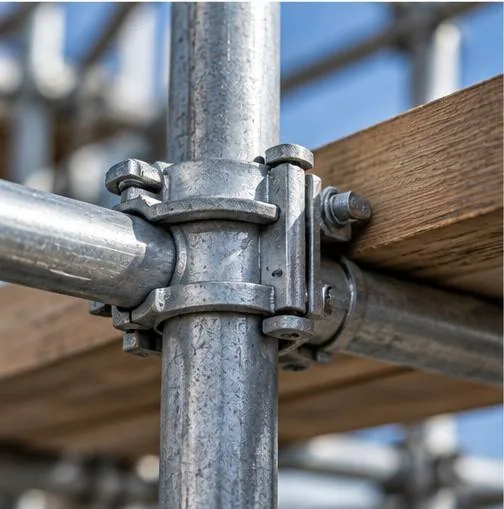
A close-up of a right-angle coupler clamping two galvanised tubes, with the edge of a scaffold board and its retaining clip just visible behind.

The whole thing together

Two readers who want opposite things, served by one homepage.

A householder needs scaffolding explained to them. A contractor needs nothing explained and everything shown — rates, lead time, records. The same homepage has to serve both without patronising one or boring the other, and the order it goes in is most of the job.

Homepage — desktop
The homepage of a scaffolding website designed by Central Systems. A dark header carries the firm name, five navigation links, a phone number and a book-a-site-survey button, above a yellow strip reading free site survey, permit applications handled, and fixed price, dates in writing. The hero headline reads up on Monday, signed off before you climb it, set over a photograph of a scaffolder standing on a boarded lift above rooftops at sunset, with two buttons beneath it and three ticked lines.
The same homepage on a phone. The header collapses to the firm name, a call icon and a survey button; the headline, the lede, the two buttons and the three ticked lines stack into a single readable column; and a fixed bar sits at the foot of the screen offering call and site survey.

Gleniffer Scaffolding does not exist. We invented the firm so that the pieces above could be shown working together instead of described one at a time — the estimator, the ground question, the tag, and a homepage that has to hold a main contractor and a worried householder in the same screen. There are no customer reviews anywhere on it; a real firm’s site would have them. Inventing evidence to make a picture look better is not something we will do for a demonstration, and it is not something we would do for you.

The overrun that is not yours

The roof runs three weeks late. The scaffold is the part the street can see.

You are the visible half of a job that belongs to somebody else. When the slater does not turn up, or the stone underneath turns out to need twice the work anyone expected, the thing standing outside the house for an extra month is the thing with your name across the debris netting. A fair amount of that is unavoidable and almost none of it is fair — but a dated record is the one thing that separates the delay you caused from the delay you inherited.

Dates

Date-stamp the handover

Up on this day. Signed off on this day. Inspected on these days. Every one of those is already written down somewhere; it simply never leaves the van, and the one week it would have been useful is the week nobody can find it.

Terms

Publish how the strike is booked

How much notice you need to come and take it away, and what happens when a job finishes at four on a Friday. Most arguments about scaffold sitting too long turn out, on inspection, to be arguments about who was meant to ring whom.

Access

Give the customer somewhere to look

A householder who can see the record for their own job is a householder who stops ringing you about a slater you have never met. It costs one page and it buys back an afternoon a month.

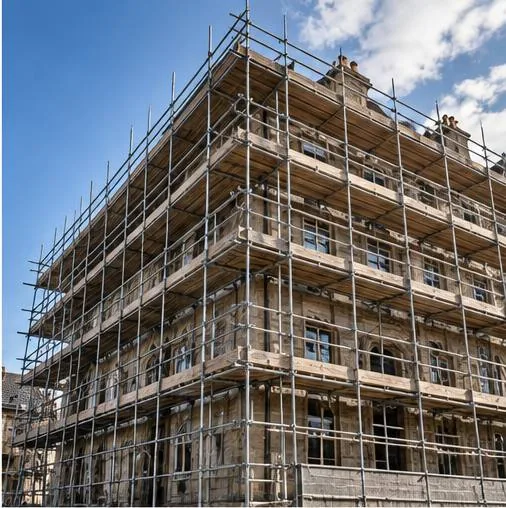
A large stone frontage carrying a full-height scaffold, boards and guardrails square on every lift and a ladder access bay running up one side.

Nobody remembers who put it up. Everybody remembers how long it stayed.

The reasonable objections

What scaffolders usually say when we suggest this.

“Publish weekly rates and I get undercut.”

Undercutting on a hire rate is easy to do and hard to survive, and the firms doing it are not the ones a main contractor rings twice. What an unpublished rate really costs you is the roofer who could not work out whether you were affordable and padded his own quote to cover it. He never rang, so he appears in nothing you can look at — and an invisible loss always loses the argument to a visible one.

“My work comes from four roofers and a builder.”

Then the site is not there to find new work. It is what those five send a householder who asks who is putting the scaffold up, and it is what happens the year one of the five retires — which is generally the year a firm discovers what its enquiry pipeline actually was.

“Householders do not understand any of it anyway.”

They understand it perfectly well once somebody explains it, and hardly anybody does. A firm that sets out what a permit is, how long it takes and why the scaffold might have to touch next door’s garden is not being technical. It is being the only comprehensible result on the page.

“Every job is different. I cannot put a price up.”

Nor should you price a job you have not stood in front of. What can go up is the shape of it: what an erect-and-strike covers, how many weeks sit inside it, what the week after that costs. Nobody reading mistakes that for a quote, and nobody expects to.

“I would rather they rang so I can talk it through.”

Most of them still will — this is not a trade that gets bought through a form. What changes is where the call starts. Answer the ground question and the hire question on the page and a twenty-minute explanation becomes a two-minute confirmation, done for you while you are up a lift and the phone is in the van.

“It is all just tube. There is nothing to show.”

There is more here than in most trades, and none of it is the tube. It is a drawing, a design check, a tag, a week of inspection entries, and a photograph of a finished lift on a stone frontage where the boards are genuinely level. Contractors read every one of those.

Let’s build the part that answers before the phone goes.

Tell us the towns you cover, the councils you deal with and the work you would take more of — domestic, main contractor, or both. Then we will take you through the same set of pages rebuilt around your rates, your councils and your own inspection records.