New: Try our free Website Audit tool. Run your free audit →Run it free →

Plumbers & heating engineers

Half your customers are soaked and panicking. The other half are getting three quotes.

Nothing else about a plumbing business is as awkward for a website as that. One visitor has water coming through a ceiling and will give you about fifteen seconds; the other is planning a new boiler and will spend a fortnight deciding. Most sites in the trade are built for neither, so they lose the first to whoever answers and the second to whoever explained themselves better.

Emergency routesQuote captureBoiler sizingLandlord complianceCoverage checksMap visibilityRemindersLooked after
Interface by Central Systems
Emergency triage
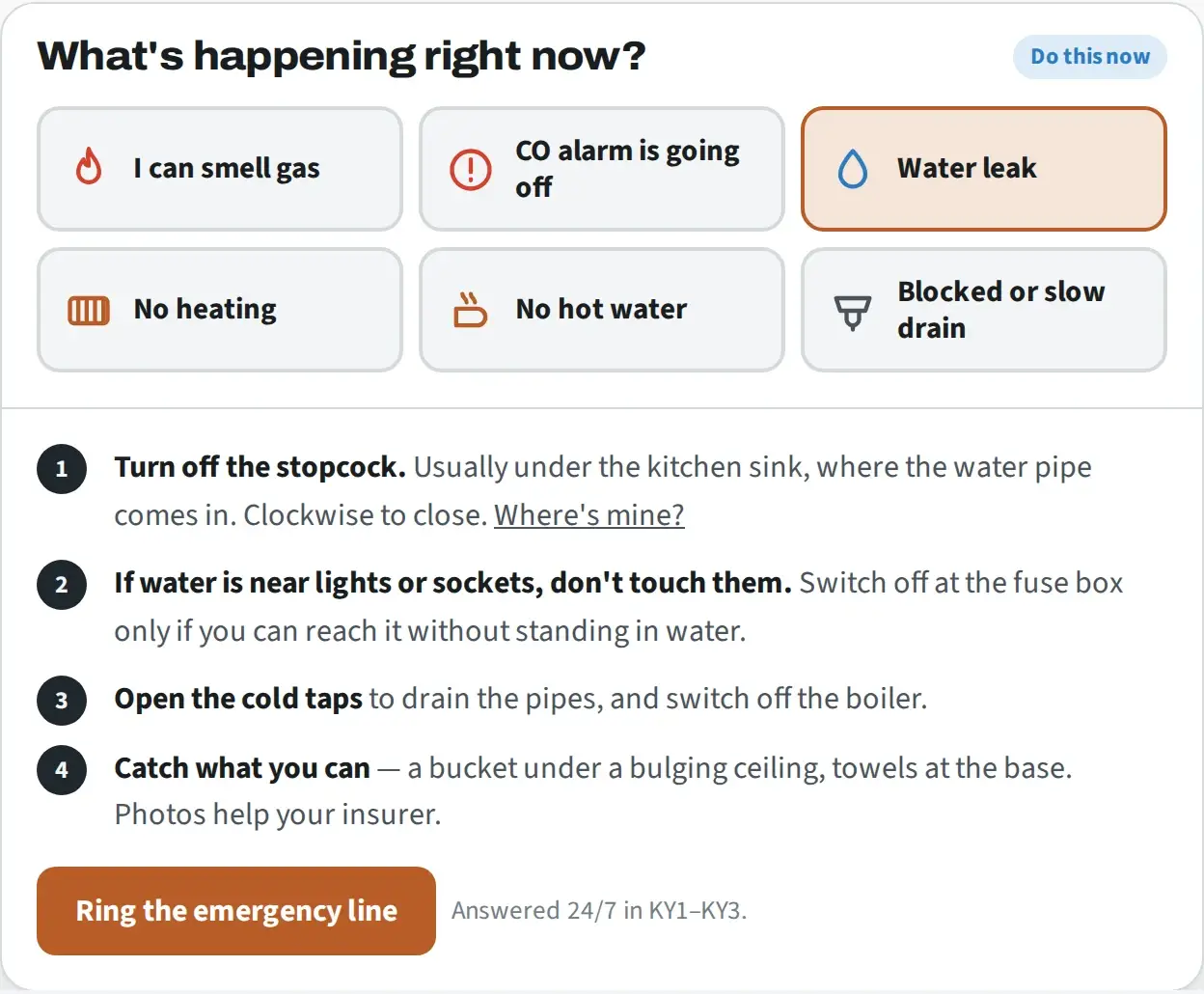
An emergency triage panel designed by Central Systems: six symptom buttons covering gas smell, a carbon monoxide alarm, a water leak, no heating, no hot water and a blocked drain, with the leak option selected to reveal four numbered steps to take immediately and a button to ring the emergency line.

The state of it

Built for a browser, used by somebody standing in water.

In short

The trade’s websites are mostly designed as brochures — a slider, a services grid, an about page — when the two jobs they actually have are triage and reassurance. Neither is a design problem exactly. Both are a question of what the page does in the first few seconds.

Nobody reads a plumber’s website. They scan it for a number, a place name and a reason to believe you will turn up. If those three things are not settled before the first scroll, the tab closes and the next firm gets the call — and on a phone, in the dark, with the stopcock still running, that happens fast.

What we tend to find is on the right.

What we usually find
  • The number below the fold. Or worse, on a contact page two taps away, which is two taps more than somebody watching a ceiling bulge is going to give you.
  • Emergency and planned work in one paragraph. A burst pipe and a bathroom refit described in the same breath, so neither reader is sure the page is for them.
  • No clue what a call-out costs. The single most common reason people hesitate before ringing a trade, and the thing almost no site addresses in any form.
  • Credentials as a row of logos. Unlabelled badges in the footer, where a visitor cannot tell what any of them certify or how to check one.
  • Coverage as a list of forty towns. Which nobody believes, and which tells the person in the next street nothing useful about whether you will come.
  • Nothing at all for landlords. A segment with a recurring legal obligation and a diary problem, addressed by a single line on the services page.
  • Slow on the one device that matters. Heavy sliders and uncompressed photographs, loading over a phone signal, for a reader who has already started dialling somebody else.
  • A form that goes nowhere visible. Nothing acknowledged, nothing logged, and a reply that waits until somebody thinks to look at their phone between jobs.

Two customers

Urgency in this trade has no middle.

Work arrives either right now or in a few weeks’ time, and hardly ever in between. That single fact should decide the shape of the site, because the two readers want opposite things and a page that splits the difference serves neither.

Right now

Something has failed

A leak, a dead boiler in February, no hot water with a house full of people. This reader is not comparing anybody. They want to know you cover their street, that somebody will answer, and what to do in the meantime. Every additional word is friction.

  • Phone first
  • Coverage obvious
  • What to do now
  • Speed over polish
In a few weeks

Something is being planned

A new boiler, a bathroom, a system upgrade before winter. This reader will read everything, get two or three quotes and take a fortnight over it. Here the site has to explain, show workings and build enough confidence to be one of the three.

  • Detail welcome
  • Evidence of work
  • How quoting works
  • Trust over speed
On a cycle

Something is due again

Landlord gas safety checks, annual servicing, a warranty condition. Predictable, repeating, and the closest thing the trade has to recurring revenue — yet usually left to whoever remembers to ring.

  • Dates, not enquiries
  • Reminders
  • Batch booking
  • Records kept
Sent to you

Somebody else has the work

Letting agents, builders, kitchen and bathroom fitters, insurers. A referral relationship is a different route again, and it wants terms, capacity and a named contact rather than a domestic enquiry form.

  • Trade route
  • Capacity stated
  • Invoicing
  • A person to ring

Getting the routing right is mostly enquiry handling — see business automation.

The urgent route

Be useful in the first fifteen seconds, or be closed.

An emergency page has one job before it has any other: get somebody to the right action. Sometimes that action is ringing you. Occasionally it is not, and a page willing to say so is the one people remember afterwards.

One tap to dial, fixed on the screenNot in a header that scrolls away. On a phone the number should be reachable from anywhere on the page without hunting for it, because that is the entire transaction.
Where you actually go, stated plainlySomebody two streets outside the patch needs to know that in the first screen, not after a phone call. Honest limits are faster for both of you than a list of towns you would never drive to at midnight.
Send the genuinely dangerous elsewhereA smell of gas or a sounding carbon monoxide alarm is not an enquiry to capture. The National Gas Emergency Service is on 0800 111 999, it is free, and a page that puts that in front of somebody before its own number is doing the right thing — and is trusted for it.
What to do while you waitWhere the stopcock usually is, which taps to open, when not to touch a fuse box. General guidance of the kind any competent engineer would give on the phone — it limits the damage and it is the most useful thing a page in this trade can carry.
When the line is actually answeredStated as it really is, including the hours it is not. Somebody who rings at two in the morning expecting an answer and does not get one is a bad review; somebody who reads the hours first is not.
A fallback that is not a formIf the line is engaged, a message that goes somewhere with a time stamp and an acknowledgement. The worst outcome is an enquiry sitting unseen in a mailbox while the customer rings three other firms.

The planned route

A boiler is the third-largest thing most people buy for a house.

After the house and the car. It gets researched accordingly — a fortnight of reading, two or three quotes, and a decision made largely on who seemed to know what they were talking about. That is a contest the website can enter before anybody rings.

The trade’s instinct is to keep it all for the survey, because the size and the price genuinely depend on things you cannot see from a laptop. That is true, and it still loses work — because the reader is going to form a view from somewhere, and if not from you then from a manufacturer’s marketing page or a forum.

A tool that asks four honest questions and gives an indicative type and size is not a quote, and should say so in as many words. What it does is put the reader in a conversation with you rather than with a search engine.

  • An indication, clearly labelled as oneType, a size range, an approximate band. With a plain line saying the survey confirms it and the quoted figure is the figure — which is both honest and, for most people, reassuring rather than off-putting.
  • The reasoning shownWhy three bedrooms and two showers points where it does, why a weak mains flow changes the answer. Somebody who understands the logic trusts the recommendation and arrives at the survey already halfway sold.
  • Alternatives mentioned fairlyHeat pumps, cylinders, keeping what is there and servicing it properly. Naming the option you do not profit from is disproportionately persuasive, and it is what a good engineer says on a doorstep anyway.
  • What is included, written outFlush, filters, controls, the making good, who registers the warranty. Quotes in this trade are notoriously hard to compare, and the firm that makes comparison easy tends to win the comparison.
Boiler sizing tool
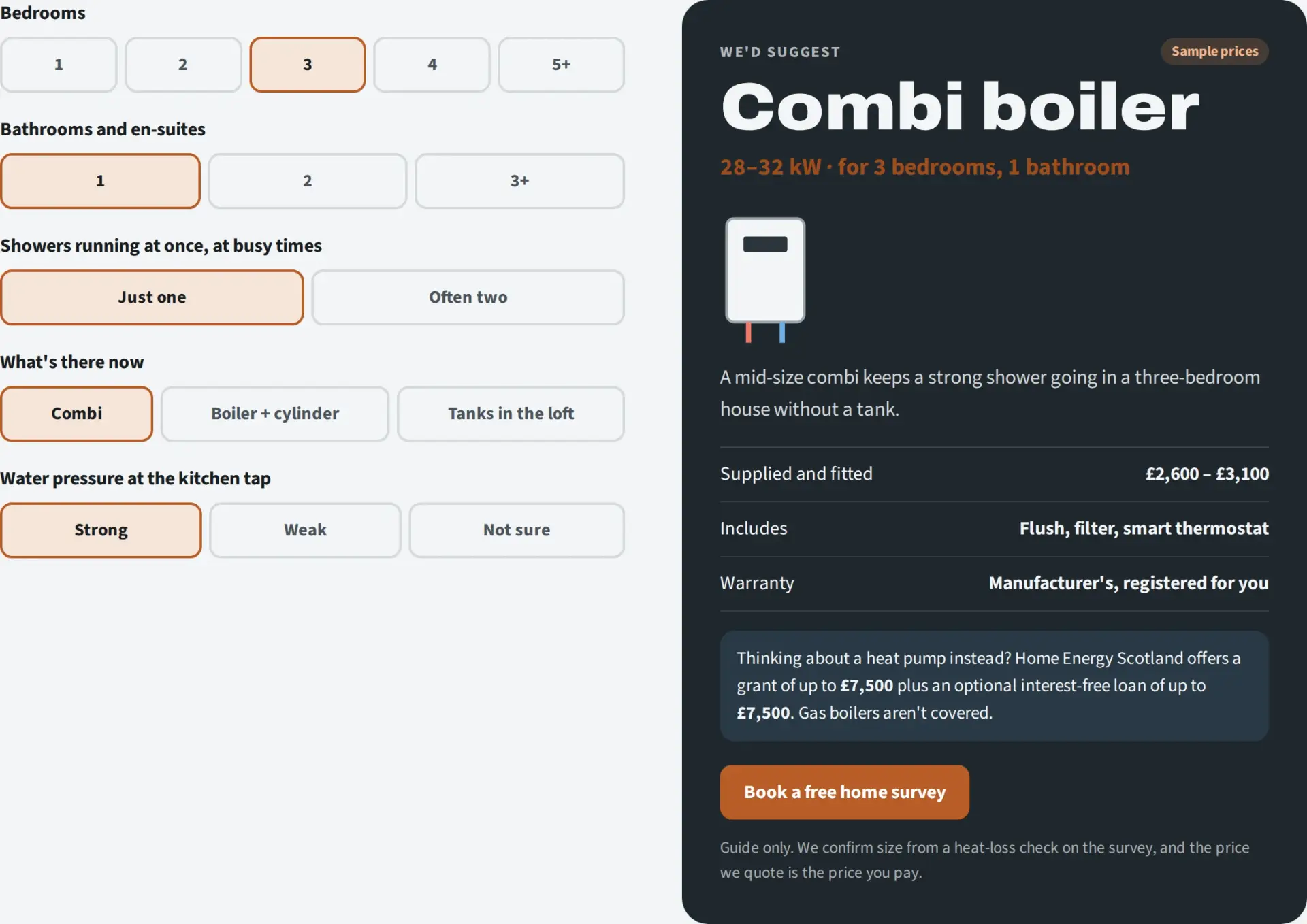
A boiler sizing tool designed by Central Systems: four questions covering bedrooms, bathrooms, simultaneous showers, the existing system and mains pressure, producing a suggested boiler type and output range alongside an indicative price band, what the work includes, and a note that the survey confirms the specification.

Four questions, an answer, and its own caveat. The panel states a band rather than a price and says on its face that a heat-loss check at survey decides the specification — which is the only way a tool like this can be both useful and defensible.

Being believed

A badge nobody can check is just a picture.

Every site in the trade carries a row of logos. Very few make any of them verifiable, explain what they certify, or say which of them actually applies to the work being sold on that page — and that is where the credibility is won or thrown away.

Registration, stated so it can be checkedWhere gas work is involved, the registration a customer would expect to see is a real one held on a public register. Putting the detail where somebody can verify it themselves is worth more than any logo — and it is the one credential in this trade the public has actually heard of.
Insurance described, not impliedWhat cover is held and what it covers. “Fully insured” on its own has been used by enough cowboys to have stopped meaning anything to the people you want to reassure.
The guarantee, in writing and in plain wordsHow long, what it covers, what voids it, who honours it if the manufacturer does not. Ambiguity here is read as evasion, and it is the question people ask at quote stage more than any other.
Who is coming to the houseNames, faces and how long people have been at it. A stranger is being let in, often by somebody on their own, and the trade consistently underrates how much this settles.
Reviews where people already lookOn the profiles that appear beside a search result, kept current, and answered — including the poor ones. A firm that replies calmly to a bad review reads better than one with nothing but praise.
Work you have actually donePhotographs of your own installs, in houses like the reader’s, with a line about what the job involved. Manufacturer stock imagery says nothing, and people can tell the difference immediately.

We only ever publish credentials a business genuinely holds and can evidence — nothing on a page we build asserts a qualification we have not seen.

Money

Nobody expects a fixed price. They expect to know how it works.

Plumbing cannot be priced from a web page and customers understand that perfectly well. What stops them ringing is not the absence of a number — it is the suspicion that the number will be invented once somebody is standing in their kitchen.

  • Explain the structure, whatever yours isCall-out and then hourly, a first hour that includes the visit, a fixed fee for common jobs, free quotes on planned work. Any of these is fine. Saying which one you use is the part that matters.
  • Name what changes itEvenings, weekends, parts, parking, a second engineer, whether the floor has to come up. Somebody who knows the variables in advance does not feel ambushed by them afterwards.
  • Say who approves extra workThat nothing beyond the agreed figure happens without a conversation first. This single sentence answers the fear that runs underneath every hesitation about ringing a trade.
  • Keep indicative figures indicativeBands for common jobs, labelled as guidance and reviewed when they stop being true. A stale price on a website is worse than none, because the argument on the doorstep starts from your own page.

There is a reasonable worry that publishing anything about money invites people to shop on price alone. In practice the customers who filter purely on cost were never going to be good ones, and they take up an enormous amount of time before saying no.

The ones worth having are trying to establish something different — that you are straightforward, that the figure will hold, and that they will not be taken advantage of at a moment when they have very little choice. Explaining how you charge answers all three at once.

Nothing we publish states a price on your behalf without your sign-off, and figures are dated so they can be kept current — see ongoing care.

Landlords & agents

The one part of this trade with a date attached.

Gas safety checks recur on a legal cycle, servicing recurs on a warranty condition, and both are usually managed by somebody with a spreadsheet and a bad feeling. It is the most predictable work in the business and the least likely to have anything on the website aimed at it.

Landlord certificate tracker
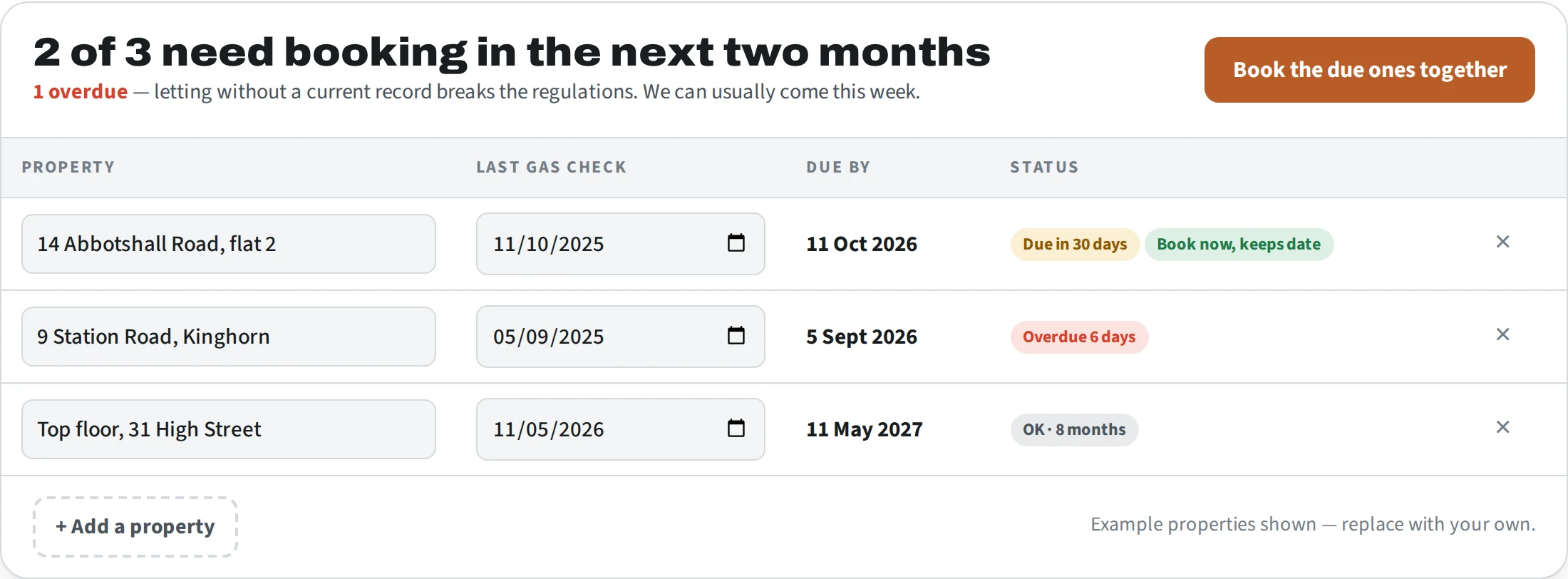
A landlord certificate tracker designed by Central Systems: a list of rental properties with the date of the last gas safety check, the date the next one falls due, and a status against each showing which are due soon, which are overdue, and which can be booked early without losing the original expiry date.

Dates, not an enquiry form. A landlord with four properties does not want to describe a problem — they want to see which checks are due and book the lot in one go. The panel answers the question they actually arrived with.

  • Speak to the diary problemSeveral properties, several dates, tenants to arrange access with, and a penalty for letting a record lapse. That is the anxiety to design for, and nothing on a standard services page touches it.
  • Book several at onceAn agent or portfolio landlord booking four addresses in one action is worth considerably more than four separate enquiries, and takes less of your time to schedule.
  • Remind before it lapsesA message a month out, then a fortnight, addressed to whoever manages the property. The most reliable repeat work in the trade comes from the firm that remembered first.
  • Send the paperwork automaticallyThe record emailed to the landlord and the tenant as soon as the job is signed off, and stored somewhere both parties can find it again in a year.
  • Say what you need to get inAccess arrangements, tenant contact, keys or a code. The single biggest cause of a wasted visit on this kind of work, and it can be settled at booking.

The reminders and record-keeping are automation rather than design — see business automation and CRM & business systems.

Being found

“Near me” means something different at midnight.

Urgent searches behave unlike anything else in local search. They happen on a phone, in one session, with words like today and now attached, and the decision is made from whatever appears first without anybody reading very much at all.

  • The profile carries the urgent searchHours, service area, phone number and photographs, kept accurate. For a reader in trouble the map listing often settles it before your website is ever opened.
  • Hours that are true, including the awkward onesIf the line is not answered at three in the morning, the profile should not imply it is. Wrongly stated availability generates exactly the sort of review that costs work for a year.
  • Pages for the places you really serveWritten for the town, with the coverage and response you can honestly offer there. Not forty spun variants — those read as thin to a search engine and as dishonest to a person.
  • Speed treated as a featureUrgent search happens on a middling mobile connection. A page that takes six seconds has lost to one that took two, regardless of which firm is better.
  • Positions nobody can promiseAnyone offering a guaranteed map placement is selling something else. We build the structure properly and give you a straight account of what it produced.

The planned side behaves in the opposite way. Somebody researching a boiler over a fortnight reads several pages, compares, comes back and only then makes contact — and that journey is won with substance rather than speed.

One site has to do both. In practice that means the urgent path is engineered for immediacy and the planned path for depth, rather than a single compromise that is mediocre at each.

Set out in full on SEO & growth.

Content that earns its place

Answer the question people type at two in the morning.

Long before anybody searches for a plumber, they search for what is wrong. Those pages cost nothing but the time to write down what you already explain on the phone ten times a week, and they are the most durable asset a site in this trade can have.

Symptom“Why is my boiler dripping?”The questions people type in the moment. Written properly they bring somebody in while they still have the problem, which is the only time they are going to ring anybody.
Cost“What does a new boiler cost?”Asked constantly, answered honestly almost nowhere. A page explaining what actually drives the figure earns enormous goodwill from people about to spend a lot of money.
PreventionWhere the stopcock isThe thing everybody wishes they had known an hour earlier. Genuinely useful, endlessly shared locally, and it puts your name next to the moment somebody needed help.
ComparisonCombi, system or heat pumpA decision people research for weeks. Explaining the trade-offs plainly, including where your preferred option is the wrong one, does more selling than any amount of persuasion.
ComplianceWhat landlords have to doAn obligation with dates and consequences attached, and an audience that will bookmark whoever explains it clearly and come back when the next one falls due.
SeasonalBefore the cold startsServicing, lagging, frozen condensate pipes. Published ahead of the weather rather than during it, when everybody is already too busy to write anything.

On safety-critical subjects we keep to general guidance of the sort you would give on the phone, and nothing we publish implies an outcome can be guaranteed. Anything technical is checked by you before it goes live.

Systems

Your job software already exists. We feed it.

Scheduling, engineer diaries, parts, certificates and invoicing belong in the job-management products written for this trade, and a firm running one should keep running it. What we care about is the part customers touch, and getting what it collects into whatever you already use.

Connected

An enquiry that arrives as a job

Address, symptom, access notes, urgency and whether the property is let — arriving in your system as something an engineer can be sent to, instead of an email retyped at nine at night. If the product publishes a workable way in, that is the route we take.

Honest limits

Where nothing can connect

Several products in this trade simply do not open up, and no amount of scripting round the edges makes that safe. You will be told which yours is. What you get instead is a tidy, consistent hand-off — two minutes of copying, and none of it guesswork.

Certificates

Records where people can find them

Gas safety records and servicing paperwork issued from whatever you already use, then delivered and stored somewhere a landlord or agent can retrieve them a year later without ringing you for a copy.

Bespoke

Only for a real gap

Now and again a firm has grown into something off-the-shelf software does not reach — several engineers, a contract book, an agent who insists on billing their own way. Building for that is money well spent. Writing another diary is not.

If that layer is the interesting part for you: CRM & business systems, industry management software, and AI integrations.

Who this is for

The businesses this suits

A one-van jobbing plumber and an eight-engineer heating firm want almost nothing in common from a website. A good deal of the above will not apply to any particular business, and sorting out which part does takes up most of a first conversation.

Sole traderOne van, reactive workWhere the site has one job — get the phone to ring from people in the right streets — and everything else on it is a distraction from that.
HeatingBoiler installersHigher value, longer decision, and the segment where explaining yourself properly on the site does the most work before anybody ever picks up the phone.
MixedEmergency and installation togetherTwo audiences on one site. The usual failure is letting the urgent side set the tone everywhere and wondering why the installation enquiries stopped.
LandlordCompliance-led businessesBuilt on gas safety checks and servicing for agents and portfolio landlords, where dates and record-keeping matter more than any amount of persuasion.
RenewablesHeat pump and low-carbon installersA newer, more sceptical buyer who needs a great deal more explaining, and where the grant and funding landscape is part of the decision rather than a footnote.
CommercialCommercial and contract workFacilities managers, schools, licensed premises. Accreditation, capacity and invoicing carry it, and a domestic emergency form actively gets in the way.
GrowingSeveral engineers and a coordinatorPast the point where one person holds it all. The site now feeds somebody else’s diary, so what it collects has to be complete enough to schedule from.
DatedAnyone with a site from years agoCrawls on 4G, hides the phone number, ignores landlords entirely, and has a form last proven to work by the person who installed it. Patching that is rarely cheaper than starting again.

Reading on from here: starting from scratch, tearing down what is there, or trades generally.

After launch

Winter arrives every year. The site should be ready before it does.

This trade has a season, and the work that wins it has to be in place months earlier. That, plus figures going stale and coverage changing as the team grows, is why a site here benefits more than most from somebody looking after it every month.

  • Ahead of the cold, not during itServicing and breakdown content published in late summer so it has settled by the time anybody searches for it. Written in October it is already too late to be found in November.
  • Indicative figures kept currentAnything about money carries a review date. Prices drift, grant schemes change, and a page quoting last year’s numbers argues against you on the doorstep.
  • Coverage and hours as they actually areTaken on an engineer, dropped a town, changed the out-of-hours arrangement — the site and the map profile both need to say so, because that is what people rang expecting.
  • The symptom pages extendedEvery question you answer on the phone twice a week is a page that does not exist yet. They accumulate slowly and they compound.
  • Somebody keeping an eye underneathLoad times over mobile data, enquiries proving they still arrive, patches, copies held off-site. Watched all year, so the first cold snap is not how you learn about it.
Counted as calls and quotesHow many came in, how they split between urgent and planned, and what people had been reading beforehand. Ranking graphs come along too, since everyone wants them — but they settle nothing. Visibility that produces no work gets rewritten, not framed.
Yours to reprioritiseEverything queued sits on one open list. Started fitting heat pumps last week? Say so and it leapfrogs whatever was scheduled; the quieter jobs keep.
Hosting and upkeep includedAll of it under the same roof. Something goes wrong in the middle of a January rush and there is a single number to ring — no triangulating between whoever sells you server space and whoever built the pages.

Detail lives elsewhere: SEO & growth handles getting found, ongoing care handles everything else. Take one, both or neither — some firms much prefer running it themselves once it is built, and that is a perfectly sensible way to do it.

Straight answers

What plumbing and heating firms ask us

Will an emergency page just bring me time-wasters at midnight?
It should do the opposite. A page that states your hours plainly, shows the area you actually cover and tells somebody what to do while they wait filters out most of the calls you did not want — the out-of-area ones, and the ones that were never urgent. What it keeps is the person in the right street with a genuine problem, and it hands them to you before they have worked down a list of four other firms.
Should I put prices on the site?
Not fixed prices for plumbing work, no — the job decides that and everyone knows it. What is worth publishing is how you charge: call-out or first-hour structure, what makes it go up, and that nothing extra happens without asking. That answers the question people are really nervous about. For installation work an indicative band, clearly labelled as guidance and confirmed at survey, is usually safe and helps a great deal.
Can you build the boiler sizing tool?
Yes, and it needs care. A tool like that has to say what it is — an indication that the survey confirms — and the logic behind it has to be yours, not ours. We build the interface and the rules you give us; you sign off what it says before anybody sees it. A tool that quotes confidently on a house it has not seen creates arguments on the doorstep, which is exactly what it was meant to avoid.
Do you handle the Gas Safe side of things?
No, and nobody building websites should claim to. Registration is between you and the register. What we do is present what you genuinely hold in a way a customer can verify for themselves, and we will not put a credential on a page without seeing evidence of it — which protects you rather more than it inconveniences you.
We use job management software already. Is that a problem?
It is usually an advantage. Those products handle diaries, certificates and invoicing properly and we have no interest in replacing one. The useful work is making the website feed it, so an enquiry lands as something you can schedule rather than as an email. Where a product publishes a workable interface we connect to it; where it does not, we say so plainly and set up a clean hand-off instead.
What about landlords and letting agents?
That is often the most valuable part of the site and the part most firms leave out. The work recurs on a fixed cycle, an agent with a portfolio wants to book several addresses at once rather than describe a problem, and whoever reminds them first tends to get the job. Building a route aimed at that audience is usually the change that pays for itself quickest.
What will it cost, and how long will it take?
That depends entirely on which parts you want. Something quick and credible — emergency route, decent quote form, honest coverage — sits at the lower end. Sizing tools, a landlord portal, pages for each town and a link into your job software each push it up. Whatever the shape, you will have a scope document and a fixed number in front of you before a line of it gets built, and we do not make figures up over the phone. Think weeks, not months.
Who writes it?
We do, from a conversation with you. What makes these pages work is the detail that only exists in the head of somebody doing the job — what people always get wrong about their stopcock, which streets have the old lead mains, why you would not fit a particular thing in a particular house. We get that out of you, structure it and draft it; you check anything technical before it goes anywhere near live.

Next step

One site, built for both of your customers.

A first proper website, a rebuild of something slow, or a landlord route that finally makes the repeat work repeat — tell us which half of the business you want the site working harder for, and where your vans actually go.

Phone, message or form — take your pick; we know you are on the tools. Scoping it out is on us, and you will have approved a number long before anyone starts building.