Roofers & roofing contractors
They have seen it from the pavement. They have never seen the felt, the battens, the flashing round the chimney, or the six inches of lap that decide whether the bedroom stays dry. The work happens where they cannot go, gets covered over by teatime, and does not announce itself as wrong until the second winter. Every other trade can be checked on the day. Yours cannot — and that one fact should decide how the website is built.
The state of it
A householder about to spend five figures on something they will never lay eyes on is looking for reasons to believe you. Most roofing sites give them a phone number, a gallery of finished roofs and the word “reliable” — which is exactly what the outfit that knocked their door last Tuesday said too.
Every honest roofer is paying off a debt run up by somebody else, in a trade where the rogues got there first and made the word itself a warning. The people who trade on that reputation are not going to build a website that answers hard questions. So the questions are yours to answer, plainly, before anyone has to ring and ask.
The list on the right is what we keep finding.
The verification gap
The photographs that settle a five-figure decision are the ones taken at eleven in the morning with the covering off: the rotten batten, the tear in the old felt, the flashing that was never dressed in properly. Nobody can take those but you, and once the new slate goes on, nobody can take them at all.
Getting those off the phone and onto the job record without anybody retyping anything is automation work, not website work — but the two want to be the same system.
Two customers
They arrive on the same page from the same search box, and almost nothing they need is the same. Put them through the same contact form and you win the one who happens to ring you and lose the one who was going to spend real money.
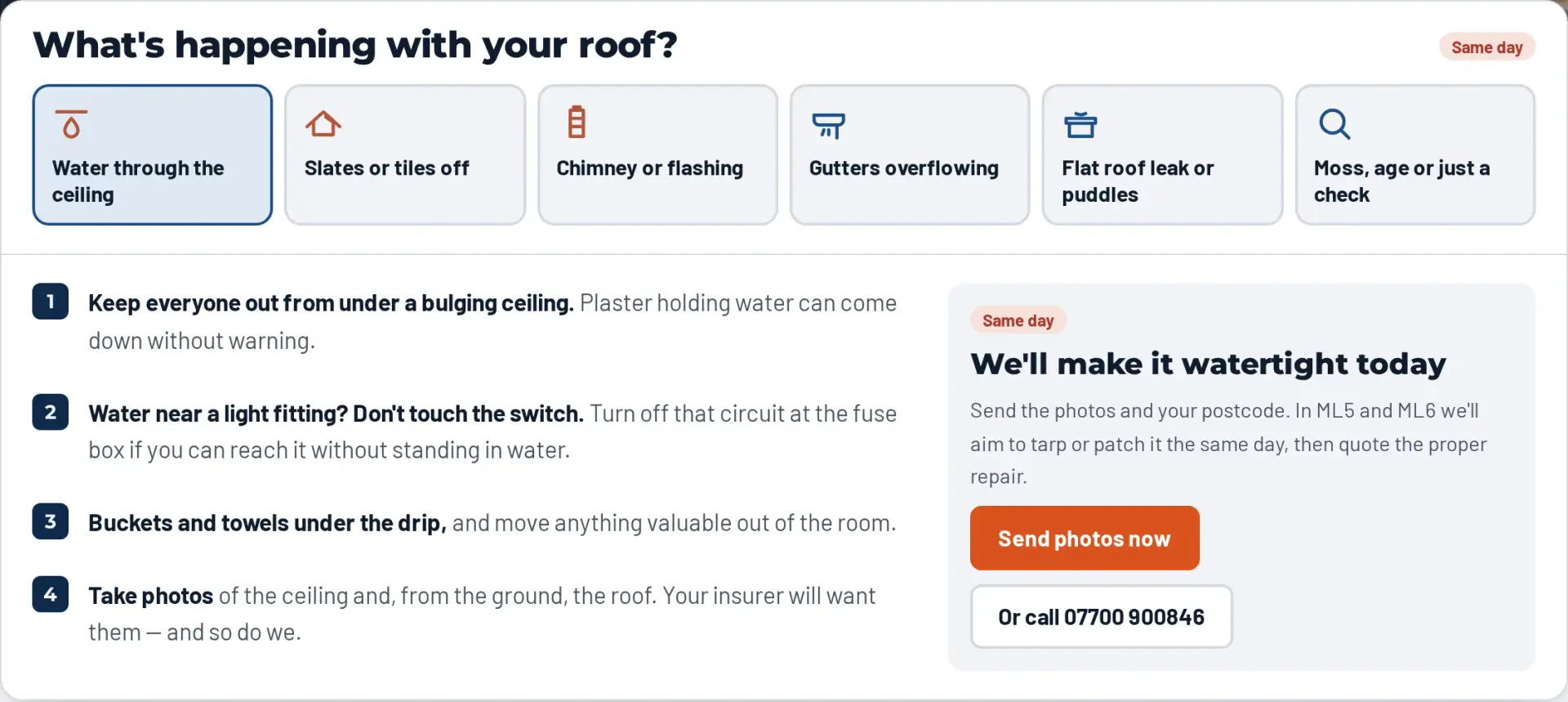
Four steps, then the ask. The advice comes first and costs nothing. By the time the button appears, the person reading has already decided you are the one who knows what they are doing.
The storm
Demand arrives all at once, stays for a few days and then vanishes — and the same wind brings two very different callers to the door. One has a genuine hole in the roof. The other has a stranger in a van telling them they need a new one.
The searching, the ringing and the doorstep callers all land inside about forty-eight hours. Whoever answers first, or answers best, takes most of the work. A site that cannot be updated the same morning has already missed it.
After every storm, people are told from the pavement that their roof is finished. A page that explains what actually warrants a full replacement — and what is a morning’s repair — is a real service, and it is the reason they ring you instead.
Nobody can make sixty roofs watertight in two days. “Same day in these postcodes where it is safe to get a ladder up, otherwise the day after” is a better sentence than a promise you break by Thursday.
Writing plainly that you will not put a man on a roof in a gale is not a weakness. It tells a homeowner you are the sort of firm that has rules, which is precisely the signal they are hunting for.
Half the storm enquiries want work in March. Captured properly, that fortnight of chaos becomes a booked spring rather than a fortnight of chaos.
Money
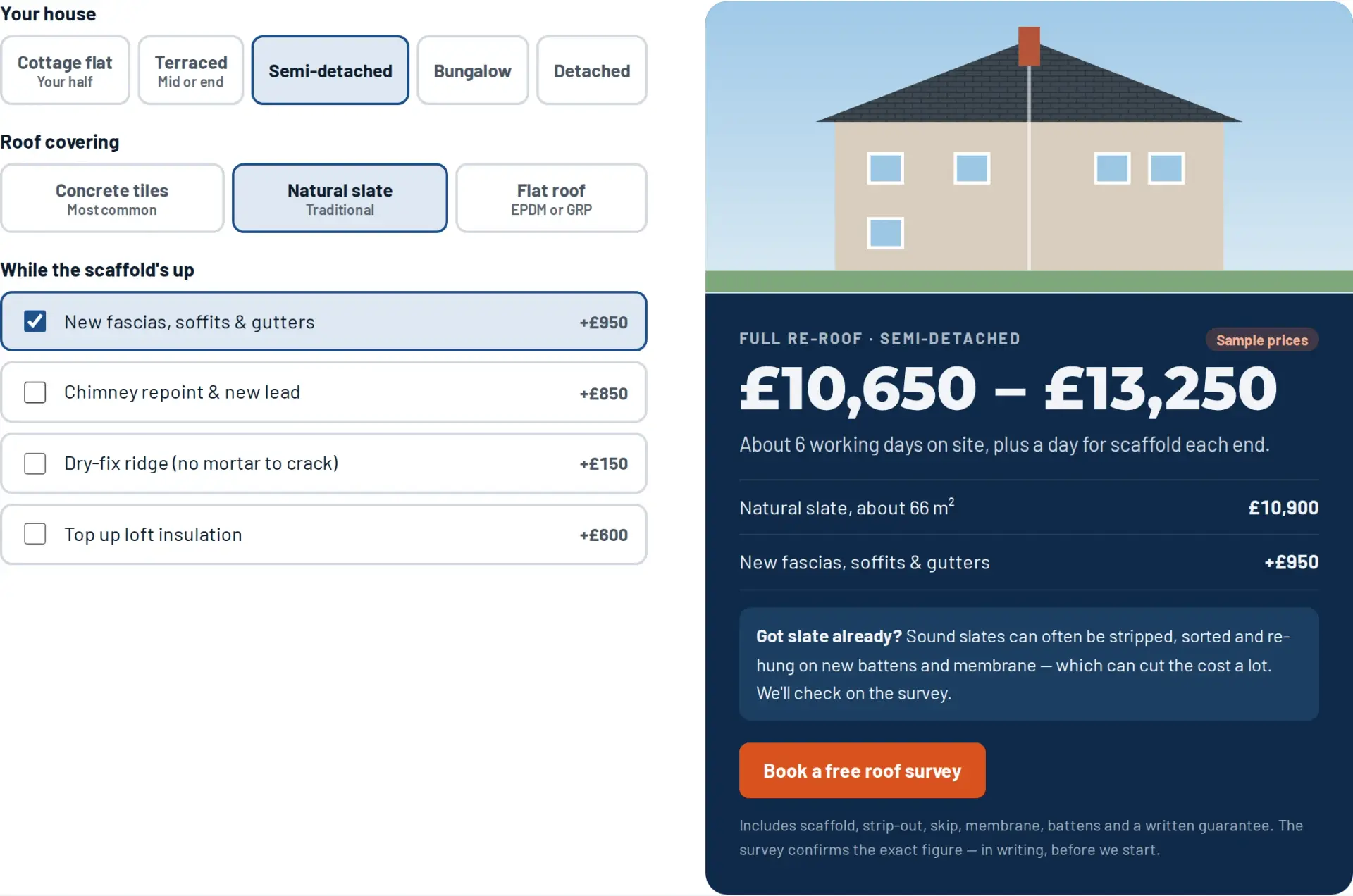
Roofing genuinely does vary enormously — which is the reason given for publishing nothing, and the reason publishing something matters so much. A householder with no figure at all cannot tell a fair quote from a chancer’s, so they default to the cheapest of three. That is not a market you want to compete in.
A range, and what is in it. Nobody is booking a re-roof off a web page. They are working out whether to ring you at all, and whether the quote that arrives next week is a sensible one.
Every figure is yours, checked by you, and flagged for review before it drifts — that upkeep lives in ongoing care.
Plain words
Verge, abutment, soaker, undercloak. A homeowner reading a quote full of those cannot tell whether they are being sold something necessary or something invented, so they go quiet and ring the cheaper one. Explaining the words is not dumbing down; it is the difference between a quote that gets read and a quote that gets forwarded to a spouse with a question mark.
Insurance
A large share of storm work goes through an insurer, and the homeowner has usually never made a claim in their life. They do not know what an excess means for a job this size, what a loss adjuster does, or whether asking you to invoice the insurer is a normal request.
Holding that lot against the job rather than in three phones is what a customer record is for, and it is nearly always the first thing worth fixing.
The promise
Everybody writes one on the van. Very few write down what it covers, what it does not, whether it survives a house sale, and what a customer should do on the day they find a stain on the ceiling. Those four answers are worth more than another five years on the headline figure.
The slate carries a manufacturer’s warranty. The way it was hung carries yours. They run for different lengths and they fail in different ways, and separating them in writing is the mark of a firm that has thought about it.
Public liability and working at height, with the actual figures, where they are genuinely held. Anyone can type “fully insured”. Far fewer will put the number next to it, and the gap between the two is where trust gets made.
A row of badges nobody has checked is worse than none. One genuine membership, with the registration number and a link to the register, is a verifiable fact rather than a logo.
Roofs occasionally leak after work; weather is like that. A firm that has written down how it responds is telling a customer it expects to still be there. That is the entire promise, really.
The certificate, the photographs and the invoice sent the day after the scaffold comes down. Most people have to ask twice. Not having to ask at all is remembered for years.
Where you work
Roofing is bought locally and searched locally, and the map listing does a disproportionate amount of the work — especially in the two days after a storm, when people search on a phone and ring the first firm that looks close and real.
The other half of it is the phone. Most storm searching happens on a handset in a hallway with a bucket in it, so a page that takes eight seconds to appear has already lost. Weight, hosting and image size are not technical detail here; they are the whole enquiry.
And the site has to be legible one-handed, in the dark, by somebody who is annoyed. That is a real design constraint, and it is the one most roofing sites fail.
Adjacent trades, in case they are useful: trades & construction, plumbers & heating engineers, window cleaners and estate & letting agents.
Systems
That works at three vans and stops working at six. We are not here to sell you software you do not need — only to point out where the same information is being written down twice, and what that costs you in a busy fortnight.
If some of that is already in hand, industry management software and AI integrations set out where the joins usually go.
Honest fit
Afterwards
Prices move with materials. Scaffold rates move. The areas you cover change with where the vans are based. A site built beautifully in March and never touched again is a slightly misleading document by the following spring, and it is your name on it.
None of that is dramatic. It is the unglamorous half of owning a website, and it is the half that decides whether the thing is still earning in year three or quietly embarrassing you.
We would rather do a small amount of it every month than rebuild something neglected every four years, which in our experience is what actually happens otherwise.
The arrangement is set out on ongoing care, and the search side on SEO & growth.
Straight answers
Next step
A first proper site, a rebuild of something that has not moved in five years, or just photo quotes and an honest price range added to what you already have — tell us which jobs you are losing and roughly where they go.
Email if that is easier — we know the phone goes unanswered when you are thirty feet up. Working out what it needs costs nothing, and you will have the figure in writing before anything is built.