Retail & ecommerce
We build and rebuild online shops around the commercial reality of the business behind them — the products, the customers, the payments, the delivery rules, the repeat orders and the admin nobody enjoys. The storefront is the part people see. It is rarely the part that decides whether the business works.
The real problem
Most ecommerce businesses did not choose their stack. It accumulated. A plugin for delivery rules, a second one for discounts, a spreadsheet the supplier sends every month, a payment tool, an email platform, an analytics account nobody opens, and a person who re-types the same product information into three of them.
Individually each piece works. Together they do not. That gap is where margin quietly goes — in admin hours, in orders that stall, in products that never get listed properly, and in customers who buy once and are never contacted again.
We look at the whole operation before touching the design, because the storefront is usually not the thing that is broken.
The work is usually in the joins. Not in any one of these tools, but in the fact that none of them speaks to the next one.
What we build
Websites and rebuilds are the offer. Everything after them exists because an online shop that nobody finds, nobody completes a checkout on, or nobody returns to is an expensive catalogue — not because we are trying to sell six things at once.
WooCommerce shops built around how people actually buy the thing you sell — findable products, product pages that answer the question that stops the sale, and a checkout that does not lose people at the last step.
Dated, slow or poorly converting shops rebuilt properly — without blindly reproducing the old structure, and without throwing away the URLs, content and search visibility that already earn you money.
Large ranges, deep category trees, variable products, supplier data and the specification detail furniture, equipment and considered purchases actually need before somebody will commit.
Stripe, card and flexible-payment options, customer accounts, and a purchase flow measured on completion rather than on how it looks in a design file.
The second order is cheaper than the first and most shops never go after it. Rewards, wishlists, recommendations, bundles and newsletters — built where they suit the product, not because a plugin exists.
Supplier workflows, integrations and operational tooling for the parts where the standard plugin genuinely does not fit — and an honest answer when it does.
Related: website design, website redesign, business automation and ongoing care.
Storefront vs system
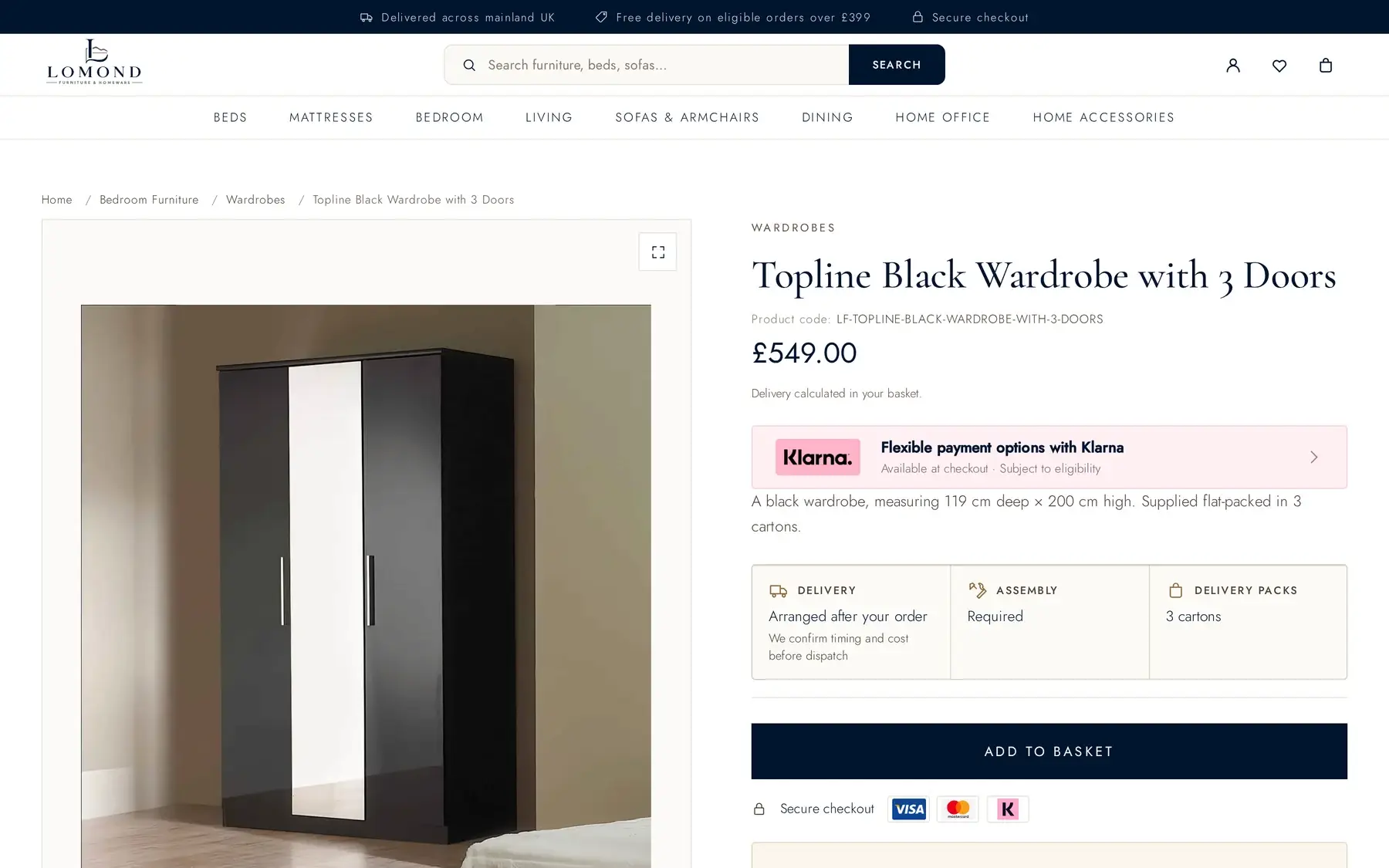
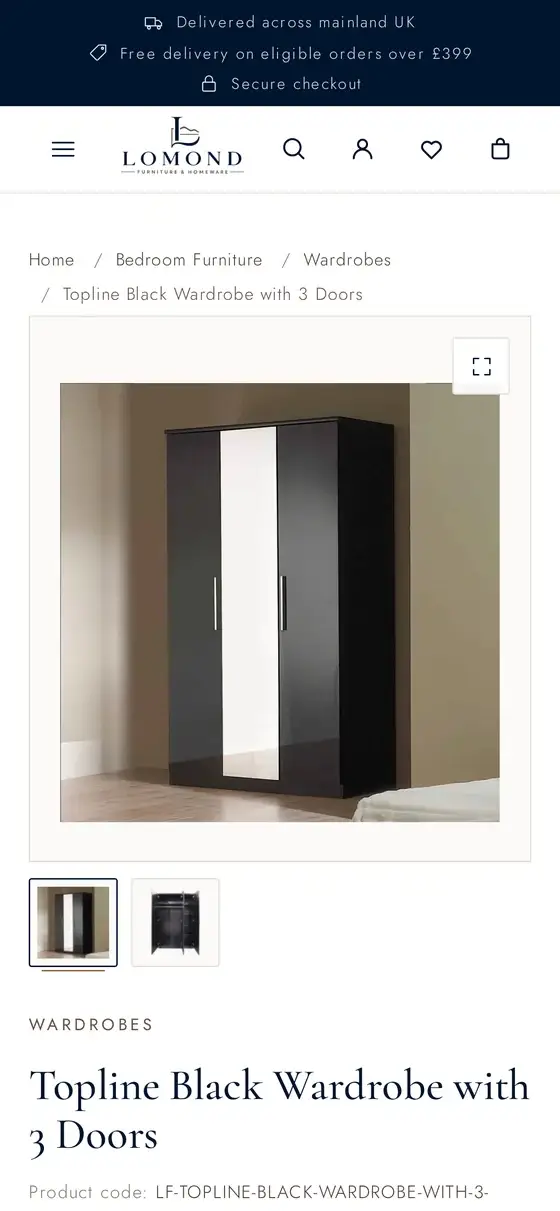
This is one product page from a shop we built. Almost everything on it is a decision about the operation behind the shop, not a decision about layout.
Lomond Furniture & Homeware — a live product page. Every element numbered opposite is driven by data or logic in the system, not typed in by hand per product.
Real project
A furniture and homeware retailer selling online across mainland UK. Central Systems built the shop and the systems around it — the catalogue, the payments, the delivery logic, the customer accounts and the reporting — and continues to develop it as the range grows.
Furniture is an awkward thing to sell online. The items are large, the delivery is expensive and rule-bound, the customer needs dimensions and carton counts before they will commit, and the catalogue arrives from suppliers as spreadsheets rather than as a feed. Almost none of that is a design problem.
So the build went wider than a storefront. Supplier data drives the product records. Delivery is priced by a set of rules the business can actually explain, charged once per order rather than per item, with a free-delivery threshold above it. Payments run through Stripe with flexible-payment options at checkout. Customers get accounts, a wishlist and a rewards balance, so a second order costs less to win than the first.
Underneath, the shop is set up to be found and to be measured — category and product architecture built for search, ecommerce analytics configured properly, and a product feed prepared for Google Shopping. It is designed to keep taking suppliers and ranges without a rebuild each time.
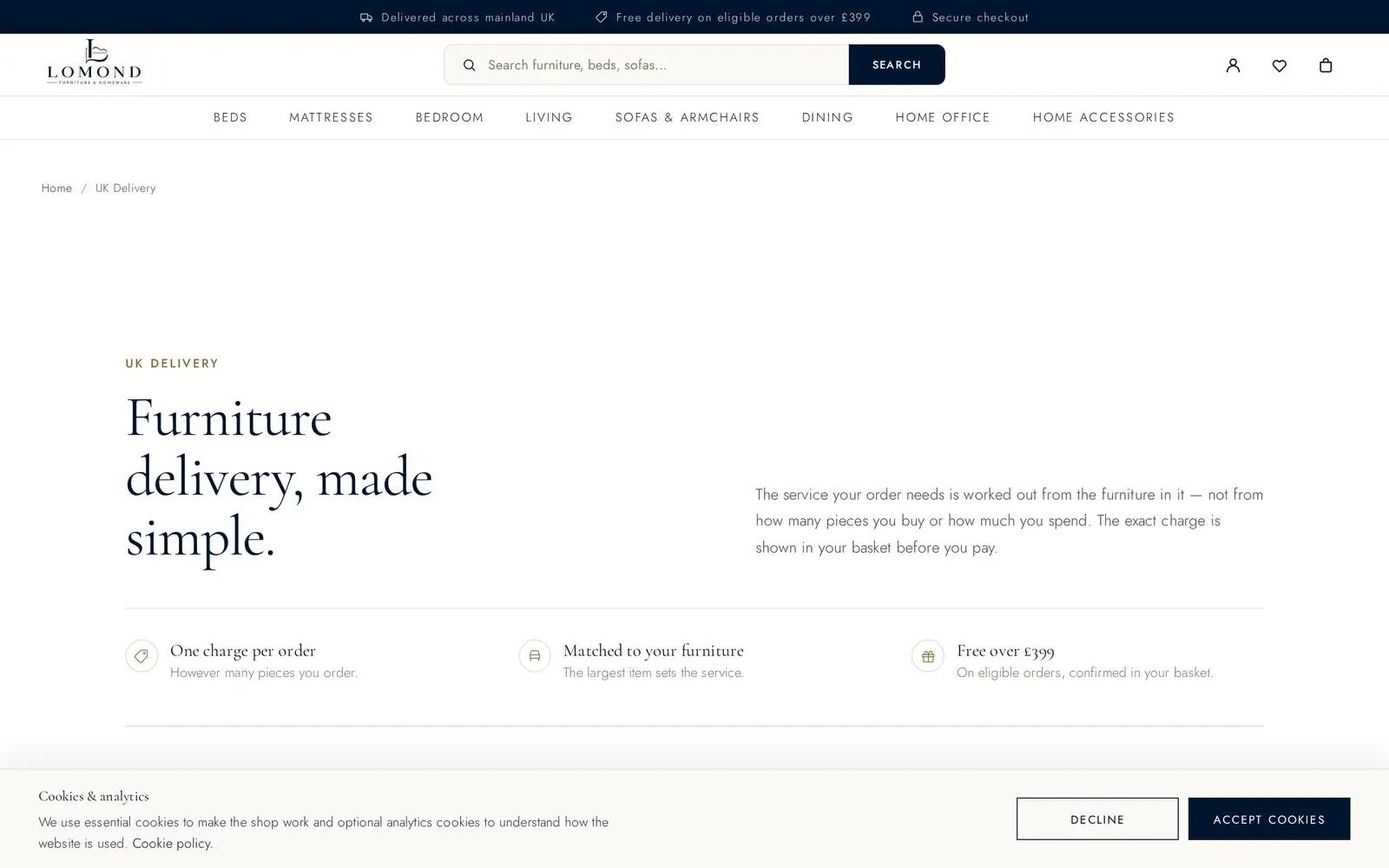
Delivery, made explainable. Four tiers, one charge per order, matched to the furniture in the basket — published as a page a customer can read rather than a surprise at checkout.
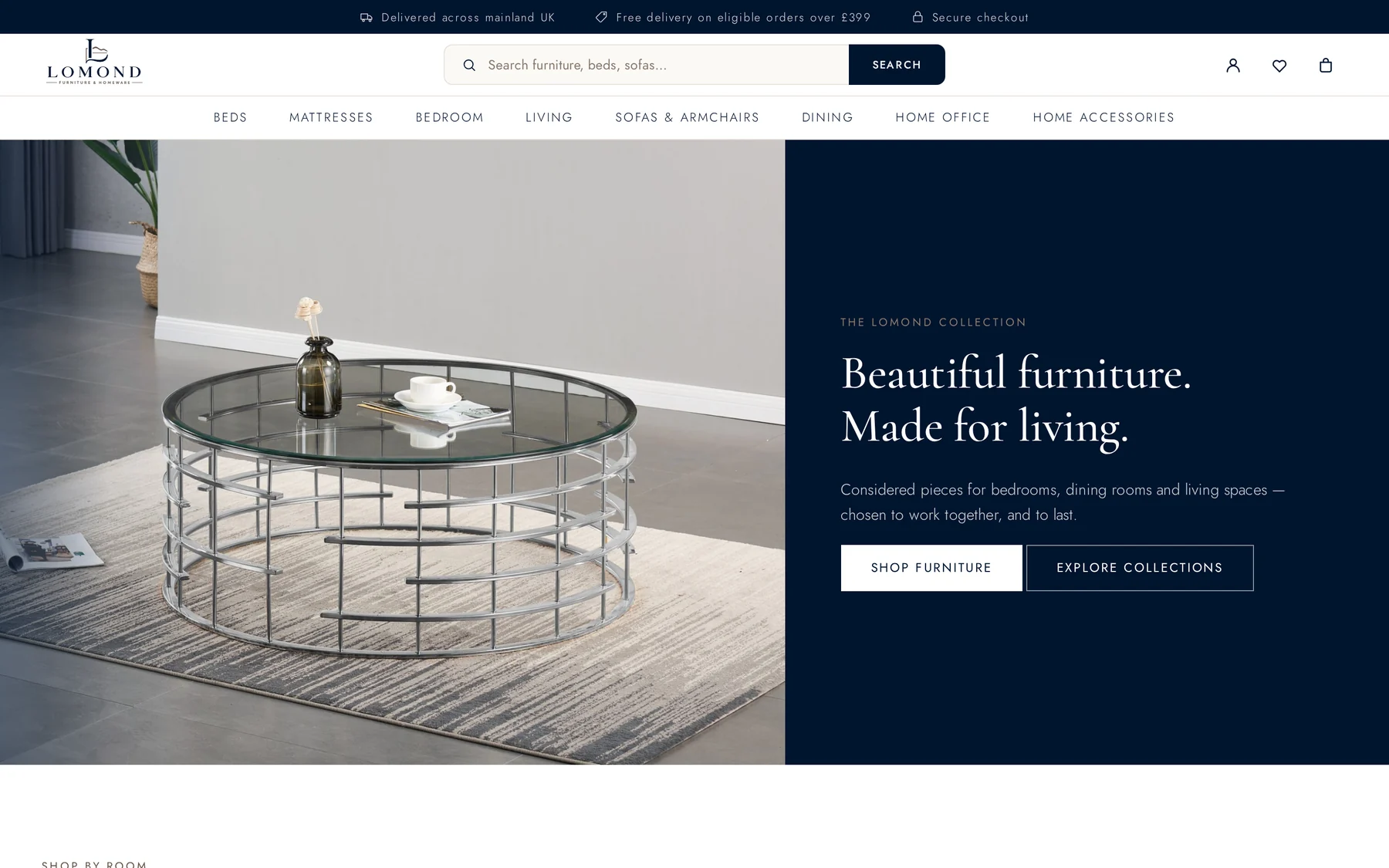
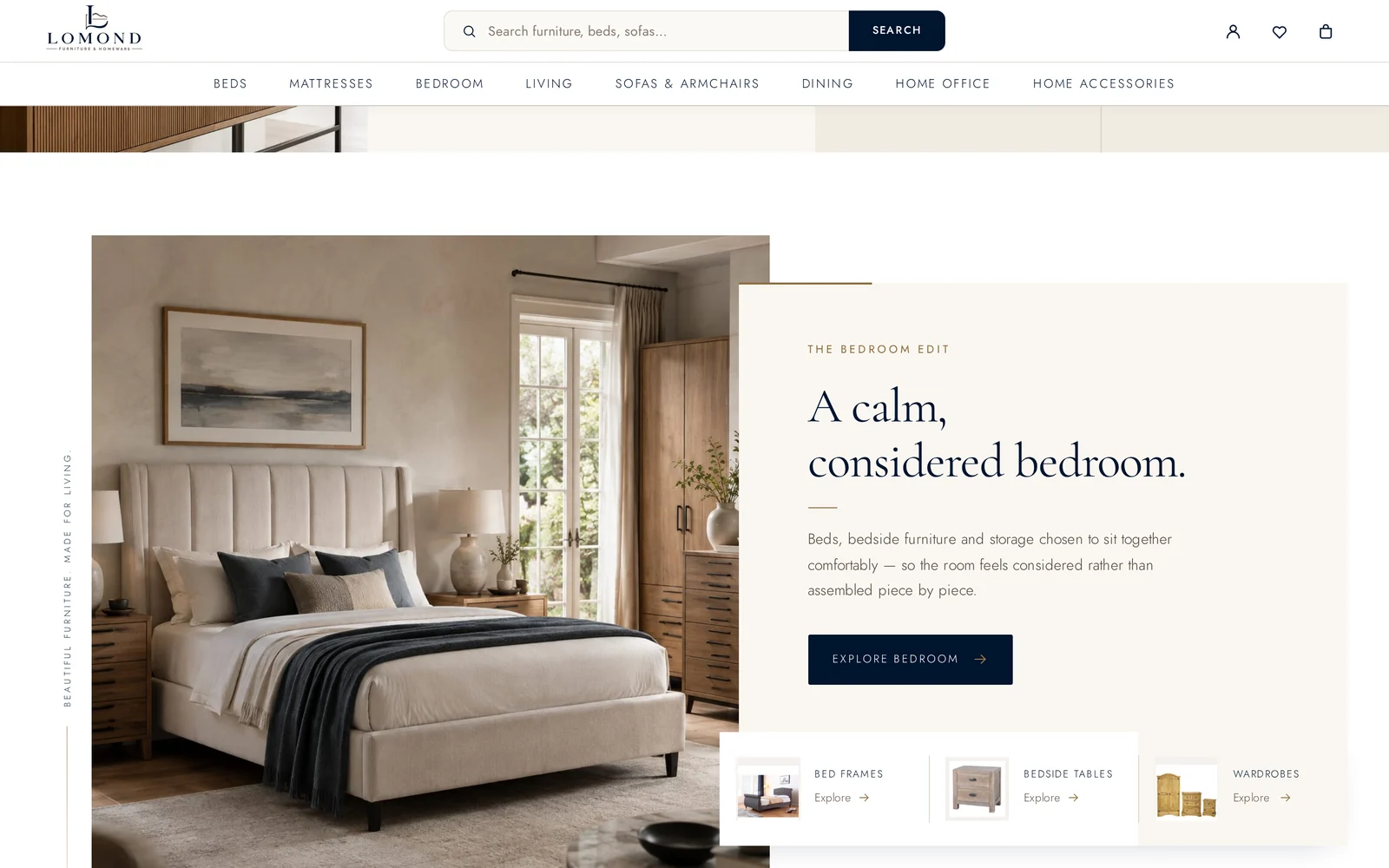
The screenshots on this page are unedited captures of lomondfurniture.co.uk. We have not published revenue, conversion or traffic figures for this project, and we do not intend to invent any — the catalogue size and the delivery structure above are simply what is on the site and can be checked in a browser.
Working with what exists
A full replatform is occasionally the right answer and usually is not. Most of the shops we are asked to look at have something worth keeping — a domain with history, a catalogue that took years to build, customers who already know the URL. The work is to fix what is losing money and leave the rest alone.
Often it is two or three of them rather than all nine, and occasionally the honest answer is that the shop is fine and the problem is upstream in how products get listed. That conversation happens before the quote, and the first one costs nothing. To see where your shop stands before committing to anything, start with the free website audit.
Secondary capability
Every ecommerce business eventually hits something the plugin directory does not cover, because it is specific to how that business runs. We can build it. This is not a product we are selling you — it is the reason we can keep going when a normal web agency stops.
WooCommerce and its ecosystem cover most of what most shops need, and where a well-maintained plugin does the job we will tell you to use it. Custom development earns its keep only when a real operational problem has no packaged solution behind it — priced against an agreed specification, never sold as a licence.
More on this kind of work: CRM & business systems, software built for an industry, and AI integrations.
How it goes
Most of the value is decided before anybody opens a design tool. This is consultative work — we are not asking you to pick a template.
Next step
We can rebuild the storefront, improve the customer journey and develop the systems behind it. Tell us what you sell and which part of the operation is creaking; you will get a candid assessment of the change worth making first.
The opening conversation is free of charge, and costs are fixed in writing before development begins.