New: Try our free Website Audit tool. Run your free audit →Run it free →

Energy & renewables

Websites and business systems for energy companies — easier to find, trust and buy from.

Websites & rebuildsSEOAI-assisted searchEnquiry qualificationCRMAutomation

Central Systems builds and rebuilds websites for offshore wind, subsea, inspection and energy-services businesses — then connects what the website collects to the CRM, the project record and the admin behind it. Better enquiries, found for the work you actually want, and far less of it re-typed by hand.

Need more than a website? Explore business automation.

What we build for this sector
The website

Built around how a campaign planner and a project engineer each decide whether to contact you — not around a services menu.

Being found

Search and AI-assisted search structured around the services, assets and regions the business genuinely works in.

The system behind it

Enquiries arriving qualified, into a CRM, with the follow-up, documents and project handoff already moving.

The commercial problem

Your website should know more about your business than your brochure does.

Most energy-sector websites were right when the company was smaller. They now undersell a capability that has grown past them, and everything they fail to capture becomes somebody’s admin. These are the six we are asked to fix most often.

The old brochure websiteReal capability buried across five generic service pages, none of which answers the question the buyer actually arrived with.
Found for the company name, and little elseYou rank when somebody already knows who you are. For the services, assets and regions you want work in, you are nowhere.
Enquiries that cannot be priced“Name, email, message” arrives with no asset, no access, no window and no deliverable — and costs a week of email to become quotable.
Technical information nobody can findCapability lives in PDFs, inboxes and long-serving staff. A buyer who cannot verify it moves on to someone they can.
Sales admin done twiceEnquiries re-typed into a spreadsheet or CRM by hand, chased inconsistently, and forgotten when whoever owned them is offshore.
Project handoff from scratchEverything gathered during the sale is re-keyed once the job is won, because none of it was ever connected to anything.

What we build

More than a better website.

Four layers, and most businesses start with one. The point is that they are built to fit together, so the second thing you do is not a rebuild of the first.

Layer 01WebsiteThe part the buyer judges you on, built around how they actually evaluate a supplier.
01Smart websites

Premium sites structured around the buying journey — capability written as scopes of work, technical information where an engineer expects it, and a route to contact worth taking.

02Website rebuilds

Replace an ageing site while protecting the URLs that already rank, the pages that already bring enquiries and the analytics history you have.

Layer 02GrowthBeing found for the work you want, by search engines and by the assistants buyers increasingly ask first.
03SEO & content architecture

Service, sector, asset, region and problem-led pages built around search demand that genuinely exists inside your business — never keyword-swapped duplicates.

04AI-assisted search

Technical information structured so a machine can tell what you do, which assets you work on and where — clear entities, question-led pages, truthful schema and real internal linking.

Layer 03SalesTurning traffic into opportunities somebody can actually work, instead of a shared inbox.
05Qualified enquiry systems

Interactive enquiry journeys that collect the asset, the access, the window and the deliverable before anybody has to make a call.

06CRM & sales pipelines

Enquiries become managed opportunities with an owner, a stage, a follow-up date and a history — not a forwarded email.

Layer 04OperationsThe work that starts once the job is won, and where most of the wasted time actually sits.
07Client & project portals

Where it earns its place, one place for documents, status, actions and the project record — so “where are we?” stops being a phone call.

08Business automation

Connect what sits behind the website and remove the repeat administration: routing, reminders, document collection, status updates and reporting.

Nobody needs all eight. We start with whichever one is costing the business most, and build so the next one fits. Website design · SEO & growth · CRM · Automation.

Website to business system

The website can be the start of the system — not the end of the enquiry.

A good website should not create another admin task. If a buyer has already told you the asset, the window and the deliverable, that information should be capable of moving into the systems that need it — rather than being read off an email and typed in again three times.

Phase 01Attract
  • Search, AI-assisted search or referral
  • The service, asset or region page that answers the question
  • Technical resources that prove you have done this before
Phase 02Qualify
  • Structured project enquiry, not a three-field form
  • Asset, access, window and deliverable captured
  • Opportunity created in the CRM with an owner and a stage
  • Acknowledgement back to the sender, with a reference
Phase 03Operate
  • Scope and quote built from what was already captured
  • Follow-up tasks and dates created automatically
  • Documents collected against the project, not the inbox
  • Project handoff, status and client updates
  • Reporting somebody will actually read

Built to fit the business you have. We are not trying to move you off software that works — the useful work is almost always the layer between the website and the systems already in place.

Why one template does not work

One sector. Two completely different buying journeys.

An offshore operations buyer and a subsea engineer work in the same wider industry and arrive with entirely different questions, evidence requirements and enquiry journeys. That is why we do not build industry websites from one template with the nouns swapped. Below are two website concepts we built to show the difference.

Concept 01 · commercial and operational

Northbrae Offshore Wind Services

The buyer is a campaign planner deciding whether your team can actually start work when it arrives.

Leads on
Competence, mobilisation, coverage, project scope, readiness
Decides on
“Can this team start on arrival, in my window?”
Concept 02 · technical and engineering

Cairn Deep Subsea Engineering

The buyer is a project engineer deciding whether you understand the asset before you talk about the company.

Leads on
Asset, environment, interface, engineering information, method
Decides on
“Do they know what they would need from me?”

Scroll the image sideways to read it at full size.

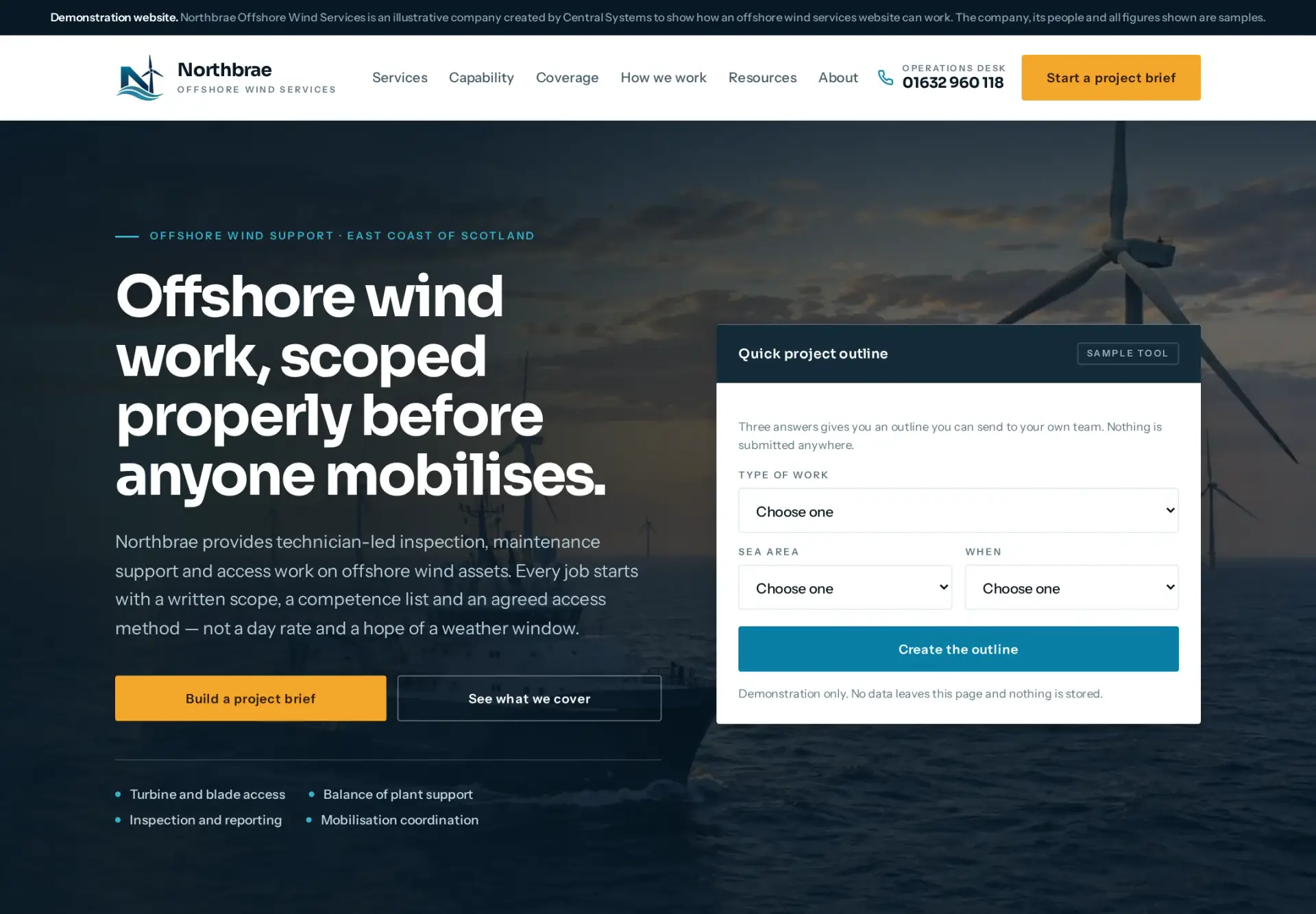
Northbrae Offshore Wind Services · illustrative concept
The homepage of an offshore wind services website concept: a service operation vessel alongside a turbine at dusk, a headline about scoping work before anyone mobilises, and a three-field project outline tool in the right-hand panel.
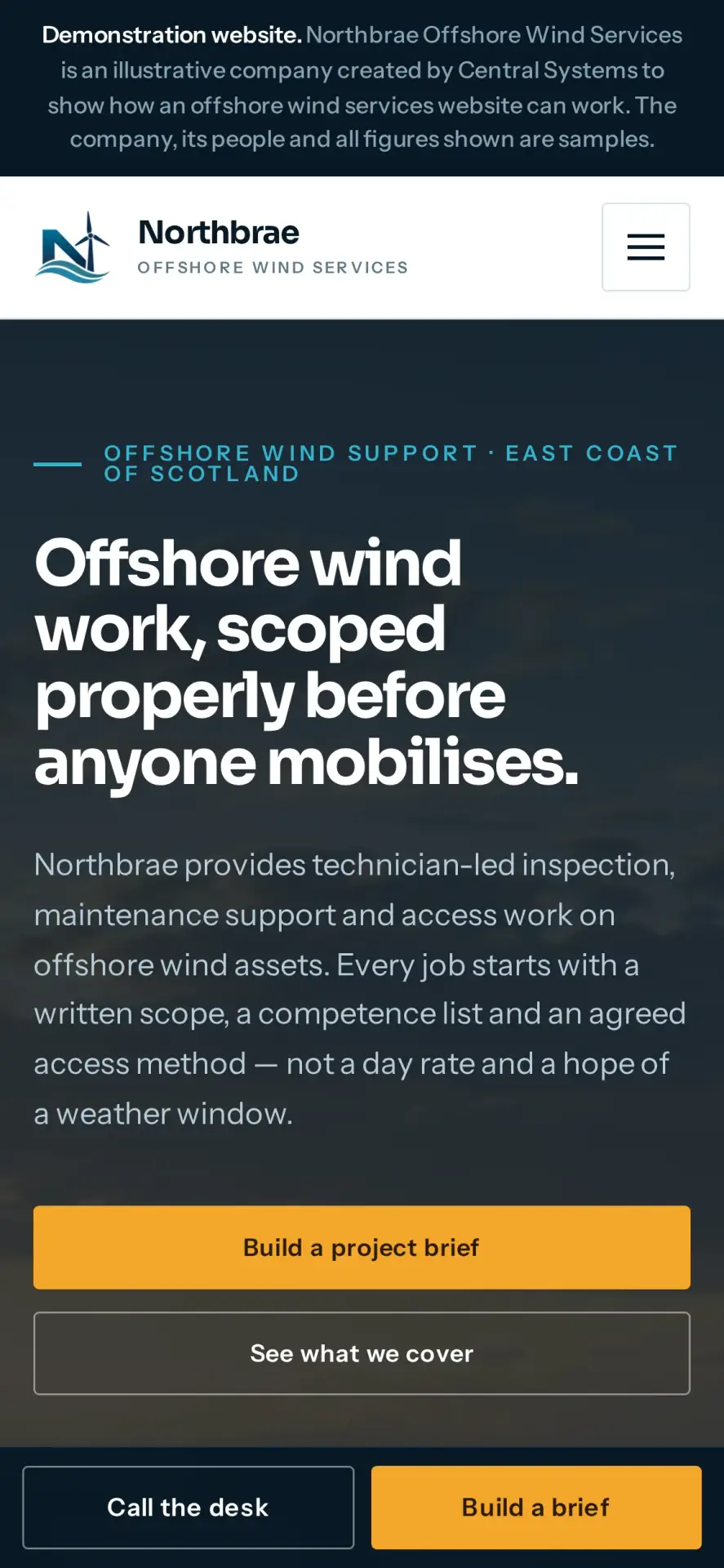
The same offshore wind concept on a phone, with the headline, the two calls to action and the project outline tool stacked in a single readable column.

Northbrae. A commercial buyer lands on a scope-first argument and a tool that starts the brief in three answers.

Scroll the image sideways to read it at full size.

Cairn Deep Subsea Engineering · illustrative concept
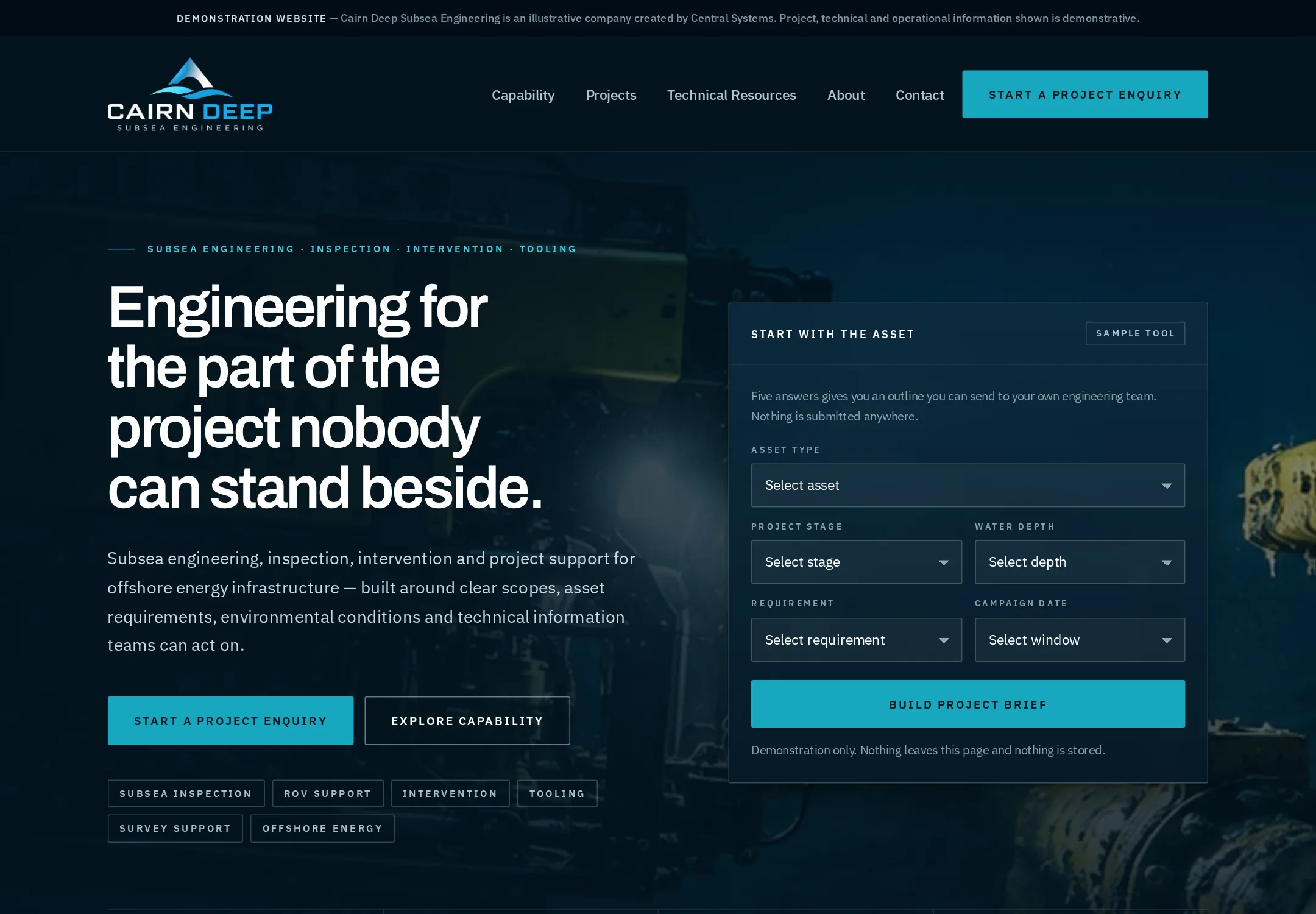
The homepage of a subsea engineering website concept: a work-class ROV using its manipulator arm on a pipeline connection, a headline about engineering the part of the project nobody can stand beside, and a five-field asset panel.
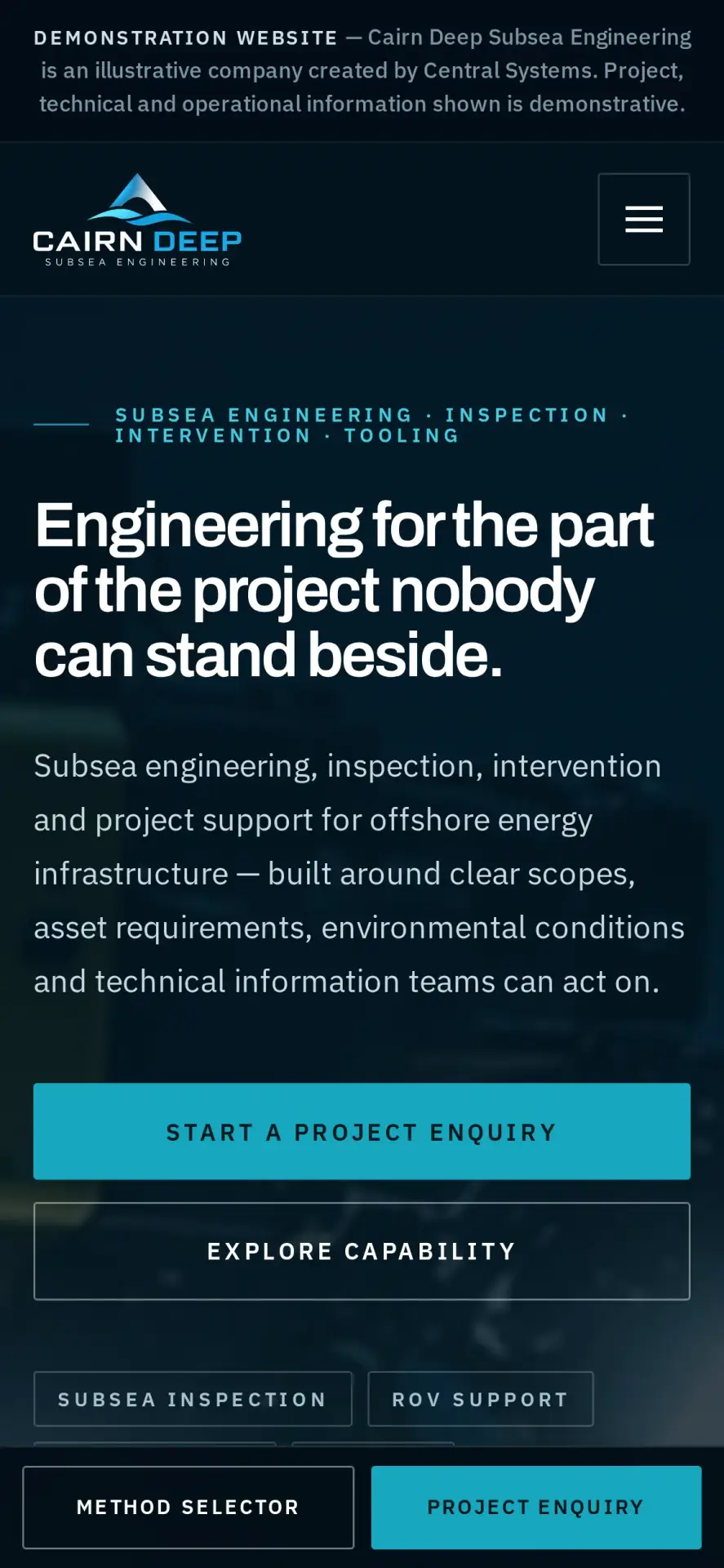
The same subsea engineering concept on a phone, with the headline, capability tags and the asset panel stacked in a single readable column.

Cairn Deep. A technical buyer lands on the asset, not the company. Same sector, same platform, a completely different first screen.

Illustrative conceptsNorthbrae Offshore Wind Services and Cairn Deep Subsea Engineering are illustrative website concepts created by Central Systems to demonstrate different digital buying journeys within the energy sector.

Interactive content that earns its place

Give the buyer something useful, and the enquiry arrives qualified.

Energy buyers do not browse; they arrive with a job to do. Build the thing they are already looking for and two things happen at once — they come back, and what they send you is worth reading. Four we built into the concepts, and the commercial problem each one solves.

Scroll the image sideways to read it at full size.

Northbrae Offshore Wind Services · illustrative concept
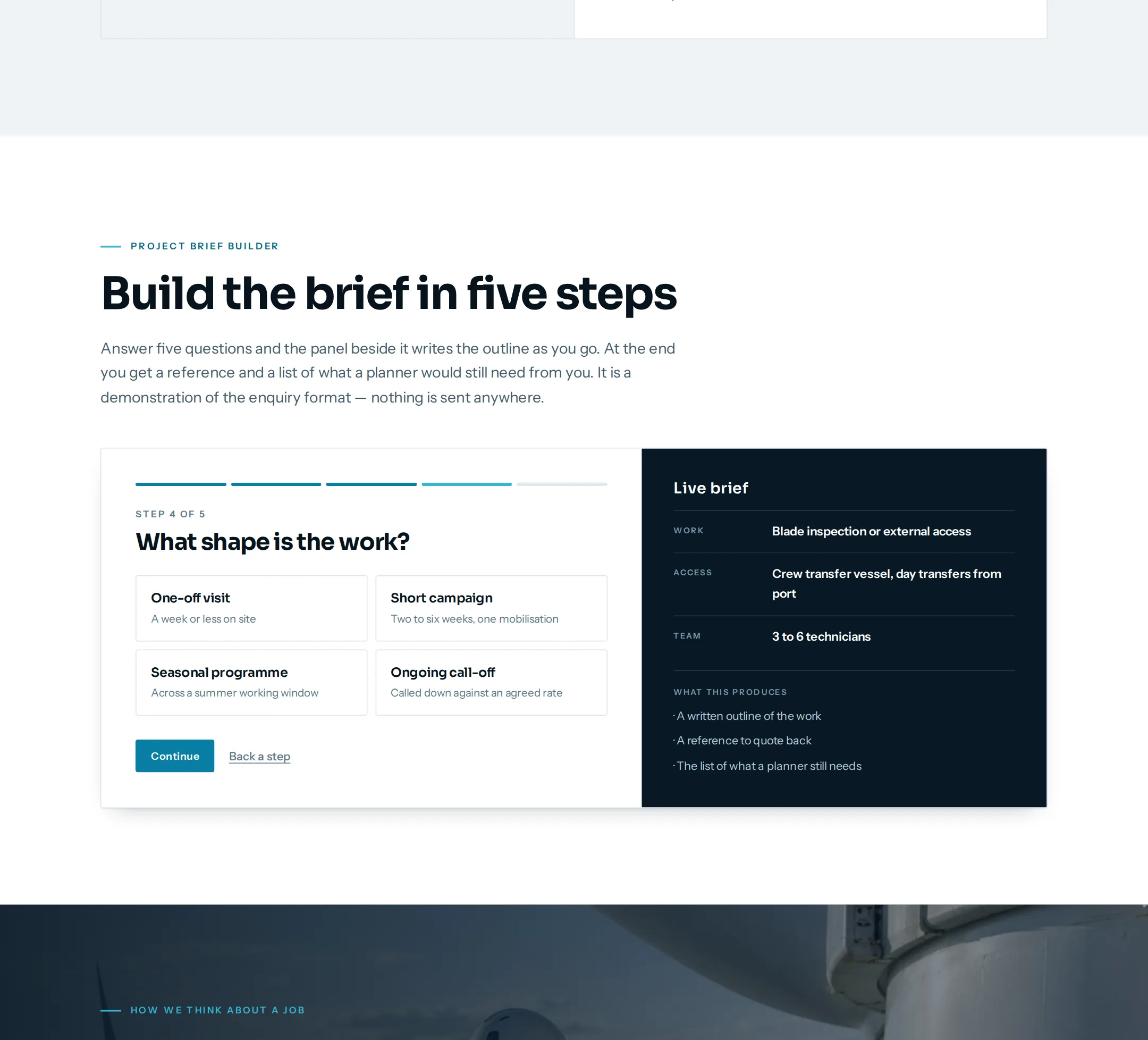
A five-step project brief builder on an offshore wind website concept, shown at step four asking what shape the work is, with a live brief panel beside it already carrying the type of work, the access method and the team size.
SolvesProject brief builderTurns a vague enquiry into something the commercial and technical teams can actually work with — and gives the sender a reference, which is what stops them mailing three competitors the same afternoon.

Scroll the image sideways to read it at full size.

Northbrae Offshore Wind Services · illustrative concept
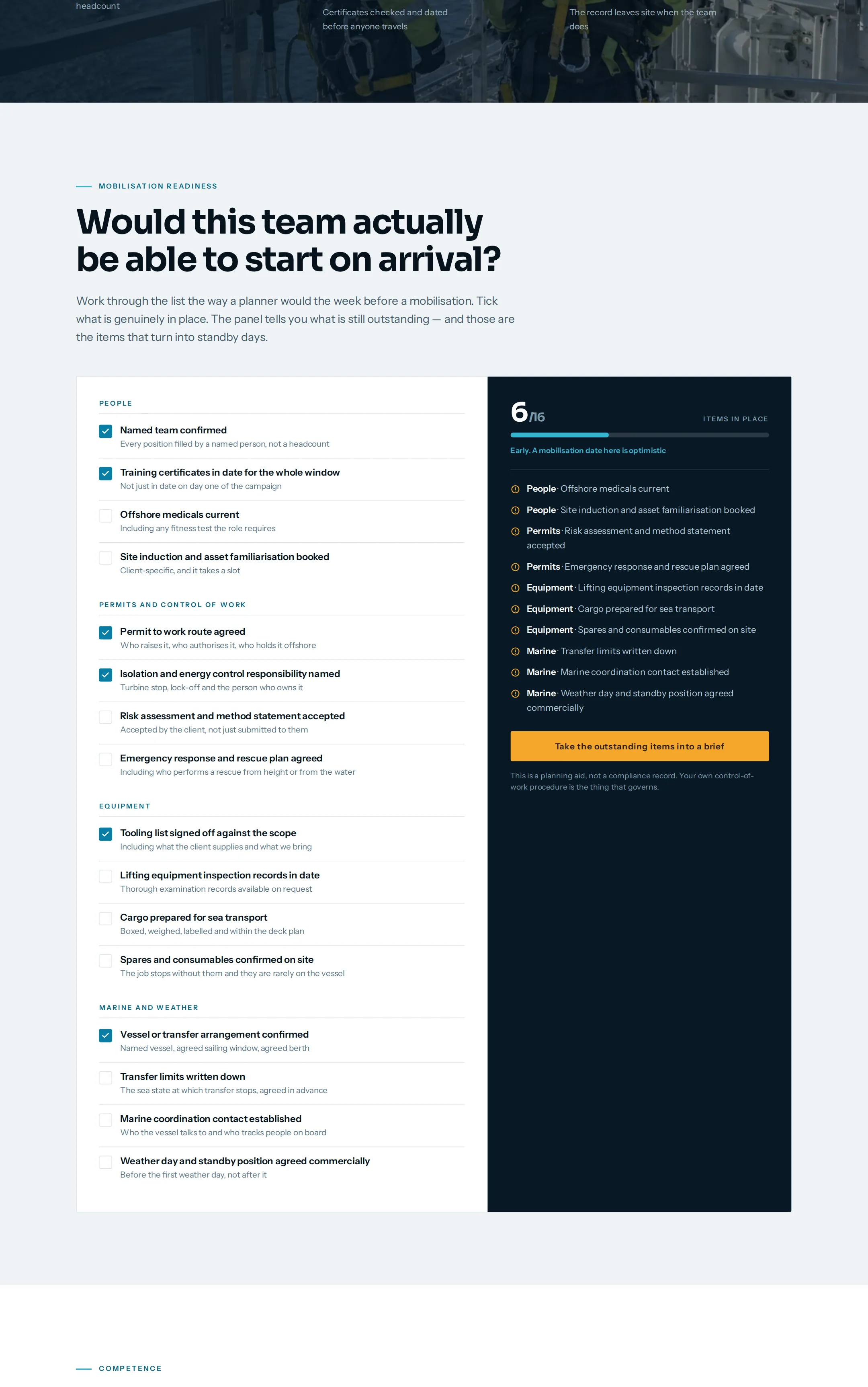
A sixteen-item mobilisation readiness checklist on an offshore wind website concept, grouped into people, permits, equipment and marine, with six items ticked and a panel listing the ten still outstanding alongside a button to take them into a brief.
SolvesMobilisation readinessLets a buyer see whether an organisation can genuinely mobilise, and surfaces the missing information before the project starts rather than on the quay. The outstanding items become the enquiry.

Scroll the image sideways to read it at full size.

Cairn Deep Subsea Engineering · illustrative concept
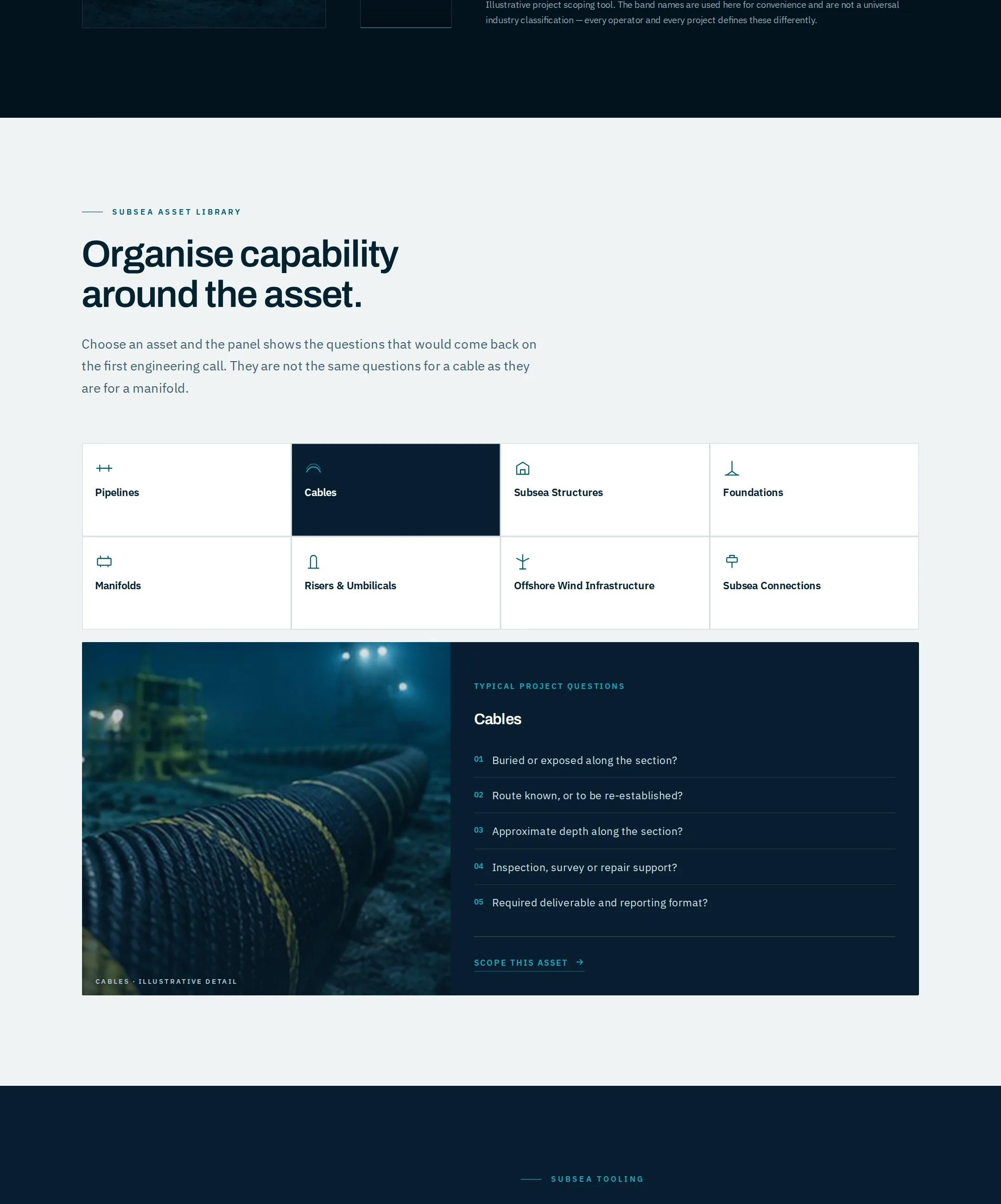
A subsea asset library on an engineering website concept: eight asset tiles including pipelines, cables, manifolds and offshore wind infrastructure, with cables selected and a panel listing the five typical project questions that asset would raise on a first engineering call.
SolvesCapability by assetTurns a generic capability statement into a specific answer about the buyer’s asset — and creates exactly the kind of page a search engine or an assistant can quote, because it answers a real question rather than making a claim.

Scroll the image sideways to read it at full size.

Cairn Deep Subsea Engineering · illustrative concept
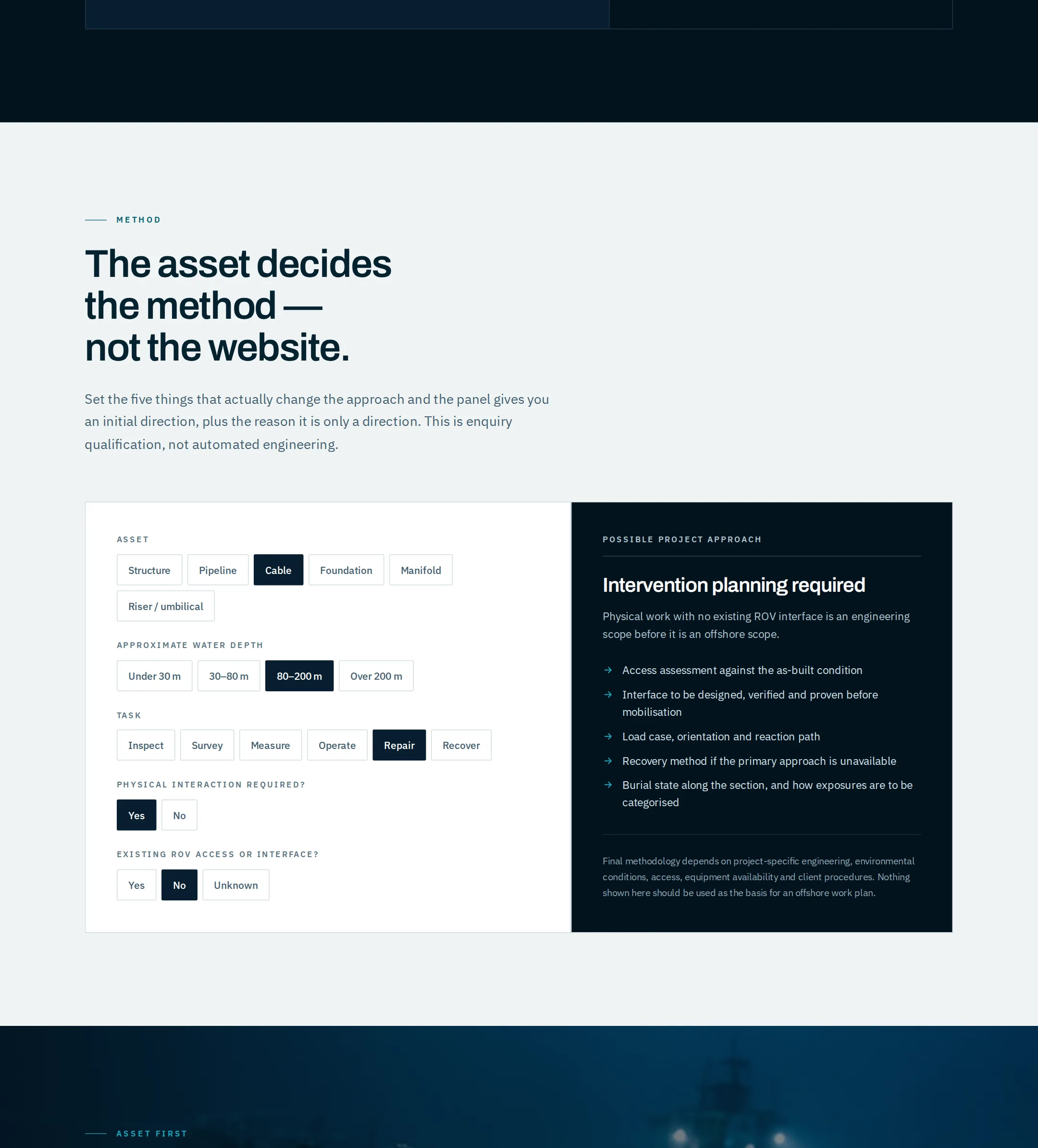
A method selector on a subsea engineering website concept with five inputs set — asset, water depth, task, whether physical interaction is required and whether ROV access exists — returning a possible project approach and a caveat stating that final methodology depends on project-specific engineering.
SolvesMethod directionDemonstrates technical understanding before the first call, and qualifies the enquiry without pretending to do the engineering — which an engineer would see through in seconds.

Search & AI-assisted search

Be found for the work you want — not just your company name.

Energy search is never one phrase. It is a service against an asset, in a region, attached to a problem — and increasingly it is a question typed into an assistant rather than a search box. We build the site around the combinations that genuinely exist inside the business, and around the questions buyers actually ask.

ServiceSubsea inspection
+
AssetExport cable
LocationAberdeen · North Sea
+
ProblemExposure & integrity
=A page with a reason to existIt answers a question somebody genuinely types, about work you genuinely do. Not a keyword-swapped duplicate of the page above it.
ServiceBlade inspection
+
SectorOffshore wind
RegionScotland
+
Buyer question“Can you mobilise here?”
=The page that wins the enquiryBecause it answers the thing that decides the contract, in the place the buyer was already looking.

What that looks like as an architecture

Each layer supports the one above it. Built in this order, the site is legible to a search engine, to an assistant, and to a buyer in a hurry.

  1. Service pagesWhat you actually do, written as scopes of work rather than adjectives.
  2. Sector & asset pagesThe same service against a pipeline, a cable, a foundation, a turbine — because the work is not the same.
  3. Regional relevancePorts, sea areas and operating regions, stated only where you genuinely work.
  4. Technical resourcesThe documents and explanations a buyer goes looking for before writing an enquiry.
  5. Internal linkingThe structure that tells a machine how service, asset and region relate to each other.
  6. Structured dataSchema describing what the business is and does — only ever what is true.
  7. Readable by search and by AIClear entities and question-led pages, so an assistant can tell what you do, which assets you work on, and where.

We will not promise a ranking position or an AI citation, and nobody credible will — no agency has privileged access to any search or AI platform. What we control is the mechanism: the content, the structure and the markup. How we approach SEO and growth.

CRM, pipelines & automation

When the enquiry is won, the system should keep going.

This is where most of the recoverable time in an energy-services business actually sits — not in the website, but in everything that happens after somebody replies to it. We build the operational layer around the way the business already runs, rather than pushing it into generic software that nearly fits.

Lead created automaticallyFrom the enquiry itself, with everything the buyer already told you attached.
Opportunity assignedAn owner, a stage and a value — not a forwarded email and a hope.
Project scope attachedAsset, access, window and deliverable carried through, not re-keyed.
Follow-up date createdA task with a date on it, so the chase still happens when the owner is offshore.
Quotation producedBuilt from the captured scope, in your format, with your terms.
Documents collectedRequested, chased and stored against the project rather than an inbox.
Job or project createdThe won opportunity becomes the project record, with nothing typed twice.
Tasks allocatedWho does what, by when, visible to the people who need to see it.
Client kept updatedStatus, documents and actions in one place, or sent on a schedule.
Management dashboard updatedPipeline, workload and what is waiting on somebody — without a weekly spreadsheet.

Scroll the image sideways to read it at full size.

Cairn Deep Subsea Engineering · illustrative concept
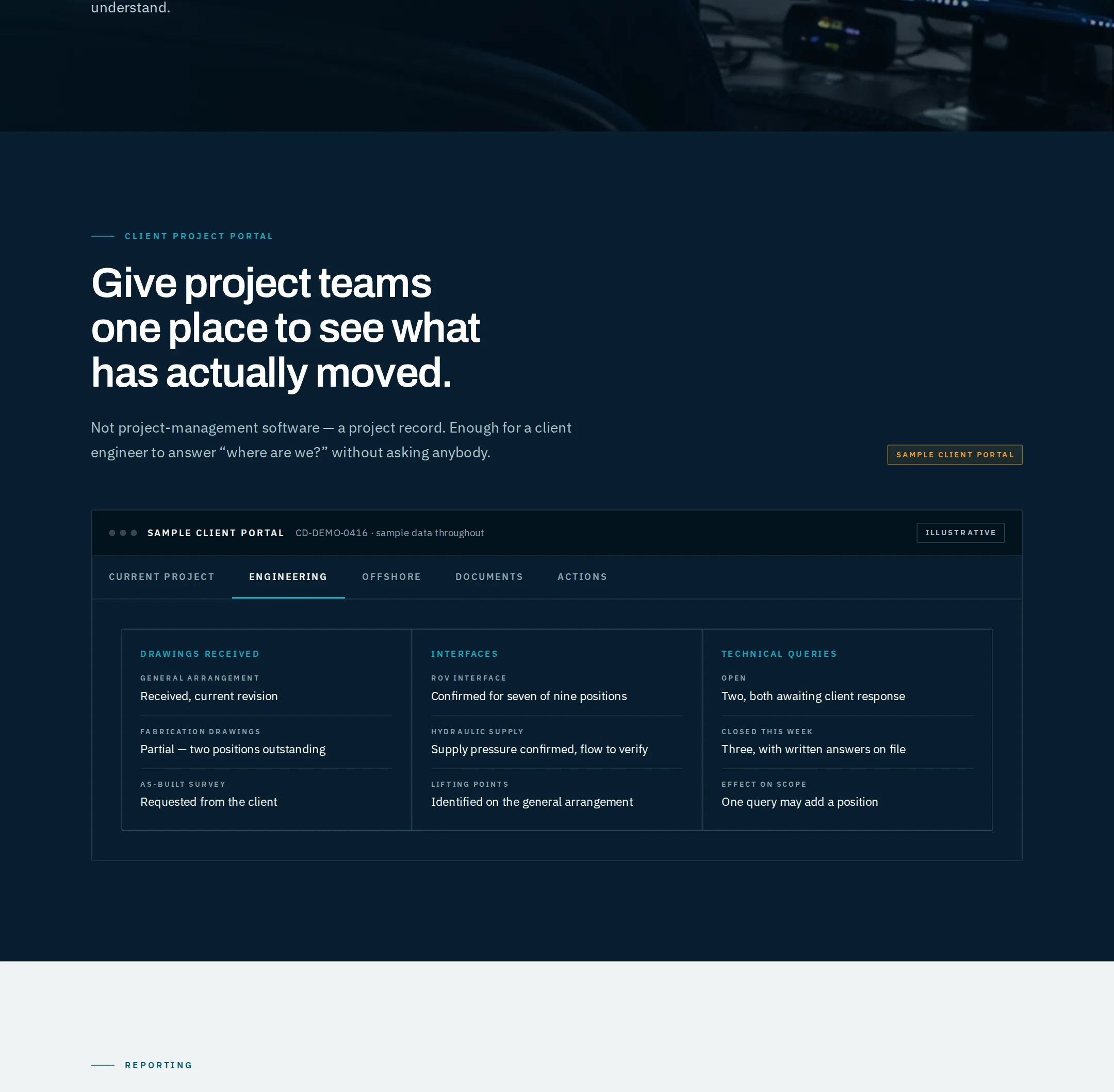
A sample client project portal on a subsea engineering website concept, open on its engineering tab showing drawings received, interface status per position and open technical queries.
SolvesClient and project portalsWhere it earns its place, one place a client engineer can answer “where are we?” without ringing anybody — and one place your own team stops assembling status by hand.

Where you start

Build something better — or keep what already works and rebuild around it.

Most established energy businesses do not need to throw away what the current site has earned. A rebuild keeps it and replaces the parts that are costing you work.

New build

Built from the buyer’s questions backwards

Strategy and information architecture first, then design, content structure and the systems that sit behind it.

  • Strategy, information architecture and design
  • Technical capability published where a buyer looks for it
  • Search foundations built in, not bolted on later
  • Enquiry systems, CRM and automation integrated from the start
See how we build websites
Rebuild

Keep the domain, the rankings and the history

Preserve what is working, modernise what is not, and add the parts the current site never had.

  • Valuable URLs protected, redirects mapped before launch
  • Rankings and analytics history carried across where possible
  • Mobile treated as a design, weak content restructured
  • New search opportunities, qualification, CRM and automation added
See how a rebuild works

Trust

Technical credibility should be easy to verify.

This sector buys on things a buyer can check — a scheme, a certificate number, an assessed scope, an expiry date. We build a clear, prominent place for each of them and populate it with what you can genuinely evidence.

We build the place for the evidence. We do not invent the evidence.

Where proof does not exist yet, the section is built so it can be filled in later and shipped empty in the meantime. No invented statistics, response times, win rates, client names or accreditations go on a site we build — in the copy, in an image, or in structured data.

  • Certifications and management systems
  • Assessed scope and supply-chain registrations
  • Industry memberships
  • Insurance a client actually asks to see
  • Competence and technical standards
  • Released project evidence and technical documents

Who this is for

Energy is not one buyer, and this is not one build.

What changes between these businesses is who reads the website first and what they need settled before they will make contact. The build follows that, not a template.

Discuss Your Website
  1. Offshore wind O&M and accessTechnician supply, blade and tower access, balance of plant. The deciding question is mobilisation readiness.
  2. Subsea inspection, ROV and interventionThe buyer wants to know you understand the asset before you tell them about the company.
  3. Survey, geotechnical and site characterisationSold on data quality and deliverable format, so the site has to be specific about what the output is.
  4. Cables and offshore infrastructureBurial state, route knowledge and exposure. The enquiry is meaningless without the section and the reference.
  5. Subsea tooling and engineering servicesRarely a question about the tool — it is the interface, the load case and the recovery route.
  6. Onshore renewables, solar and battery storageA mixed buyer: developers, landowners, commercial sites and formal procurement.
  7. Decommissioning and late-life supportBought on documentation, waste routes and evidence. The paperwork is part of the product.
  8. Energy consultancy and technical advisorySells expertise, so published thinking is the entire shop window.

The whole engagement

One partner for the website — and for what sits behind it.

You are not co-ordinating a designer, an SEO agency, a developer and whoever set up the CRM. It is one team, and the parts are built to fit each other.

Website
  • Design and development
  • Rebuilds and migrations
  • UX and conversion
  • Mobile as a design
  • Accessibility and performance
Growth
  • SEO and technical SEO
  • Content architecture
  • AI-assisted search
  • Structured data
  • Analytics and reporting
Sales
  • Enquiry qualification
  • Quotation journeys
  • CRM and pipelines
  • Routing and follow-up
  • Recruitment pipelines
Operations
  • Business automation
  • Internal dashboards
  • Project and job systems
  • Client portals
  • Bespoke internal tools

If you machine, fabricate or subcontract the parts that end up offshore rather than working on the asset, the page you want is engineering & manufacturing. Also relevant: logistics, haulage & freight for project cargo, and every industry we build for.

Questions

What energy businesses ask before starting.

We already have a website. Do we have to start again?

Usually not. Most established energy businesses need a rebuild rather than a rescue: keep the domain, the URLs that already rank and the analytics history, and replace the parts costing you enquiries. How a rebuild works.

Can you connect the website to our CRM and internal systems?

Yes, where there is a sensible route in. Enquiries can be written into a CRM as records, routed to a named person, acknowledged automatically and chased on a schedule. Where a bespoke system genuinely is the answer, we build that too — but we would not propose replacing integrity-management, planned-maintenance, certification or finance systems that are there for good reasons.

Will this get us ranking for offshore wind or subsea searches?

We will not promise a position, and nobody honest will. What we build is the content and structure that make you eligible for the searches that genuinely exist in this sector — service plus asset, service plus region, and the technical questions engineers type before writing an enquiry.

What is “AI-assisted search” in practical terms?

Buyers increasingly ask an assistant “who inspects subsea cables in the North Sea?” rather than typing a keyword. Those systems need to be able to tell what your business does, which assets it works on and where. We structure the content, the entities, the internal linking and the schema so that is answerable. Nobody can guarantee you will be cited — the mechanism is what we control.

We cannot publish our project history — most of it is confidential.

Normal in this sector, and less of an obstacle than it looks. You can publish the format — the engineering problem, the method, the deliverable and what the client was able to decide — with the details blank until a client releases one. The slot is built so a released project drops straight into it.

How long does this take, and does it have to happen at once?

It does not have to happen at once, and it usually should not. We start with whichever layer is costing the business most — often the website and the enquiry journey — and build so the CRM and automation work fits onto it later without a rebuild. Consulting & strategy if you want the plan before the build.

Energy & renewables

Your website should do more than prove you exist.

Whether the problem is an outdated website, weak search visibility, enquiries nobody can price, or disconnected systems behind the site, we start with the part that is slowing the business down and build from there.

Central Systems · Leslie, Fife · working with businesses across Scotland and the UK

Or go straight to the operational side — discuss CRM & automation.