
When a Scottish homeowner enquires about a heat pump, their first question is almost never “how much?”. It is “do I qualify, and can you do it?” — and the second half of that has a hard yes-or-no answer that most heating firms never put on their website.
This is about the funding a customer is actually asking about, the certification gate that decides whether you can touch the work at all, a sequencing rule that quietly disqualifies people, and a deadline in 2027 worth knowing about now.
What is actually on the table
Home Energy Scotland runs the grant most Scottish enquiries are referring to. The figures, from MCS and Home Energy Scotland:
- “Grant funding of up to £7,500 for air/ground/water source heat pumps and biomass boilers, with an additional £7,500 of funding available as an optional interest-free loan.”
- “An uplift of £1,500 is available to households in remote rural and island areas, as well as off-gas accessible rural areas” — taking the grant itself to £9,000.
- The heat pump must provide “100% of heating and hot water requirements”. Hybrid systems are explicitly ineligible.
- Funding operates first-come, first-served, and “funding cannot be granted retrospectively”.
For a rural household combining the uplifted grant with the loan, that is a substantial share of a heat pump installation covered. It is why the enquiries arrive at all, and it is why they arrive already half-informed.
The gate: MCS, or you are not in the conversation
Here is the part that decides whether any of the above is relevant to your business:
Both halves. Certified installer, certified product, for the specific system being installed. There is no partial route, no “working towards it”, and no way for a customer to claim the grant on work done by a firm outside the scheme.
Which means the market splits cleanly in two. If you are MCS certified, every grant-funded heat pump enquiry in your area is addressable. If you are not, you can install heat pumps perfectly competently and your customer simply cannot have the money — so in practice you will not get the job.
That is a genuine strategic decision for a heating business, not a marketing one. But it has an immediate website consequence either way, because the customer is trying to determine which side of the line you are on, and most sites make them ring up to find out.
The sequencing trap
This one costs real customers real money, and a firm that explains it early looks like the adult in the room.
“You cannot start work on any installations until you’ve received the funding offer in writing, funding cannot be granted retrospectively.”
The trap is obvious once stated and invisible beforehand. A homeowner whose boiler has failed wants the work done next week. If they let you start before the offer lands, the funding is gone — not delayed, gone.
So the honest answer to “my boiler has packed in, can I get a heat pump with the grant?” is usually: not on that timescale. The grant route needs the application to complete first. That is an awkward conversation on the phone and a very good section on a web page, because it stops you being blamed for a rule you did not write.
A deadline worth knowing
Separately from the grant, HMRC guidance confirms a zero VAT rate on the installation of qualifying energy-saving materials, including heat pumps: “A zero rate applies to the installation of certain specified energy-saving materials from 1 May 2023 to 31 March 2027.” After that, “from 1 April 2027 onwards these will revert to the reduced rate of VAT of 5%”.
That is a real, dated cliff edge rather than a manufactured urgency. Worth stating plainly on the page — and worth stating accurately, because a customer who checks will find the date.
A heat pump is not a boiler sale
Most heating websites are built around one purchase, and it is the boiler. That page does a good job: a sizing question or two, an indicative range, book a survey. A grant-funded heat pump enquiry behaves almost nothing like it.
- The timeline is weeks, not days. Application, offer, then work — in that order, with no shortcut.
- The customer has already been reading. They arrive knowing a figure and a scheme name, and they are checking whether you match it.
- The qualifying question is about the property, not the fault. Insulation, radiators, cylinder space, whether the system can supply 100% of heating and hot water.
- Money works differently. A grant, possibly a loan, and a VAT position — against a boiler that is simply a price.
- The objection is different. Not “how much” but “will it actually heat the house”.
Trying to serve both from one page serves neither. The boiler side benefits from speed and a number; the heat pump side benefits from explanation and a qualifying conversation.
What the page has to answer
Six things, in roughly this order. None of them requires a rebuild.
- 1. Are you MCS certified? Stated in words, near the top, with your certificate number. This is the filter, and making someone ring to find out loses the ones who will not ring.
- 2. What the funding actually is. The grant, the optional loan, the rural uplift — with a link to Home Energy Scotland rather than a figure you will have to maintain forever.
- 3. The order of operations. Apply, receive the written offer, then work starts. Stated before someone books you for next Tuesday.
- 4. What makes a property suitable. Honestly, including the cases where the answer is “not yet, and here is what would need doing first”.
- 5. What you do when it is not suitable. The boiler route, said without embarrassment. Naming the option you profit less from is disproportionately persuasive.
- 6. What happens next. Survey, timescale, who applies for what. The grant process is the part customers find opaque, and explaining it is cheap.
Our plumbing and heating page covers the rest of the site — the emergency half, the badge nobody can check, the price question, winter readiness. And if the recurring landlord side of the business is the bit that leaks, that is a separate problem we have written about.
If you are not MCS certified
Then say so implicitly by simply not claiming it, and compete where you actually compete. There are three honest positions, and all three are better than vagueness:
- Not doing heat pumps. Fine. Say what you do, and let the enquiry go to someone who can fund it. A clear no costs you nothing you were going to win.
- Doing them, but not grant-funded. Legitimate for self-funding customers and some commercial work. It has to be stated, because a domestic customer will assume the grant applies and be annoyed later.
- Getting certified. A business decision with cost and administration attached. If it is underway, the website should not say so until it is done — “working towards MCS” reads to a customer as “cannot get you the money”, which is exactly what it means.
What we would not put on your site
- A grant figure with no source and no date. These schemes change. Cite and link, or describe the scheme and let the customer confirm the number.
- “Government grants available” as a banner with nothing behind it. It reads as bait, and the customer who clicks through to nothing does not come back.
- Any implication of MCS certification you do not hold. It is a checkable register. This is the one claim here with real consequences.
- Savings or running-cost figures you cannot evidence. Efficiency depends on the property, the system and the tariff. Publishing someone else’s number invites a complaint.
- Manufactured urgency. The VAT date is real and dated. It does not need help.
Sources and method
- Home Energy Scotland Grant and Loan, MCS — the MCS installer and product requirement, the grant and loan amounts, the rural uplift, and the rule against starting work before the written offer.
- Grants and loans, Home Energy Scotland — the 100% heating and hot water condition, hybrids being ineligible, first-come-first-served, and that funding cannot be granted retrospectively.
- VAT on energy saving materials, Notice 708/6, HMRC — the zero rate from 1 May 2023 to 31 March 2027 and the reversion to 5% from 1 April 2027.
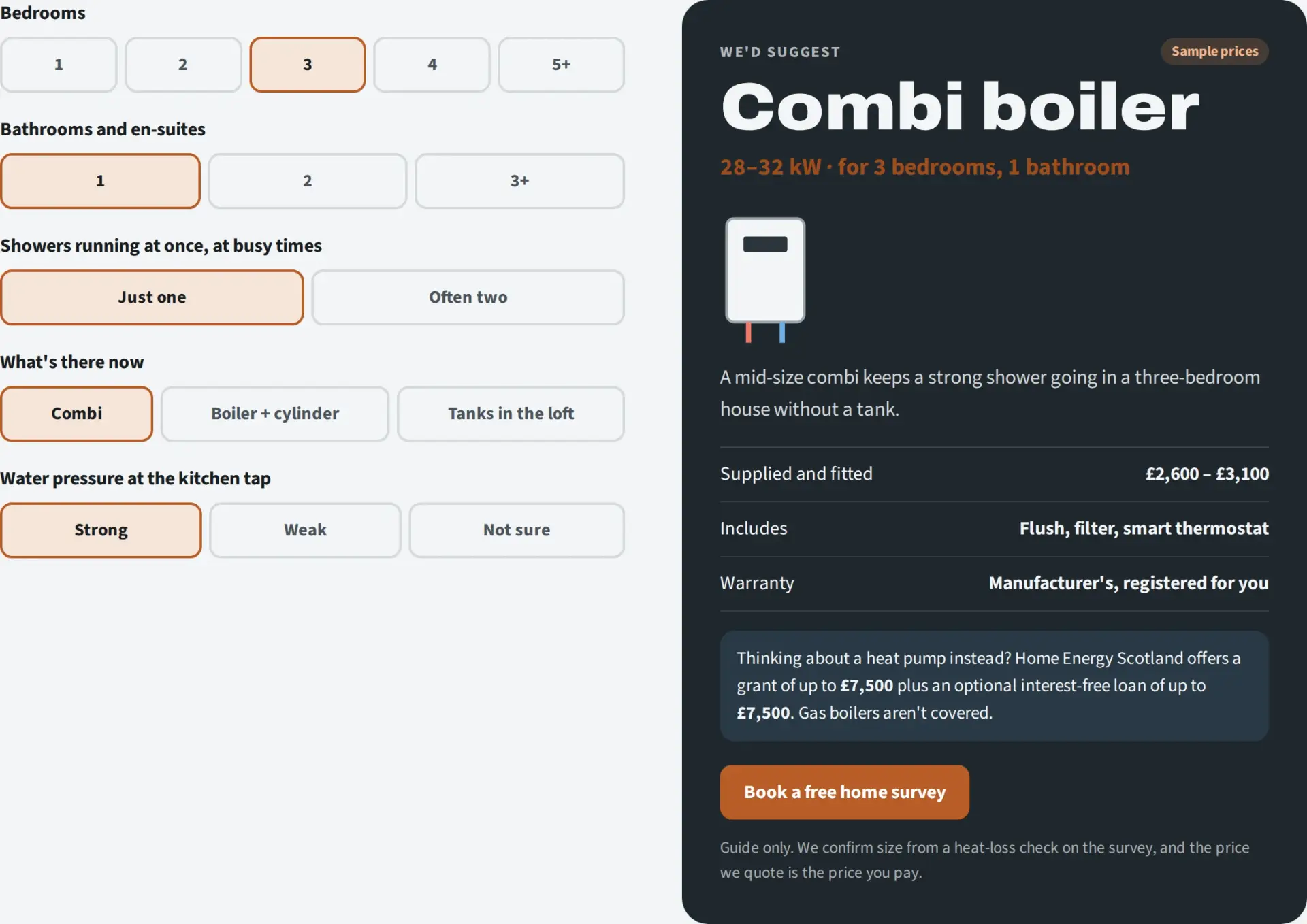
What this post does not do. It is not financial, tax or legal advice, and it is not a complete statement of eligibility — the scheme has conditions beyond those quoted, and a customer’s position should be confirmed with Home Energy Scotland directly. Funding schemes and rates change, sometimes at short notice, so treat every figure here as correct at the date above and check the linked sources rather than this page. We quote no cost or timescale for becoming MCS certified, because we have no verified figure. We name no client, and the one interface shown is a boiler tool we designed, included for contrast rather than as a heat pump example.
Questions heating firms ask us
Is MCS really non-negotiable for the grant?
For the Home Energy Scotland Grant and Loan, yes — both the installer and the product must be MCS certified for the system being installed. There is no partial or pending status that qualifies.
Should we publish the grant amount on our site?
Describe the scheme and link to Home Energy Scotland rather than hard-coding a figure you then have to maintain. If you do publish a number, date it.
A customer wants it done next week. Can we not just apply afterwards?
No. The guidance is explicit that work must not start before the written offer and that funding cannot be granted retrospectively. Starting early removes the money entirely.
Our enquiries are mostly emergency boiler work. Is this relevant?
Possibly not, and that is a legitimate answer. The useful move then is to make the boiler side excellent and be clear you do not do grant-funded heat pump work, rather than leaving it ambiguous.
Does the VAT change affect the grant?
They are separate. The zero VAT rate is HMRC and runs to 31 March 2027; the grant is Home Energy Scotland and has its own rules. A customer may benefit from both, but neither depends on the other.
Is this a new website?
Usually a page and some structure, not a rebuild. It becomes a build question if there is nowhere sensible for a second, slower customer journey to live alongside the emergency one.
Which half of the work do you actually want more of?
Tell us whether you are chasing grant-funded heat pump work, emergency boiler work, or the landlord book — and we will tell you honestly what the site needs to do differently for it.