
A no-show on a Saturday costs more than a week of advertising, and the standard fix is a deposit and a cancellation policy. Both are contract terms, and once a booking is taken online, two pieces of UK consumer law have opinions about what those terms may say.
This is a practical account of what an online booking page has to tell a customer, what a deposit or no-show fee can fairly be, and how to keep both without writing something unenforceable. It is written with dog groomers in mind, because the trade lives and dies by the diary, but it applies to any appointment business taking bookings through a website. It is not legal advice.
Taking the booking online changes the paperwork
A booking made through a website, with nobody meeting face to face, is a distance contract under the Consumer Contracts (Information, Cancellation and Additional Charges) Regulations 2013. That brings a set of information you must give before the customer is bound, and, for most services, a 14-day right to cancel.
The exemptions in regulation 28 cover accommodation, transport of goods, vehicle hire, catering, and “services related to leisure activities” supplied on a specific date. A grooming appointment is not obviously any of those, so the safe planning assumption is that the cancellation right applies to your online bookings. Whether it does in your particular case is a question for your own adviser.
Two provisions make this worth getting right rather than ignoring.
Where the trader does not provide the information on the right to cancel, “the cancellation period ends at the end of 12 months after the day on which it would have ended”.
Regulation 36(6)
“The consumer bears no cost for supply of the service, in full or in part, in the cancellation period, if— (a) the trader has failed to provide the consumer with the information on the right to cancel…”
Read those together. Say nothing about cancellation, and a 14-day right can become a twelve-month one. Perform the service inside that period without having given the information, and the customer may not have to pay for it.
The sequence that keeps you straight
Most appointments are booked for a date inside the next fortnight, which is exactly the situation regulation 36 addresses. The regulation says a trader “must not begin the supply of a service before the end of the cancellation period… unless the consumer has made an express request”. And the right is lost once the service has been fully performed, but only where performance began after that express request and “with the acknowledgement that the consumer would lose that right once the contract had been fully performed”.
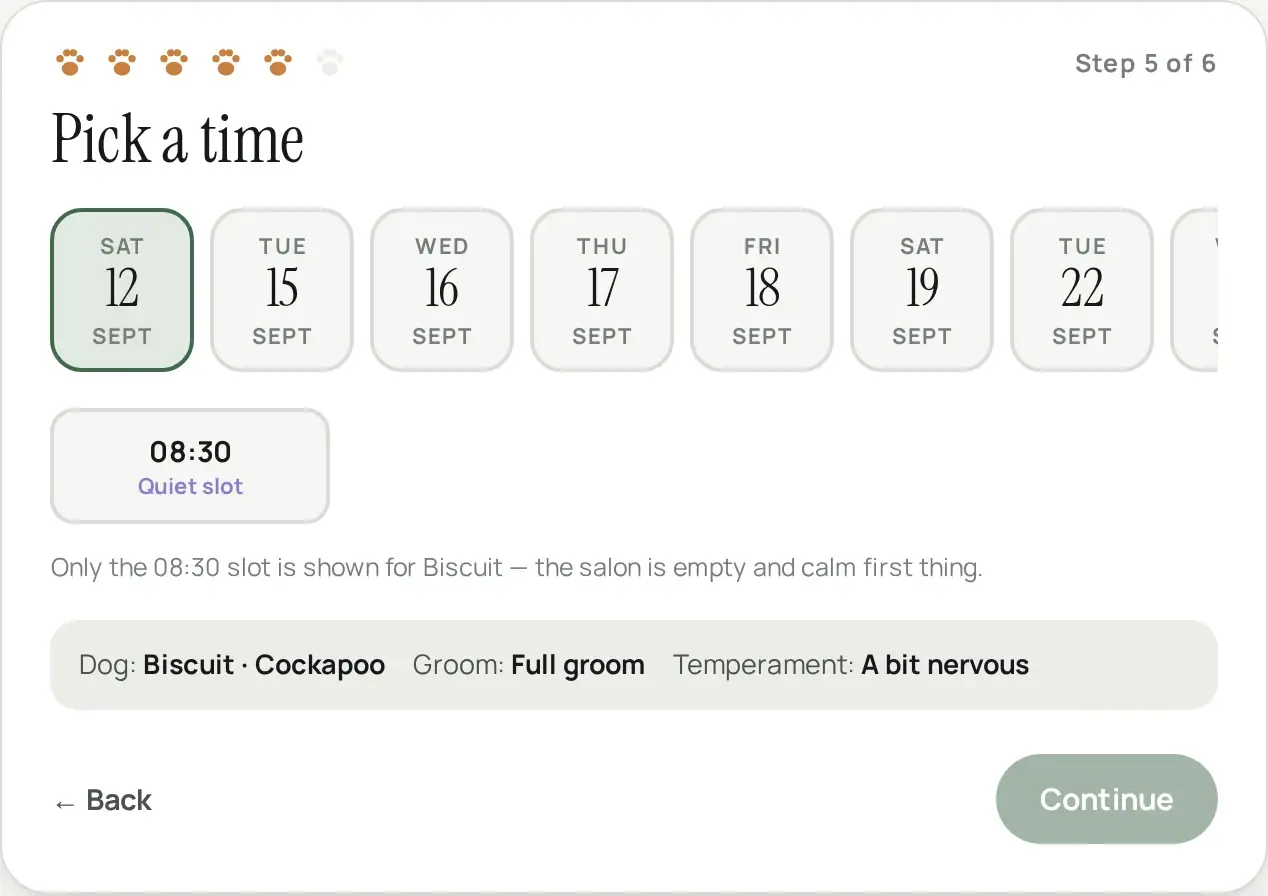
In booking-page terms, that is one tick box and one line of text, at the step where the customer confirms:
- The cancellation information itself: that a 14-day right exists, and how to use it.
- An express request for the appointment to go ahead on the chosen date, where that date falls within the 14 days.
- An acknowledgement that once the groom has been carried out, the right to cancel is gone.
None of that reads as legalese to a customer. It reads as a confirmation screen.
What a deposit is allowed to be
Deposits are normal across the appointment trades and no customer worth having objects to one. The question is what happens to it when somebody cancels, and there the Consumer Rights Act 2015 applies. Section 62(1) is short: “An unfair term of a consumer contract is not binding on the consumer.” A term is unfair if, “contrary to the requirement of good faith, it causes a significant imbalance in the parties’ rights and obligations… to the detriment of the consumer”.
Schedule 2 of the Act lists terms that “may be regarded as unfair”: the grey list. Three entries are squarely about deposits and cancellation charges:
4. “A term which has the object or effect of permitting the trader to retain sums paid by the consumer where the consumer decides not to conclude or perform the contract, without providing for the consumer to receive compensation of an equivalent amount from the trader where the trader is the party cancelling the contract.”
5. “…requiring that, where the consumer decides not to conclude or perform the contract, the consumer must pay the trader a disproportionately high sum in compensation or for services which have not been supplied.”
6. “…requiring a consumer who fails to fulfil his obligations under the contract to pay a disproportionately high sum in compensation.”
Three practical rules fall out of that, and none of them stops you protecting the diary:
- Proportionate, not punitive. A deposit that roughly reflects what a lost slot actually costs you is a different proposition from charging the full price of a groom that never happened. “Disproportionately high” is the statutory language, and the appointment you managed to refill is the obvious example of a charge that has stopped being proportionate.
- Symmetry. Paragraph 4 is aimed at the term that keeps the customer’s money when they cancel while saying nothing about what happens when you do. If the salon cancels at short notice, the policy should say what the customer gets.
- A real window to move. A policy that lets somebody reschedule with reasonable notice is both commercially better (you would rather move the appointment than lose it) and much easier to defend as fair.
Two smaller points worth knowing. A term is judged on all the circumstances when it was agreed, so how it was presented matters: a clear line at the booking step is in a stronger position than a clause discovered afterwards. And the Act’s section 50 treats what you say about a service as a term of the contract. So “deposits are fully refundable” written anywhere on the site is the policy, whatever the terms page says.
What the booking page should actually carry
- The price, the deposit and what it goes towards, at the point of booking rather than after it.
- The cancellation window in plain words. “Move or cancel free up to 48 hours before. Inside 48 hours the deposit is retained” is a policy a customer can follow and a court can read.
- What happens if you cancel. One line. It is the one almost nobody writes.
- The 14-day cancellation information, with the express request and acknowledgement where the appointment falls inside it.
- A reminder that offers rescheduling, not just a warning. The day-before message is the single most effective anti-no-show tool a salon has, and it is also the moment the customer can still save you the slot.
- A record of what the customer was shown, kept with the booking. If a charge is ever disputed, the version of the terms they agreed to is the whole argument.
Our dog groomers page covers the commercial side of the same problem: deposits, reminders, waiting lists to backfill and rebooking on a cycle. The reminders and follow-ups themselves are business automation rather than design.
What we would not put on a booking page
- “All deposits are non-refundable in all circumstances.” It is the phrasing the grey list is describing, and it is unnecessary. A clear, proportionate policy does the same job.
- A cancellation charge equal to the full appointment price, applied regardless of notice or of whether the slot was refilled.
- Terms behind a link nobody opens. If it matters, it belongs on the confirmation step.
- A policy that binds the customer and not the salon.
- Wording copied from another salon’s website. You are adopting their policy, their charges and their mistakes.
Sources and method
- Consumer Contracts Regulations 2013, regulation 28: the exclusions from the right to cancel.
- Regulation 31: the cancellation period extended for breach of the information requirement.
- Regulation 36: supply of a service in the cancellation period, the express request, and paragraph (6).
- Consumer Rights Act 2015, section 62 and Schedule 2: the fairness test and grey-list paragraphs 4, 5 and 6.
- Section 50: information about the service to be binding.
What this post does not do. It is not legal advice, and it does not tell any business what its terms should say. A solicitor or a trade body does that, on your facts. It does not assess whether a particular deposit is proportionate, whether regulation 28 exempts a particular booking, or how a court would read any specific clause. It does not cover business customers, payment-service or chargeback rules, or the separate question of what your booking software’s own terms impose on you. Legislation is amended; the linked sources are authoritative and this page is not.
Questions appointment businesses ask us
Can we still charge for a no-show?
Nothing here says you cannot. The rules are about proportion, symmetry and telling people in advance, not about whether a business may protect a slot somebody failed to turn up for.
How big should a deposit be?
That is a commercial decision and we are not the people to set it. The test in the Act is proportion to the loss, so the number most salons can defend is one that reflects a slot they could not refill rather than the full price of the groom.
Does the 14-day right mean somebody can have a free groom?
Not where the sequence is handled properly: an express request to go ahead, an acknowledgement that the right ends once the service is fully performed, and the cancellation information given before booking. Skipping those is what creates the problem. See regulation 36(6).
What about bookings taken over the phone?
A telephone booking is also a distance contract. The same information duty applies, which is why the confirmation message you send afterwards matters as much as the booking page does.
Our booking system has its own terms. Is that enough?
Read them. Plenty of systems provide a generic policy that may not match what you actually do about deposits and cancellations, and the customer is contracting with you rather than with the software.
Does this apply to us if we only take a card to hold the appointment?
Holding a card, taking a deposit and charging a fee are different mechanics for the same commercial purpose, and the fairness questions follow the charge rather than the method. Say plainly what will be charged, when, and in what circumstances.
Does your booking page say what it needs to?
Send us the link. We will tell you what your booking journey collects, where the deposit and cancellation wording sits, and whether the diary is being protected properly.
Websites for dog groomers · Business automation · Talk to us