
On 5 February 2026 the UK rule on letting software make a decision about a person was rewritten. The old rule started from a ban and worked backwards to a few exceptions. The new one starts from permission and attaches conditions. For a business about to connect AI to its enquiries, quotes, bookings or staff rota, that is better news than it sounds, and it still has teeth.
Our earlier post on what AI on your website is allowed to say ended by saying it did not cover automated decisions that produce legal effects. This is that post. It explains what changed, which of the workflows a small business actually automates fall inside the new rules, what “meaningful human involvement” means now that the regulator has defined it, and what has to be built in when a decision is left to the system. It follows the same line as whether your business should be using AI yet: accountability is the one thing AI cannot take off your hands. It is not legal advice. The guidance quoted below is a draft under consultation, and the Information Commissioner and your own adviser decide how any of it applies to you.
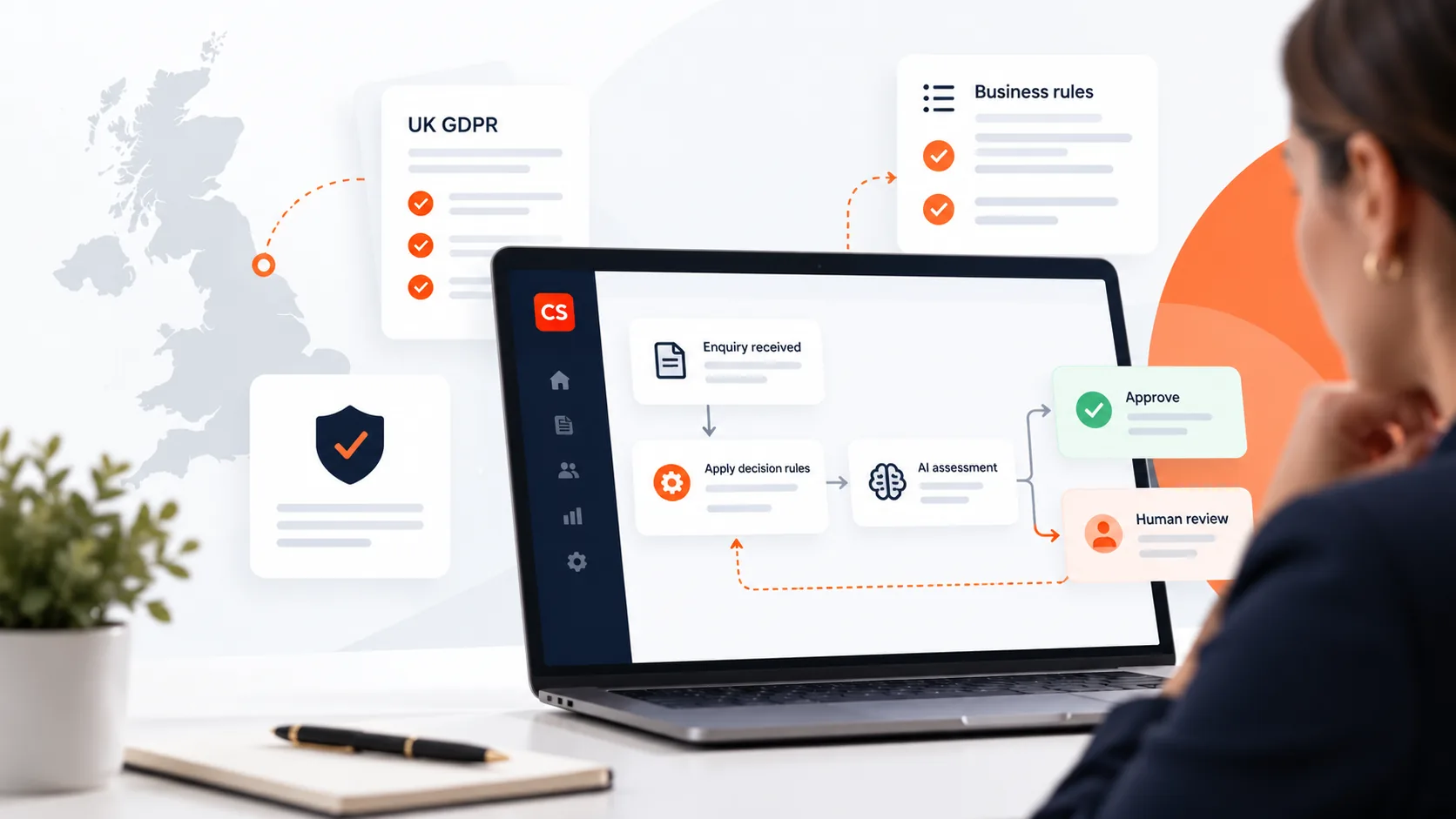
What changed on 5 February 2026
Section 80 of the Data (Use and Access) Act 2025 replaced Article 22 of the UK GDPR with four new articles, 22A to 22D. The commencement regulations brought it into force on 5 February 2026 and saved decisions taken before that date, and the Information Commissioner’s Office confirmed on 19 June 2026 that all of the Act’s data protection provisions are now in force.
The ICO’s own summary of the effect is short. The Act “opens up the full range of reasons, or ‘lawful bases’, that you can rely on when you use people’s personal information to make significant automated decisions about them”, which “potentially includes allowing you to rely on the legitimate interests lawful basis for this type of processing”, so long as “you continue to apply appropriate safeguards”. It adds: “This doesn’t apply to special category data which is more protected.”
So the shape of the rule is now: a decision about a person may be left entirely to the system, as long as it is not resting on sensitive data, and as long as four specific safeguards are in place. Whether the rules apply at all turns on two definitions, and the Act now states both.
“(a) a decision is based solely on automated processing if there is no meaningful human involvement in the taking of the decision, and (b) a decision is a significant decision, in relation to a data subject, if (i) it produces a legal effect for the data subject, or (ii) it has a similarly significant effect for the data subject.” And: “When considering whether there is meaningful human involvement in the taking of a decision, a person must consider, among other things, the extent to which the decision is reached by means of profiling.”
The ICO published updated draft guidance on 31 March 2026 to go with the new articles. The consultation closed on 29 May and the final version is listed for winter 2026, so the wording may still move. What follows quotes the draft, because it is the clearest statement yet of how the regulator reads an Act that is already in force.
Three questions decide whether the rules apply
The guidance says the provisions apply only when three things are all true: “you are using a system that is making a decision (or decisions) about a person”, “the decision is a significant decision”, and “the decision is solely automated”. Taken one at a time, against the kind of automation a small business actually buys:
1. Is the system deciding, or applying a rule you set?
This is the most useful distinction in the whole document, and it is the one most AI vendors skip. The guidance says decisions “need to involve some kind of evaluation or analysis of personal information, not just applying a rule that a human has already set”. Its example: a business decides in advance which payment cards it accepts, and the system accepts or rejects cards accordingly. “In this case, the decision was made by a human, not the system.”
A quote built from your own price matrix, a booking slot offered because the diary is free, a reminder sent because an invoice is 30 days old: these are rules you wrote, applied by software. The system is not evaluating the person. Contrast the guidance’s lettings example, where a system analyses “previous letting history, ratings from previous landlords, payment behaviour, and behavioural signals” and decides whether to allow the lease. There “the system is making a judgement about the person”. That is a decision.
The practical test for an AI integration: if you removed the model and replaced it with an if-then rule you could write on one line, would the outcome be the same? If yes, the rule is yours. If the model is weighing things about the individual that you never specified, it is deciding.
2. Is the decision significant?
A legal effect is the easy half: refusing a licence or benefit, setting a tax liability, issuing a penalty. Almost none of that happens inside a small private business. The half that does is “similarly significant”, which the guidance defines as “an equivalent impact on someone’s circumstances, behaviour, opportunities, or choices”, and then illustrates with a list that should be read slowly by anyone automating a customer or staff process. It asks you to consider the impact on a person’s:
- “financial circumstances (including creditworthiness, bank account access, and evaluation, provision or denial of insurance or benefits)”;
- “employment opportunities and circumstances (eg recruitment, promotion)”;
- “access to essential public and private services”;
- “reputation (eg automated scoring systems that influence trust ratings or professional standing)”;
- “choices (eg dynamic pricing or discriminatory offers)”.
The two examples the guidance gives of ordinary commercial decisions that qualify are the “automatic refusal of an online credit application” and “e-recruiting practices without meaningful human involvement”.
Map that onto what gets automated in a trade or professional firm. An AI that classifies an enquiry as a boiler repair and routes it to the right engineer is not changing anyone’s circumstances. An AI that scores an enquiry and quietly declines to quote the ones it rates as low value, that sets a different price or deposit for a customer based on who it thinks they are, that decides whether an account customer gets credit terms, that filters job applicants before anyone reads a CV, or that sets a worker’s pay or hours from measured productivity, is making the kind of decision the list describes. The guidance’s factory example is the last of those: pay set per shift by an algorithm, with no human reviewing the outcome, and therefore in scope.
One line in the draft matters for anything running at volume: “Unless you are confident that you can accurately separate out the people who will experience legal or similarly significant effects from those who will not, you should apply the safeguards to all the decisions you make.”
3. Is it solely automated?
This is where most businesses believe they are safe, because a person is involved somewhere. The guidance is blunt that the involvement has to be real: “for human involvement to be ‘meaningful’ in the context of the UK GDPR, you must ensure it is active and not just a token gesture.” It then sets out what active means, and that is the subject of the next section.
What “meaningful human involvement” now means
For there to be meaningful human involvement, the draft says, a human should:
“assess and review the decision at an appropriate point to ensure actual impact on the outcome; have the ability to influence the outcome; have discretion and authority to alter the decision; be suitably trained and qualified to understand the system’s logic, outputs, limitations, and risks; and take into account the relevant data and factors on which the decision was based.”
Four further points in the same section remove the usual escape routes:
- Timing. The involvement must come “before you apply the decision to a person and at a time you can still change any recommendation”. A review after the customer has already been told is not involvement.
- Spot checks do not count. “Using ad hoc spot-checking isn’t sufficient because some automated decisions won’t receive a check and therefore don’t have meaningful human involvement.”
- Building the system does not count. “A human merely designing or building an automated system does not count as meaningful human involvement.”
- Typing the data in does not count. “Where a human only inputs the data for the system to process and the system then carries out the decision-making, the processing is still in the scope of the ADM provisions if there is a significant effect.”
The guidance also says: “You should keep a record of how the human was involved in the decision.” And its bank example describes the pattern most AI tools ship with by default: an automated decision where “no human reviews the individual case unless the customer challenges the outcome”. That, it says, “lacks meaningful human involvement”.
Our AI integrations page describes three levels of control: Assist, where AI prepares a draft and a person completes the action; Review, where AI completes the task and a person approves it before anything is sent or changed; and Automate, where approved routine actions run inside defined rules. Read against the draft guidance, Assist and Review are meaningful human involvement only if the person approving can genuinely change the outcome, sees the data the system used, and does it every time. An approve button pressed within a second by someone who cannot see why the system chose what it chose is the token gesture the guidance describes. Automate, by definition, is solely automated, which is fine for decisions that are not significant and requires the safeguards for any that are.
Where the line stays hard: sensitive data
Article 22B keeps one real prohibition. A significant decision “based entirely or partly on” special category data, which is the Article 9 list covering health, ethnicity, religion, trade union membership, sexual orientation, biometrics and the rest, “may not be taken based solely on automated processing” unless one of two conditions is met: the decision is based entirely on data the person has given explicit consent for, or it is necessary for a contract or required by law and a substantial public interest condition under Article 9(2)(g) applies.
For a small business the second condition is effectively out of reach, which leaves explicit consent or a human in the decision. The way this catches people is not through deliberate profiling. It is through free-text. An enquiry form that asks “tell us about the problem” collects health data the moment a dental patient describes their symptoms or a removals customer mentions a disability, a point our post on health data in dental enquiry forms made about collection. If an AI then reads that text and decides anything significant from it, the decision is “partly” based on special category data and 22B applies. The guidance’s own recommendation elsewhere is to “delete any special category data that your system may receive or infer before profiling if you do not require it”.
The four safeguards, and what each one looks like when built
Where a significant decision is solely automated, Article 22C requires the controller to have safeguards in place, and names four. The ICO says they must be applied “consistently rather than on an ad hoc discretionary basis”.
“The safeguards must consist of or include measures which (a) provide the data subject with information about decisions described in paragraph 1 taken in relation to the data subject; (b) enable the data subject to make representations about such decisions; (c) enable the data subject to obtain human intervention on the part of the controller in relation to such decisions; (d) enable the data subject to contest such decisions.”
- Information about the decision. This is not the privacy notice. The guidance calls it “decision-specific information about the actual outcome, rather than simply repeating information you provide in your privacy notice”, and expects it to say “which factors contributed to the decision” and “whether profiling was involved”. In a built system that means the reasons are stored with the record at the moment of the decision, in language a customer can read.
- Representations. The person must be able to “put forward their point of view” and supply “any additional information you may have missed”, and you “must make it clear to people that they have this right”.
- Human intervention. A review by someone with the same five qualities as meaningful involvement: trained, with access to “all relevant data and original facts that your ADM system used”, with authority to change it. It adds a tell worth building into any dashboard: “If human reviewers are regularly changing decisions when people challenge them, it may indicate issues with the performance of your ADM systems.”
- Contesting. A way to challenge or appeal. “This doesn’t have to be complicated for you to establish or operate.”
All three of the last ones carry the standard deadline: act “without undue delay and at the latest within one month of receipt”.
And before any of it goes live, the guidance’s position on impact assessments is plain: “You should do a DPIA for any ADM as this is very likely to be a type of processing that can result in high risk.” A DPIA is also, in its words, a way to “decide whether or not the ADM provisions are likely to apply to your intended processing in the first place”, which makes it the right first document for the project rather than the last.
What this changes about how an AI integration is built
None of this argues against automation. The regulator’s own position is that automated decisions “can benefit both candidates and employers”, and the Act was written to make them easier. What it argues for is deciding, step by step, which kind of thing each automated step is. The rules we apply:
- Classify every automated step as a rule or a decision, in writing, before it is built. Rules you set are yours. Judgements the model makes about a person are decisions, and they need the next question asked.
- Anything touching money, access, employment, price or reputation defaults to Review. Declining to quote, pricing differently, granting credit, screening applicants, scheduling or paying staff from measured data. The approval must be real: a named person, every case, before the customer hears, with the system’s reasoning on screen. Logged.
- Automate only what is not significant, or build the four safeguards into it. Classification, routing, acknowledgements, reminders, document generation from confirmed data: these are the bulk of the value and carry none of the risk. The automation that saves a business its evenings is almost all of this kind.
- Store the reasons with the outcome. Every automated decision about a person writes its factors to the record in plain words. That serves the information safeguard, makes human intervention possible, and is the best diagnostic you will have for a model that has started drifting.
- Strip sensitive data before the model sees it, or keep a human in the decision. Free-text enquiry fields are the usual leak.
- Put the challenge route on the output. Any customer-facing result of an automated decision carries one line saying how to ask for a person to look at it, and that request reaches someone who can change the answer.
Common questions
We use an off-the-shelf tool. Does this fall on the vendor?
The safeguards in Article 22C sit with the controller, which is the business making the decision about its own customers or staff. The vendor’s tooling makes the safeguards easier or harder to deliver, but the duty is yours. Ask the vendor to show you where the reasons for each decision are stored and how a review is triggered before you sign.
AI drafts the email and a person sends it. Is that an automated decision?
If the person reads it, understands what it commits to, can change it and sometimes does, the decision is the person’s. If the draft goes out unread, or the person approving cannot see what the system based it on, the guidance says that is a token gesture. The question is not whether a person is in the loop but whether they can change the outcome and do.
Our system rejects spam enquiries automatically. Is that a significant decision?
Discarding an obvious bot submission is a rule. Declining a genuine enquiry because a model scored the person as unlikely to convert is closer to a decision about their access to a service, and the guidance tells you to apply the safeguards where you cannot reliably tell the two apart. The honest design is to route uncertain cases to a person rather than to silence.
Sources and method
- Data (Use and Access) Act 2025, section 80, and the substituted Article 22A, 22B, 22C and 22D of the UK GDPR.
- The Data (Use and Access) Act 2025 (Commencement No. 6 and Transitional and Saving Provisions) Regulations 2026, regulations 2(j) and 5.
- ICO, Automated decision-making, including profiling, draft guidance updated 31 March 2026: the sections on what the UK GDPR says, the safeguards, special category data and what else to consider. Consultation closed 29 May 2026; final version listed for winter 2026.
- ICO, The Data (Use and Access) Act 2025: what does it mean for organisations?, including the 19 June 2026 commencement note.
- ICO, Automated decisions can streamline the hiring process, with the right safeguards in place, 31 March 2026.
All were read on 24 October 2026. Central Systems is not a regulator or a law firm. The ICO guidance quoted is a consultation draft and may change before it is finalised; the Act and the UK GDPR articles are in force as quoted. Whether a particular automated step is a significant decision, and whether the people around it amount to meaningful involvement, depends on facts a blog post cannot assess. The linked text is authoritative where this page is not.
Want the automation without the exposure?
Tell us which steps you want the system to take on its own. We will sort them into rules, reviewed decisions and automated ones, show you where the safeguards need to live, and build it that way from the start.