
Automating a removals quote is not the difficult part. Deciding which number the website is allowed to show, and making sure that number is one the firm will actually honour, is where most quoting systems go wrong.
This is a practical account of what a removals firm can sensibly automate between an enquiry and a booked job, what it should leave to a survey, what UK consumer law now expects of any price shown on screen, and when an off-the-shelf removals CRM is the right answer rather than something built. It is written for removals and storage operators, and for anyone about to buy a “quote calculator” for one.
It draws on eleven years our founder has spent marketing removals firms, online and offline. That is long enough to have watched a good many quoting tools promise more than a web form can deliver.
What a form can see, and what it cannot
A removals price is built from a handful of things, and they split cleanly into two groups.
A form can collect these reliably:
- The moving date, and whether it is fixed or flexible.
- Where from and where to, which gives distance and, usually, whether it is a local or long-distance job.
- The size of the property, as a number of bedrooms or a property type.
- Which services are wanted: packing, part-packing, dismantling, storage.
- Basic access: which floor, whether there is a lift, whether the van can park outside.
A form cannot see these, however well it is designed:
- How full the house actually is. Two three-bedroom semis can differ by a whole van.
- The loft, the garage and the shed, which customers routinely forget to mention.
- The piano, the American fridge-freezer and the wardrobe that came in before the stairs were changed.
- Whether “parking outside” means a driveway or a bus route on a Saturday.
Everything in the first list is worth automating. Everything in the second list is why a website should be careful about what kind of number it produces.
Three kinds of number, and which to automate
Our removals industry page sets out the approach we recommend: an honest ladder from a rough guide to a firm price, where each step says plainly what it is.
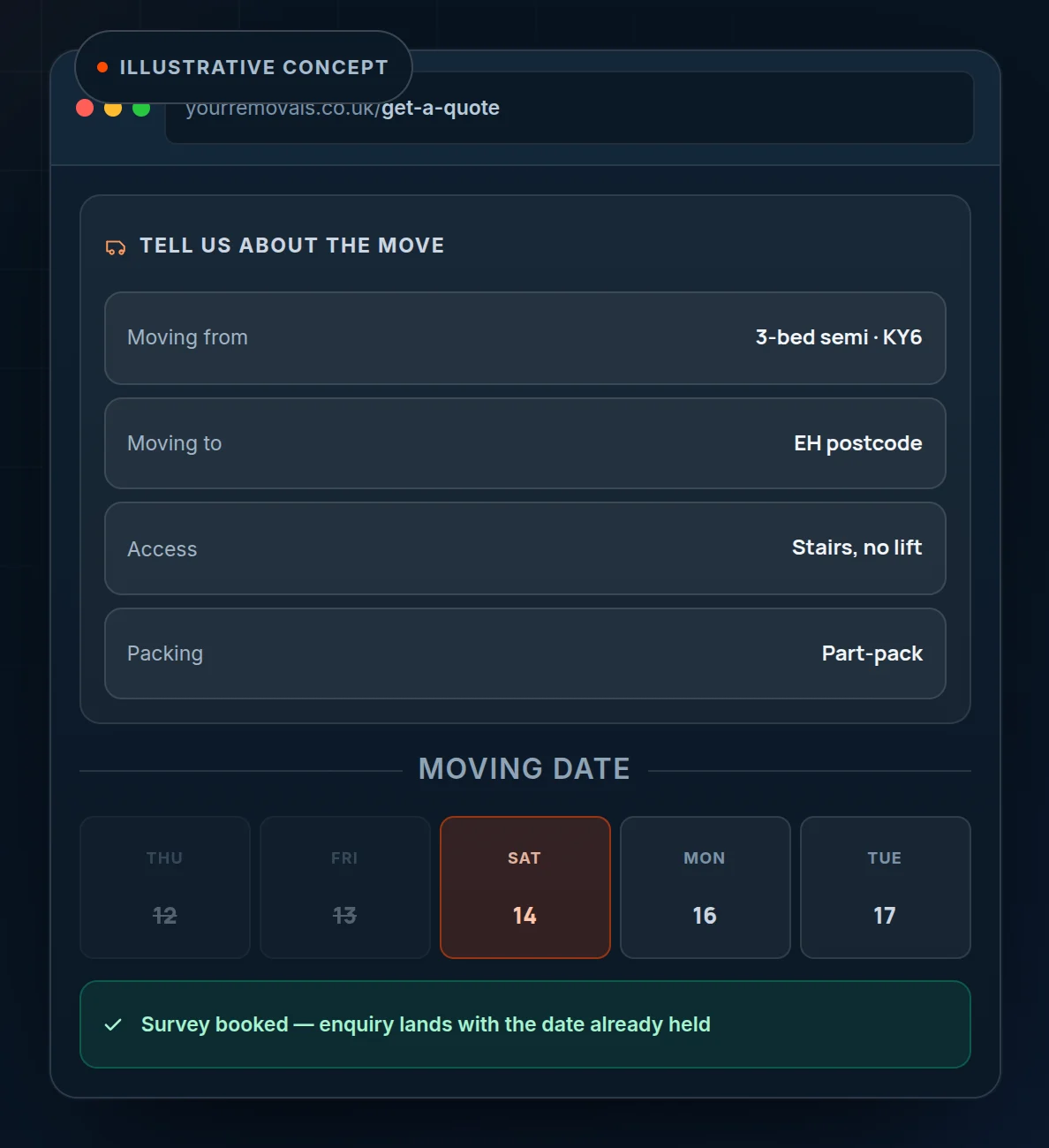
1. An indicative range
Generated instantly from property size, distance and the services selected, using the firm’s own rates, and shown as a range with its assumptions printed beside it. Its job is to tell a customer whether you are within their budget at all, and to save both of you a survey that was never going to convert.
This is the part people usually mean by “automated quoting”, and it is genuinely useful. It is also the part that carries the most risk, because it is the only one that shows a price before anybody has seen the job.
2. A booked video survey
The customer walks through the house on their phone while someone at the firm looks at the actual volume and the actual access. For most domestic moves this is the step that produces a price both sides can rely on, without anybody driving to the property.
What is worth automating here is not the survey. It is the booking of it: offering a real slot from the firm’s availability while the customer is still on the page, confirming it, and reminding them beforehand. A survey booked at 9pm on a Sunday, the moment somebody gets a completion date, is worth considerably more than a callback promised for Monday. That is the argument of our post on the 9pm Sunday enquiry.
3. A home survey
For larger moves, difficult access or commercial work, where the volume genuinely has to be walked. The website’s job is to make sure that when the surveyor arrives, the date, the addresses and the services are already on the record.
Whether a firm offers all three steps, or deliberately shows no figure at all, is a commercial decision rather than a technical one. Some firms want a number on screen to filter out price-shoppers; others will not publish one because it invites arguments on moving day. Both are defensible. What is not defensible is showing a number that means something different from what it appears to mean.
The price on the page is now more tightly regulated
Since 6 April 2025, the unfair commercial practices rules in the Digital Markets, Competition and Consumers Act 2024 have applied in place of the older 2008 regulations. Section 230 deals with what an “invitation to purchase” must contain, and an online quote tool that shows a price and invites the customer to book is squarely the kind of thing it describes: a practice that “indicates the characteristics of a product and its price” and “enables, or purports to enable, the consumer to decide whether to purchase”.
“…the total price of a product includes any fees, taxes, charges or other payments that the consumer will necessarily incur if the consumer purchases the product.”
Section 230(2)(c)
“if, owing to the nature of the product, the whole or any part of the total price cannot reasonably be calculated in advance, how the price (or that part of it) will be calculated”
Section 230(5) adds that where the price cannot be calculated in advance, the explanation of how it will be calculated must be set out “with as much prominence” as the price itself. Section 230(9) says that giving information “in a way that is unclear or untimely”, or where the consumer is “unlikely to see it”, counts as omitting it.
For a removals calculator, that has some direct consequences:
- A charge every customer pays belongs inside the number. If a fuel surcharge, a booking fee or VAT applies to every job, a figure that excludes it is not the total price.
- A charge that depends on the job needs saying next to the number, not in the terms. Stairs, long carries, parking suspensions and weekend premiums are the usual examples. Where the calculator can price them from what the customer entered, it should. Where it cannot, the page should say that they may apply and how they are worked out, at the same prominence as the range.
- “From £X” needs a job that genuinely costs £X. A headline figure only the smallest possible move would ever achieve, with everything else added later, is the pattern this section was written to deal with.
- A price that changes at survey needs to say why it might. The honest version of an indicative range lists the assumptions it was built on, so that when the survey finds a loft full of boxes, the change is explained by something the customer was told at the start.
The older Consumer Contracts Regulations 2013 point the same way for bookings taken online. Schedule 2 requires the total price or “the manner in which the price is to be calculated”, and any additional charges or “the fact that such additional charges may be payable”. Regulation 13(5) sets out the consequence of leaving the additional charges out: “the consumer is not to bear the charges or costs referred to”.
We build websites; we are not lawyers. How these provisions apply to a particular firm’s pricing and terms is a question for that firm’s solicitor or trade body. What we can do is make sure the site is capable of saying whatever they advise, in the place the law expects it to be said.
The cancellation question most sites never answer
Most online purchases in the UK carry a 14-day right to cancel. A dated removal usually does not. Regulation 28(1)(h) of the 2013 Regulations excludes “the supply of accommodation, transport of goods, vehicle rental services, catering or services related to leisure activities, if the contract provides for a specific date or period of performance”.
That matters to a website in two ways. First, it means the firm’s own cancellation and deposit terms are what govern a change of plan, so they belong beside the booking button rather than at the end of a PDF. Second, Schedule 2 paragraph (o) requires the customer to be told when there is no right to cancel: “the information that the consumer will not benefit from a right to cancel”. A booking flow can do that as a plain line at the point of confirmation.
Storage is worth a separate look. A storage agreement is not obviously “transport of goods” for a specific date, and may not fall within the same exclusion. That is exactly the kind of question to put to an adviser before the booking flow is built, not after.
What to automate after the number
A price, however good, is one step of six. Between somebody filling in a form and a crew arriving, the steps that repay automation are the unglamorous ones:
- Acknowledgement. Immediately, including out of hours, saying what arrives next and when.
- Availability. Checked against the date as soon as it arrives. A job you cannot take is worth knowing about now, not on Tuesday.
- Survey booking. From real availability, with a reminder the day before.
- Quote follow-up. A chase if the quote goes quiet, which most do, and a rule that stops chasing the moment the customer books or declines.
- A record. Every enquiry, with where it came from and what happened to it, so the firm can see which sources produce jobs and which only produce enquiries.
None of this needs to be clever. It needs to be dependable, and describable in one plain sentence by whoever runs the office. Our business automation page covers the principles in more depth.
Off-the-shelf CRM, or something built?
This is the question behind most searches for “automated quoting”, and the honest answer is that most removals firms should start with a packaged product.
There are removals-specific CRMs on the market that handle enquiries, surveys, quotes, diaries and storage reasonably well, and the good ones are genuinely good. For most firms, the right build is the website end of the journey (lead capture, “book a video survey” and “get a quote”) feeding straight into whichever removals CRM the firm already runs, or chooses. The website does what websites are good at: being found, reassuring the customer and collecting a usable enquiry with the date attached. The CRM does the rest.
Something built earns its place in a narrower set of cases:
- An instant price from the firm’s own pricing matrix. Where a firm has a pricing model it trusts (volumes, rates, distance bands, access and service adjustments) and wants the website to produce a range from it, with its assumptions shown, rather than a generic estimate.
- Booking and deposits from that price. Where the customer can go from the range to a held date without a phone call, against real availability.
- Requirements a packaged product does not meet. Multi-depot routing, a storage operation run as its own business, or an existing system with no usable way to connect to it.
In those cases we build to the firm’s own rules, and it is often a more modest project than people expect, because the scope is the firm’s pricing logic and booking flow rather than a whole operational system. Where a packaged CRM fits, we will say so rather than quote to rebuild it.
What we would not build
- A binding price from a form. The form cannot see the loft. A calculator should produce an indicative range that leads to a survey, not a contract.
- A headline figure no real move achieves. See section 230 above.
- Surcharges that first appear on the survey. If a charge can apply, the customer should have been told it could before they booked the survey.
- Countdown timers and “only two dates left this month” unless it is true. Schedule 20, paragraph 7, lists falsely stating that a product is available only for a limited time among the practices treated as unfair in all circumstances.
- Rates we made up. Every figure a Central Systems calculator produces comes from the firm’s own rates and rules. We do not set removals prices and we do not invent the arithmetic behind them.
Sources and method
- Digital Markets, Competition and Consumers Act 2024, section 230: subsections (2), (4), (5), (9) and (10), quoted above; in force from 6 April 2025 by S.I. 2025/272.
- Digital Markets, Competition and Consumers Act 2024, Schedule 20: paragraph 7.
- Consumer Contracts (Information, Cancellation and Additional Charges) Regulations 2013, regulation 28: paragraph (1)(h).
- Regulation 13: paragraph (5).
- Schedule 2: paragraphs (f), (g) and (o).
What this post does not do. It is not legal advice, and it does not assess whether any particular firm’s pricing or terms comply with consumer law. It does not review or recommend any specific removals CRM or quoting product. It says nothing about operator licensing, goods-in-transit cover or trade association codes, which are outside what we do. The one illustration is a concept from our own removals page, not a client’s site. Legislation is amended; check the linked sources, which were current when this was written, rather than relying on this page.
Questions removals firms ask us
Can a website give an exact removals price?
For a small, well-defined job, such as a man-and-van booking with a fixed number of items, sometimes. For a house move, not honestly. The volume and the access decide the price, and a form cannot see either properly. A range with its assumptions stated, leading to a video survey, is what we recommend for most domestic work.
Should we show prices at all?
It is a commercial decision. A range filters out enquiries that were never going to book; no figure avoids anchoring a customer on a number that later moves. Either works if the page is clear about which one it is doing.
We already use a removals CRM. Do we need anything else?
Possibly only a better front end. If enquiries are arriving without the date, the size or the access, the CRM is being fed badly, and that is a website problem. Where the CRM accepts enquiries from outside, we connect the site to it; where it does not, we check what it does allow before promising anything.
Can an instant quote take a deposit and hold the date?
Yes, if the firm is prepared to commit to the range and the date is checked against real availability. That is usually the point at which a bespoke build is justified, and the firm’s cancellation terms need to be on screen before payment.
Do customers have 14 days to cancel a removal booked online?
Generally not, where the booking is for a specific date: regulation 28(1)(h) excludes dated transport of goods from the statutory cancellation right. The firm’s own terms govern instead, and the customer must be told there is no statutory right. Storage may be different. Check the detail with your adviser.
Does a calculator have to include VAT?
If the customer will necessarily pay it, section 230(4) treats it as part of the total price. Showing a price “plus VAT” to consumers, with the VAT-inclusive figure elsewhere or not at all, is the kind of presentation to raise with your adviser.
Would your quote form produce a number you would honour?
Send us your quote page and tell us which CRM, if any, you run the diary on. We will tell you what the form is missing, whether the price shown would survive a survey, and whether you need a build or just a better connection.
Websites for removals firms · Business automation · Talk to us