
An advice firm’s website is not marketing that happens to be regulated. Each page that invites somebody to engage with a regulated service is a financial promotion in its own right, and the rules that govern it reach into type size, page structure and what a calculator is allowed to say.
This is a practical account of which rules actually bear on an adviser’s website, what they mean for the people designing and writing it, and where sites in this sector usually go wrong. It is written for advice firms and for whoever builds their websites. Central Systems is not authorised by the Financial Conduct Authority. This is not legal, regulatory or compliance advice, and nothing here approves anything. What a firm’s website may say is a decision for that firm’s compliance function.
Why a web page counts
Section 21 of the Financial Services and Markets Act 2000 restricts any person who, “in the course of business”, communicates “an invitation or inducement to engage in investment activity”. The FCA Handbook’s glossary uses the same words to define a financial promotion.
The restriction does not bite on an authorised firm communicating its own promotions. Section 21(2)(a) sees to that. What follows instead is the Handbook, and in particular the conduct rules in COBS 4. An adviser firm does not need anybody’s approval to publish its own website; it does need that website to satisfy the rules that apply to promotions.
The FCA is explicit that the medium is irrelevant. Its finalised guidance on social media (FG24/1) states that the rules “are technology neutral and apply across all channels used to advertise”. A landing page, a service page, a downloadable guide and a LinkedIn post are all judged against the same standard.
The rule that shapes the page
The headline requirement is short. COBS 4.2.1R: “A firm must ensure that a communication or a financial promotion is fair, clear and not misleading”, and, as part of complying, “a firm must take into account the nature of the client”.
The detail that affects design sits in COBS 4.5.2R, which requires that information:
“is accurate and always gives a fair and prominent indication of any relevant risks when referencing any potential benefits” · “is sufficient for, and presented in a way that is likely to be understood by, the average member of the group to which it is directed” · “does not disguise, diminish or obscure important items, statements or warnings”
And then the provision that is, in effect, a typography rule in a rulebook: where a risk indication is required, its font size must be “at least equal to the predominant font size used throughout the information provided”.
That single line disposes of the house style of an entire sector. A benefit stated in 40px and a risk noted in 11px grey underneath it is not a design decision that compliance might tolerate. It is the arrangement the rule was written to stop.
Every page stands on its own
The other principle that changes how a website is built is standalone compliance. FG24/1 puts it in two sentences:
“We expect financial promotions to be standalone compliant. This means that each communication must comply with our rules when considered individually.”
For a website that has real consequences, because websites are built out of shared furniture:
- A warning in the footer is not a warning on the page if the page is judged individually. Whether a given layout satisfies the rule is your compliance function’s call, but the safe assumption while designing is that each page must carry what it needs.
- A page that can be reached directly must work directly. Search results, shared links and assistant summaries all skip the journey you designed.
- “It’s explained on the next step” is a weak answer. Signposting to fuller information is allowed (FG24/1 accepts it “as long as the promotion remains standalone compliant”), but the promotion still has to stand up by itself.
Consumer Duty turns writing into a testable requirement
The consumer understanding outcome does something unusual: it makes the clarity of your words an obligation with evidence attached.
- PRIN 2A.5.3R requires that communications “are likely to be understood by retail customers”.
- PRIN 2A.5.8R requires firms to tailor communications taking account of “the characteristics of retail customers, including any characteristics of vulnerability”, the complexity of the product, the channel used and the role of the firm.
- PRIN 2A.5.10R expects firms, where appropriate, to “test communications before communicating them” and to “regularly monitor the impact of the communications once they have been communicated”.
Testing before publishing and monitoring afterwards is, in website terms, user testing and analytics. Most advice firms already own the second and skip the first. Reading a draft page aloud to two clients who are not in the industry is a cheap version of the same thing, and it finds more problems than another round of internal review.
The vulnerability limb also settles an argument that usually gets framed as aesthetics. An audience that skews older, and that often arrives at an adviser during bereavement, divorce or redundancy, is the audience the rule is describing. Contrast, text size, tap targets, forms that can be completed by keyboard, no forced timers: that is not a nice-to-have on an adviser site. It is the design expression of a rule the firm is already bound by.
What this means for the parts people argue about
Calculators and planning tools
A tool that shows what a set of inputs produces, under stated assumptions, labelled as an illustration and ending in a conversation, is a different thing from a tool that tells somebody what to do. Where exactly that line falls is a judgement for your compliance function, not for your web agency.
What the builder can do is make the judgement easy: assumptions printed on screen rather than buried in a tooltip, the tax year and bands stated, the output labelled in type you can actually read, and every rate in the tool traceable to a table the firm owns and approves. For Scottish firms there is a further trap: Scotland’s income tax bands are not the UK-wide ones, and a relief calculator using the wrong set is quietly wrong for every client.
Qualifying enquiries, and turning some away
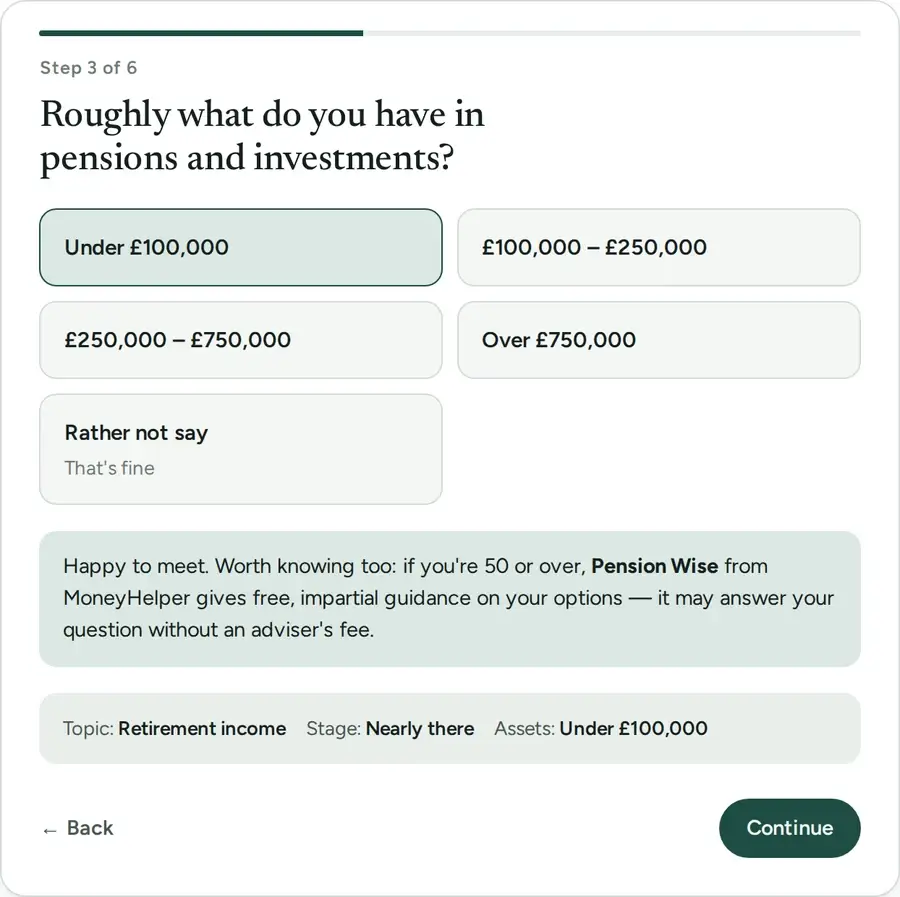
Signposting to free, impartial guidance is not a regulatory requirement of a website, and we are not suggesting it is. It is a commercial and ethical choice that happens to sit comfortably with a Duty built around good outcomes, and firms that do it tend to find the enquiries that remain are better ones.
The record nobody thinks about until they need it
COBS 4.11.1R requires a firm to “make an adequate record of any financial promotion it communicates”, and the retention periods are long: indefinitely for pension transfers, conversions, opt-outs and FSAVCs; six years for life policies and pension schemes; five years for MiFID or equivalent third country business; three years otherwise.
Apply that to a website and an awkward question appears: what did that page say in March last year? A content management system that silently overwrites pages cannot answer it. Version history, a dated log of content changes, and an archived copy of any page carrying figures are the website-side answer, and they cost nothing if they are set up at the start.
Status disclosure
GEN 4.3.1R requires a firm to take reasonable care that every letter “(or electronic equivalent)” sent to a retail client in connection with regulated activity carries the disclosure in GEN 4 Annex 1R. For most UK advice firms, that is “Authorised and regulated by the Financial Conduct Authority”. Where that statement, the firm reference number and registered details belong on a website is a question for your compliance function; what a builder should do is design proper places for them rather than leaving them to be squeezed in at the end.
How this changes the project, in practice
- Compliance reviews structure and copy before the build, and again before launch, as two booked stages. Most of the friction in adviser website projects comes from constraints arriving after the design.
- Risk and status content gets designed space, at a readable size, next to the claim it qualifies.
- Each page is reviewed as if it were the only page.
- Anything numeric carries a review date, because allowances and bands move and a page quoting last year’s is worse than no page.
- Content changes are logged, so the record requirement is satisfied by the system rather than by memory.
Our financial advisers page sets out the rest: site structure around situations rather than products, adviser profiles, rebuilds, and what monthly work looks like once a site is live.
What we would not put on an adviser’s site
- A benefit in display type with the risk in grey underneath. See the font-size provision above.
- A calculator whose assumptions are invisible or whose output reads like a recommendation.
- Rates and allowances we sourced ourselves. Every figure in a tool or a page comes from the firm and is approved by the firm.
- Regulatory status we have not been given in writing. We publish what the firm supplies, verbatim; checking the register or inferring permissions is not our job.
- Testimonials or case studies that imply an outcome somebody else can expect.
- A content management setup with no version history, on a site subject to record-keeping rules.
Sources and method
- Financial Services and Markets Act 2000, section 21: the restriction on financial promotion and the exemption for authorised persons.
- COBS 4.2.1R: fair, clear and not misleading.
- COBS 4.5.2R: accuracy, prominence of risks, comprehensibility, and the font-size provision.
- COBS 4.11.1R: records of financial promotions and retention periods.
- PRIN 2A.5: the consumer understanding outcome, including 2A.5.3R, 2A.5.8R and 2A.5.10R.
- GEN 4.3.1R and GEN 4 Annex 1R: status disclosure in letters and electronic equivalents.
- FG24/1, Finalised guidance on financial promotions on social media: paragraphs 1.1 and 2.20.
What this post does not do. Central Systems is not authorised or regulated by the FCA. This is not legal, regulatory or compliance advice, it does not approve any promotion, and it is not a complete account of the financial promotion rules. COBS 4 alone runs to sections on past performance, comparisons, and product-specific requirements that are not covered here. Nothing here tells a firm what its website may say; that is for the firm’s compliance function, using its own permissions. Rules are amended: the Handbook references were checked against the FCA’s published text when this was written, and the linked pages are authoritative rather than this one. The interface shown is a Central Systems design using sample data, not a client’s site.
Questions advice firms ask us
Does our website need to be approved before it goes live?
An authorised firm communicating its own promotions does not need another firm’s approval under section 21. Your own internal sign-off process is a separate matter, and it is the one that governs the project schedule.
Is a blog post a financial promotion?
It depends on what it does. Material that invites or induces someone to engage in investment activity is caught; genuinely educational content may not be. That judgement belongs to your compliance function, and it is worth settling the test with them once rather than per article.
Can we say we are independent?
If the firm meets the Handbook’s conditions for describing its advice that way. It is a status claim, so it comes from you and goes up as given. We do not assess it.
Where should risk warnings sit on the page?
Next to the claim they qualify, at a size at least equal to the predominant font size where a risk indication is required. Designing that space in at the start is easier than retrofitting it and produces a better page.
Our network has a house template. Can you work within it?
Usually, but tell us at the first conversation. An appointed representative arrangement typically adds an approval layer and sometimes a prescribed style, and both affect what the structure and the timetable can be.
How do we prove what the site said two years ago?
With version history and a dated change log, set up when the site is built. Retrofitting a record after the question is asked is not the same thing.
Would your site survive being read one page at a time?
Send us your website and we will tell you where benefits outweigh risk wording, which pages depend on the footer, and what a compliance-first rebuild would actually involve.
Websites for financial advisers · Free website audit · Talk to us