New: Try our free Website Audit tool. Run your free audit →Run it free →

Roofers & roofing contractors

Nobody has ever seen their own roof.

They have seen it from the pavement. They have never seen the felt, the battens, the flashing round the chimney, or the six inches of lap that decide whether the bedroom stays dry. The work happens where they cannot go, gets covered over by teatime, and does not announce itself as wrong until the second winter. Every other trade can be checked on the day. Yours cannot — and that one fact should decide how the website is built.

Photo quotesStorm responseRe-roof estimatesInsurance claimsWritten guaranteesJob photo recordsMap visibilityLooked after
Interface by Central Systems
Roofing contractor — home
The homepage of a roofing contractor site designed by Central Systems: a header with storm damage, services, prices and a photo-quote button, a strip stating that storm damage is made watertight the same day where a ladder can safely be put up, and a triage panel asking what is happening with the roof.

The state of it

A business card, for the one purchase nobody can inspect.

In short

A householder about to spend five figures on something they will never lay eyes on is looking for reasons to believe you. Most roofing sites give them a phone number, a gallery of finished roofs and the word “reliable” — which is exactly what the outfit that knocked their door last Tuesday said too.

Every honest roofer is paying off a debt run up by somebody else, in a trade where the rogues got there first and made the word itself a warning. The people who trade on that reputation are not going to build a website that answers hard questions. So the questions are yours to answer, plainly, before anyone has to ring and ask.

The list on the right is what we keep finding.

Eight things we keep seeing
  • “Call for a free quote.” The entire site, in four words, offering nothing a caller could weigh up first.
  • A gallery of finished roofs. Which proves nothing whatsoever. From the pavement, a roof laid properly and a roof laid badly are the same photograph.
  • “Fully insured” and nothing else. No insurer, no cover, no working-at-height mention — the words every caller has already heard from someone they did not trust.
  • A guarantee with no terms. A number of years and no statement of what is actually covered, or what voids it.
  • Silence on insurance claims. A large share of storm work runs through an insurer, and almost nobody explains how that conversation tends to go.
  • One route for everybody. The woman with water coming through a light fitting and the couple comparing three re-roof quotes get sent to the same contact form.
  • No figure of any kind. Not a rate, not a range, not even the order of magnitude — so the first honest quote lands with no context to judge it against.
  • Stock photographs of American roofs. Asphalt shingles and a timber-framed house, on a site selling slate work in Lanarkshire.

The verification gap

The finished roof is the least useful photograph you own.

The photographs that settle a five-figure decision are the ones taken at eleven in the morning with the covering off: the rotten batten, the tear in the old felt, the flashing that was never dressed in properly. Nobody can take those but you, and once the new slate goes on, nobody can take them at all.

BeforeWhat it looked like strippedDaylight through the sarking. Nails gone to rust. The thing the customer suspected but could not see is now a photograph with a date on it, and the quote stops sounding like an opinion.
DuringEach layer, before it is coveredMembrane, battens, lead, ridge. Four photographs taken as you go, costing nothing, and they are the only proof that will ever exist of how the roof was actually built.
DetailThe joints, not the slopesValleys, abutments, the chimney. Roofs almost never fail in the middle of a slope; they fail where two things meet. A close photograph of a join done properly says more than a full elevation.
AfterThe same angle, twiceA before and an after from one spot beats twenty flattering shots from the garden. It is the only pairing a non-roofer can actually read.
HandoverThe set goes to the customerA folder of their own roof, theirs to keep, is worth more than the guarantee certificate to most people — and it is what they forward to the neighbour who asks who did it.
LaterThe record is the estate agent’s answerEight years on, a survey flags the roof and the owner can produce dated photographs of the build-up. That is a favour they remember, and a phone call you get.

Getting those off the phone and onto the job record without anybody retyping anything is automation work, not website work — but the two want to be the same system.

Two customers

One of them is standing in a puddle. The other has six weeks.

They arrive on the same page from the same search box, and almost nothing they need is the same. Put them through the same contact form and you win the one who happens to ring you and lose the one who was going to spend real money.

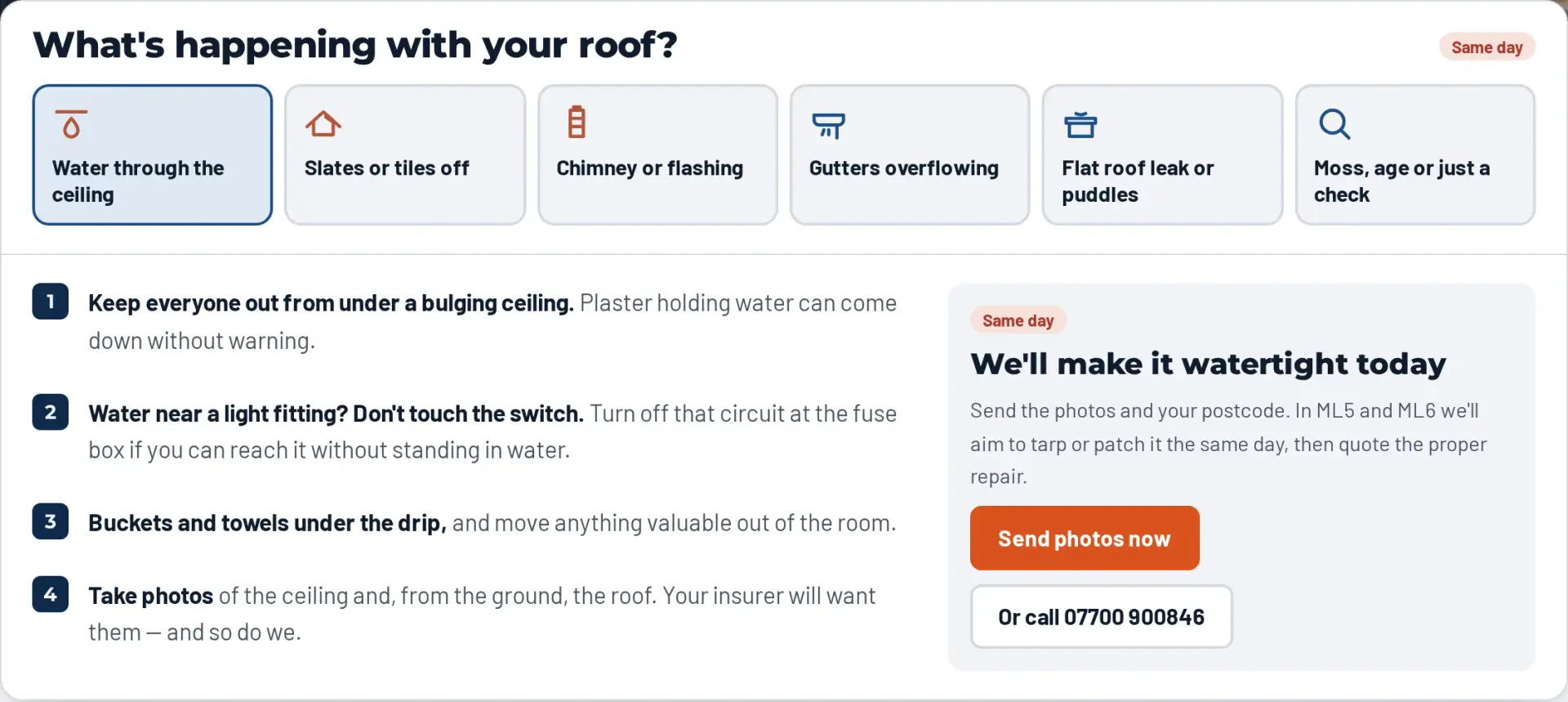
  • Sort the enquiry before it reaches youWater through a ceiling, a slate off, a chimney, gutters, a flat roof, or just a roof that is getting on. Six choices, one tap, and the answer shapes everything that follows.
  • Tell them what to do right nowKeep out from under a bulging ceiling. Do not touch the light switch. Photograph it for the insurer. Genuinely useful, costs you nothing, and it is the moment they decide you are the sensible one.
  • Be honest about which ones are urgentMoss on a concrete tile is not an emergency and saying so builds more trust than treating everything as one. The trade’s bad reputation is built on manufactured urgency — refusing to do it is a position worth taking openly.
  • Give the planned buyer something to readSix weeks of comparing needs pages that explain repair against replacement, what a guarantee covers, how the claim works. Whoever wrote those is the one still in the running at the end.
Triage — water through the ceiling
A triage panel designed by Central Systems: six choices describing what is happening with the roof, with the water-through-the-ceiling option selected, showing four numbered safety steps and a panel offering to make the roof watertight the same day.

Four steps, then the ask. The advice comes first and costs nothing. By the time the button appears, the person reading has already decided you are the one who knows what they are doing.

The storm

A named storm rearranges your year in about nine hours.

Demand arrives all at once, stays for a few days and then vanishes — and the same wind brings two very different callers to the door. One has a genuine hole in the roof. The other has a stranger in a van telling them they need a new one.

The window

Everything happens before the wind drops

The searching, the ringing and the doorstep callers all land inside about forty-eight hours. Whoever answers first, or answers best, takes most of the work. A site that cannot be updated the same morning has already missed it.

  • A line at the top, changed in minutes
  • Photo enquiries, no phone queue
  • Honest wait times, not promises
  • Make-safe now, quote properly later
The other caller

Somebody knocked their door

After every storm, people are told from the pavement that their roof is finished. A page that explains what actually warrants a full replacement — and what is a morning’s repair — is a real service, and it is the reason they ring you instead.

Capacity

Say what you can honestly do

Nobody can make sixty roofs watertight in two days. “Same day in these postcodes where it is safe to get a ladder up, otherwise the day after” is a better sentence than a promise you break by Thursday.

Safety

Wind is a reason to stay down

Writing plainly that you will not put a man on a roof in a gale is not a weakness. It tells a homeowner you are the sort of firm that has rules, which is precisely the signal they are hunting for.

After

The spike is a list, not a week

Half the storm enquiries want work in March. Captured properly, that fortnight of chaos becomes a booked spring rather than a fortnight of chaos.

Money

“We’ll come out and have a look” is not a price.

Roofing genuinely does vary enormously — which is the reason given for publishing nothing, and the reason publishing something matters so much. A householder with no figure at all cannot tell a fair quote from a chancer’s, so they default to the cheapest of three. That is not a market you want to compete in.

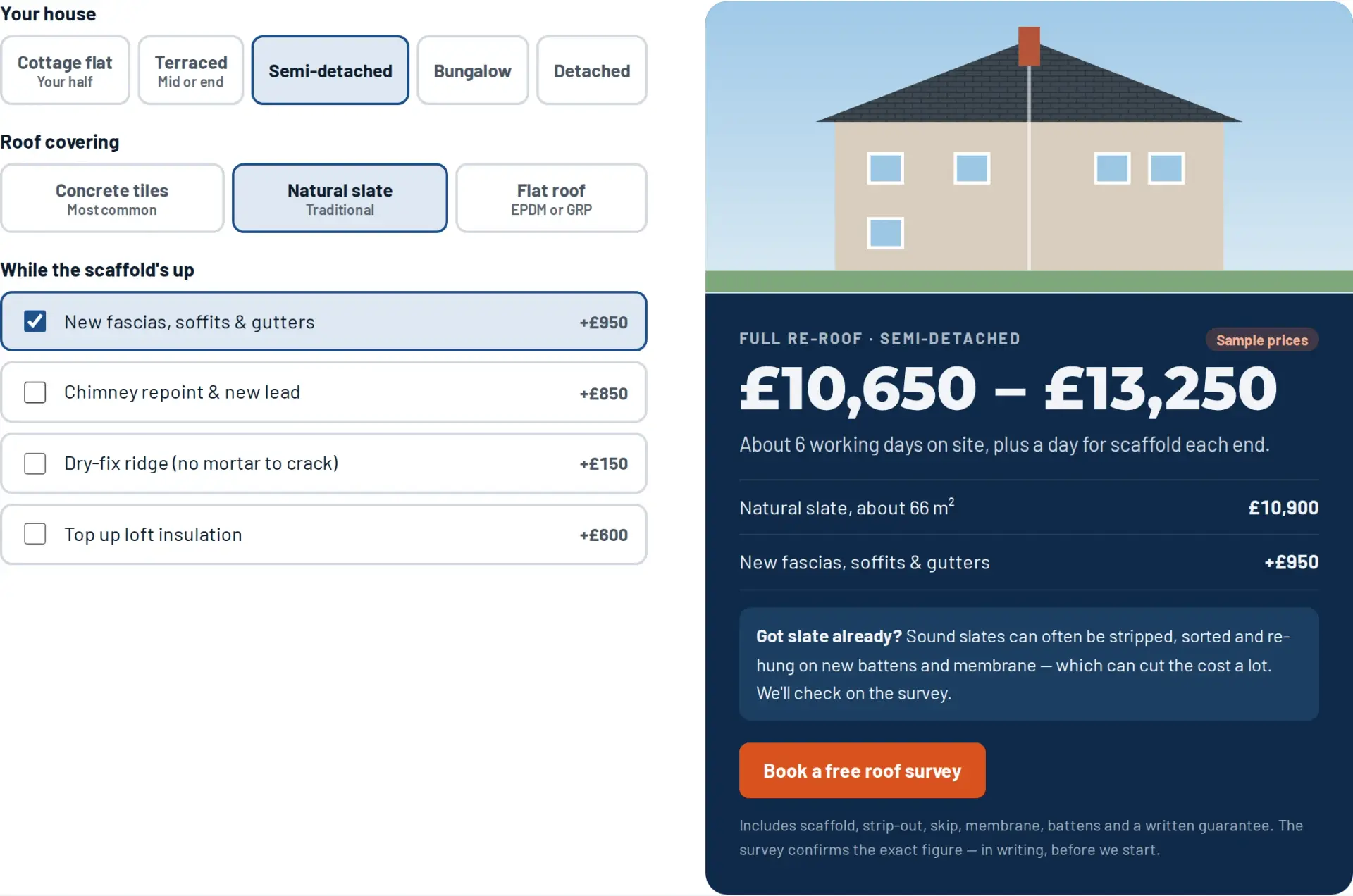
Price the house, not the jobTerrace, semi, bungalow, detached. Slate or tile. Those two answers get a homeowner inside the right band in about four seconds, and that is all a range has to do.
Say what is inside the figureScaffold, strip-out, skip, membrane, battens, disposal. Half the gap between two quotes is one of them leaving the scaffold out, and the customer has no way of knowing which.
Show the days as well as the money“About six days on site, plus a day for the scaffold each end” answers the question people are too embarrassed to ask: how long will my house be a building site.
Offer the things worth doing while the scaffold is upRoofline, chimney, dry-fix ridge, loft insulation. Doing them now is cheaper than doing them in four years, and saying so is advice rather than an upsell.
Name the things that move itA roof that has been felted once already. A chimney nobody mentioned. Scaffold that has to go over a conservatory. Listed in advance, they are variables; produced at the end, they are a row.
Label the estimate an estimateA range on the website and a fixed written figure after the survey is an honest sequence, and it is the one the trade is least trusted to follow. Following it visibly is worth a great deal.
Re-roof estimate — semi in slate
A re-roof estimating panel designed by Central Systems: the owner picks their house type, roof covering and any extras to do while the scaffold is up, and the panel returns a price range, the number of days on site and an itemised breakdown, labelled as sample prices.

A range, and what is in it. Nobody is booking a re-roof off a web page. They are working out whether to ring you at all, and whether the quote that arrives next week is a sensible one.

Every figure is yours, checked by you, and flagged for review before it drifts — that upkeep lives in ongoing care.

Plain words

Half the quote is in a language the customer does not speak.

Verge, abutment, soaker, undercloak. A homeowner reading a quote full of those cannot tell whether they are being sold something necessary or something invented, so they go quiet and ring the cheaper one. Explaining the words is not dumbing down; it is the difference between a quote that gets read and a quote that gets forwarded to a spouse with a question mark.

Name the parts on a pictureRidge, valley, flashing, fascia, soffit, batten, membrane. Labelled once on a simple cross-section, and every quote you write afterwards reads as information rather than as a barrier.
Say how each part failsMortar cracks and the ridge rocks loose. Nails rust and slates slip one at a time. Lead splits. Told how a thing goes wrong, a customer can see the fault themselves from the garden.
Answer repair against replacement honestlyMost calls are a few slates, a ridge or a flashing. A page that says so — and says what genuinely does justify stripping a roof — costs you a handful of unnecessary re-roofs and wins you the trade of everyone who reads it.
These pages are what the search engines want“Do I need a new roof or a repair” is a question people genuinely type, and it is answered badly nearly everywhere. Answering it properly is both the useful thing and the thing that ranks.

Insurance

The claim is the part everybody dreads and nobody explains.

A large share of storm work goes through an insurer, and the homeowner has usually never made a claim in their life. They do not know what an excess means for a job this size, what a loss adjuster does, or whether asking you to invoice the insurer is a normal request.

EvidencePhotograph it before you touch itThe tarpaulin goes on and the evidence goes with it. Dated photographs from the ground and the roof, taken before the make-safe, are the single most useful thing you can hand a customer.
WordingWrite the report in their language“Storm damage” and “wear and tear” are not descriptions, they are categories with money attached. A clear, factual account of what the wind did is worth more than an opinion about it.
SequenceSet out the order of eventsMake safe, report, quote, decision, works. Four lines on a page that stop the customer ringing three times to ask what happens next, and stop them doing something that complicates the claim.
HonestyNever promise the outcomeYou do not decide what an insurer pays and saying otherwise is the fastest way to turn a happy customer into an angry one. “Here is what we will give you to support it” is the only defensible promise, and it reads as more competent, not less.
ExcessSay the awkward part earlySometimes the excess is most of the repair and claiming is not worth it. Telling somebody that costs you a job and buys you a customer for the next twenty years.
RecordsKeep the file where you can find itAdjusters come back with questions months later. Photographs, report and quote held against the job, not in a phone gallery, is the difference between five minutes and an afternoon.

Holding that lot against the job rather than in three phones is what a customer record is for, and it is nearly always the first thing worth fixing.

The promise

A guarantee with no terms is a number, not a guarantee.

Everybody writes one on the van. Very few write down what it covers, what it does not, whether it survives a house sale, and what a customer should do on the day they find a stain on the ceiling. Those four answers are worth more than another five years on the headline figure.

Terms

Workmanship and materials are two different promises

The slate carries a manufacturer’s warranty. The way it was hung carries yours. They run for different lengths and they fail in different ways, and separating them in writing is the mark of a firm that has thought about it.

  • What is covered, in a sentence
  • What is not, in a sentence
  • Whether it transfers on sale
  • How to make a claim on it
Insurance

Name the cover, do not just claim it

Public liability and working at height, with the actual figures, where they are genuinely held. Anyone can type “fully insured”. Far fewer will put the number next to it, and the gap between the two is where trust gets made.

Membership

Only the ones you actually hold

A row of badges nobody has checked is worse than none. One genuine membership, with the registration number and a link to the register, is a verifiable fact rather than a logo.

Afterwards

Say what happens if something does go wrong

Roofs occasionally leak after work; weather is like that. A firm that has written down how it responds is telling a customer it expects to still be there. That is the entire promise, really.

Paperwork

Issue it without being chased

The certificate, the photographs and the invoice sent the day after the scaffold comes down. Most people have to ask twice. Not having to ask at all is remembered for years.

Where you work

Nobody wants a roofer from an hour away in February.

Roofing is bought locally and searched locally, and the map listing does a disproportionate amount of the work — especially in the two days after a storm, when people search on a phone and ring the first firm that looks close and real.

What actually moves the map listing
Say where you genuinely goA postcode checker that says yes, says yes-but, and sometimes says no. Turning work away honestly is better for the listing and better for the reviews than driving forty miles and doing it badly.
Photographs with a place in themA sandstone terrace, a Lanarkshire skyline, real slate. Stock imagery of a roof in Ohio does nothing for a local search and quietly tells people you have no local work to show.
Reviews, asked for at the right momentThis trade is read on its reviews more than most, because there is nothing else to go on. The day the scaffold comes down and the photographs land is the moment to ask.
One page per real area, not fiftyThin pages naming every village within thirty miles are transparent and they do not work. Three or four honest area pages, written by somebody who has worked there, do.

The other half of it is the phone. Most storm searching happens on a handset in a hallway with a bucket in it, so a page that takes eight seconds to appear has already lost. Weight, hosting and image size are not technical detail here; they are the whole enquiry.

And the site has to be legible one-handed, in the dark, by somebody who is annoyed. That is a real design constraint, and it is the one most roofing sites fail.

Adjacent trades, in case they are useful: trades & construction, plumbers & heating engineers, window cleaners and estate & letting agents.

Systems

Most roofing firms run on a phone, a notebook and a memory.

That works at three vans and stops working at six. We are not here to sell you software you do not need — only to point out where the same information is being written down twice, and what that costs you in a busy fortnight.

EnquiriesOne list, not four inboxesWebsite form, phone, Facebook, the number on the van. When they land in different places, the one that gets forgotten is always somebody’s five-figure re-roof.
PhotographsAttached to the job, not the phoneThree lads photographing four roofs a day fills a gallery nobody can search. Tied to the job number on the way in, it becomes the record that settles questions years later.
QuotesWritten once, sent from anywhereThe quote written in a laptop at nine at night is usually the one that was going to be won and is now a day late. Built off the survey on site, it goes out before you have driven home.
DiaryWeather is a scheduling inputHalf your year is moved by rain. A diary that is one thing the whole firm can see beats six people ringing each other to find out whether Thursday is still on.
ChasingThe quotes that went quietPlanned re-roofs take weeks to decide. A single polite follow-up at the right interval recovers more work than any amount of advertising, and almost nobody sends it.
FitKeep what already worksIf you run job-management software and it suits you, keep it. The question is only whether the website feeds it or whether somebody retypes every enquiry into it by hand.

If some of that is already in hand, industry management software and AI integrations set out where the joins usually go.

Honest fit

Where this tends to pay, and where it does not.

Firms that already do the work properlyIf the roofs are right and the paperwork is right, the only problem is that nobody can tell from the outside. That is a website problem, and it is a solvable one.
Anyone chasing planned re-roofsReactive repair work mostly comes down to being close and picking up. High-ticket replacement is decided on evidence and clarity over several weeks, and that is a fight you win on paper.
Growing firms losing enquiries in the gapsThe point at which a second or third van arrives is usually the point at which enquiries start falling down the back of the sofa. That is a plumbing problem between systems, not a marketing one.
Not if you want the badges without the substanceWe will not put an insurance figure, a guarantee term or a trade body on a page unless you actually hold it. In this trade, an unverifiable claim is worse than no claim at all, and we would rather say so now.

Afterwards

A roofing site goes stale faster than most.

Prices move with materials. Scaffold rates move. The areas you cover change with where the vans are based. A site built beautifully in March and never touched again is a slightly misleading document by the following spring, and it is your name on it.

  • Someone looking at it, not just hosting itUpdates applied, backups checked, forms actually tested from a phone. The commonest failure we find on trade sites is an enquiry form that has been quietly dead for months.
  • Figures reviewed before they misleadA diary reminder to revisit every range on the site. Two or three times a year is enough, and it is the difference between a useful page and a liability.
  • Storm-week readiness, arranged in advanceThe banner, the message and the capacity line agreed while the weather is calm, so changing them takes ten minutes rather than a phone call to somebody on holiday.
  • The slow half, written properlyRepair against replacement, what a guarantee covers, how a claim runs. These pages take months to matter and then keep mattering, and whoever writes them first tends to keep them.

None of that is dramatic. It is the unglamorous half of owning a website, and it is the half that decides whether the thing is still earning in year three or quietly embarrassing you.

We would rather do a small amount of it every month than rebuild something neglected every four years, which in our experience is what actually happens otherwise.

The arrangement is set out on ongoing care, and the search side on SEO & growth.

Straight answers

What roofing firms ask us

Should I really publish prices when every roof is different?
A range, not a price. Roofing does vary enormously, and that is exactly why a homeowner with no figure in their head cannot judge your quote at all — so they judge it against the two other numbers in front of them and pick the smallest. Giving them a band by house type and covering, clearly labelled as an estimate confirmed after a survey, costs you nothing and stops you being priced against somebody who has left the scaffold out.
Will a photo quote just fill my phone with rubbish enquiries?
It usually does the opposite, because it asks for effort. Somebody who has gone outside, taken three photographs and typed their postcode is a considerably warmer enquiry than somebody who pressed a phone number. It also means you can price a slipped slate from the van instead of driving across town to look at it, which is where most of the day goes.
We are busy enough. Why would we bother?
Being busy and being busy with the right work are different problems. Most firms that say this are full of small reactive repairs and short of planned re-roofs, which is the work that actually pays. Those are decided on evidence over weeks, and that is the bit a website does and a van sign cannot.
Can you actually help with the insurance-claim side?
We can build the part that is yours: the page explaining how the process generally runs, the report template, and somewhere to keep photographs and paperwork against the job so an adjuster’s question months later takes five minutes. What we will not do is write anything implying you can guarantee what an insurer pays, because you cannot and it would land you in trouble.
I have not got photographs of anything. Is this a non-starter?
No, but start taking them from the next job. We will build the site so there is an obvious place for them and get you going with the rest — and within a couple of months you will have something no competitor can copy. Photographs of your own work, stripped and mid-build, are the one asset in this trade that cannot be bought.
Do you put trade-body logos on?
Only ones you genuinely hold, with the registration number shown. A wall of badges nobody can verify reads exactly like the sites people are trying to avoid, and in a trade with this much suspicion in it, one checkable membership beats six decorative ones.
What does something like this cost, and how long?
It depends entirely on how much of it you want. A straightforward site with photo quotes and an estimate range is a modest job; adding claim handling, a job record and area pages is a larger one. We scope it properly first, put a fixed figure in writing, and nothing starts until you have agreed it — the same sequence we have just spent a page recommending to you.
Who writes the technical bits?
We do, from a long conversation with you and then checked back. Nobody wants a roofing page written by somebody who has never been up a ladder, and the detail that makes these pages land — which failures you actually see round here, what you refuse to do and why — only exists in your head.

Next step

Let’s make the work visible.

A first proper site, a rebuild of something that has not moved in five years, or just photo quotes and an honest price range added to what you already have — tell us which jobs you are losing and roughly where they go.

Email if that is easier — we know the phone goes unanswered when you are thirty feet up. Working out what it needs costs nothing, and you will have the figure in writing before anything is built.