New: Try our free Website Audit tool. Run your free audit →Run it free →

Dog groomers & pet salons

You can only sell nine o’clock once.

Grooming is not a service business with a diary attached — the diary is the business. Every hour on the table is a thing you can sell exactly one time, and an empty Tuesday is gone for good. Almost every website in the trade is built to describe what a groom involves. Very few are built to fill the week.

Online bookingPrice by breedDepositsRebookingQuiet slotsPhoto updatesMap visibilityLooked after
Interface by Central Systems
Dog grooming salon — home
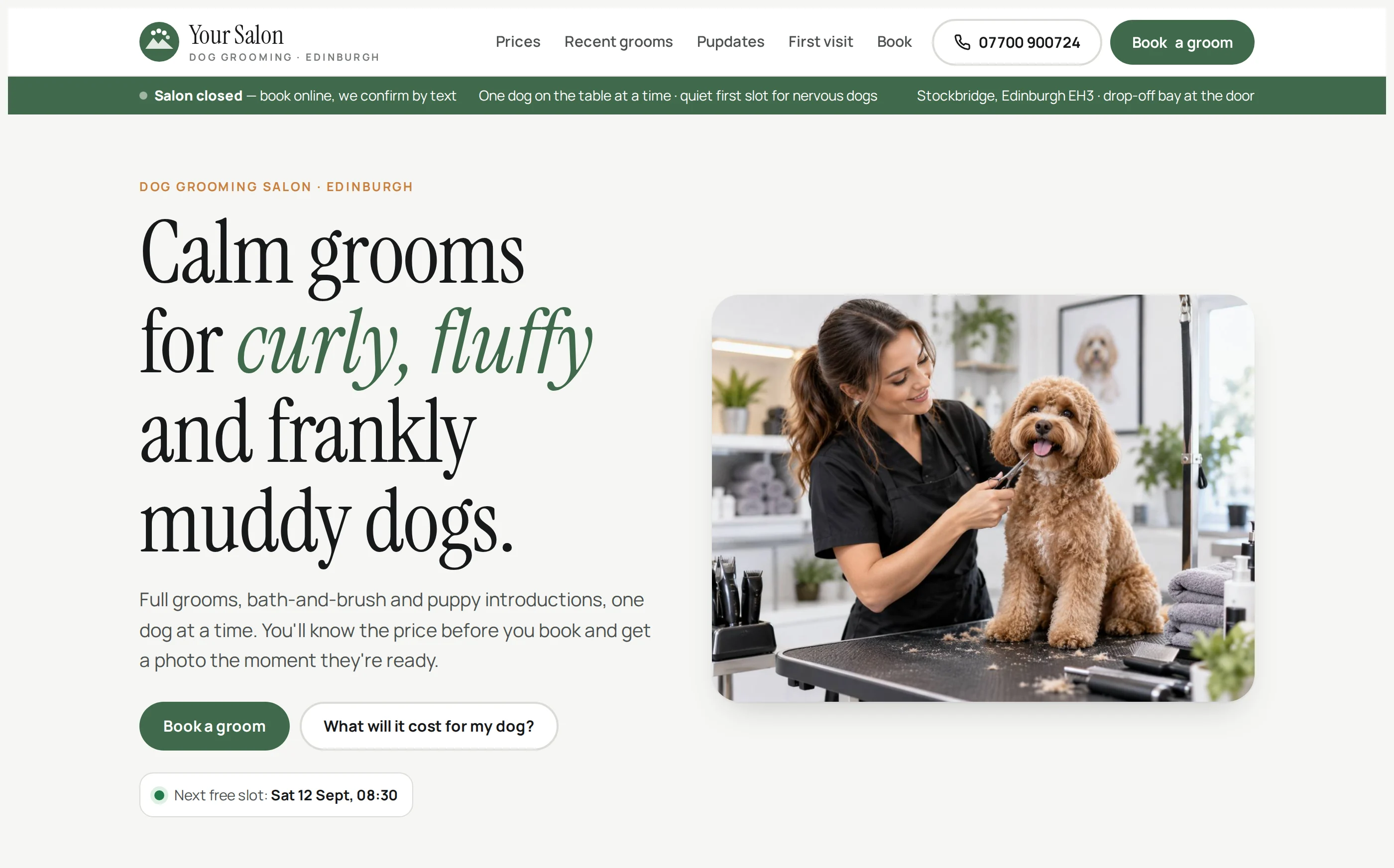
The homepage of a dog grooming salon site designed by Central Systems: a header carrying prices, recent grooms, updates and booking, a strip saying the salon is closed but bookings are confirmed by text, and a headline promising the price before booking and a photograph the moment the dog is ready.

The state of it

Built like a brochure for a business that runs like a restaurant.

In short

A groomer has a fixed number of covers a day and no way to make more. The site should be selling those covers — and instead it is usually a gallery, a price list that says “from”, and a contact form that goes to an inbox nobody opens until seven.

The person reading it is holding a phone in one hand and a lead in the other. They want to know three things: can you take my dog, what will it cost, and when. If the site cannot answer those without a phone call, they will ring the next salon — and you will find out at the end of the day, with soap on your hands and a missed call notification.

The list on the right is what turns up again and again.

Eight things we keep seeing
  • “Prices from £30.” Which tells a doodle owner nothing, and sets up the exact conversation on the doorstep that everybody dreads.
  • No way to book. Just a form, or a Facebook message, or “ring the salon” — from a business where the owner’s hands are wet for seven hours a day.
  • Nothing about no-shows. No deposit, no reminder, no cancellation terms — and a gap on Saturday that cost more than a week of advertising.
  • A gallery and nothing else. Forty lovely afters, no indication of what any of them cost or how long they took.
  • Silence on matting. The single hardest conversation in the trade, left entirely to the moment the owner is standing there.
  • No mention of nervous dogs. Even though it is the thing a huge share of owners are most worried about, and the reason they leave one salon for another.
  • Nothing that rebooks. No cycle, no reminder, no next date — so every appointment has to be won again from scratch.
  • Slow, heavy and hard on a phone. Full-size photographs of every dog ever groomed, loading over mobile data outside a wet park.

The real product

Table time is stock, and it perishes at closing.

A shop can sell tomorrow what it failed to sell today. A groomer cannot. Every unfilled hour is written off at five o’clock, which makes the website less a shop window than a till — and it should be designed that way.

The gap

A no-show is the expensive one

Two and a half hours held for a dog that never arrives, at a time somebody else would gladly have taken. A small deposit at booking, a reminder the day before and a stated cancellation window turn most of those back into appointments.

  • Deposit at booking
  • Reminder the day before
  • Clear window to move
  • Waiting list to backfill
The quiet week

Not all days are equal

Saturdays fill themselves. Tuesday mornings in February do not. A site that can nudge a discount, a slot release or a waiting list toward the quiet end of the week is doing something no gallery can.

  • Slot releases
  • Short-notice list
  • Off-peak pricing
  • Seasonal pushes
The overrun

The dog that takes twice as long

A coat worse than described pushes everything back and eats the afternoon. Asking about the coat honestly at the point of booking is scheduling, not sales — it protects the rest of the day.

  • Coat asked at booking
  • Time held to match
  • Nothing sprung on you
  • Fewer overruns
The blank slot

Nobody books at nine at night

Except that they do. A large share of enquiries land after the salon shuts, when somebody has finally sat down. If the only answer then is a form, the booking waits until morning — and often never happens.

  • Bookable out of hours
  • Live availability
  • Confirmed instantly
  • No phone tag

The reminders and deposits are automation more than design — see business automation.

Money

“From £30” is the most expensive sentence on the site.

Because it delivers the wrong customer. A cockapoo owner reads thirty and hears thirty; you are looking at two and a half hours of scissor work. The disappointment lands on the doorstep, and one of you eats it.

Price the dog, not the serviceBreed or coat type, size, and what the coat is actually like today. That is what decides the work, so that is what the page should ask before it says a number.
Show the time as well as the price“Two and a half hours on the table” explains the figure better than any justification. It also sets a collection expectation instead of inviting somebody to wait in the car.
Say what moves itMatting, size within a breed, a coat left twice as long as it should have been. Named in advance, a surcharge is fair; produced at collection, it is a row and a bad review.
Label an estimate as an estimateConfirmed on the table, before any clipper is switched on, never at collection. Said plainly, that line does more for trust than a page of promises.
Publishing prices filters, it doesn’t exposeThe shoppers who only ever wanted the cheapest were never going to be good customers, and they take up a remarkable amount of time on the phone before saying no.
Keep it current or take it downA price list two years old is worse than none, because it is your own page arguing against you while somebody stands at the counter holding a lead.
Price by breed and coat
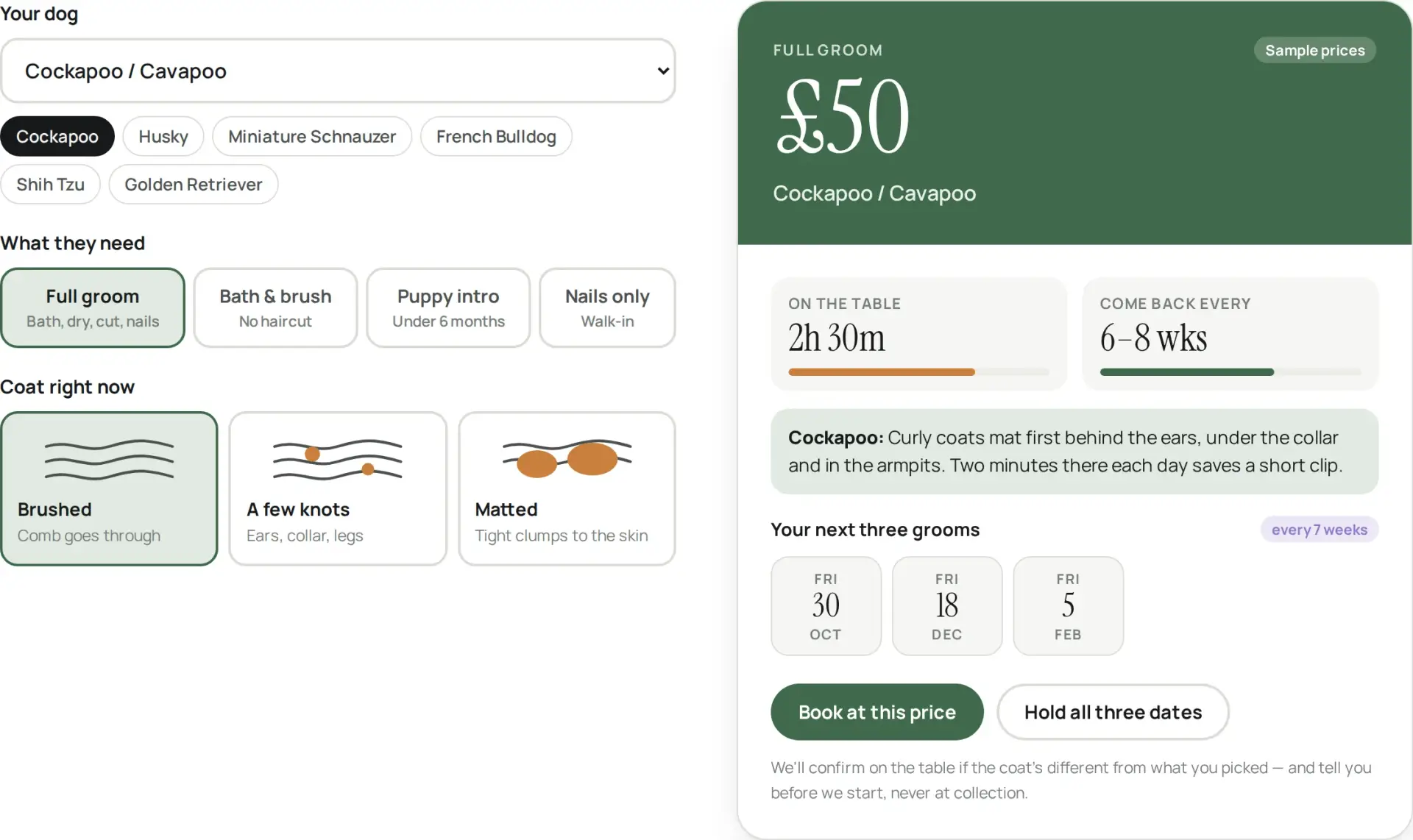
A grooming price tool designed by Central Systems: the owner picks their breed, the service and the current state of the coat, and the panel returns a price, the time the dog will be on the table, how often to come back, and the next three appointment dates.

Ask about the dog first. Breed, size and the state of the coat decide the work, so the panel asks for those before it commits to anything — then returns the price, the time on the table, how often to come back and the next three dates that fit.

No number reaches a live page until you have looked at it, and each one gets a diary reminder to revisit — that upkeep sits under ongoing care.

Taking the booking

Fewer options, better bookings.

A booking form is not a calendar with everything on it. The good ones ask two or three questions about the dog and then show only the slots that suit that dog — which looks like less choice and produces better days.

  • Ask about temperament, then act on itNervous, elderly or arthritic dogs belong in the first slot, before the dryers are going and the salon is full. A form that asks and then quietly restricts the options is doing real work.
  • Hold the right amount of timeThe answers decide the block. A puppy introduction and a matted double coat are not the same appointment, and a diary that treats them as one will be wrong by lunchtime.
  • Take a deposit without apologyIt is normal across every appointment trade now. Said plainly, with a fair window to move, almost nobody objects — and the Saturday gaps stop.
  • Capture what you need to startVaccination status, lumps and sore spots, what they are like with the dryer, who is collecting. Asked at booking, none of it eats into the appointment.
Booking a nervous dog
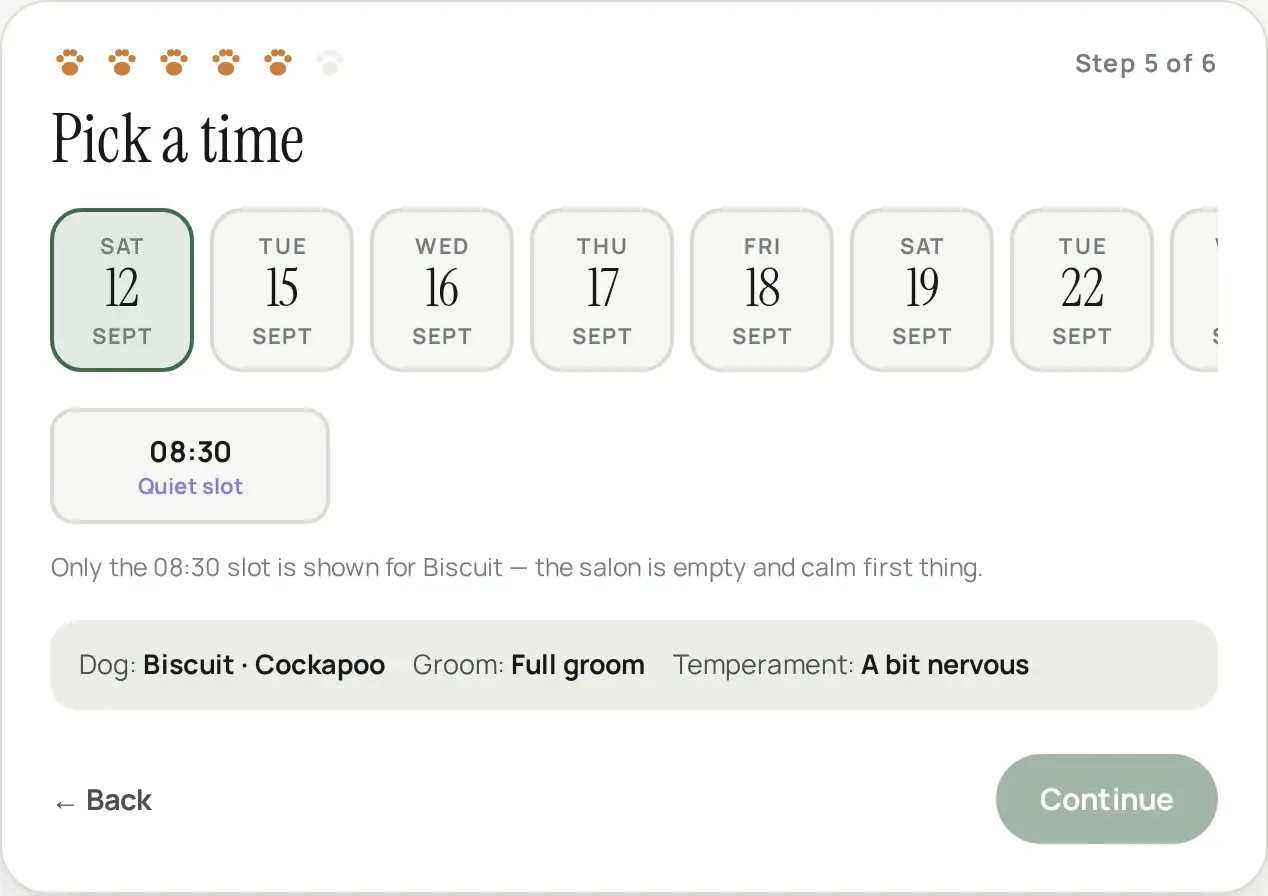
A booking step designed by Central Systems: having been told the dog is a bit nervous, the form offers only the first appointment of the day, marked as a quiet slot, and explains that the salon is empty and calm first thing.

One slot, on purpose. Because the owner said the dog was nervous, the form stops offering the busy afternoon and explains why. Restricting choice is what makes the answer feel like advice rather than a calendar.

The hard conversation

Have the matting conversation before the dog arrives.

Everybody in the trade has had the same morning: a coat felted to the skin, an owner who has no idea, and a choice between hurting the dog and disappointing the person. The website can take most of the sting out of that, weeks earlier and in writing.

ExplainWhat matting actually isNot tangles — a solid pad against the skin that pulls with every step. Once an owner understands the difference, the recommendation stops sounding like an upsell.
ShowWhat it looks likePhotographs of a comb refusing to pass, of what comes off. Uncomfortable, and far more persuasive than a paragraph about brushing more often.
DecideWhy short is the kind answerDematting a felted coat is hours of pulling on skin. Clipping short and starting again is the humane choice, and saying so in advance makes it a decision instead of a shock.
PriceWhat it costs, said up frontExtra time is extra money and everybody knows it. Publishing the band, and confirming before starting, keeps it a fair charge rather than a surprise.
PreventThe two minutes that stop itBehind the ears, under the collar, the armpits, the back legs. Naming the four places that mat first is the single most useful thing a grooming site can tell somebody.
RebookWhy the interval mattersMost matting is a booking problem, not a brushing problem. A coat left twelve weeks when it needed six was always going to arrive like that.

Knowing the coat

“We don’t shave double coats” is a whole marketing strategy.

Because the people who look that up are exactly the customers worth having, and the salons that will shave a husky in July are not going to write it down. Technical honesty about coat types separates a groomer from a clipping service faster than any amount of branding.

Every coat type is a page somebody is searching for. Curly and wool coats and the maintenance they demand. Double coats and why stripping the undercoat is not the same as taking the length off. Wire coats and the case for hand-stripping. Silky ears and feathering that tangle where nobody looks.

Written properly, these pages do two jobs at once: they bring in the owner researching their breed, and they arrive at your door already understanding why you charge what you charge.

  • Say what you will not doRefusing to shave a double coat, or to demat a felted one, reads as expertise rather than inflexibility — and it pre-filters the arguments.
  • Write for the breed, not the serviceSomebody types their dog’s breed, not “dog grooming near me”. A page that names the coat and its quirks meets them where they actually are.
  • Keep it your own voiceThis is knowledge you already have and give away on the phone twice a day. Written down once, it works while you are drying a retriever.
Where this shows up

Coat-type content is what search engines and AI assistants quote when somebody asks how often a cockapoo needs grooming, or whether a husky can be clipped. Being the salon that answered it properly is worth considerably more than being the salon with the most photographs.

Covered in full on SEO & growth.

The three hours nobody sees

They have left a member of the family with a stranger holding scissors.

Whatever else the appointment is, that is what it feels like from the car park. Almost nothing a grooming business can do buys more goodwill than closing that gap — and it costs a photograph and a text.

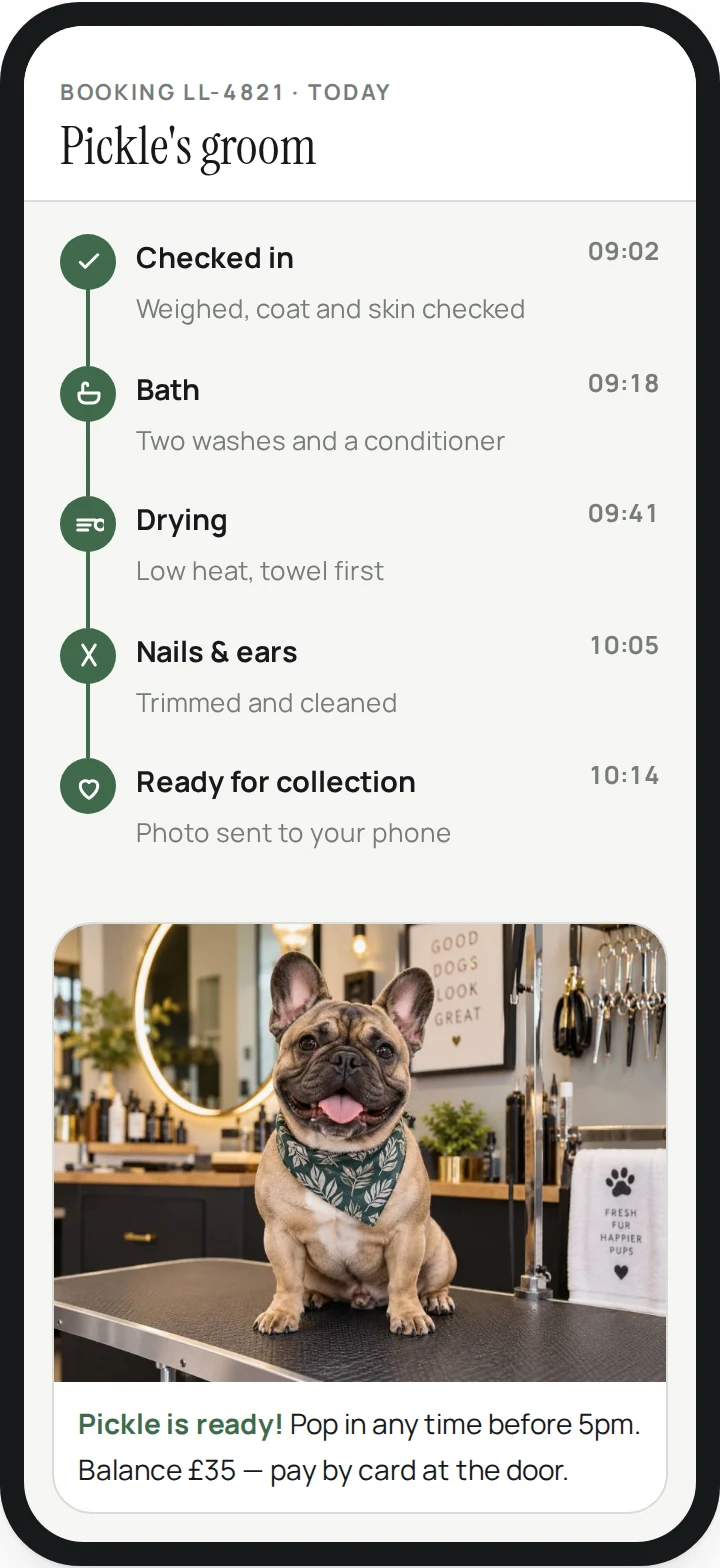
A booking page designed by Central Systems shown on a phone: each stage of the groom is ticked off with a time against it, from check-in through bath and drying to nails and ears, ending with a photograph of the finished dog and a note that it is ready for collection.

The bit the owner cannot see. Each stage is one tap for the groomer and a small reassurance for the person who has been wondering since nine. The photograph at the end is the part people show other people.

  • Say when they will be readyNot “we’ll ring you” — an actual time. It stops the phone going at half past ten, and it stops somebody sitting outside in the car for two hours.
  • The photograph does the marketingA picture of a delighted, freshly groomed dog is the most shared thing your business produces. Sending it as a matter of course turns every appointment into something somebody else sees.
  • Flag anything you foundA lump, a sore ear, a cracked pad. Passed on properly, it is the single most valued thing a groomer does that the owner did not pay for.
  • Take the payment before pick-upA card link with the ready message clears the counter and removes the awkward part of collection entirely.
  • Book the next one while they are pleasedThe moment somebody sees their dog looking like that is the easiest moment of the entire cycle to get a date in the diary.

The business model

One customer, booked on a cycle, is worth a dozen who found you once.

A dog needs grooming every few weeks for a decade or more. That is the whole economics of the trade, and it is the part websites in this sector almost never touch — they are all built to win a first appointment and then go quiet.

The interval belongs to the coatFour weeks for one dog, twelve for another. A site that knows the difference by breed can suggest the right date instead of leaving it to whenever somebody notices the eyes have disappeared.
Book the next three at onceStanding appointments are normal in every other appointment trade and rare in this one. Offering the next three dates in a single action fills the quiet weeks months ahead.
Reach the ones who driftedEvery salon has a list of dogs last seen eight months ago. A friendly message naming the dog, sent at the right interval, is the cheapest booking you will ever take.
Start them as puppiesA first groom booked at sixteen weeks is a customer for the next twelve years. A page written for new owners — what happens, why it is short and gentle — is worth more than it looks.

Reminders and standing appointments are handled under business automation, with the client records in CRM & business systems.

Being found

People choose a groomer the way they choose a hairdresser.

Close enough to walk or park easily, and recommended by somebody they know. That is a map listing, a set of photographs and a stack of reviews far more than it is a website — but the website is what turns the visit into a booking.

  • The map profile carries the searchPhotographs of the salon and the work, current opening hours, the booking link and the phone number. For a local service this is genuinely more valuable than the homepage.
  • Ask for the review at the right momentNot a week later by email — in the message with the photograph, while somebody is still delighted. That timing is most of the difference between salons with ten reviews and salons with two hundred.
  • Answer the poor ones calmlyEvery groomer eventually gets one about a length or a price. A measured reply reads better to the next reader than a wall of five stars with nothing else.
  • One page per place you actually serveA mobile groomer covering six towns can justify six pages if each says something true about that round. Twenty spun variants help nobody and read as thin.
  • Treat guarantees as a warningPlacement cannot be bought or promised, whatever is being pitched down the phone. What we can do is build the foundations correctly and show you, month by month, exactly what came of it.

There is a second route that matters more each year. Owners ask assistants how often a breed needs grooming, whether a coat can be clipped, what to do about matting — and the answers come from pages that explained it clearly, not from pages that listed services.

That is the same coat-type writing as above, doing a different job. It is slow, it compounds, and it belongs to whoever wrote it first.

Set out properly on SEO & growth.

Systems

You may already run salon software. Good — keep it.

There are decent booking and client products written specifically for this trade, and a salon running one happily should carry on. The question worth asking is whether the website and that product are the same system or two things a person retypes between.

Joined up

One diary, two front doors

Availability shown on the site is the availability in the diary, and a booking taken online appears there without anybody copying it across. Where the product opens up properly, that is what we build.

Straight answer

When it will not connect

Some products in this sector are closed. Rather than bolting something fragile onto the side, you will be told plainly, and we will make the hand-off tidy and consistent instead of pretending it is live.

Records

What you know about the dog

Coat notes, the clip they have, what they are like with the dryer, the sore spot last time. Held in one place and in front of whoever is on the table, that history is a large part of why people stay.

Bespoke

Only where nothing fits

Several groomers, a van and a salon, a day-care arm, boarding alongside. Occasionally the packaged products genuinely do not stretch, and then building is the right answer. Rewriting a working diary is not.

If the plumbing behind the booking is what interests you, start with CRM & business systems, then industry management software or AI integrations.

Fit

Grooming businesses come in very different shapes

A mobile groomer working alone from a van and a four-table salon with a receptionist want almost opposite things from a website. Plenty of the above will not apply to you, and working out which parts do is most of a first conversation.

SalonA high street shopfrontWalk-past trade, a waiting area and a diary that has to stay full. Booking, deposits and the map profile carry almost all of it.
MobileGrooming from a vanTravel is unpaid time, so the site has to be clear about where you go and price the distance honestly rather than taking every enquiry.
HomeWorking from a converted spaceOne dog at a time, usually booked solid, usually by word of mouth. Here the site is mostly about filtering — the right dogs, the right expectations, no phone calls.
GrowingTwo or three groomersPast the point where one head holds the diary. Availability, records and reminders now have to live somewhere other than a notebook.
SpecialistHand-stripping and show workA smaller, more knowledgeable audience who will travel. Here the coat-type writing is not marketing — it is the entire proposition.
AlongsideDay care, boarding or a shopGrooming as one arm of something larger. The trick is a site that sells all of it without making any part of it confusing to book.
StartingNewly qualified, first premisesNo reviews yet and no reputation. What works is being specific and being honest — about the coats you are best with and the ones you are still learning.
DatedAnyone with a site from years backSlow on a phone, no booking, prices from three price rises ago, and a form last tested by whoever installed it. Usually cheaper to rebuild than to patch.

Reading on from here: starting from scratch, replacing what is there, or the other sectors we build for.

After launch

A diary is never finished being filled.

Prices move, a groomer joins, the quiet month turns out to be January rather than February. A grooming site benefits more than most from somebody adjusting it every month, because what it is really managing is next week.

  • Push the quiet weeksWhere the gaps actually fall is something only the diary knows. Aiming a slot release or a short-notice list at the right fortnight beats advertising into a month that was already full.
  • Keep every figure honestPrices carry a review date. A rise that reaches the counter before it reaches the website is a conversation nobody enjoys having.
  • One coat type at a timeWhatever owners keep ringing to ask about is a page waiting to be written. Added gradually, they stack up into something that keeps earning long after the month it went live.
  • Refresh what is on the profileNew photographs of recent work, hours changed for the holidays, a new groomer named. The map listing is the shopfront for most of your search traffic.
  • Someone minding the plumbingLoad times over mobile data, booking forms proving they still submit, patches applied, copies kept off-site. Watched year-round, not discovered in December.
Measured as appointmentsHow many bookings arrived, which were new dogs and which were rebooks, and what people read first. Ranking graphs are in the pack because everybody wants them — but a page that ranks and fills nothing gets rewritten.
A list you controlEverything queued sits somewhere you can see it. Taken on a second groomer this month? Say so and it jumps the queue; the quieter jobs wait.
Hosting and upkeep togetherAll of it in one arrangement, so when the booking form misbehaves on a Saturday morning there is one number to ring rather than two companies pointing at each other.

Detail sits elsewhere: SEO & growth for being found, ongoing care for the rest. Take either, both or neither — a fair number of salons run it perfectly well themselves once it is built.

Straight answers

What grooming businesses ask us

Will online booking actually fill the quiet days?
On its own, no — it removes friction rather than creating demand. What fills the quiet end of the week is being able to act on it: release a short-notice slot, message the people who asked for one, or price a Tuesday morning differently. Booking is what makes those things possible in an afternoon instead of an evening on the phone.
Should I really put my prices on the website?
Yes, priced by breed and coat rather than as one “from” figure. It filters out the callers who only ever wanted the cheapest, and it stops the doorstep disagreement that costs you a customer and a review. Label it as an estimate confirmed on the table — that is both honest and, for most owners, reassuring.
Can you build the price tool for my prices?
Yes, and the logic has to be yours. We build the interface; you tell us the breeds, the bands, what matting adds and where the grey areas are. Every band goes past you before it goes anywhere near the public. Anything that sounds too certain about a dog nobody has laid hands on simply relocates the disagreement to the counter.
I use booking software already. Are you replacing it?
Almost certainly not. Those products handle diaries, client records and payments properly, and if yours works you should keep it. The useful job is connecting the website to it so availability is real and a booking lands in the diary without retyping. Where a product does not open up, we will say so and make the hand-off tidy instead.
What about deposits — will people object?
Far less than most groomers expect. Deposits are normal now across appointment trades, and taken at booking with a fair window to move they simply become part of it. The people they lose are, in the main, the people who were going to be the no-show. The Saturday gap costs more than the awkwardness.
Do I need a page for every breed?
Not every breed — every coat. Curly, double, wire, silky and smooth cover most of it, and a page each on what they need and how often is genuinely useful. Breed pages are worth adding for the ones you are asked about constantly. Twenty thin variants of the same paragraph help nobody.
Roughly what are we talking, and how quickly?
Entirely down to scope. Something quick and solid — honest prices, a real booking route, fast on a phone — sits at the modest end. A breed-by-breed price tool, a library of coat-type pages, deposits, and a link into your salon software each move it up. Either way, a written scope and a fixed figure land with you before a line of it is built, and we do not guess at numbers on an introductory call. Reckon on weeks.
Who writes it?
We do, from talking to you. What makes these pages land is the detail only somebody on the table has — which coats come in worst, what owners always get wrong about brushing, why you will not clip a particular dog. Our job is drawing that out of you, giving it a structure and writing it up — then handing anything technical back for you to verify before it publishes.

Next step

Let’s get the week filled.

A first site, a rebuild of something slow, or just online booking and honest pricing bolted onto what you have — tell us where the gaps in the diary actually fall and what you are turning away.

Message rather than ring if that suits you better — we are well aware your hands are wet most of the day. Working out the scope is free, and nothing gets built until you have signed off what it costs.