New: Try our free Website Audit tool. Run your free audit →Run it free →

Window cleaners & exterior cleaning

A customer on the wrong street costs you money. Your website should know that.

Window cleaning is a round, not a sales pipeline, and almost no website is built for the difference. Most collect an enquiry from anyone anywhere, then hand you the job of ringing back to explain your price and, half the time, that you do not come that way. We build sites that settle the postcode first, show the price on the screen, and put a suitable customer straight onto the right day.

Round-aware websitesInstant pricingPostcode checksOnline sign-upMap listingsMonthly search workText automationLooked after
Interface by Central Systems
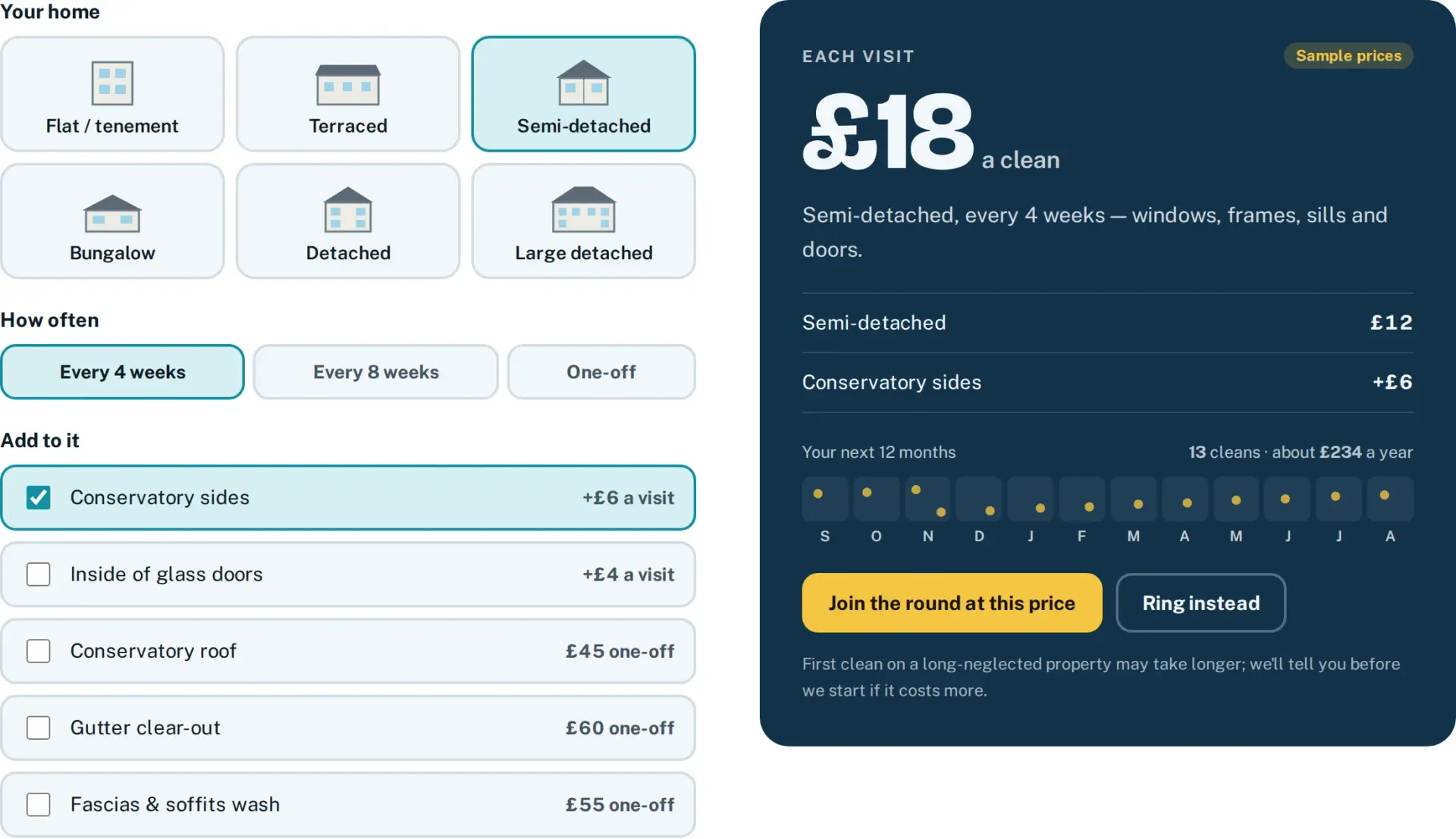
Instant price tool
A window cleaning price tool designed by Central Systems: property types shown as illustrated tiles, a frequency choice and a list of add-on services on the left, with a running price per visit, an itemised breakdown and a twelve-month visit calendar on the right.

The state of it

Every site in the trade says the same three things.

In short

Rounds were built on the street, by knocking doors and by being recommended over a fence, and the website came along years later as an afterthought. It shows. The trade has some of the best word-of-mouth in the country and some of the weakest websites attached to it.

That mattered less when a new customer meant a card through a door. It matters now, because somebody moving into a house looks for a window cleaner the same way they look for anything else, and the first thing they want to know is whether you come down their street and roughly what it will cost. Neither question is usually answered anywhere on the site.

What we find instead is on the right, and it is remarkably consistent from one firm to the next.

What we usually find
  • “Call for a free no-obligation quote.” Which means an evening spent quoting, against two rivals who also want a phone call, for a job worth a tenner a visit.
  • A form that accepts anybody, anywhere. No postcode check, so enquiries arrive from streets you have no intention of driving to, and somebody still has to let them down.
  • A gallery of clean glass. Fifteen photographs that all look identical and answer no question anybody was asking.
  • No mention that frames and sills are included. The thing that actually separates you from the cheapest bidder, left unsaid on every page.
  • No round days, no coverage detail. A list of town names in the footer is not the same as telling somebody you are on their street a week on Thursday.
  • Nothing about how it works in practice. Do I need to be in, what happens if it rains, how do I pay, can I stop — the four questions every new customer has, unanswered.
  • One mobile number as the only route. Answered from the top of a pole, or not at all, and the caller has already tried the next firm by the time you ring back.
  • Domestic and commercial in one heap. A facilities manager and a householder want completely different things, and the site tries to serve both with the same paragraph.

Pricing

Put the number on the screen.

Window cleaning is one of the few trades where the price can honestly be published, because it turns on things a customer already knows: what sort of house it is, how often, and whether there is a conservatory. A tool like the one at the top of this page asks those three things and shows the answer.

The trade’s habit is the opposite. “Free quote” sounds generous and costs you two things: the evenings you spend giving them, and the customers who never ask because they assume anybody hiding a price is expensive.

It also does the filtering for you. Somebody who thinks a semi should be five pounds sees the number and goes elsewhere, which is the correct outcome for both of you and takes no phone call to reach.

More on the build itself under website design and website redesign.

  • Bands, not guessesFlat, terrace, semi, bungalow, detached, large detached. Anything genuinely unusual gets a band of its own and a note that the first visit confirms it — which is honest, and stops the tool promising something you cannot hold to.
  • Say what is includedFrames, sills and door glass on every visit is the line that wins the job against a cheaper quote. Most sites in the trade never print it, and the ones that do stop being compared on price alone.
  • The first-clean surcharge, stated up frontA property nobody has touched in two years takes longer. Saying so on the pricing page costs you nothing; springing it on somebody afterwards costs you the customer and the review.
  • Extras priced separatelyGutters, fascias, conservatory roofs and the inside of glass doors are a real part of the money in this trade, and they sell far better sitting next to a price than hidden behind “ask us”.
  • Commercial is the exceptionOffices, shops, schools and care homes need a survey and a written quote. The site should route them somewhere else entirely rather than pretending a tile picker covers it.

The round

The postcode is the first question, not the last.

Cleaning a semi takes a quarter of an hour. Driving twenty minutes to reach it is the part that is not paid for, which is why a tight round earns and a scattered one does not. A website that ignores geography is quietly working against the business behind it.

On the round

Tell them the day

When the postcode lands inside the round, the site can say which day you are on that street and roughly when you would next be there. That is a far stronger answer than a promise to ring back, and it is the point at which most people simply sign up.

Near the edge

Be straight about it

Just outside is worth a different answer — a one-off clean, or a place on a list for that street. Pretending it is covered leads to a customer you resent driving to, and that one usually cancels first anyway.

Outside

Send them somewhere useful

Saying no clearly, and pointing at a trade body listing or a firm you know covers it, costs you an enquiry you never wanted and earns the kind of goodwill that comes back as a recommendation.

Not yet

Collect the street, not the lead

Four houses asking from the same street is a round worth starting; one is not. A waiting list held by street rather than by person turns a scatter of refusals into a map of where to expand, and gives you a reason to get back in touch.

This is enquiry handling more than it is design — see business automation for the routing side of it.

Coverage

Same street, same day. Say so.

Most rounds already run to a weekly pattern in the owner’s head. Writing that pattern down and putting it on the site answers the question people actually have, which is not whether you exist but when you would be there.

It also does something useful for search. A town a customer recognises, with a real day attached and a genuine description of what you cover, is a page worth having. Twenty near-identical town pages spun from a template are not, and we will say so rather than build them.

Where the round genuinely reaches, the page earns its place. Where it does not, a paragraph on an existing page is the honest answer.

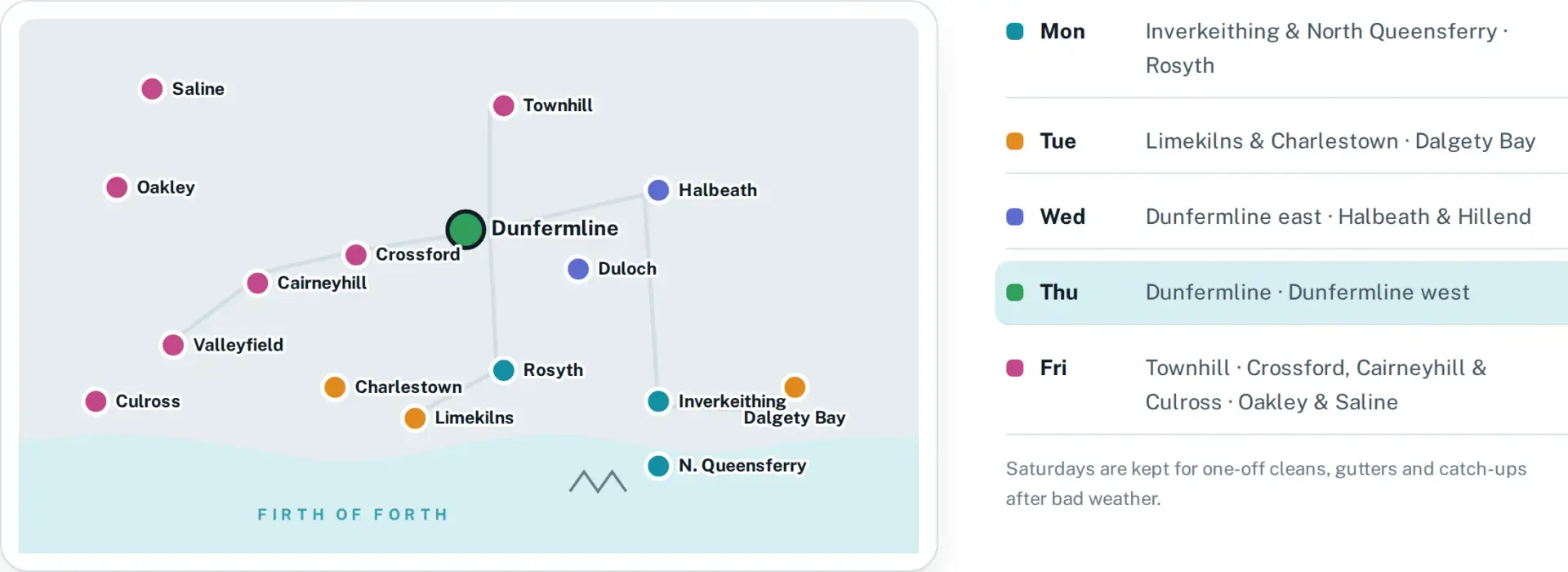
Round days by area
A round-day map designed by Central Systems: towns plotted across a simplified area map, each coloured by the weekday it is cleaned, with a matching list of days and the areas covered on each one.

Geography made legible. A map does in one glance what a footer list of town names never manages — and selecting a town highlights its day, so somebody can find their own street without reading the lot.

  • A page only where there is something to sayThe day you are on that street, what is included, the sort of property there, and anything specific to the place — salt off the coast, sap under the trees, the tenement stairs. If none of that is true, it does not need a page.
  • Coverage stated as it really isNot a list of every town within thirty miles, which nobody believes anyway. A line that says where the van actually goes reads as confidence rather than limitation.
  • Round days kept currentThe one thing worse than not publishing a schedule is publishing one that stopped being true eighteen months ago.

Explaining the work

The method is the sales argument. Write it down.

Pure water, poles, no ladders, frames every visit — the trade knows why all of that matters and almost never explains it to the person paying. It is the most useful content a window cleaning site can carry, and it doubles as the answer to the complaints you get most often.

Why the glass stays clear longerSpots are minerals left behind when ordinary water dries. Take them out first and there is nothing to leave a mark. That is a paragraph, and it is worth more than a gallery.
“You have left it wet”The single most common message a window cleaner gets, and one a page can answer before it is ever sent. Explaining that it dries clear on its own saves a conversation every week.
What happens in bad weatherRain is mostly clean water, so the work carries on; wind is the one that stops it. Saying which is which stops people assuming you simply did not turn up.
How high you reach, and from whereWorking from the ground matters to anybody who has had a ladder against their render. Upper flats, tenements and townhouses all want to know before they ask.
What is actually includedFrames, sills, door glass, and the cobwebs round the top windows. Written plainly, it is the difference between a price comparison and a reason to choose you.
Why four weeks rather than eightThe honest version — what builds up in a month near a main road or the coast, and why a longer gap makes each clean harder rather than cheaper.

Written properly, these are also the pages that pick up searches — see SEO & growth.

Signing up

Let them join the round without ringing anybody.

The usual route is a mobile answered from the top of a pole, or not answered at all, and a callback that evening if it gets remembered. A short structured sign-up does the same job while you are working, and collects the things you would otherwise have to ask for twice.

A handful of steps, one decision eachProperty, postcode, how often, how to get round the back, how they would like to pay. Each one a tap, nothing that needs a keyboard until the last screen.
Access details, captured onceThe gate code, the dog, where the tap is, which side to park. Operationally this is the most valuable thing on the form and the thing a phone call always forgets to ask.
A date, not a promiseBecause the round already has a shape, the site can offer the next real visit for that street rather than saying somebody will be in touch. That is the moment the sign-up stops feeling like an enquiry.
It works at nine in the eveningWhich is when people sort this kind of thing out. An enquiry that has to wait for you to be off the van is an enquiry that has already tried the next firm on the list.

The running relationship

The admin is the service, as far as the customer can tell.

Nobody watches you clean their windows. What they experience is the text the night before, the text afterwards, the way they pay and how easy it is to skip a month — and that is what gets described when somebody asks them for a recommendation.

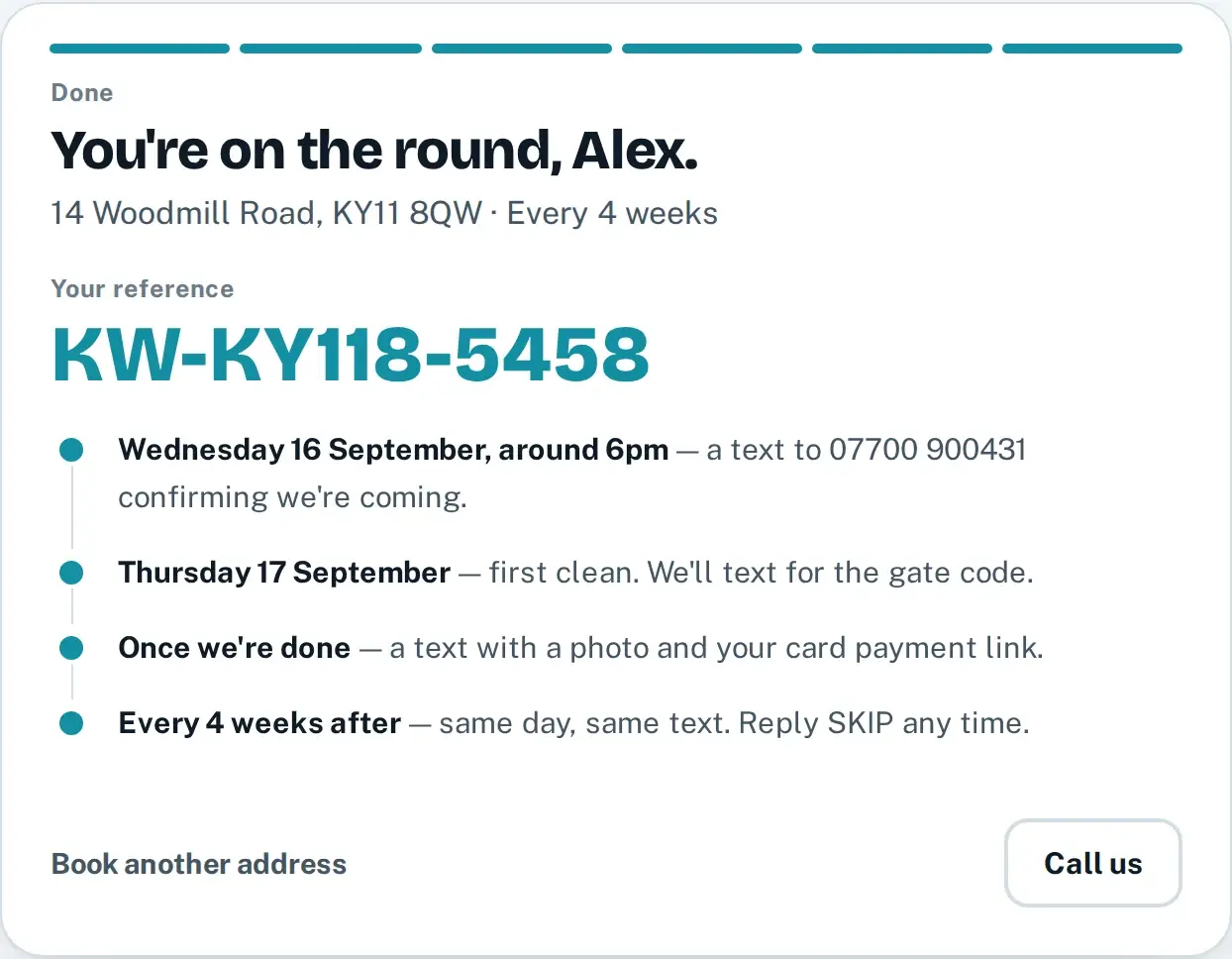
Sign-up confirmation
A sign-up confirmation screen designed by Central Systems: a reference number, the address and frequency, and a timeline setting out the reminder text the evening before, the first clean date, what arrives once the work is done, and what happens on the following visits.

What happens next, set out on the screen. A reference, a first date and the sequence of texts to expect — written at sign-up rather than left for the customer to work out over the first two visits.

  • The evening-before textGates get unlocked, cars get moved, and nobody is startled by somebody in their back garden. It is the single cheapest thing you can automate and the one customers mention most.
  • Proof it was doneA message when you leave, with a photograph where it helps — the conservatory roof, the upstairs at the back. Settles the “were you even here?” question permanently.
  • Paying without a doorstep conversationA payment link after the clean, or a monthly arrangement for the ones who prefer it. Cash still works for whoever wants it; it should simply not be the only option in the year we are in.
  • Skipping made easy on purposeLetting somebody stand a month down with one reply keeps them on the round. Making it awkward is how a skip quietly turns into a cancellation.
  • No contract, said plainlyThe biggest unspoken objection in domestic window cleaning is being tied in. One sentence on the page removes it.

Most of this is automation rather than web design — see business automation and AI integrations.

Being found

Most of this trade is won on a map, not a web page.

Somebody wanting a window cleaner types the job and the town, and what appears first is a map with three businesses on it. The website still matters — it is what they check before they tap — but the profile beside it is doing at least as much of the work.

  • The profile and the site pulling togetherMatching name, address and number, services that correspond to real pages, and photographs of actual work rather than stock glass. The two are read as one thing.
  • Reviews asked for at the right momentThe minute after the “all done” message is when somebody is most willing, and it is the only realistic time you will ever catch them. Building the ask into that message is worth more than any amount of chasing later.
  • Photographs that are yoursYour van, your streets, your weather. They carry location signals a stock library cannot, and they look like the firm that will actually turn up.
  • Positions nobody can promiseAnyone guaranteeing a map placement is selling something other than what they say. We build the structure and the content properly, then tell you straight what it did.

The website’s job in all this is narrower than agencies like to claim, and more important than the trade usually assumes. It has to load quickly on a phone held in one hand, make the area obvious, show a price, and give somebody a way to sign up while they are still thinking about it.

Do that and the map listing has somewhere worth sending people. Skip it and the listing quietly stops converting, which looks like a search problem and is not one.

Covered at length on SEO & growth.

Commercial work

A facilities manager wants none of the above.

Commercial is a different sale to a different person with a different set of worries, and putting it through the domestic pricing tool serves neither. Where a firm does both, the site needs a second route that starts from what that buyer needs to see.

Paperwork, findablePublic liability cover, method statements and risk assessments, and whatever accreditation you hold. Half of a commercial decision is somebody checking they can justify the choice internally.
The kinds of premises you handleShops, offices, schools, care homes, showrooms, industrial units. Each implies different access, different hours and different constraints, and naming them does more qualifying than any paragraph about quality.
When you workBefore opening, after closing, term-time only, weekends. A commercial buyer is choosing around their own operating hours before they ever consider price.
Invoicing, not a payment linkPurchase orders, monthly invoices, account terms. Saying so signals that you have done this before, which is most of what a facilities manager is trying to establish.
A survey route, not a priceA short form that gathers site, storeys, frequency and access, then a written quote. The domestic tool is the wrong instrument and pretending otherwise loses the job.
The wider exterior listGutters, fascias, cladding, solar panels, render and pressure washing. Commercial buyers often want one supplier for the lot, and that only happens if the site says you do it.

Systems

We are not replacing your round software.

Rounds, schedules, debts and job history belong in the round-management products built for this trade, and firms running one should keep running it. Our interest is the gap in front of it — the part customers touch — and getting what the website collects into whatever you already use.

Feed it

The website is the front door

A sign-up should arrive in your round software as a customer with an address, a frequency, a price and the access notes attached — not as an email somebody has to retype on a Sunday night. Where a usable interface is published, we connect to it.

Honest limits

Where no connection exists

Some products in this trade have no practical way in. We will tell you that rather than build something brittle around it, and the fallback is a clean, structured hand-off you can work from in a couple of minutes.

Bespoke

Only where there is a real gap

Occasionally a firm has grown into something the packaged products do not cover — several crews, a commercial contract book, an unusual billing arrangement. That is worth building. Rebuilding a scheduler that already exists is not.

Ownership

Your customers stay yours

Addresses, access notes and history are the value in a round. Whatever we build, that data stays somewhere you control and can take with you, which matters a great deal on the day somebody sells the round.

Further detail: CRM & business systems · industry management software.

Who this is for

The operations this suits

A one-van round and a six-van operation want very different things from a website, and a good deal of what is above will be irrelevant to any particular firm. Working out which portion applies is most of a first conversation.

OwnerOwner-operator with a full roundNot looking for volume — looking to replace the weaker customers with better ones on streets already being driven, and to stop losing evenings to quoting.
GrowingTwo to five vansPast the point where one person remembers everything. The site has to qualify properly, because somebody other than the owner is now picking up what it sends.
MixedDomestic and commercial togetherTwo audiences, two routes, one brand. The common failure is letting the domestic side write all the copy and wondering why commercial enquiries never arrive.
ExteriorWider exterior cleaning firmsGutters, render, roofs, driveways and solar as well as glass. Higher-value work that needs its own pages rather than a line on the services list.
ContractCommercial-only contractorsNo domestic round at all. Credibility, accreditation, capacity and coverage carry the site, and a pricing tool would actively get in the way.
Multi-siteFranchise and multi-branch operationsOne brand, several territories, and the perennial question of how a visitor gets to the right one without being asked to work out which branch they are in.
NewStarting up, or buying a roundWhere the site has to do the credibility work that years of being seen on the street would otherwise do — and where getting the area and price right from day one saves a lot of undoing.
DatedAnyone with a site built years agoTypically slow on a phone, no pricing, no sign-up, and a contact form nobody has tested since it was installed. Usually a rebuild rather than a repair.

Where to go next: a first build · replacing an old site · who looks after it afterwards.

After launch

A round grows. The site has to keep up with it.

Launch is not the finish. Areas get added, a van gets bought, prices move, and the search work that puts you on the map takes months rather than weeks to settle. Our ongoing arrangement is a monthly retainer that keeps both the site and the visibility moving with the business.

  • New areas, written properlyWhen the round reaches a new town, that town gets a page with a real day and a real description — added as the van actually starts going there, not twenty at once in the hope that something sticks.
  • Prices that stay trueA published price is only an asset while it is current. Rates get reviewed on a schedule rather than whenever somebody notices the site is a year behind.
  • The map listing maintainedPhotographs added, services kept in step with the site, questions answered, and the review flow kept running out of the “all done” message.
  • Seasonal work brought forwardGutters in autumn, conservatory roofs in spring. Content and pages timed to when people actually search for them rather than sitting flat all year.
  • The technical side watchedSpeed on a phone, forms still submitting, updates, backups and uptime. Checked continuously, not discovered when a customer mentions the sign-up is broken.
Measured as sign-ups, not rankingsA monthly account of how many joined the round, from which areas, and which pages were involved. Ranking charts are included because people like to see them, but a page that ranks and signs nobody up is a page to rewrite rather than celebrate.
One list, in priority orderFixes, improvements and new pages sit on a single backlog you can see and reorder yourself. Taken on a new estate this week? It goes to the top, and something less urgent waits.
Maintenance in the same arrangementHosting, updates, security and backups sit alongside the improvement work, so there is one team accountable rather than a hosting company and a web designer pointing at each other.

Two pages cover this properly: SEO & growth for the visibility work, ongoing care for everything keeping the site itself healthy. Nobody has to take either. A good many firms buy the build and run it themselves quite happily.

Straight answers

What window cleaners ask us

If I publish prices, do I lose the ability to price a big house properly?
No, provided the tool is built to admit what it does not know. Bands cover the overwhelming majority of domestic properties; anything unusual gets a band of its own and a line saying the first visit confirms it. That is a normal thing to read and nobody objects to it. What loses you money is a tool that quotes confidently on a property it has never seen, which is why we would rather it said less.
Will you build the round software as well?
Not unless there is a genuine reason to. The round-management products written for this trade handle scheduling, debts and job history perfectly well, and rebuilding one is an expensive way to end up slightly behind. We build the customer-facing part and get what it collects into whatever you run. If your operation has genuinely outgrown the packaged options, that is a different conversation and we will say so plainly.
I only want one page. Is that enough?
It can be, for a full round that is not trying to grow and simply needs somewhere credible to send people. Be clear about what you are buying, though: one page can carry a price, an area and a sign-up, but it cannot rank for the towns you serve or answer the method questions that win comparisons. If the aim is to be found rather than just to exist, one page is the wrong shape.
Can the site take payment?
It can, and for one-off work like gutters it often should. For a recurring round the money usually moves after the clean rather than before it, so the useful thing is a payment link in the “all done” message or a monthly arrangement set up at sign-up. Which of those fits depends on how you bill now, and we would rather match that than impose a model on a round that is working.
What about the towns I do not cover yet?
We would rather hold them as a list by street than write pages for places the van does not visit. Thin pages built for towns you cannot service are a poor bet with search engines and a worse one with the people who read them and then get turned away. When the round genuinely reaches somewhere, that is the point the page gets written.
What will it cost, and how long?
It turns on how much of the above is in scope. A credible site with pricing and a sign-up is a modest piece of work; area pages, a commercial route and a connection into round software each add to it. You get a written scope and a fixed price before anything starts, and nothing is guessed at on a first call. Most builds of this size run to a few weeks rather than months.
Do you write the content?
Yes, from a conversation with you. The detail that makes these pages work — why you clean four-weekly, what the coast does to glass, which streets are awkward for parking — only exists in the head of the person doing the job. We get it out, structure it and draft it; you check it reads like you before anything goes live.
My round is full. Why would I want more enquiries?
You probably would not, and a site that just increases volume would make your week worse. The useful version does the opposite: it filters by area and price so that what does arrive is on a street you already drive, which lets you drop the awkward customers at the edge of the round without losing income. Density, not volume, is the thing worth chasing once the diary is full.

Next step

A website that knows where your van goes.

Whether that means a first proper site, replacing something slow and dated, or finally letting people sign up without ringing you — tell us where the round runs and what you would like it to stop costing you in evenings.

Ring it through, text it, or use the form — whichever suits somebody who is out on a van all day. Working out what you need costs nothing, and no work starts until you have seen a figure and said yes to it.