
When a business customer pays you late, the law already gives you interest at 11.75% a year and a fixed sum of up to £100 on each overdue debt. Almost nobody claims it, because working it out by hand is fiddly and asking for it feels awkward. An invoicing system can do the sums for you and let you decide, customer by customer, whether to send them. And a bill now in the Commons is about to make those rights harder for big customers to write out of a contract.
Our business automation page says a business shouldn’t rely on memory, spreadsheets or chasing people, and lists payment reminders and late-payment escalation among the work we automate. This post covers what that escalation is allowed to add today, what the Commercial Payments Bill changes, and what your invoicing system needs to record to use either. It applies across the UK, including Scotland. It is not legal advice. The bill can still change before it becomes law, and your own adviser decides how the rules apply to your contracts.
Who this covers
The Late Payment of Commercial Debts (Interest) Act 1998 applies to a contract for goods or services “where the purchaser and the supplier are each acting in the course of a business”. That covers business-to-business invoices and invoices to public bodies, because the Act counts “the activities of any government department or local or public authority” as business.
It does not cover householders. A plumber chasing a homeowner, or a window cleaner chasing a household on their round, gets nothing from this Act. Your system needs to know which customers are businesses before it adds a penny.
What you can add to an overdue invoice today
Three things, all from the 1998 Act:
- Interest. Simple interest at 8% a year above Bank Rate. The Bank Rate used is fixed twice a year: the rate on 30 June applies to debts that go overdue between 1 July and 31 December, and the rate on 31 December covers the first half of the next year. Bank Rate was 3.75% on 30 June 2026, so a debt that goes overdue this half-year carries 11.75% a year. Scotland has its own order setting the same formula.
- A fixed sum, once interest starts to run, under section 5A. It is £40 for a debt under £1,000, £70 for a debt of £1,000 to £9,999.99, and £100 for a debt of £10,000 or more.
- Reasonable recovery costs above the fixed sum, where the fixed sum does not cover what it actually cost you to recover the debt.
Interest starts the day after the payment date you agreed. If no date was agreed, it starts after 30 days, counted from whichever comes later: the day you did the work or delivered, or the day the customer had notice of the amount, which in practice means your invoice. An invoice raised the day a job is marked complete starts that clock weeks earlier than one typed up at the end of the month.
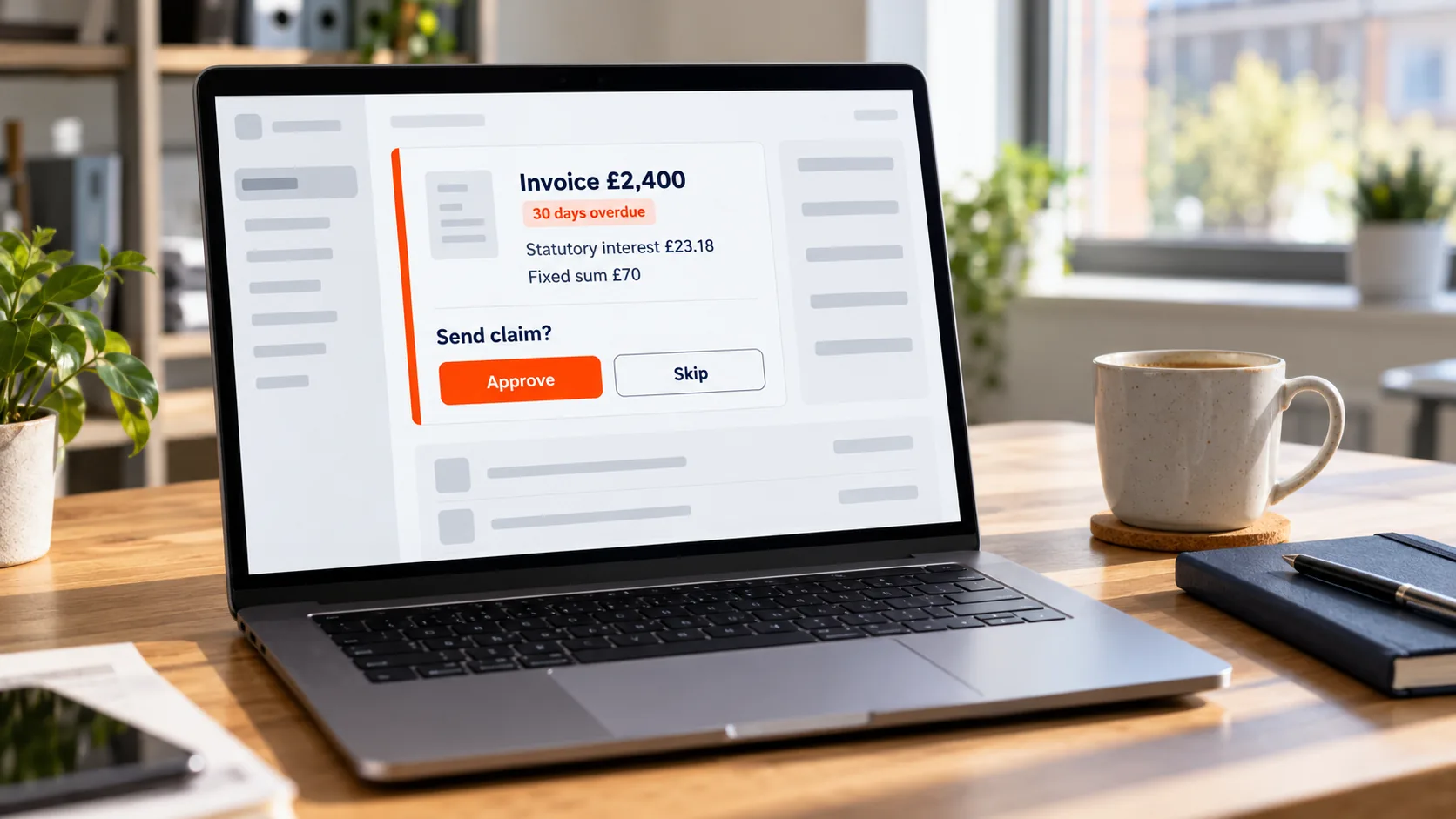
You invoice a business customer £2,400 on 30-day terms, due on 30 November 2026. They pay 30 days late. Interest runs from 1 December at 11.75%: £2,400 × 11.75% × 30 ÷ 365 = £23.18. Add the fixed sum for a debt between £1,000 and £10,000, which is £70. That invoice now carries £93.18 on top of the original amount.
On one invoice that is small change. Across a year of slow payers, for a firm whose customers routinely stretch 30 days to 60, it is real money. It is also the only lever most small suppliers have that the larger customer actually notices.
Why most firms never claim it
The arithmetic is not hard, but it is easy to get wrong by hand. You have to work out the right start day, use the Bank Rate from the right half-year, pick the right fixed-sum band and track the days. Then somebody has to decide whether claiming it is worth the conversation. Most offices settle that by doing nothing.
A system fixes the first part completely and makes the second part a decision rather than a chore. A well-built chase sequence:
- Knows the due date for every invoice, from the agreed terms or, where none were agreed, the 30-day default from the later of completion and invoice.
- Sends a reminder before the due date, not only after it. Payment that arrives on time beats any interest claim.
- Calculates the interest and fixed sum every day once a business invoice goes overdue, using the Bank Rate fixed for that half-year, and shows them on the customer record.
- Asks a person before the first statutory claim goes out. Some customers are worth more than £93. The system sets the figure; the owner decides whether to send it.
- Stops when the invoice is disputed or paid, and records which happened and when.
- Never touches a householder’s invoice, because the Act does not apply to them.
What the Commercial Payments Bill changes
The government introduced the Commercial Payments Bill in the House of Lords on 19 May 2026. The Lords passed it on 20 October and it had its first reading in the Commons on 21 October. It now waits for its second reading there. When it passes, the 1998 Act is renamed the Commercial Payments and Interest on Late Payment Act 1998, and the bill itself becomes the Commercial Payments Act 2026. These are the changes that matter to an invoicing system, from the text as passed by the Lords:
- A hard cap on payment terms. A new section 2B limits the period for payment to 60 days, or 30 days where the customer is a public authority. A longer term is void. If a contract sets no terms at all, payment falls due after 30 days. Today a term longer than 60 days survives if it is not “grossly unfair” to the supplier; that escape goes.
- Statutory interest that cannot be written out. A new section 6A makes a term void if it “purports to exclude or vary the right to statutory interest”, including a lower rate or a later start. Today a contract can replace statutory interest with a “substantial remedy” of its own; that part of the Act is repealed. The fixed sum gets the same protection.
- A charge for disputes raised late. A new section 11A lets you recover a fixed sum from a customer who raises a dispute too late to justify holding back payment. The deadline is the first day of the 8-day period ending with the due date, so roughly a week before it. The sum is the higher of £40 or 1% of the amount in dispute. It also applies if the customer raises a dispute in time but does not give you enough information to understand it. A dispute can be raised “orally or in writing”. This charge does not apply to construction contracts.
- Construction retentions are banned after a two-year transition, under separate clauses that amend the Housing Grants, Construction and Regeneration Act 1996. Builders have their own rules on this; we covered a different part of them in our post on quote cancellation rights.
- The Small Business Commissioner gets an adjudication scheme for payment disputes and powers to investigate poor payment practices.
It is not retrospective. Clause 11 says the changes to payment terms, interest and disputes do not affect contracts entered into before the date each one comes into force. There is no start date yet. Apart from a few powers, the Act starts on days the Secretary of State appoints by regulations. Exemptions for some contracts, such as where the customer is smaller than the supplier and both sign up to an exemption in writing, also depend on regulations not yet made.
What your system needs to record now
Because the new rules apply contract by contract from a date nobody knows yet, the useful work now is in the records, not the reminders:
- The date of each customer contract. Once the Act starts, two customers on identical terms can be treated differently because one signed a week earlier. A system that only stores the invoice date cannot tell them apart.
- Whether each customer is a business or a consumer, and whether it is a public authority, since the cap is 30 days for public bodies and 60 for everyone else.
- A dispute log with a date and time on every entry, including phone calls. The late-dispute charge depends on exactly when a customer raised a problem and what they said. If it was a phone call, you need a note made at the time.
- The agreed payment terms as data, not a sentence in a PDF. When the cap starts, the system should flag any new contract that sets terms longer than 60 days, before you sign it.
Almost all of this is the same plumbing that already makes invoicing quicker: invoices raised on completion, reminders scheduled rather than remembered, and one customer record that knows its own terms. The law decides what three or four of the fields must say.
Common questions
Will claiming interest lose me customers?
It can, which is why the decision should stay with you. The point of automating it is that the figure is always ready. You can send it to the customer who pays every invoice 40 days late, and skip it for the one who paid late once.
Does any of this apply in Scotland?
Yes. The 1998 Act applies in Scotland, with Scottish versions of some sections and its own rate order setting the same 8% above Bank Rate. The bill extends to the whole UK, apart from its construction clauses, which have separate versions for Northern Ireland.
Can I add interest if my terms say nothing about it?
Yes. The 1998 Act makes statutory interest an implied term of every business contract it covers, so it applies whether or not your terms mention it. Saying so on your invoices does no harm, and makes the claim less of a surprise.
When will the 60-day cap start?
Nobody can say yet. The bill must pass the Commons and receive Royal Assent, and then the government has to appoint start dates by regulations. Even then, it will only apply to contracts made after that date.
Sources and method
- Late Payment of Commercial Debts (Interest) Act 1998, as in force today: sections 2, 4 and 5A.
- Late Payment of Commercial Debts (Rate of Interest) (No. 3) Order 2002, article 4, and its Scottish counterpart, the Late Payment of Commercial Debts (Rate of Interest) (Scotland) Order 2002.
- Commercial Payments Bill [HL], text as amended on Report in the Lords (no amendments were made at third reading): clauses 1, 3, 5 to 8, 10, 11, 31 and 32, and Schedule 1 paragraph 6. Stages taken from the bill’s page on the Parliament website.
- Bank of England Bank Rate series, for the rate in force on 30 June 2026.
All were read on 29 October 2026. The bill is still before Parliament and may change. Central Systems is not a law firm, and nothing here assesses any particular contract. The linked text is authoritative where this page is not.
Still chasing invoices by memory?
Tell us how invoices go out and get chased today. We will show you where the dates, reminders and late-payment figures could run on their own, and what to record now so the new rules are easy to follow when they start.