
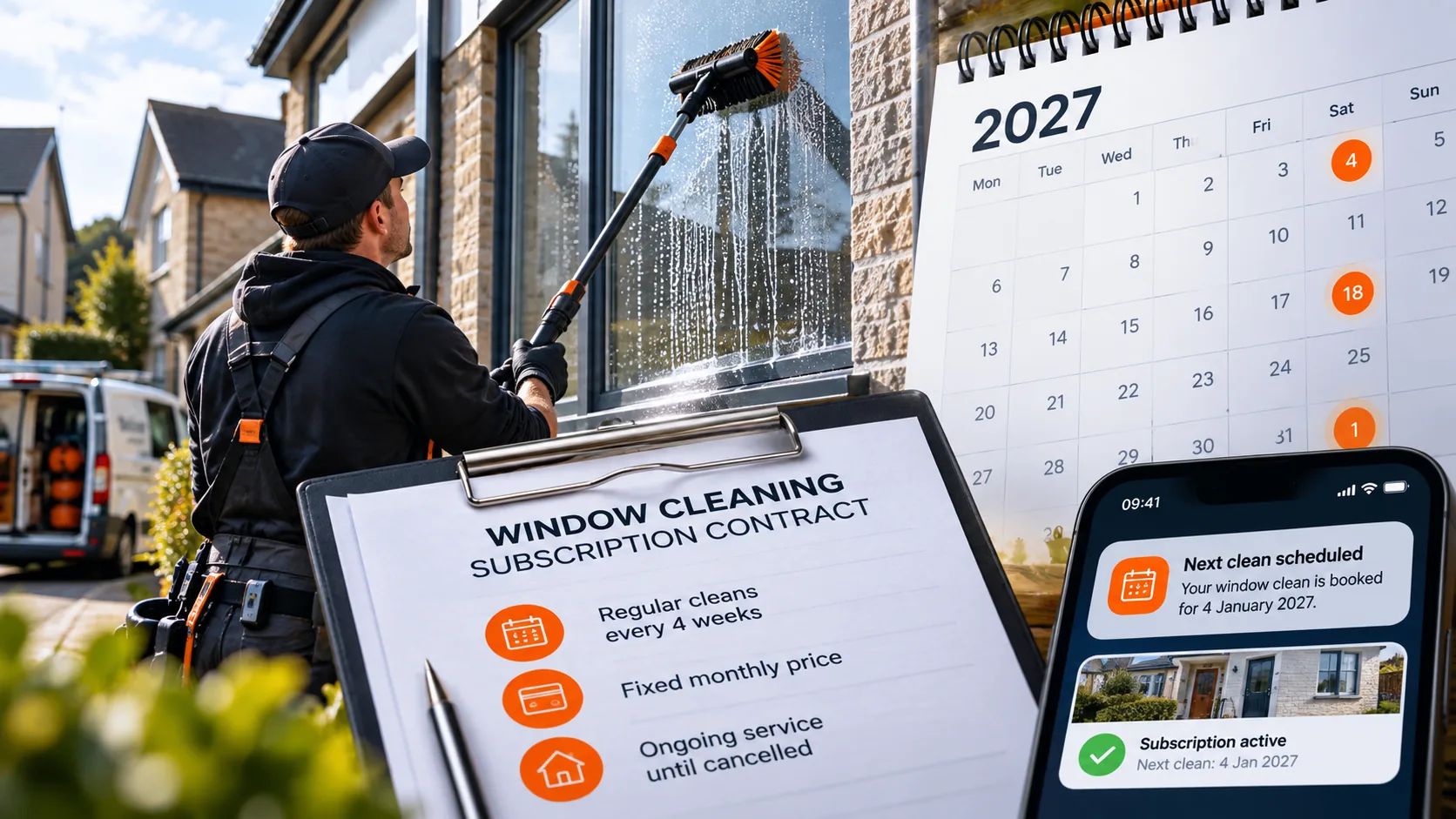
A window cleaning round is about the purest subscription in the high street. The customer signs up once, you come back every four weeks until somebody says stop, and each clean is paid for without a new agreement. From 1 January 2027, if Parliament approves the regulations now before it, that shape has a legal name and a set of rules attached. Most of those rules land on the sign-up: the form on your website, and the conversation on a doorstep.
Our page for window cleaners argues that the website should settle the postcode, show the price and put a suitable customer straight onto the right day. This post covers what the new subscription rules require of that sign-up, of the reminders you send afterwards, and of the way a customer leaves the round. It follows our earlier piece on why the facilities manager asks how you clean windows, which dealt with the commercial side; this one is about householders. It is not legal advice. The regulations are still in draft, and trading standards and your own adviser decide how they apply to your business.
Where the rules come from, and when
Chapter 2 of Part 4 of the Digital Markets, Competition and Consumers Act 2024 sets out a regime for consumer subscription contracts. It was passed in 2024 but left switched off until the government made regulations to complete it. Those are the Consumer Subscription Contracts (Cancellation and Information) Regulations 2026, laid before Parliament in draft for approval by both Houses, with a coming-into-force date of 1 January 2027. The Department for Business, Innovation, Science and Trade published draft guidance alongside them on 19 October 2026.
Three points about timing matter for a round:
- It is not retrospective. The guidance says the rules “only apply to new subscription contracts entered into on or after the subscription regime comes into force on the 1 January 2027.” Customers already on your round are not caught by it.
- Every new customer from that date is. A round grows one door at a time, so within a year a fair share of it will be on the new terms.
- It is UK-wide. The draft regulations extend to England and Wales, Scotland and Northern Ireland. In Scotland the one criminal offence carries a fine of up to level 5 on the standard scale, and local trading standards enforce it.
The government’s own guidance points out that the regime applies to contracts made “online”, “over the phone”, “in person on business premises” and “in person off business premises (e.g. a consumer’s doorstep)”. A round built by knocking doors is covered as fully as one built through a website.
Is a window cleaning round a subscription contract?
Section 254 of the Act defines one. Stripped of the trial-period limb, which most rounds do not use, a contract between a trader and a consumer is a subscription contract if its terms have the effect of providing:
“(a) for an automatically recurring, or continuing, supply of goods, services or digital content to the consumer for an indefinite period or a fixed period, (b) for the consumer to automatically incur liability for each supply, or recurring liabilities for the continuing supply, and (c) a right for the consumer to bring the contract to an end.”
Read that against an ordinary domestic round. You clean every four or eight weeks, with no end date. The customer owes the price of each clean when it is done, without agreeing to it again. And they can stop whenever they like. All three limbs fit. It makes no difference whether payment is by card, Direct Debit, bank transfer or cash in an envelope under the mat; the test is about what the arrangement provides, not how the money moves.
The guidance gives the boundary from the other side. Discussing charity “friends” schemes, it says the rules are unlikely to apply where the organisation “is under no contractual obligation to supply” and the consumer “is under no contractual obligation to make the payments”. Translated to the trade: a customer who rings you each time they want a clean, and books one clean at a time, is not on a subscription. A customer on the round, who expects you to turn up and expects to pay when you do, almost certainly is.
The milkman is excluded. The window cleaner is not.
Schedule 22 of the Act lists the contracts that are excluded. Utilities, financial services, phone and broadband, prescriptions, rented housing, package holidays, timeshares, childcare and gambling are on it. So is one exclusion aimed at very small businesses: a contract between a micro-entity and a consumer for “foodstuffs, beverages or other goods intended for current consumption in the household”, delivered regularly by the trader itself. That is the milk round and the local veg box.
There is no equivalent exclusion for a small business supplying a service. A one-van window cleaner is inside the regime on the same footing as a national gym chain. Gardeners, gutter cleaners, dog walkers and anyone else running a domestic round are in the same position.
What the sign-up has to show
Section 256 requires two layers of information before the contract is made. The “key pre-contract information” in Part 1 of Schedule 23 must be given “all together” and “separately from the full pre-contract information and any other information”. For a round, the items that matter are:
- That it continues until the customer ends it, and that they keep incurring charges until they do (paragraph 2).
- How often they pay and the minimum amount each time (paragraph 4).
- The monthly equivalent, if you do not charge monthly (paragraph 5). This one catches rounds. A clean every four weeks is thirteen cleans a year, so £18 every four weeks has to be shown as £19.50 a month as well.
- The minimum total amount they will become liable for under the contract (paragraph 6). With no minimum term, that is normally the price of one clean.
- Any built-in change to the price or frequency, or any option for you to change them (paragraph 7). A first-clean surcharge is a change in amount. So is a yearly price review written into your terms. Both belong here, in the summary, not only in the small print.
- How to stop, and how much notice you need (paragraphs 8 and 9), with the actual phone number, email address or web page.
- When reminders will arrive (paragraph 10), and a summary of the 14-day cooling-off right (paragraph 11).
The “full pre-contract information” in Part 2 adds the ordinary trading details: who you are, your business address, telephone number and email, what the service includes, payment arrangements, your complaints process and the full cooling-off terms. That can sit behind a clear link online, but the guidance says it must then also be sent “in a durable medium (e.g., email) as soon as reasonably practicable after the contract is entered into”.
Online: no click to read the summary, and a button that says pay
Two rules in section 257 apply when somebody joins the round through your website. The key information must be shown “in such a way that the consumer is not required to take any steps to read the information, other than the steps the consumer must take to enter into the contract”. The guidance answers the obvious question directly: a link to the key information is not enough. It has to be on the screen.
And the final step has a fixed meaning:
“The trader must ensure that the final step which the consumer is required to take to enter into the contract involves the consumer expressly acknowledging that the contract imposes an obligation on the consumer to make payments to the trader.” “If the trader does not comply with subsection (2), the consumer is not bound by the subscription contract.”
A button that says “Join the round” or “Book my first clean” does not obviously do that. “Join the round and agree to pay £18 per clean” does. The difference is a few words on a button, and the consequence of getting it wrong is a customer who is not bound to pay for anything.
The doorstep is where the offence is
Most rounds still grow on foot. You clean one house, the neighbour asks, and the customer is signed up on the path. The Act calls that an “off-premises subscription contract”, one entered into “in person, in a place which is not the business premises of the trader”, and it is the only part of the regime with a criminal offence attached.
Section 268 makes it an offence to enter into an off-premises subscription contract and fail to give the cooling-off summary from paragraph 11(a) of Schedule 23 and the full cooling-off information from paragraph 21. For an in-person contract, section 256 requires the key information “in writing and on a durable medium”. The guidance is plain: “When entering into an off-premises subscription contract with a consumer (for example, on a consumer’s doorstep), it is a criminal offence for a trader to fail to provide the consumer with information about their initial cooling-off rights.” If somebody else signs customers up for you, the offence can be theirs as well.
A verbal “you can stop any time” is not enough. In practice this needs a printed card or leaflet carrying the key information, handed over on the doorstep, or a text or email sent to the customer’s phone before you start the first clean. The guidance accepts that “a letter, email, SMS or WhatsApp message may qualify, as long as the consumer could retain and retrieve it”.
The first clean, and the 14-day cooling-off
Every new subscriber can cancel for any reason during the first 14 days. On a round, the first clean very often falls inside that window, and the draft regulations decide whether you get paid for it.
Regulation 11 starts from a full refund: the customer’s liability for all payments “is extinguished”. Regulation 19 lets you keep the price of the clean you have already done, but only if three conditions are met for a contract cancelled in the first 14 days:
- you gave the cooling-off information correctly;
- “before the supply of the services to the consumer began, the consumer gave their express consent to the trader for the trader to begin the supply of those services”; and
- for a doorstep sign-up, “the consumer gave that consent in writing on a durable medium”.
Miss any one of them and a customer can have their first clean, cancel on day ten, and owe nothing. The guidance defines express consent as “clear and active agreement, given through a positive action. It cannot be inferred from silence, a pre-ticked box, or merely accepting the trader’s general terms and conditions.” Online, that means an unticked box saying something like “Please start my cleans before the 14-day cancellation period ends”. On the doorstep, it means the customer replying “Yes” to a text that asks the same question.
This is not new territory for the trade. The cooling-off rules for doorstep contracts already exist under the 2013 Consumer Contracts Regulations, which our post on builders’ cancellation rights covers. The guidance says that for subscription contracts the new rules “replace the CCR requirements on pre-contract information and cooling-off cancellation”, so a round signed up in 2027 follows the subscription version.
After the sign-up: reminders, and an exit that works
A reminder roughly every six months
Section 258 requires a “reminder notice” before certain payments. For a contract with no trial period and a rolling short interval, the guidance summarises it as “once every 6 months if the consumer is on a rolling weekly or monthly subscription contract”, and its worked example puts the reminder before the last payment in each six-month period. The draft regulations require it “in writing on a durable medium” and in a way that makes it “readily apparent” that it is a reminder that payments will continue unless the customer stops them. A text twice a year that says what the next clean costs, when it is, and how to stop the round will do this. A customer who did not get the reminder can cancel under section 263 for breach of an implied term.
Stopping has to be as easy as starting
Section 260 requires you to let the customer end the contract “in a way which is straightforward” and “without having to take any steps which are not reasonably necessary”. If they joined online, they must be able to leave online, with the instructions “displayed online in a place or places that a consumer seeking to end the contract is likely to find them”. A customer may also simply tell you, by any “clear statement setting out their decision”, and under the draft regulations they may do so “at any time”.
Once they have, section 261 requires an “end of contract notice” on a durable medium, confirming the date the round stops for them. If they ended it online, you have 24 hours. If they told you in person or by phone, you have three working days. The common failure in this trade is quieter than a hard-to-find cancel button: the customer says “we’ll leave it for now” at the door, nobody writes it down, and the cleaner turns up again four weeks later expecting to be paid.
What the website should carry
None of this needs a new site. It needs the sign-up, the confirmation messages and the cancel route built for it, ideally before the first new customer of 2027.
- A sign-up summary box on the page itself, not behind a link. Price per clean, frequency, the monthly equivalent, any first-clean surcharge, no minimum term, how to stop, the 14-day right and when reminders come.
- A final button that names the obligation. “Join the round and agree to pay £18 per clean.”
- An unticked consent box for starting within the 14 days.
- An automatic welcome email or text carrying the full pre-contract information and confirming the consent, so it exists on a durable medium.
- A one-page doorstep version: the same summary on a card for canvassing, plus a text the customer can answer “Yes” to before the first clean.
- A visible “Leave the round” page, linked from the footer and from every reminder, that sends the confirmation straight away.
- Six-monthly reminder texts, scheduled from the sign-up date rather than remembered.
- A record of all of it against each customer: what they saw, when they consented, which reminders went out and when they left. The guidance makes the trader prove that “the required information or notices were given to the consumer correctly”.
Most of that is the same automation that already makes a round easier to run. The welcome message, the reminder before a clean and the confirmation when somebody leaves are texts a good round already sends. The rules decide what three of them must say.
Common questions
Do I have to rewrite the terms for my existing customers?
The guidance says the rules “do not apply retrospectively”, so customers who joined before the start date are not covered. It also says that “best practice would be for consumers to receive consistent protections”, and running two sets of terms on one round is more work than running one.
My customers pay cash after each clean. Does that take me out of it?
No. The definition is about the arrangement: a continuing supply, liability arising automatically for each one, and a right to stop. How the money is collected does not change that.
What about commercial contracts?
They are not covered. The rules apply only between a trader and a consumer, meaning “an individual acting wholly or mainly outside their business”. An office, a shop or a managing agent is not a consumer.
What if the regulations are not approved in time?
The Act is already law, but the subscription chapter only starts when the government commences it. The guidance and the draft regulations both work to 1 January 2027. If that moves, the requirements will not change much, because almost all of them are in the Act rather than in the regulations. Building the sign-up properly now costs nothing either way.
Sources and method
- Digital Markets, Competition and Consumers Act 2024, Part 4 Chapter 2: sections 254, 256 to 261, 263 to 266, 268, 271 and 272; Schedule 22 (excluded contracts) and Schedule 23 (pre-contract information).
- Draft Consumer Subscription Contracts (Cancellation and Information) Regulations 2026: regulations 2, 11, 19, 32, 34 and 35.
- Department for Business, Innovation, Science and Trade, Draft Guidance on Consumer Subscription Contracts, 19 October 2026: sections 2, 3, 4.4, 7.3 and 9, and FAQs 1, 2, 3, 7, 8, 12, 17 and 18.
All were read on 27 October 2026. The regulations and the guidance are drafts awaiting parliamentary approval and may change; the Act is law but the subscription chapter is not yet in force. Central Systems is not a law firm or a trading standards service, and nothing here assesses any particular business’s terms. The linked text is authoritative where this page is not.
Is your round’s sign-up ready for January?
Send us your website. We will check the sign-up, the confirmation messages and the way customers leave against the new rules, and tell you plainly what needs to change before the first new customer of 2027.
Websites for window cleaners · Free website audit · Talk to us