
“Fitted wardrobes from £1,850.” Five words that do more for a joinery website than another gallery page, because they tell a customer whether to keep reading. Since April 2025 they are also five words with a legal job to do. The law does not stop a joiner publishing a from-price. It is quite specific about how.
Our page for joiners argues that bespoke work is no reason to publish nothing, and that a price band with its conditions attached beats silence. This post is the other half of that argument: what UK consumer law and the advertising rules ask of that band, where joinery sites most often get it wrong, and what an honest one looks like. If you price jobs in the customer’s house, read it alongside last week’s post on cancellation rights for work agreed at the kitchen table. It is not legal advice.
A wardrobe page with a price is an “invitation to purchase”
The Digital Markets, Competition and Consumers Act 2024 replaced the old unfair trading regulations on 6 April 2025, across the whole UK. Its pricing rules bite at a particular moment, and the definition is wider than most trades expect:
“invitation to purchase” means a commercial practice involving the provision of information to a consumer which indicates the characteristics of a product and its price, and which enables, or purports to enable, the consumer to decide whether to purchase the product or take another transactional decision in relation to the product.
A page that says “fitted wardrobes, floor to ceiling, from £1,850” describes a product and gives a price. Deciding to book a measure is a transactional decision. That page is an invitation to purchase, and section 230 then says what it must not leave out. Two parts matter to a joiner:
- The total price, which section 230(4) says includes “any fees, taxes, charges or other payments that the consumer will necessarily incur” if they buy.
- Or, if the nature of the product means the total “cannot reasonably be calculated in advance”, how the price will be calculated. Under section 230(5), that explanation has to let the customer work the total out, and it has to be set out with as much prominence as the price itself.
That last word is the one most joinery sites fail. A from-price in large orange type with its conditions in a grey footnote is the arrangement the Act was written to stop.
Bespoke work is the case the guidance plans for
The Competition and Markets Authority published its final guidance on price transparency, CMA209, in November 2025. It names the joiner’s problem almost exactly. Paragraph 4.18 says a trader may be unable to calculate the total price “where the product is bespoke, or the total price will depend on the consumer selecting from a range of options that make it impossible to fix a standard price”. Paragraph 4.19 then sets out four lawful ways to handle it:
- Publish a full price list of the options, so the customer can add it up themselves.
- Publish an indicative or “from” price, “provided the price is realistic, meaningful and attainable”, or the total price of an illustrative example.
- Ask for the customer’s requirements first, then show a price based on them.
- Publish no price at all until you have assessed the job. The guidance names “home improvement services” as businesses that commonly do this, and it is lawful because a page with no price is not an invitation to purchase.
So “price on application” is legal. It just loses the customers who assume you are out of reach, which is the commercial case our joiners page makes. The second and third options are where a good joinery website lives, and the second is where the mistakes happen.
Five ways a from-price goes wrong on a joinery site
1. The photograph is the oak walk-in. The price is the painted straight run.
CMA209 paragraph 3.4 says “the price must relate to the product that is being advertised”. The advertising rules say the same in CAP Code rule 3.17: “Price statements must relate to the product featured in the ad.” The ASA’s own advice is that marketers should not show a top-of-the-range product while quoting the price of a basic one. A wardrobe page headed by your best job, in oak veneer across a chimney breast, with “from £1,850” underneath, implies that job costs £1,850. Either the photograph shows what the from-price buys, or the price sits next to a sentence saying what it buys.
2. The cheapest case almost never happens
A from-price is meant to be the start of a range customers actually reach. CMA209 paragraph 3.5 gives the travel version: a weekend break advertised at the midweek price misleads. CAP rule 3.22 says “from” and “up to” claims “must not exaggerate the availability” of what is offered, and the ASA has ruled again and again that a significant proportion of what is on offer must actually be available at the advertised figure. Advertising a price you have reasonable grounds to believe you cannot offer in reasonable quantities, without saying so, is on the Act’s banned list (Schedule 20, paragraph 5), which means it is unlawful whatever its effect. If £1,850 is the figure for a 1.2-metre alcove with no internals in a modern box room, and you build two of those a year, it is not your from-price.
3. The price leaves out what nearly everyone pays
Section 230(4) puts every payment the customer will “necessarily incur” inside the total. CMA209 paragraph 3.8 goes further: a charge that is not paid by everyone but is “unavoidable for most consumers” belongs in the headline figure where leaving it out would mislead. Its example is scaffolding for home improvements. The joinery equivalents are fitting, when you only sell fitted, and taking away the old units, when you always do. A supply-only number on a fitted-wardrobes page fails this test.
4. “Plus VAT” on a price aimed at householders
CAP rule 3.18: “Quoted prices must include non-optional taxes, duties, fees and charges that apply to all or most buyers.” If you are VAT registered, the from-price a homeowner reads includes VAT. “£1,850 + VAT” on a page aimed at householders breaks that rule outright, and it makes you look 20% cheaper than you are until the quote arrives. If you are not VAT registered there is nothing to add, though saying so is a small trust signal in its own right.
5. The conditions are in a footnote
Section 230(5) asks for the calculation method to be as prominent as the price. CMA209 paragraph 4.16 adds that where a total cannot be calculated, the information that lets the customer work it out must appear at each invitation to purchase, and that “it is not sufficient to present this information once (eg on the front page of the website) and then omit it at later stages”. One terms page, linked from the footer, does not cover twelve product pages with prices on them.
What an honest band looks like
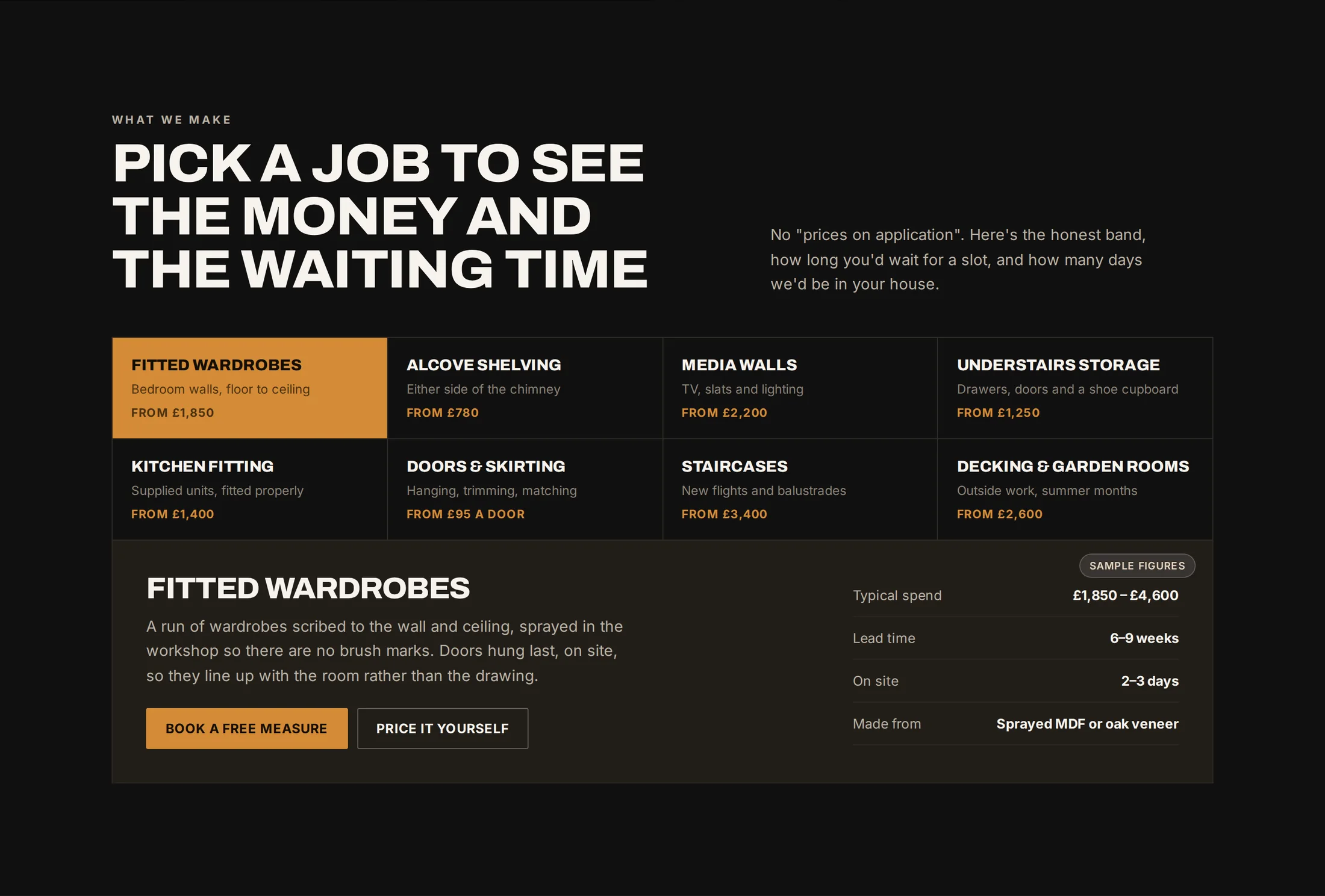
The pattern above puts the conditions where the number is, which is most of what the law asks. On each product page, beside the figure, a compliant and genuinely useful band carries:
- What the from-price buys, in one plain sentence: “A 2-metre run of painted wardrobes, floor to ceiling, two hanging rails and a shelf, fitted.”
- A typical spend, as a range drawn from jobs you actually did last year, so the customer can see where most people land.
- What moves the price: oak against painted, internals, awkward walls, the ceiling height.
- What is included, fitting and disposal especially, and whether the figure includes VAT.
- What fixes the price: “The measure fixes the price. This is a guide.”
Keep the evidence. If the from-price comes from your job records, keep the records. The ASA’s first question in a pricing complaint is how the figure was arrived at, and “it felt about right” is not an answer that survives it.
Where a price tool fits
A wardrobe designer that asks for wall width, ceiling height, door style and internals before it shows a figure is the guidance’s third option in software form. Paragraph 4.17 says that once the total becomes calculable from what the customer has entered, it must be shown from that point onwards. The CMA’s own worked example is a removals firm whose website takes rooms and distance, shows an estimate “clearly stated to be an estimate based on the requirements the consumer has provided”, and offers an in-person assessment before a final quote. Swap rooms for wall dimensions and the assessment for a measure, and that is a joinery website. The tool is not the risk. The risk is a tool whose cheapest output is a configuration nobody ever orders.
Who is actually watching
Since April 2025 the CMA can decide breaches itself and fine up to 10% of worldwide turnover. It is not going to start with a two-person joinery. In practice the pressure comes from three directions: a customer who complains to Trading Standards; a competitor who complains to the ASA, which publishes its rulings by name; and, most often, a homeowner who saw £1,850 online, was quoted £3,900 for the job in the photograph, and tells everyone on the street. The legal test and the commercial test turn out to be the same one: would the person who read the price feel misled when the quote arrived?
A five-minute check of your own site
- Open every page with a price on it. Does the photograph at the top match what the price buys?
- Of the last twenty jobs of that type, how many came in at or near the from-price?
- Is fitting, disposal or anything else most customers pay sitting outside the figure?
- If you are VAT registered, does the figure include it?
- Are the conditions next to the number, at the same size, on every page that shows it?
Common questions
Can I just put “prices on application” and avoid all this?
Yes. A page without a price is not an invitation to purchase, and CMA209 accepts that home improvement trades often price only after assessing the job. You give up the customers who assume you are too expensive, and you never hear from them.
Does this apply to work for businesses?
Section 230 protects consumers. A fit-out for a shop or an office is outside it, though the advertising rules still apply to the ad itself. Most joiners’ websites speak to householders, so plan for the stricter case.
Do the rules apply in Scotland?
Yes. The DMCC Act’s unfair commercial practices provisions and the CAP Code apply across the UK.
What about prices in a Facebook post or on a van?
The same rules apply to any invitation to purchase, wherever it appears. The guidance allows for limits of space in the medium, but not for leaving the conditions out where there is room for them.
We changed our prices. Do old pages matter?
Yes, if they are still live. An out-of-date from-price is still a price you are advertising. Put prices in one place on the site and let every page read from it, so one change updates them all.
Does your price band say what it needs to?
Send us your website. We will look at every page that shows a price and tell you, plainly, what the customer reads, what they are later quoted, and where the two drift apart.