
Before a homeowner asks what a job will cost, they usually ask whether they are allowed to touch the tree at all. In Scotland the answer depends on two separate regimes and a wildlife law. When it is wrong, the offence belongs to whoever did the cutting, not only to whoever owns the garden.
This is a practical account of what the law says about protected trees and nesting birds in Scotland, where tree surgeons’ websites tend to get it wrong, and how a site can answer the question properly without pretending to be the council. It is written for tree surgeons and arborists; it is not legal advice, and it covers Scotland only.
Why this is the tree surgeon’s problem
Section 171 of the Town and Country Planning (Scotland) Act 1997 does not make the landowner guilty of cutting a protected tree. It makes any person guilty:
“If any person, in contravention of a tree preservation order— (a) cuts down, uproots or wilfully destroys a tree, or (b) wilfully damages, tops or lops a tree in such a manner as to be likely to destroy it, he shall be guilty of an offence.” The penalty is “on summary conviction to a fine not exceeding £20,000, and on conviction on indictment, to a fine.”
Subsection (3) adds that the court “shall in particular have regard to any financial benefit” that follows from the offence. That is worth remembering the next time a tree is standing in the way of a driveway or a building plot.
So when a customer says “it’s fine, it’s my tree”, the firm doing the work has its own reason to know whether that is true. A website that deals with the question up front protects the business as well as informing the customer.
Two regimes that get confused
Most confusion comes from treating “protected” as one thing. It is two, and they work differently.
A Tree Preservation Order: consent first
A planning authority can make a Tree Preservation Order where it is “expedient in the interests of amenity” or where trees are “of cultural or historical significance” (section 160). An order can prohibit “the cutting down, topping, lopping, uprooting, wilful damage or wilful destruction of trees except with the consent of the planning authority”.
Note what is on that list. Topping and lopping are there alongside felling, so a crown reduction on a TPO tree needs consent just as a removal does. And consent is a decision the council makes, not a period that runs out: an application goes in, and the work waits for the answer.
The council has to make a copy of each order available for public inspection, free of charge, and confirmed orders are recorded against the land title, according to the Scottish Government’s Planning Circular 1/2011. In practice the planning department is where the question gets settled.
A conservation area: notice first
A tree in a conservation area that has no TPO of its own is covered by section 172. Here the rule is notice rather than consent. The defence to the offence is to have served notice on the planning authority and then either had its consent or waited “the period of 6 weeks from the date of the notice but before the expiry of the period of 2 years from that date”.
The Circular explains the point of the six weeks: it is “to give the planning authority an opportunity to consider whether a TPO should be made in respect of the tree”. It also says the notice “does not have to be in any particular form” and can be made through the ePlanning system, and that councils keep a register of these notifications (Circular, conservation areas).
That has two consequences worth putting on a website. The two-year window means a notice lodged in spring still covers a job done the following winter. And the council’s real power during the six weeks is to make a TPO, after which the tree is in the first regime, and needs consent.
The exemptions, and where they stop
Customers often arrive with half an exemption in mind. The full ones are narrower.
- Small trees in conservation areas. Regulation 8 of the 2010 regulations disapplies section 172 for a tree “having a diameter not exceeding 75 millimetres”, with diameter “measured over the bark, at a point 1.5 metres above ground level”. That is a measurement a customer can take with a tape, which makes it an ideal question for a website to ask.
- Dangerous trees. Work that is “urgently necessary in the interests of safety” is exempt under both regimes. It is not a free pass. Section 160(6) expects notice in writing to the planning authority “as soon as practicable after the operations become necessary”, and where a TPO tree comes down on safety grounds, section 167 puts a duty on the owner to plant a replacement “of an appropriate size and species at the same place as soon as he reasonably can”. Section 174 does the same for conservation areas.
- Planning permission. Regulation 8 also covers work required to implement a full planning permission, but expressly not “an outline planning permission or planning permission in principle”.
“Dead, dying or dangerous, so you don’t need permission” is a line that appears on a lot of websites. The honest version is longer: urgent danger is exempt, the council still needs telling, and the owner may need to replant.
Nesting birds: the rule with no paperwork
Planning controls have a process. Birds do not. In Scotland, section 1 of the Wildlife and Countryside Act 1981, as amended, makes it an offence if any person “intentionally or recklessly” “takes, damages, destroys or otherwise interferes with the nest of any wild bird while that nest is in use or being built”.
Two words in that sentence matter for a tree surgeon. “Recklessly” means not checking can be enough. And “otherwise interferes” is wider than cutting the branch the nest is on.
NatureScot’s standing advice on birds gives the season: “The bird breeding season runs in the main from March to August, though the precise timing within this period varies from species to species, and some species start breeding earlier or finish later than this.” It is also blunt that “there are no licensing provisions for development works that would otherwise result in an offence being committed”.
So the useful thing a website can publish is not a closed season. It is a question: have you seen birds nesting in it? Asked in the enquiry form, it costs one line; unasked, it can cost a wasted trip or something worse.
What the website should do with all this
None of this means a tree surgeon’s website should read like a planning guide. It means the site can settle the most common pre-quote question in a minute, and in doing so show that the firm knows its business.
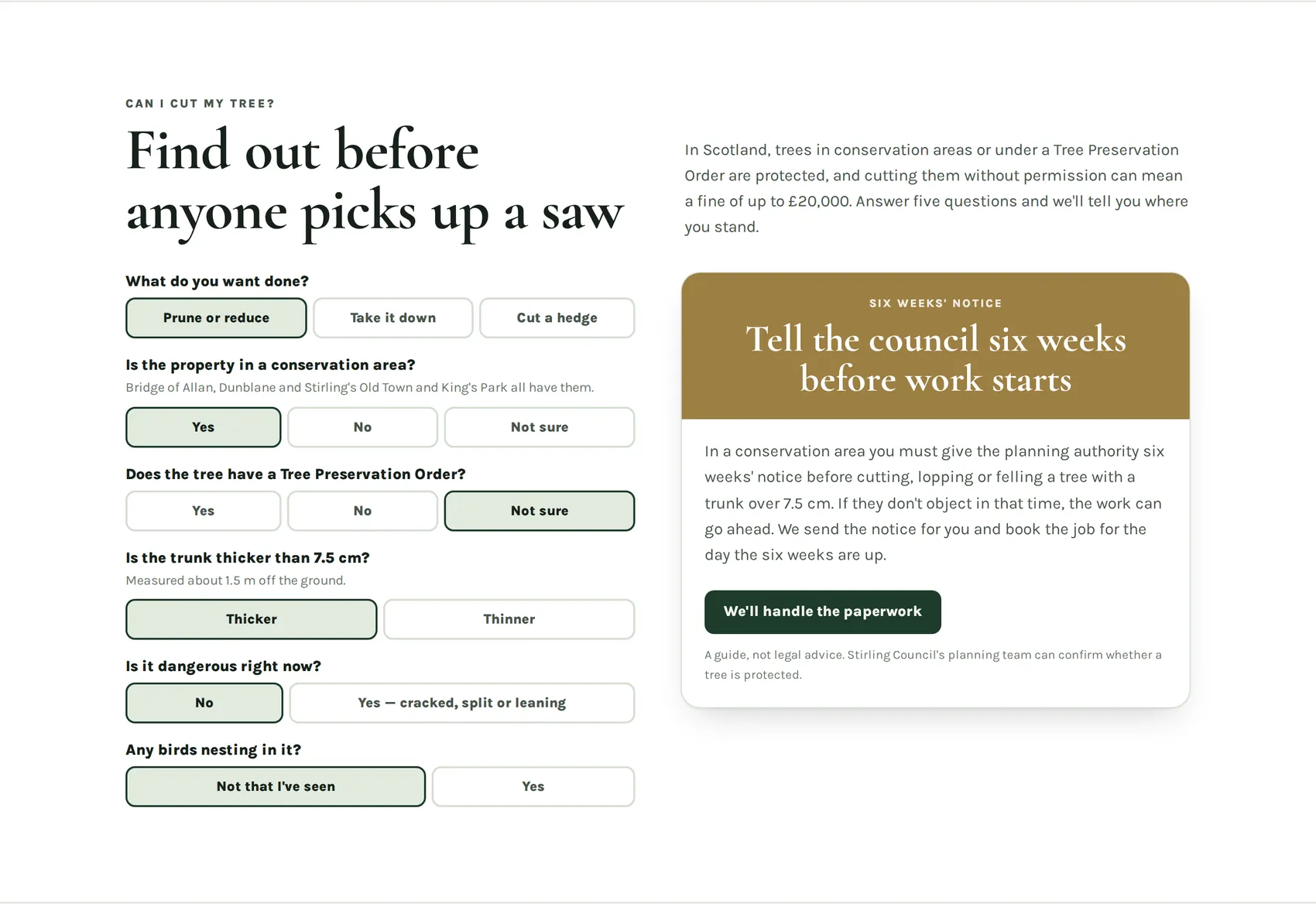
- Ask the questions the law turns on. The work wanted, conservation area, TPO, trunk thickness at 1.5 metres, danger and nesting. Those six cover nearly every situation a homeowner is in.
- Name the real conservation areas you work in. Only ones that exist, taken from the council’s own list. It is local knowledge that a template cannot fake.
- Say who decides. The council, every time. A checker that ends with “confirm with the planning department” is more credible than one that pretends to rule on it.
- Offer to lodge the notice. If you do it, say so. The notice has no required form, and a firm that handles it for the customer often wins the job over the firm that told them to ring the council themselves.
- Put the nesting question in the enquiry form. One line, answered before anyone loads the van.
- Explain the safety exemption properly on the storm page. Urgent work is allowed; telling the council afterwards and replanting may still be required.
Our tree surgeons page covers the rest of the site (photo enquiries, price bands, storm work, credentials and local search) and shows this checker in context.
What we would not put on your site
- “No permission needed for pruning.” Topping and lopping are on the TPO list.
- “Dead or dangerous trees are exempt” with nothing about notice or replanting.
- A verdict on a specific tree. The site can explain the rules and ask the right questions. Whether a particular tree is protected is the council’s answer, not ours and not the website’s.
- “Outside nesting season” as a promise. The law protects a nest whenever it is in use or being built.
- Conservation areas we have not checked. Every one named comes from the council’s published list.
Sources and method
- Town and Country Planning (Scotland) Act 1997: sections 160, 171, 172, 167 and 174, as revised.
- Town and Country Planning (Tree Preservation Order and Trees in Conservation Areas) (Scotland) Regulations 2010, regulation 8.
- Scottish Government, Planning Circular 1/2011: Tree Preservation Orders.
- Wildlife and Countryside Act 1981, section 1, the version extending to Scotland.
- NatureScot, Standing Advice for Planning Consultations – Birds.
What this post does not do. It is not legal advice and it does not tell anyone whether a particular tree may be cut. Only the planning authority can. It covers Scotland only; England, Wales and Northern Ireland have different rules. It does not cover felling licences for larger volumes of timber, bats and other protected species, high hedges or neighbour disputes. The one interface shown is a Central Systems design using a sample area, not a client’s site. Legislation and guidance change; check the linked sources rather than relying on this page.
Questions tree surgeons ask us
Can we lodge the six-week notice for the customer?
The Circular says the notice “does not have to be in any particular form” and can go through ePlanning. Preparing and sending it for the customer, with their agreement, is a service worth offering, and if you offer it, the site should say so plainly.
Does a TPO stop us pruning?
Without consent, yes. Section 160 lists topping and lopping alongside cutting down, so pruning work on a TPO tree needs the council’s consent first.
The customer says the tree is dangerous. Can we just take it down?
Work that is urgently necessary for safety is exempt, but the council should be told in writing as soon as practicable, and a TPO or conservation-area tree may carry a duty to replant. Photographs taken before the work are the firm’s best record of why it was urgent.
Is it safe to work in September?
Often, but not automatically. NatureScot describes March to August as the main breeding season, with some species earlier or later. The offence depends on whether a nest is in use, not on the date.
Should the website show a checker or just a phone number?
A checker answers the question at nine in the evening, when the homeowner is looking at the tree and nobody is answering the phone. It also produces a better enquiry: the firm knows the situation before it calls back.
Does your site answer “can I cut my tree?”
Send us your website and the towns you work in. We will tell you what it says about protected trees now, whether any of it is wrong, and what a checker for your area would need.
Websites for tree surgeons · Free website audit · Talk to us