
Two very different customers ask a window cleaner the same question. The homeowner asks whether you will be leaning a ladder against the conservatory. The facilities manager asks for your method statement. Both are asking how you actually clean the windows, and most window cleaning websites answer neither.
This is about why that question gets asked, what the Health and Safety Executive actually says about method, and the few sentences that turn it from an obstacle into the reason you win the work.
The commercial buyer is not being awkward
When a facilities manager asks how you will reach the third floor, it is easy to read it as box-ticking. It is not. They have a legal duty of their own.
The Work at Height Regulations 2005 apply, in HSE’s words, to “employers or you control work at height (for example facilities managers or building owners who may contract others to work at height)”.
Read that from their side of the desk. The person hiring you carries a duty for work they do not personally carry out. They are not gatekeeping; they are discharging an obligation, and they cannot do it on a phone call with someone who has not written anything down.
Which is why the contractor whose website already answers it starts several steps ahead of the one who has to be asked.
What HSE actually says about method
The HSE page for this trade is short and unusually direct. The starting point is not equipment at all:
That single sentence is the commercial argument for reach-and-wash, stated by the regulator rather than by a pole manufacturer. If you run water-fed poles, you are not merely using modern kit — you are working the way the guidance asks first. That is worth a line on your website, and almost nobody writes it.
Ladders are not banned
This myth costs the trade work, usually because a customer half-remembers it. HSE is explicit:
“The law calls for a sensible, proportionate approach to managing risk, and ladders can be a sensible and practical option for low-risk, short-duration tasks, although they should not automatically be your first choice.”
Both halves matter. A window cleaner who says “ladders are illegal now” is wrong. So is one who treats a ladder as the default for everything. HSE notes that portable ladders “have traditionally been used mainly for cleaning domestic premise windows on ground, first and second floors” — and adds the detail that should shape how you talk about them: “almost all falls from ladders happen because the ladder moves unexpectedly”.
So the honest position, and the one that reads as competent to both kinds of customer, is: poles by default, ladders where they are genuinely the sensible option, and footing and securing treated as the thing that actually prevents the accident.
Competence is specific to the work, not general
HSE puts it plainly: “All those working at height must have the right skills, knowledge and experience.” Importantly, that is not one badge covering everything. The guidance distinguishes work at lower floors from abseiling, which “will require different skills, knowledge and experience”, and it is specific about cradles too — “cradle operators must not have to climb over the edge of a building into a cradle”.
The practical consequence for your site: say what you are competent to do, and be equally clear about what you are not. A firm that says “up to three storeys by pole, ground floor ladder work where access allows, no rope access” sounds far more professional than one implying it can do everything.
The four sentences worth publishing
None of this needs a policy document on your homepage. It needs four plain statements that a homeowner and a facilities manager can both read in fifteen seconds:
- How you reach the glass. “Water-fed pole from the ground for everything up to three storeys.” One sentence, and it answers the conservatory question before it is asked.
- When you use a ladder, and what you do about it. Not an apology — a description. Where it is appropriate, and how it is footed and secured.
- What you will not do. The height you stop at, the access you will not attempt, whether you do rope work. Turning away one unsuitable enquiry costs you nothing and makes the rest of the page credible.
- What you can produce on request. Insurance, risk assessment and method statement, training records. You do not need to publish the documents — saying they exist and arrive within a day is the part that matters.
That last one is the single biggest gap we see. A commercial buyer working through a shortlist is not reading your documents at that stage. They are deciding whether asking for them will be easy or a fortnight of chasing.
Where this belongs on the site
The method answer is not a page on its own. It works when it sits at the three points where someone is already deciding.
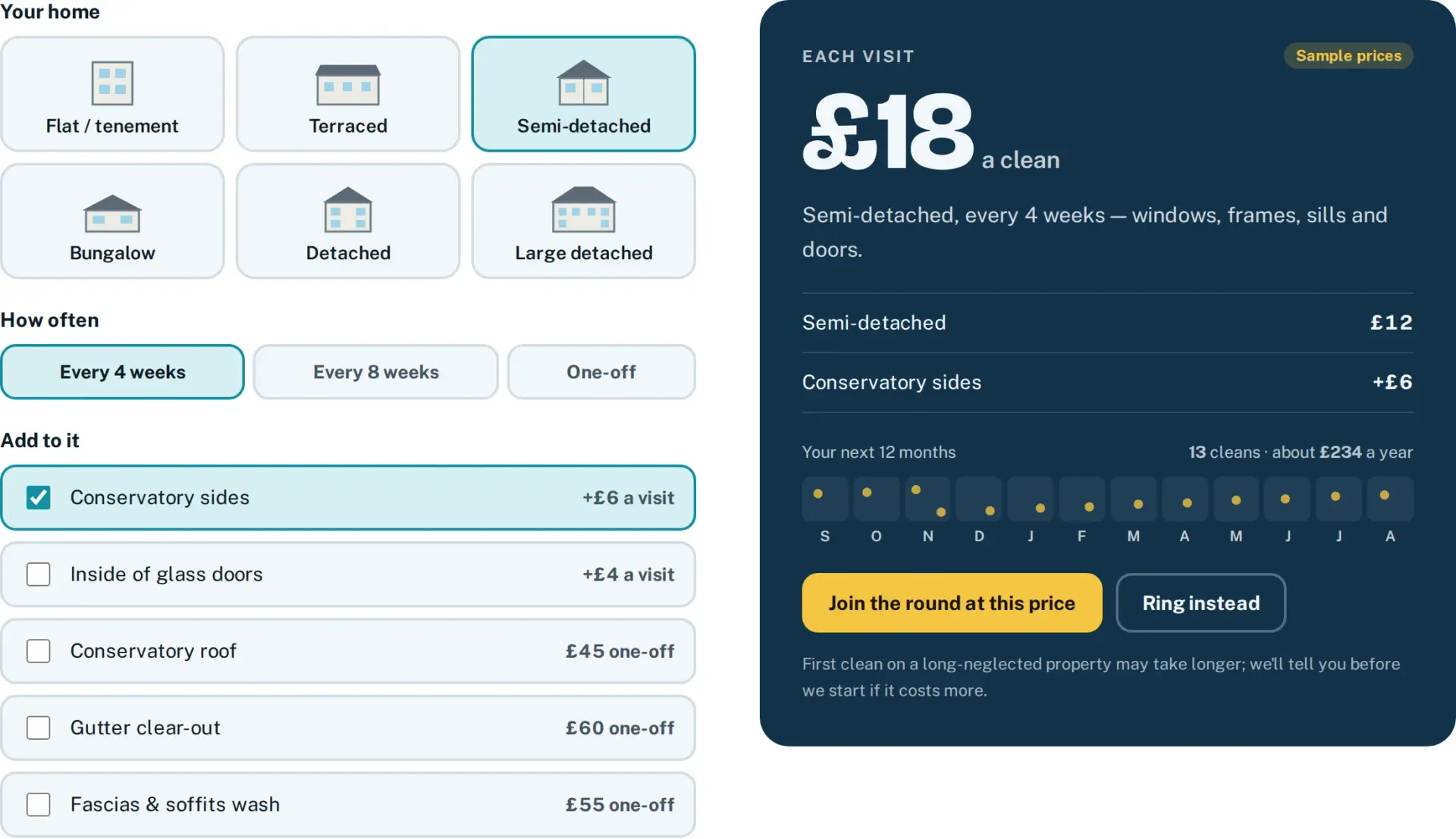
At the price
Window cleaning is one of the few trades where a genuine price can be shown on screen, because the job is defined by property size and frequency rather than by an unknown fault. The method belongs right there, next to what is included — it is part of what the customer is buying.
At the coverage question
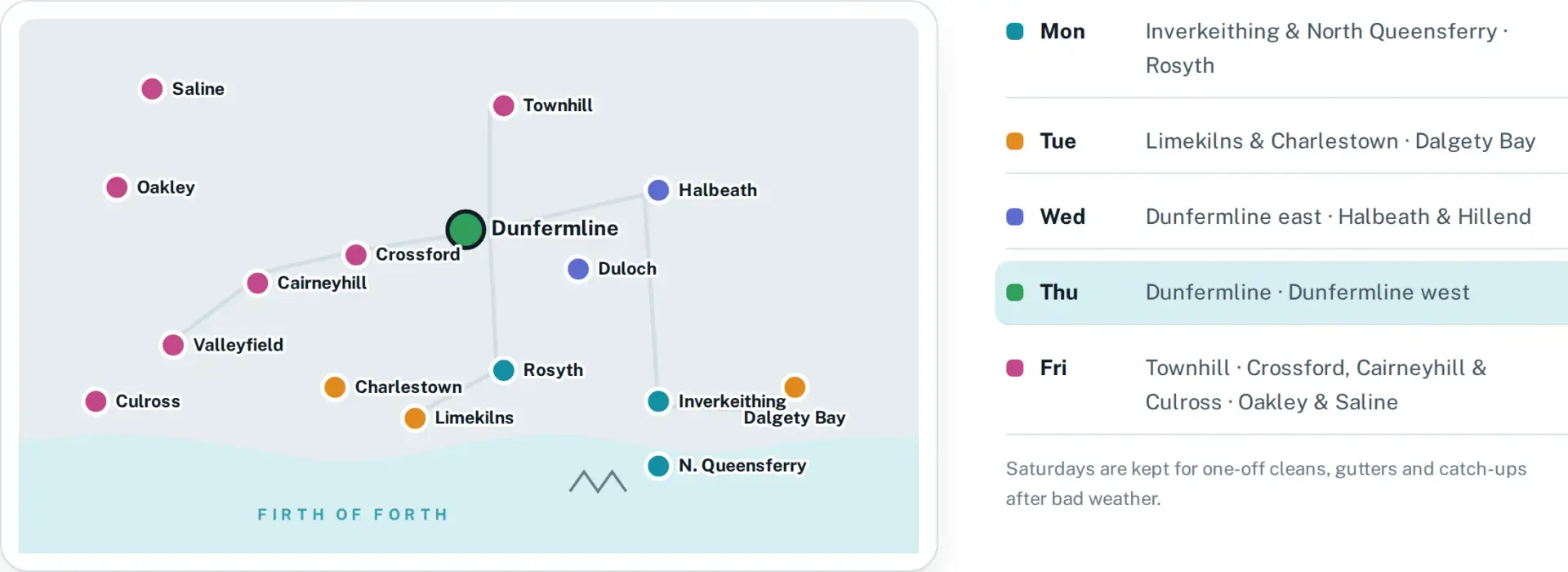
The other question that decides everything is whether you come down that street at all. A round is geography before it is anything else, and an enquiry from outside it costs you a phone call to decline.
After they commit
For a recurring service, the admin is the service as far as the customer can tell. What happens between signing up and the first clean sets the tone for a relationship that is meant to run for years.
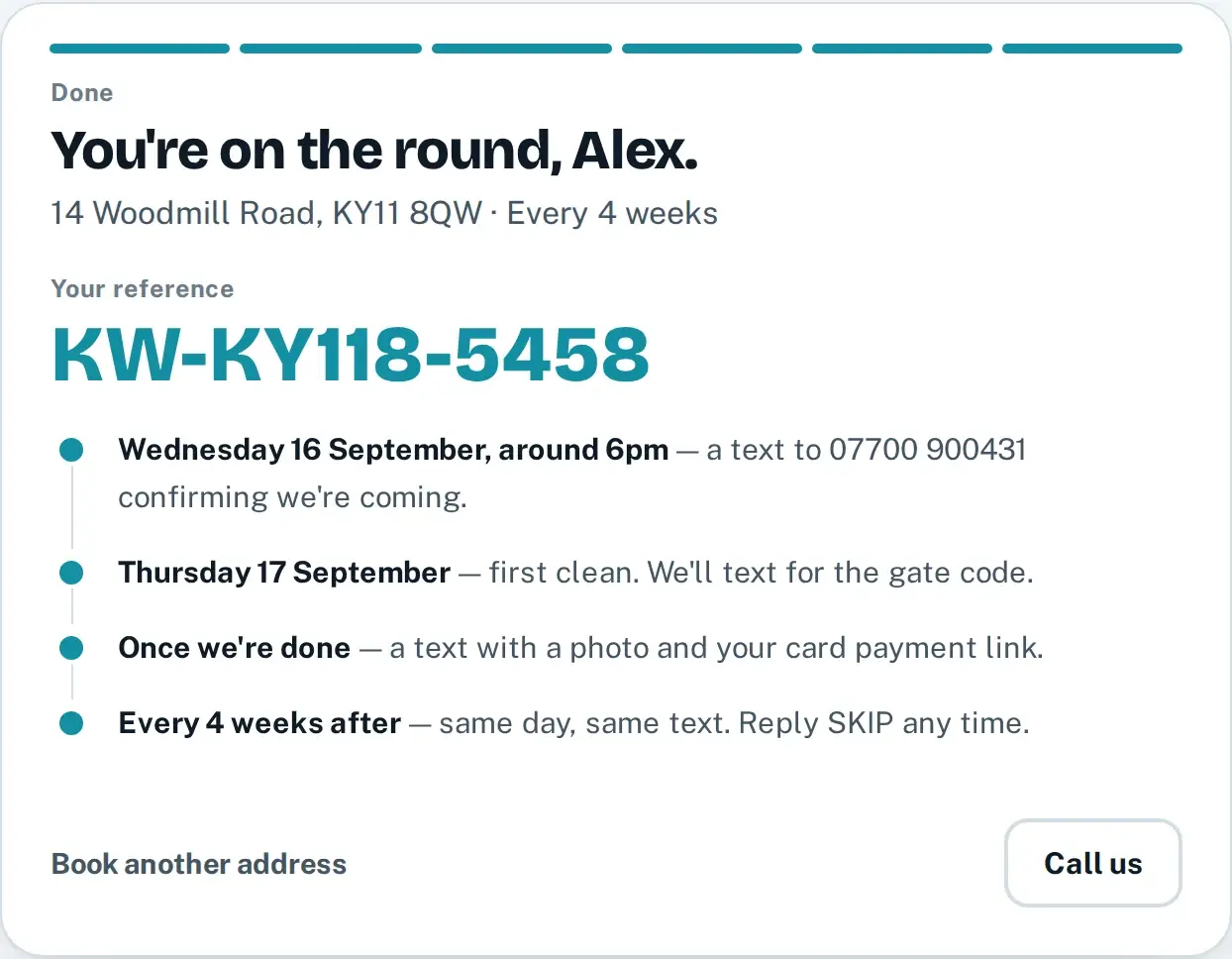
Our window cleaning page goes through the round-specific side of this in proper detail — postcode-first enquiry, same-street scheduling, online sign-up, and why most of this trade is won on a map rather than a web page.
What we would not put on your site
- A safety badge nobody can check. If a logo does not correspond to something verifiable you hold, it reads as decoration to a commercial buyer and as noise to everyone else.
- “Fully insured” with no further detail. Everyone says it. Saying what cover you carry and that the certificate comes on request says more.
- Claims about training you cannot evidence. HSE’s wording is about skills, knowledge and experience for the specific work. Implying a competence you do not hold is the one mistake here with real consequences.
- “Ladders are illegal.” They are not, and a customer who knows that now doubts everything else on the page.
- A generic H&S policy PDF as the answer. Useful to have, useless as the thing a buyer meets first. Four sentences on the page, documents on request.
Sources and method
- Working at height whilst window cleaning, HSE — the avoid-work-at-height hierarchy, water-fed poles, ladder use on domestic premises, the ladder-movement finding, cradles and rope access competence.
- Work at height — the law, HSE — who the Work at Height Regulations 2005 apply to, including facilities managers and building owners, and the planned/supervised/competent duty.
- Safe use of ladders and stepladders, HSE — that ladders are not banned, and that they should not automatically be the first choice.
What this post does not do. It is not legal advice and it is not a complete statement of your duties under the Work at Height Regulations — read the HSE pages directly and take advice on your own operation. We have not quoted a time limit for “short duration” ladder work, because we could not verify a figure on the HSE pages cited and an invented one would be worse than none. We quote no insurance levels, no training standards and no figures on enquiry or conversion rates. The three interfaces shown were designed by Central Systems and are illustrations of the pattern, not a description of any particular client’s site. Guidance is revised, so check the sources rather than this summary.
Questions window cleaners ask us
Do we really need to write any of this down?
For domestic work it wins you the nervous customer with the conservatory. For commercial work it is closer to a requirement, because the person hiring you has a duty they cannot discharge without knowing how the work will be done.
We only use poles. Is that enough to say?
It is a strong position, and HSE names water-fed poles as an example of avoiding work at height where reasonably practicable. Say it plainly, say what height it covers, and say what you do when a window cannot be reached that way.
Should we publish our risk assessment and method statement?
Usually not on the open site. Say they exist, say how fast they arrive, and send the current version when asked. Published documents go stale and are rarely read at the shortlist stage.
Will admitting we do not do high-rise lose us enquiries?
It loses you the ones you would have declined anyway, on the phone, later. Being specific about your ceiling makes the rest of the page believable.
Does any of this help with domestic customers?
More than people expect. “Cleaned from the ground with a pole, nothing leaning on your conservatory” removes the exact objection that stops a householder booking.
Is this a new website or a change to ours?
Usually a change. Four sentences and their placement is content work. It becomes a build question only if nobody can edit the site, or if there is nowhere sensible for the price and coverage answers to live.
Does your site answer the method question?
Tell us how you actually reach the glass and what work you want more of. We will tell you honestly whether that is four sentences and a tidy-up, or something larger.