Distribution & fulfilment
Websites & rebuildsSEOAI-assisted searchEnquiry qualificationClient stock portalsIntegrationsCRM & automation
Central Systems builds and rebuilds websites for third-party logistics providers, contract warehouses and fulfilment houses — then connects what the website collects to the stock system, the CRM and the admin behind it. Enquiries that arrive priceable, found for the work you actually want, and far less re-keyed by hand between the enquiry, the warehouse and the dispatch bay.
Move it as well as store it? See logistics, haulage & freight.
Built around how a brand decides who to trust with its stock — not around a services menu and a pallet-rack photograph.
Structured so the searches that matter — the service, the model, the place — land on a page that actually answers them.
Client stock portals, order and channel integration, CRM and the automation that removes the re-keying between enquiry and dispatch.
The commercial problem
Inside the building, everything is recorded. Stock is booked in against SKUs, a location is assigned, orders are allocated, pick lists are directed and every movement leaves a trail.
Then a prospect opens the website and finds five pages, a photograph of racking, a line about “total logistics solutions” and a contact form with three fields. Nothing about SKUs. Nothing about how storage and handling are actually charged. Nothing about what happens when a count disagrees.
The gap matters more in this sector than in most, because the buyer is not comparing prices — they are deciding whether to hand over their inventory. A well-run operation that presents badly loses that decision to a worse-run one that presents well, and never finds out why.
What is really being decided
A haulage buyer is placing one load and can try someone else next week. A fulfilment buyer is moving their entire inventory into a building they do not control, and switching again costs them a month. That difference changes every question they ask before they make contact — and it is why a transport-style website does not work for this sector.
What it can look like
Rather than describe it, here is the work. Strathmore Distribution & Fulfilment is a website concept designed and built by Central Systems to show what this sector's site can do when it is built around the operation instead of around a brochure.
About this concept. Strathmore Distribution & Fulfilment is an illustrative company created by Central Systems for this demonstration. It is not a client and not a trading business, the contact details shown are placeholders, and every figure inside the interface is sample data rather than anyone's results. The tools shown are working front-end demonstrations — they route, calculate and assemble, but nothing is submitted or stored.
Scroll the frame sideways to see the full width.
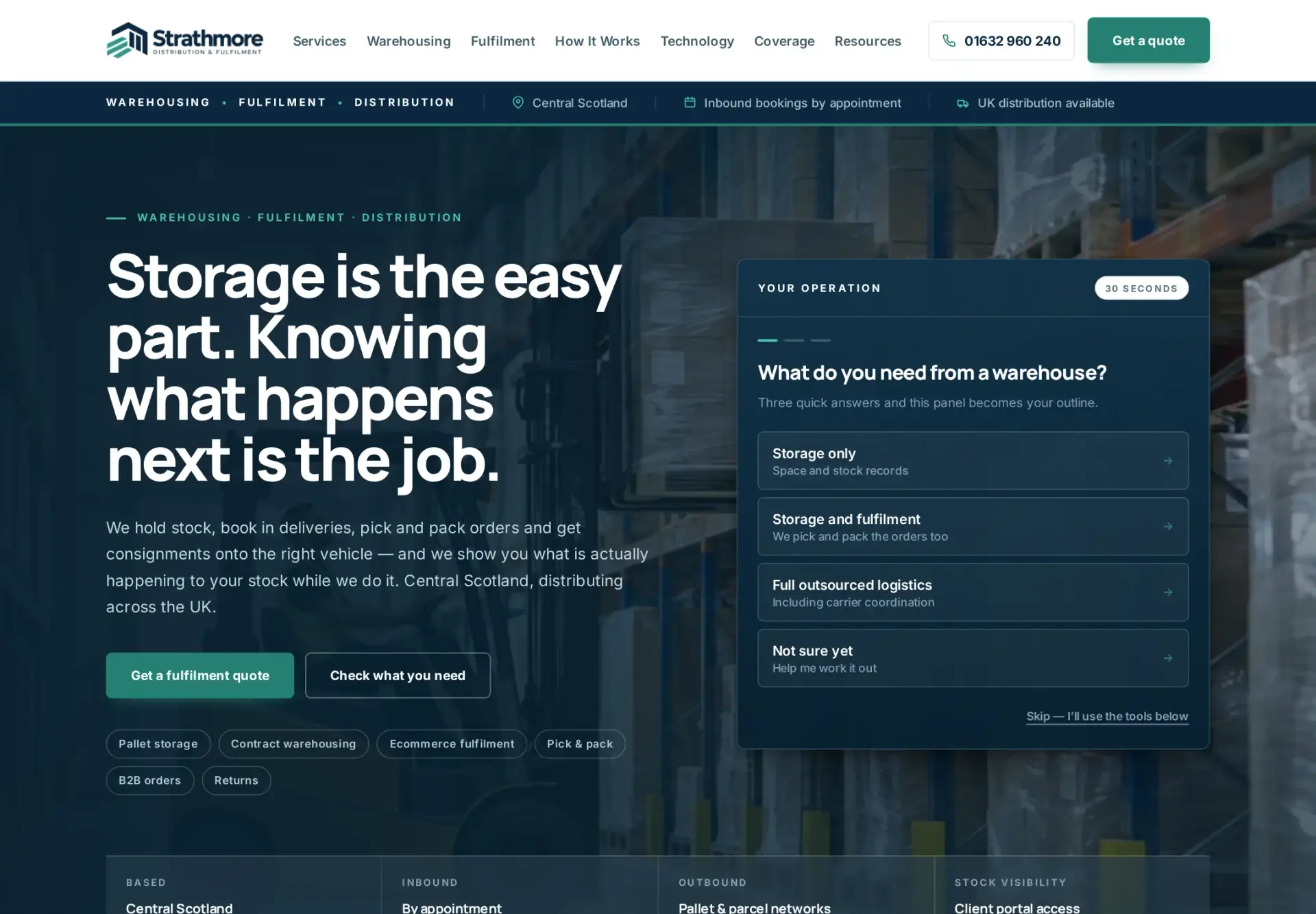
The first screen qualifies instead of introducing. The headline takes a position on what the job actually is, and the panel beside it asks the one question that decides everything downstream — storage only, storage and fulfilment, or the whole operation.
Scroll the frame sideways to see the full width.
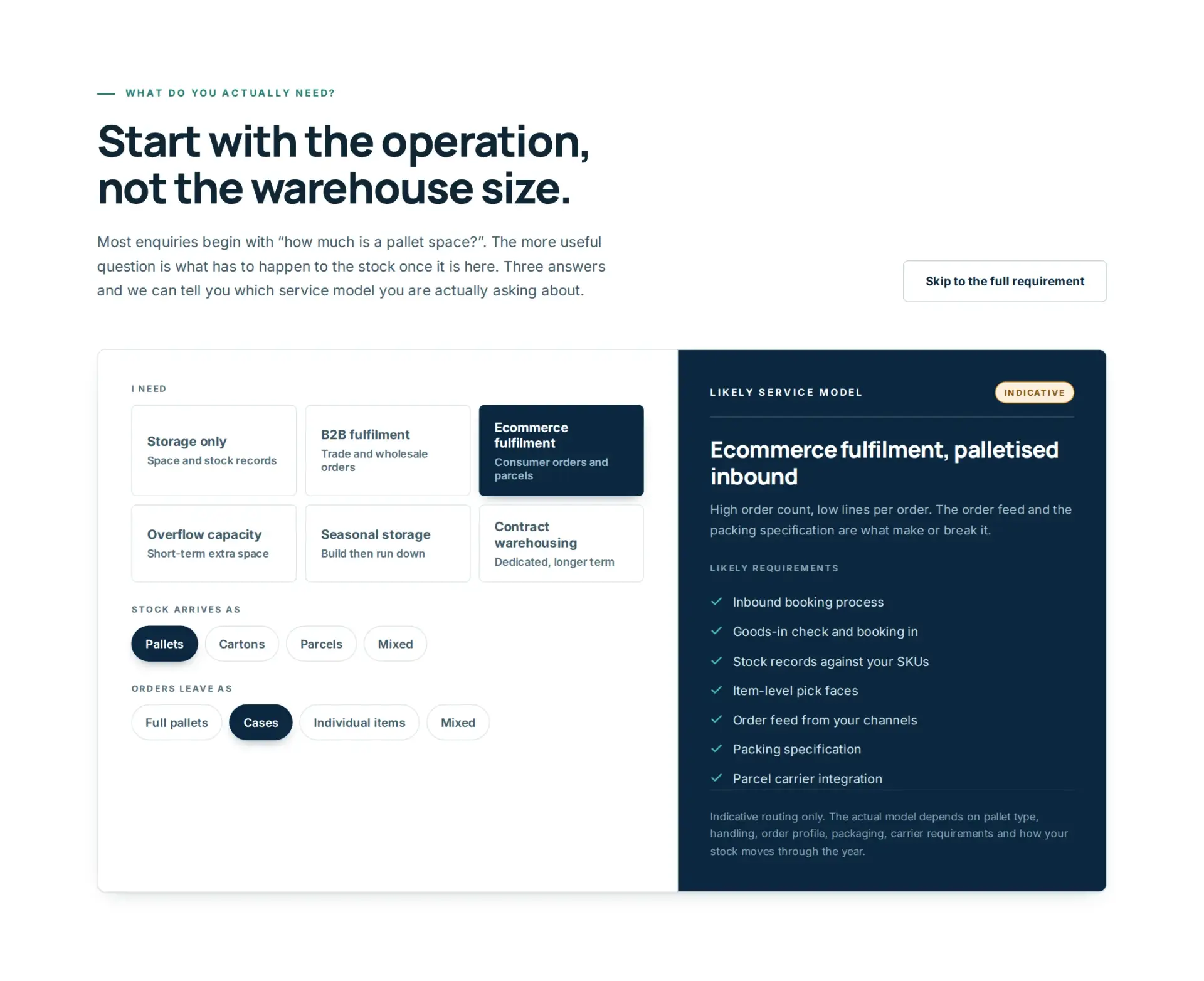
Three answers, and the enquiry is already classified. Most first calls are spent working out which conversation to have. A router does that on the page, marks itself indicative so it is never mistaken for a quote, and hands the visitor a vocabulary they can use when they do ring.
Scroll the frame sideways to see the full width.
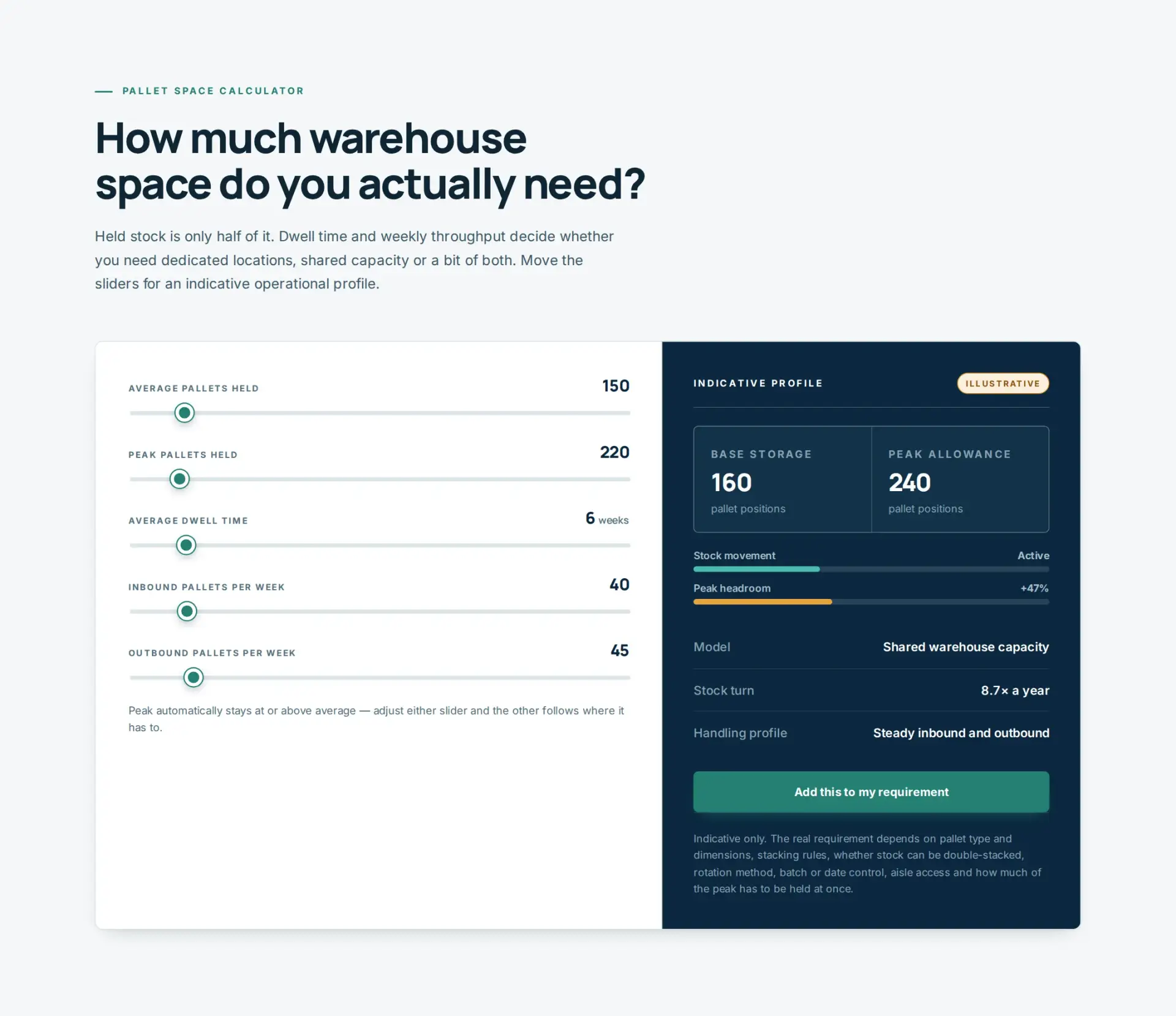
A tool that answers the question everyone opens with. “How much is a pallet space?” is the wrong question, and a calculator that works in dwell time and throughput teaches the visitor why — while collecting the numbers your own team would have had to ask for anyway.
The enquiry journey
Nobody can price storage from a name, an email address and “I'm looking for some warehouse space”. The information gap is not the customer's fault — the form never asked. Depth is a design decision, and it is the one that decides whether your team spends the week quoting or chasing.
Name, email, message. It arrives in a shared inbox and nobody can do anything with it until somebody rings.
What operations receiveAn enquiry, and a task.Product, volumes, how it arrives, where orders go. The fields are chosen by what has to be known before anyone can price.
What operations receiveEnough to give an indicative answer on the first call.A short sequence that assembles an operational brief as the visitor answers, shows them what they have built, and tells them what is still missing.
What operations receiveA written brief, a reference to quote back, and the named gaps.
Scroll the frame sideways to see the full width.
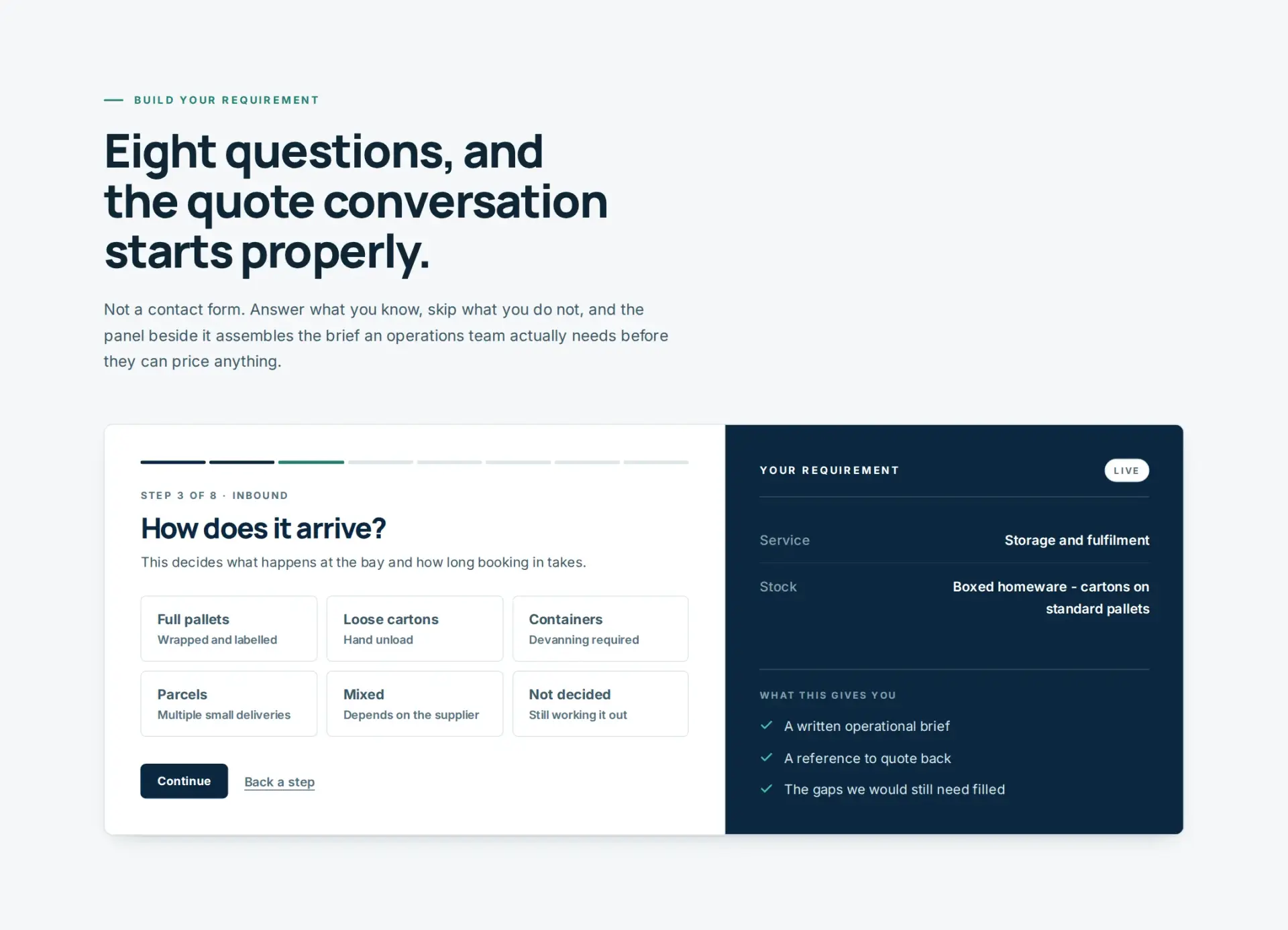
Eight questions, and the panel fills in as they go. Showing the brief being built is what keeps people answering: they can see it becoming useful. Questions they cannot answer are skippable and arrive flagged as gaps, which is far more use to an operations team than a blank field.
Client portals
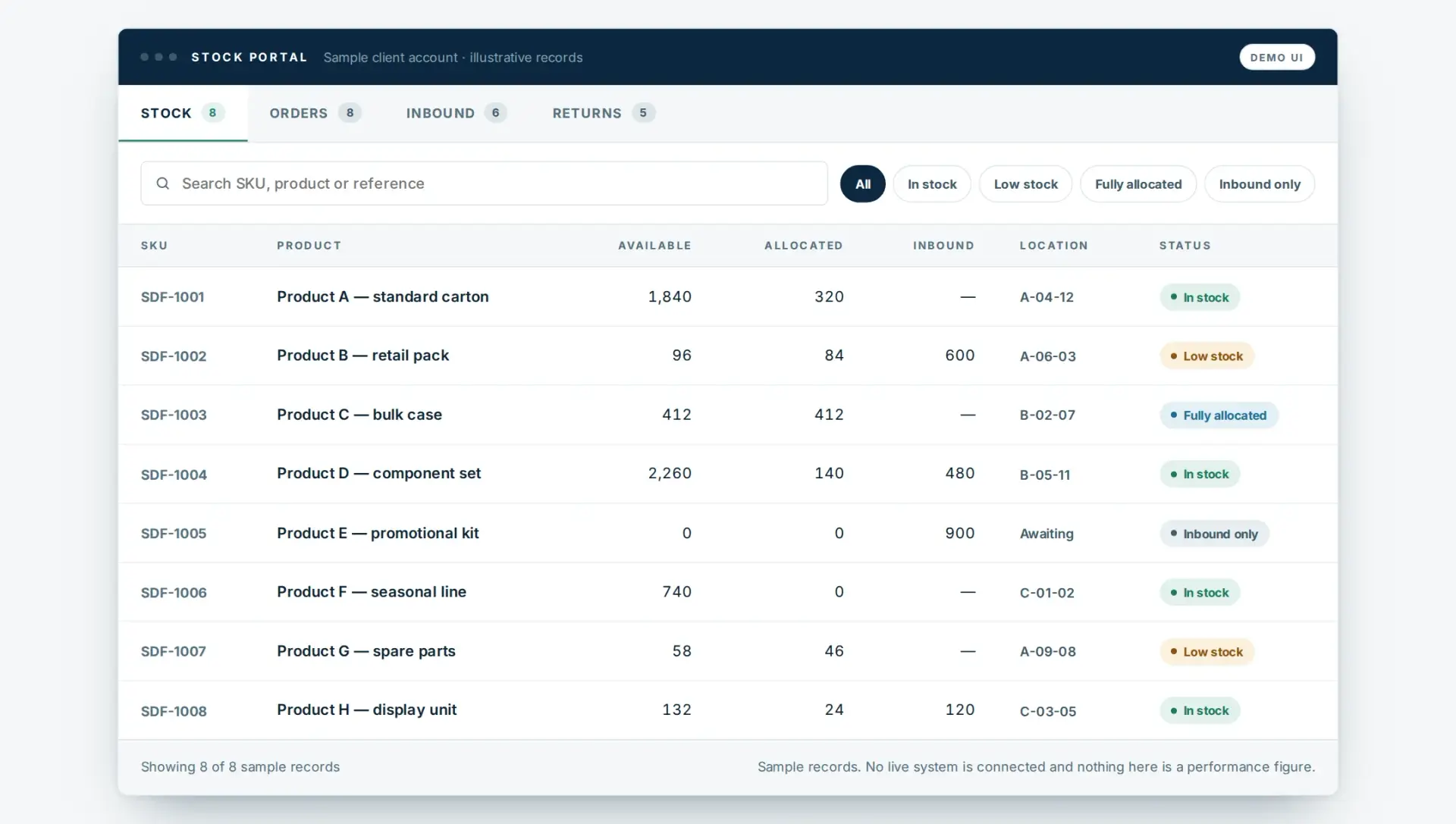
The complaint that ends outsourced fulfilment contracts is almost never picking accuracy. It is not knowing. A client who has to email to find out what is on hand, what is allocated and whether their inbound arrived will start looking elsewhere long before they tell you why.
Scroll the frame sideways to see the full width.
Four questions, answered without a phone call. What is here, what is committed, what is coming and what came back. Built as a client account on your own site rather than as another login your customer has to remember, and scoped so each account sees only its own stock.
A portal is also the cheapest support desk you will ever build.
Every “where is my pallet?” email is a person interrupting the warehouse to read something a screen could have shown. The account view removes that traffic and replaces it with something the client experiences as service rather than as self-service.
Where the admin actually is
Follow one account from first enquiry to invoice and the manual work is never where people assume. Picking is efficient; it has been optimised for years. The time goes on the joins — the points where information changes hands and somebody re-types it. Those are the points a connected system removes.
Arrives as a message with most of the operational detail missing.
Usually manualBuilt in a spreadsheet, sent as an email, remembered by one person.
Usually manualSKUs, dimensions and handling notes collected again, by email, one file at a time.
Usually manualSlots agreed by phone; the bay finds out when the vehicle arrives.
Usually manualCounted and booked against the advice note. Already systematic.
Already in the systemDownloaded from a channel, re-keyed into the warehouse system.
Usually manualDirected by the system, labelled and manifested. Already systematic.
Already in the systemStorage and handling reconciled by hand at month end.
Usually manualSix of those eight are conversations and copy-paste. That is where the website stops being marketing and starts being infrastructure — because the enquiry, the onboarding pack, the inbound booking and the client's own order view can all begin on it, in a structure your systems can read.
Scroll the frame sideways to see the full width.
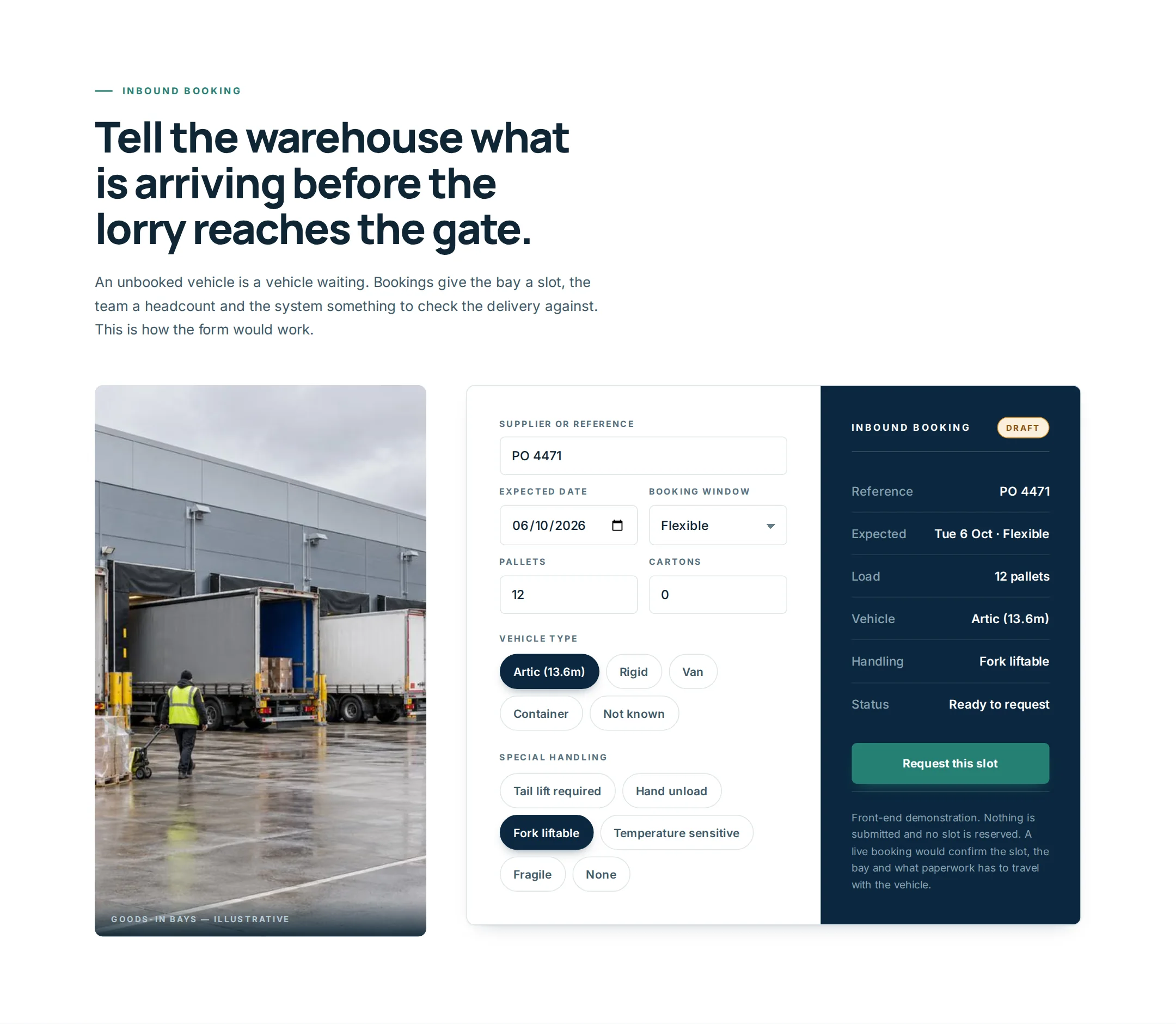
Handover 04, moved onto the website. A supplier books the slot themselves and the bay knows the vehicle, the load and the handling before it arrives. The same principle applies to onboarding a new account and to the client's own order view — each one is a phone call that became a form.
The full range
What we build for a warehousing or fulfilment business falls into four layers. Most engagements start with the first and grow into the others; none of them requires you to replace the warehouse system you already run.
A new site structured around service models, stock types and the operational questions a buyer asks before making contact.
Keeping the search equity and the pages that work, and rebuilding the structure, the mobile experience and the enquiry route around them.
Pages that match how this sector is actually searched for — by service, by model and by place — rather than one page trying to rank for everything.
Content structured and marked up so an assistant summarising your business has accurate material to work from.
Routers, calculators and requirement builders that turn a message into a brief operations can price.
Every enquiry recorded against an account with its requirement attached, so the follow-up does not depend on whose inbox it landed in.
Stock, order, inbound and returns views for your clients, and the internal reporting your own team currently rebuilds by hand.
Joining the website, the order channels and the warehouse system so the same information is not entered twice.
Where a capable warehouse management system is already in place, we build around it rather than over it. Replacing specialist software is rarely the right answer, and proposing it is usually a sign that the gaps were never actually examined.
Being found
Buyers in this sector search in three shapes, and a single services page competes in none of them well. Building the structure that matches how the demand is actually phrased is most of the work — and it is work that compounds, because each page supports the others.
“ecommerce fulfilment Scotland”
Service plus place. The commonest shape, and the one most often answered by a page that mentions neither clearly enough to rank for either.
“contract warehousing Central Belt”
Model plus region. A buyer who already knows the commercial structure they want and is filtering on geography and capacity.
“pallet storage near me”
Short, local and usually on a phone. Often a first step into a much larger requirement, and routinely lost to whoever answers it plainly.
“3PL that handles oversized stock”
Problem plus provider. The most valuable shape of all, because it is a buyer who has already been turned down somewhere else.
When an assistant is asked to shortlist fulfilment providers in a region, it works from what your site actually states: the services, the models, the locations, the limits, the contact route. A site that leaves those implicit gives it nothing to work with, and vagueness that a human visitor would forgive by ringing up simply drops out of the answer. We structure content and markup so the facts about your business are explicit and accurate. What we will not do is promise placement in an AI answer, a citation or a ranking — nobody can, and anyone offering it is selling something else.
Two routes
Most operators already have a website, and plenty of them have one that earns its keep in search. Starting again is not automatically the right move, and we will say so.
The right route when the site describes a smaller version of the business — before the second unit, before fulfilment was added, before the contract accounts. Structure, mobile experience and enquiry route are the usual reasons, not the visual design.
The right route when the site is sound and the problem is behind it — the enquiries arrive unusable, the clients cannot see their stock, or the same order is typed into two systems. The website stays; the missing parts get built.
Who this is for
“Distribution and fulfilment” covers operations with almost nothing in common commercially. The build follows the shape of the business, not the label on the sector.
Selling space, handling and everything around them to brands who want the whole problem taken away.
What the site has to carry: service models, the client portal, and the limits on what you will store.Longer, dedicated arrangements where the buyer is choosing a partner for years rather than a supplier for a season.
What the site has to carry: capability, capacity, governance and how accounts are actually run.High order counts, low lines per order, and a buyer who cares more about the channel integration than about the racking.
What the site has to carry: the integrations, the order journey and the returns process.Letting space and handling to others alongside their own operation, often without a sales function to support it.
What the site has to carry: a clear separate offer, and an enquiry route that does not need a salesperson.Where a business does more than hold and handle stock, these pages take the argument from the other end.
For the side of the business that moves consignments rather than holds them — where the enquiry is a load and a date. Transport and storage belong on one site, described in one language.
See logistics, haulage & freight →For the brands on the other side of the contract — the businesses whose orders arrive in your warehouse and whose channels you are integrating with.
See retail & e-commerce →For manufacturers whose finished-goods store has quietly become a service they could sell, and who need it presented as one.
See engineering & manufacturing →Before you start
Usually, yes — because it is narrower than it sounds. A client account showing stock, orders, inbound and returns is a read-only view of information your warehouse system already holds. The work is in getting that information out safely and presenting it so each client sees only their own. It is a far smaller build than a system that tries to run the warehouse.
No, and we would argue against it. A capable WMS is the most expensive thing to replace and the least sensible thing to rebuild. We build around it — the website, the enquiry route, the client-facing views and the joins between your order channels and the system you already run.
It can, which is why the existing structure is mapped before anything is designed. URLs that earn traffic are preserved or redirected deliberately, and the pages that already perform are kept rather than rewritten for the sake of it. If the evidence says the site is working and the problem is elsewhere, we will tell you that instead of quoting for a rebuild.
More than most people expect. A requirement builder, an inbound booking request and a structured onboarding pack are all front-end work that reaches your team as a usable document on day one. Integration then removes the last manual step — but the admin saving starts before it.
In principle yes, and in practice it depends on what each end will expose. Some channels and systems have good, documented interfaces; some have a file drop and a schedule; a few have nothing usable and the honest answer is a different approach. We establish which of those you are dealing with before proposing anything, rather than after.
Yes — and it should also say what you will not take. Stating the limits early is the most credible thing on a fulfilment website, and it removes the enquiries that were never going to convert. What the site must not do is imply a licensed capability you do not hold; where storage requires a licence, an approval or specific cover, that belongs on the page as a fact you can evidence, not as a claim.
Every engagement is quoted against the specific build, because a rebuild for a single-site contract warehouse and a portal-plus-integration project for an ecommerce fulfilment house are not comparable pieces of work. The starting point is a conversation about which of the four layers above is actually slowing the business down.
Yes. We are based in Fife and work with businesses across Scotland and the UK. For this sector it rarely matters much — the work is remote apart from the parts that genuinely benefit from standing in the building, and we will say when that is one of them.
Distribution & fulfilment
An outdated website, enquiries nobody can price, clients who cannot see their own stock, or the same order typed into two systems. We start with the one that is actually slowing the operation down, and build out from there.
Central Systems · Leslie, Fife · working with businesses across Scotland and the UK
Or go straight to the operational side — discuss integration & automation.