
The landlord book is the most predictable revenue in plumbing and heating. Every certificate you issue this month creates a job you already know about in twelve months’ time. Most firms still run that entirely from memory, a wall planner, or a spreadsheet only one person understands.
This is about the recurring half of a heating business: what the law actually requires, the two-month scheduling window most firms never use, and which parts of the cycle are genuinely worth automating — plus the parts that are not.
What the law actually requires
The duties sit in the Gas Safety (Installation and Use) Regulations 1998, and the HSE’s guidance is specific in ways that matter for scheduling.
- An annual gas safety check on each appliance and flue, carried out by a Gas Safe registered engineer.
- The record must be kept “for at least two years”.
- “You must provide existing tenants with a copy of the gas safety check record within 28 days of the check being completed.”
- “You must provide a copy of the gas safety check record to prospective tenants before they move in.”
The record itself has a defined minimum content: a description and location of each appliance or flue checked, the name, registration number and signature of the person who carried out the check, the date, the property address, the landlord’s or agent’s name and address, and “any safety-related defect identified and any remedial action taken”.
The duty is the landlord’s, not yours. But you are the one who has to be in the building on a particular date, and you are the one who gets the call when it has been missed.
The two-month window
Here is the provision that makes the whole thing schedulable, and a surprising number of firms either do not know about it or do not use it.
The regulations allow landlords “to have gas safety checks carried out up to 2 months before the date the check needs to be carried out but still retain the original deadline date (as if the check had been carried out exactly 12 months after the previous check)”.
Read that as a business fact rather than a compliance one. It means a certificate due on 3 February can be done any time from 3 December without the anniversary sliding forward. Your renewal dates stay fixed year after year, and you get a sixty-day window in which to fit each one.
That changes what is possible operationally. Instead of a rigid calendar of single dates you must hit, you have sixty-day bands you can pack — which means routing several properties in the same town on the same day, filling the quiet week in January, and stopping the February pile-up that happens when everything was first certificated in the same month years ago.
One caveat worth knowing: if you use the early flexibility, the HSE notes the record “will need to be kept until two further gas safety checks have been carried out” — slightly longer than the usual two years.
Why the diary method fails
Nobody plans to lose a renewal. It happens through ordinary friction, and the failure modes are consistent across firms:
- The date lives in one person’s head. It works perfectly until that person is on holiday, off sick, or has left.
- The certificate was issued but never sent. The check happened, the paperwork sat in the van, and the 28-day clock ran out without anyone noticing.
- The landlord changed agent. Nobody told you, and the reminder went to an address that no longer reads it.
- Everything is due in February. Because that is when the portfolio was first certificated, and nobody has ever used the early window to spread it.
- The spreadsheet has drifted. Two properties sold, one tenant changed, and three rows are now wrong in ways nobody can see at a glance.
- The renewal was remembered late. You get it done, but as an emergency squeezed into a full week rather than a planned job routed with three others.
None of these is a competence problem. They are all the same structural problem: a recurring obligation with a fixed date is being tracked by something that does not know about dates.
What the recurring cycle looks like when it is tracked properly
The useful version is unglamorous. A list of properties, the date of the last check, the date the next falls due, and a status that tells you what to do this week rather than what went wrong last month.
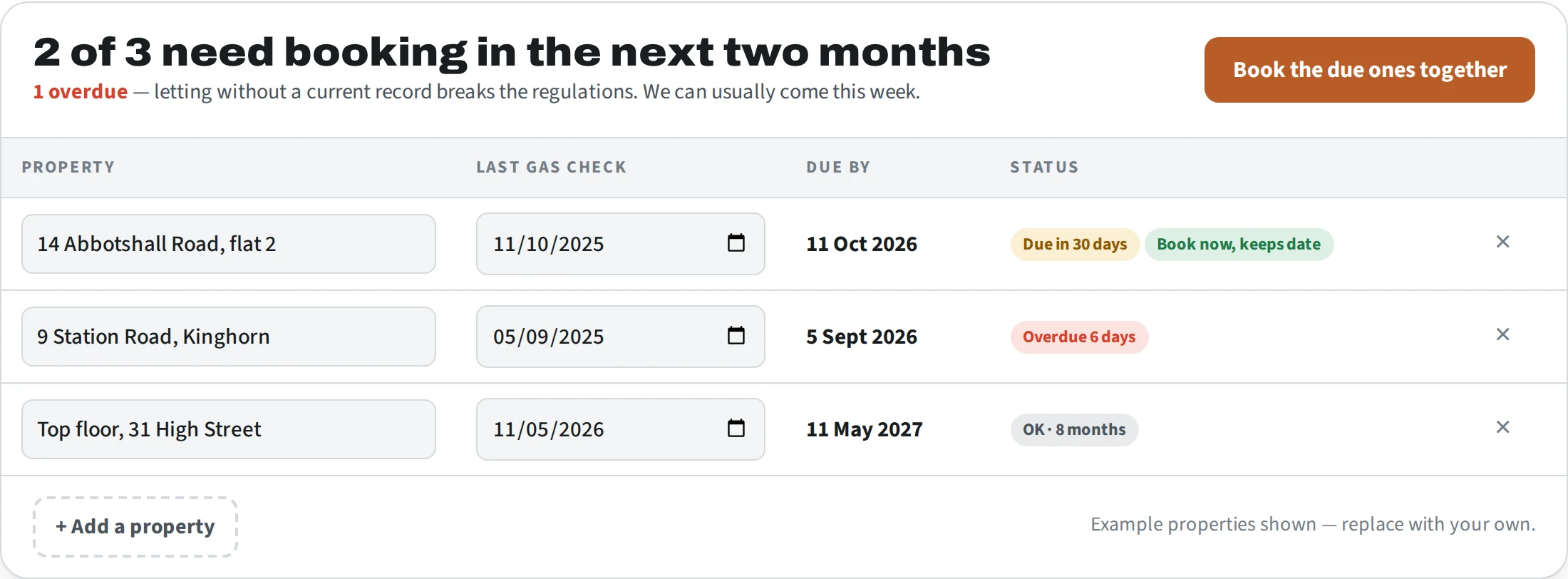
Around that list, four things are worth automating, because each is a rule you can write down without ambiguity:
- The renewal reminder. Triggered from the due date, not from somebody remembering — to you for scheduling, and to the landlord or agent so the access conversation starts early.
- The 28-day issue. The certificate goes to the tenant and the landlord when the job is marked complete, rather than when the paperwork surfaces.
- The record retention. Stored against the property automatically, so producing two years of history is a search rather than an afternoon.
- The routing prompt. When several properties in the same area fall inside their windows together, that is a day’s work worth booking as one.
Nothing there requires AI, and we would not sell it to you as such. It is a date, a rule and a trigger — which is exactly the kind of work automation is genuinely good at.
The other two flows worth the effort
Landlord renewals are the obvious recurring work. Two more parts of a heating business follow stable enough rules to be worth automating, and both sit on the website rather than behind it.
Triage, so the 2am call is the right one
This trade has no middle gear. Half the enquiries are someone standing in water who needs you now; the other half are getting three quotes for a boiler over a fortnight. Sending both down the same contact form wastes everyone’s time, and the urgent half is the half where getting it wrong is dangerous.
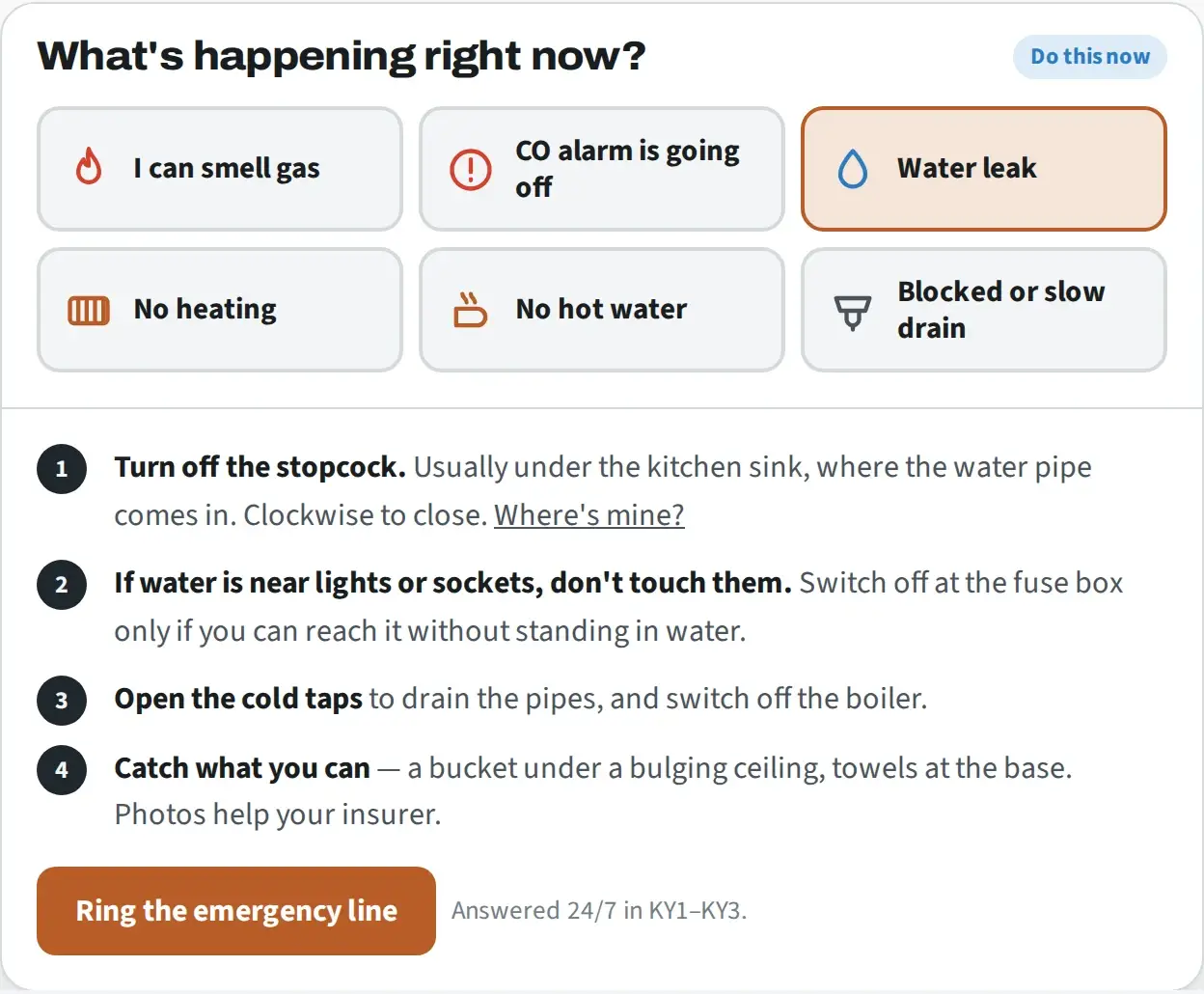
The automation here is narrow and deliberate: route by symptom, give safety instructions before any booking option, and put the genuinely urgent straight through to a phone rather than a form. A gas smell should never produce a callback request. That is one of the few places where the right answer is to stop automating and make the phone ring.
Quoting, so the fortnight-long buyer gets an answer
A boiler is among the largest single purchases most households make for a property, and it is bought slowly. “We’ll come and have a look” is a reasonable position and a poor answer to somebody comparing three firms at nine in the evening.
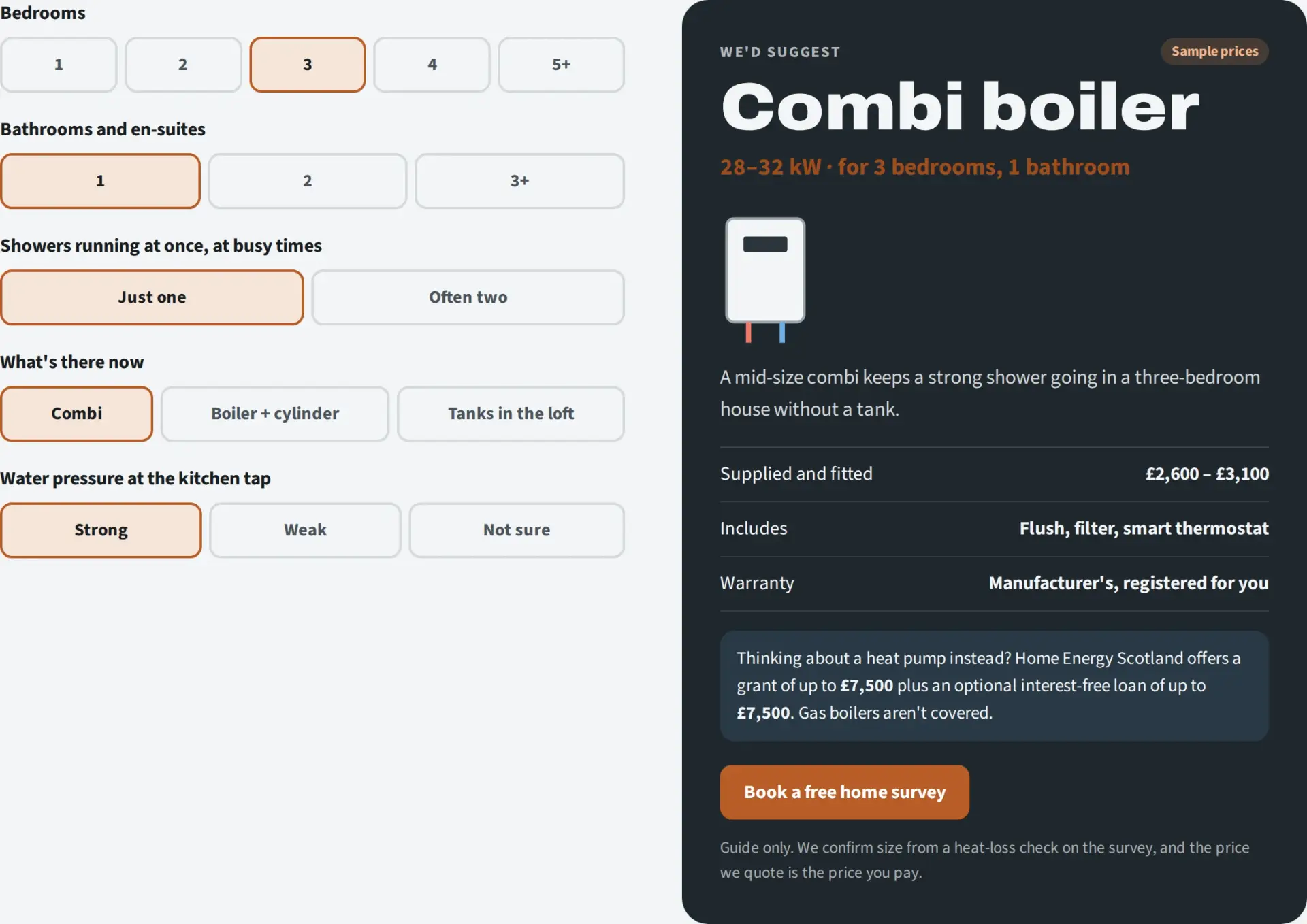
Nobody expects a fixed price from a form. They expect to know roughly how it works, roughly what it costs, and what happens next. A tool that produces a range and says plainly that the survey confirms the specification does more for you than a price list — and it qualifies the enquiry before it reaches you, which is the actual commercial benefit.
What we would not automate
A post about automation that only lists things to automate is selling rather than advising. These are the parts we would leave alone in this trade:
- The emergency call itself. No chatbot, no callback queue. If there is a gas smell or a suspected carbon monoxide alarm, the correct outcome is a person on a phone and the safety instructions on screen.
- The final price. An indicative range is honest. An automated fixed quote for work nobody has surveyed is a liability you will pay for.
- Anything requiring your registration. Software can track when a certificate is due; only a Gas Safe registered engineer can sign the check.
- Chasing a landlord who has gone quiet. Two automated reminders are helpful. Six are a reason to change supplier — after the second, it needs a phone call.
- Judgement on a defect. Classification of a safety-related defect and the remedial action is yours, and it goes on the record under your registration number.
Where this fits with the website
The tracker is back-office; the triage and sizing tools are on the site. They connect at one point: an enquiry that arrives through the website should land in the same place as the work, already tagged by which of the two customers it came from. If it does not, you have automated the front and left the re-typing intact.
Our plumbing and heating page covers the website side in detail — the two customers, what belongs above the fold, the badge nobody can check, the winter readiness. This post is the workflow behind it.
Sources and method
- Gas safety check records and what to keep, HSE — the record contents, the two-year retention, the 28-day rule, the prospective-tenant rule and the early-check flexibility.
- The Gas Safety (Installation and Use) Regulations 1998, regulation 36 — the underlying duties.
What this post does not do. It is not legal advice, and the duties described are the landlord’s rather than the engineer’s — check your own position and your customers’ against the HSE guidance rather than this summary. It quotes no figures on how much time automation saves, because that depends entirely on the size of the book and we have no verified number to give you. It names no client. The three screens shown are interfaces we designed; they are illustrations of the pattern, not a promise of what your build would contain. Regulations are amended, so check the sources rather than trusting this page indefinitely.
Questions heating firms ask us
Whose duty is the annual check, ours or the landlord’s?
The landlord’s. Yours is to carry out the check properly and issue the record. In practice the firm that tracks the dates well is the firm that keeps the portfolio, because the landlord stops having to think about it.
Can we really do the check early without losing the date?
Yes, up to two months before it is due, with the original deadline retained. Note the longer record-retention condition that comes with using it, and read the HSE wording directly before you build a schedule around it.
Do we need new job software for this?
Usually not. Most firms already run something that holds properties and jobs, and the useful work is connecting the dates and the reminders to what is already there. If a documented way in exists we use it; if none does, you hear that before you commit.
What happens when a tenant will not give access?
That is the landlord’s problem to resolve and the HSE guidance covers the steps they are expected to take. What automation can do is evidence it — a dated record of every attempt, which is exactly what the landlord needs later.
Is any of this AI?
No, and it does not need to be. A due date, a rule and a trigger is ordinary automation. We would rather tell you that than attach a fashionable word to a scheduling problem.
We only have a dozen landlord properties. Is it worth it?
Probably not as a project on its own. At that size a shared calendar with the dates in it fixes most of the failure modes. It becomes worth building when the book is large enough that February is a problem.
Which part of your year repeats?
Tell us how the landlord book is tracked today and how many properties are on it. We will tell you honestly whether that needs a system, a shared calendar, or nothing at all.
Business automation · Plumbing & heating websites · Talk to us