New: Try our free Website Audit tool. Run your free audit →Run it free →

A lorry fleet parked up on a distribution centre yard at dusk, trailers backed onto the loading doors.

Logistics, Haulage & Freight

Websites built to move logistics businesses forward.

Central Systems builds and rebuilds websites for haulage and logistics companies around better transport enquiries, stronger search visibility and the systems behind the sale — from structured quoting and CRM to automation and customer portals.

HaulagePallet distributionDedicated transport Contract distributionWarehousingFreight operators

The commercial problem

A modern fleet can still be hidden behind an outdated website.

The vehicles have been replaced, the warehouse has been taken on and the contract book has grown. The website is still five pages describing a smaller company.

A transport buyer arrives with a load and a date, not with an interest in your company. They are usually comparing two or three operators, often on a phone in a warehouse, and they are trying to answer a short list of questions before anyone picks up a telephone.

A good transport website answers as much of that list as it can before the phone rings. Everything it cannot answer becomes a call, and every call that starts from nothing is a call the traffic office has to have twice.

Question 01Can you move it?
Question 02Where can you collect?
Question 03Where can you deliver?
Question 04What vehicle does it need?
Question 05What do you need from me?
Question 06What happens after I enquire?

What usually gets in the way

  • A dated site, and a poor phone experience on the device most enquiries begin on
  • Vague services — “transport solutions” rather than pallets, part loads, dedicated or contract
  • Unclear coverage, so a buyer cannot tell whether their lane is one you run
  • Generic stock imagery of vehicles that are not yours, on roads that are not here
  • Nothing useful about the fleet — no vehicle classes, no handling, no access information

And what happens after the enquiry

  • A generic contact form producing “can you move eight pallets?” and nothing else
  • Quote requests missing the weight, the dimensions, the access or the date
  • Enquiries landing in a shared inbox that nobody owns and nothing tracks
  • Follow-up by memory, which works until the week the traffic office is busy
  • No analytics worth reading, so nobody knows which lane or service brought the work in

Website redesign

If the operation has moved forward but the website hasn’t, rebuild it properly.

Most operators we speak to already have a site. The question is rarely whether to have one — it is whether the one they have still describes the business.

Fleets get replaced. Routes get added. A warehouse gets taken on, a distribution contract gets won, and coverage quietly stretches from a region to most of the country. The brochure site built around the earlier version of the business carries none of it.

A rebuild is not redecoration. We keep what earns its keep — the URLs already pulling traffic, the pages already ranking, the yard and fleet photography worth carrying over — and rebuild everything else around how the business sells today.

  • A phone layout designed, not a desktop one squashed
  • A page per service, not one transport list
  • Fleet and capability stated in vehicle classes
  • Coverage a buyer can actually read
  • Existing search equity carried across, not discarded
  • Analytics and CRM wired in before launch, not after
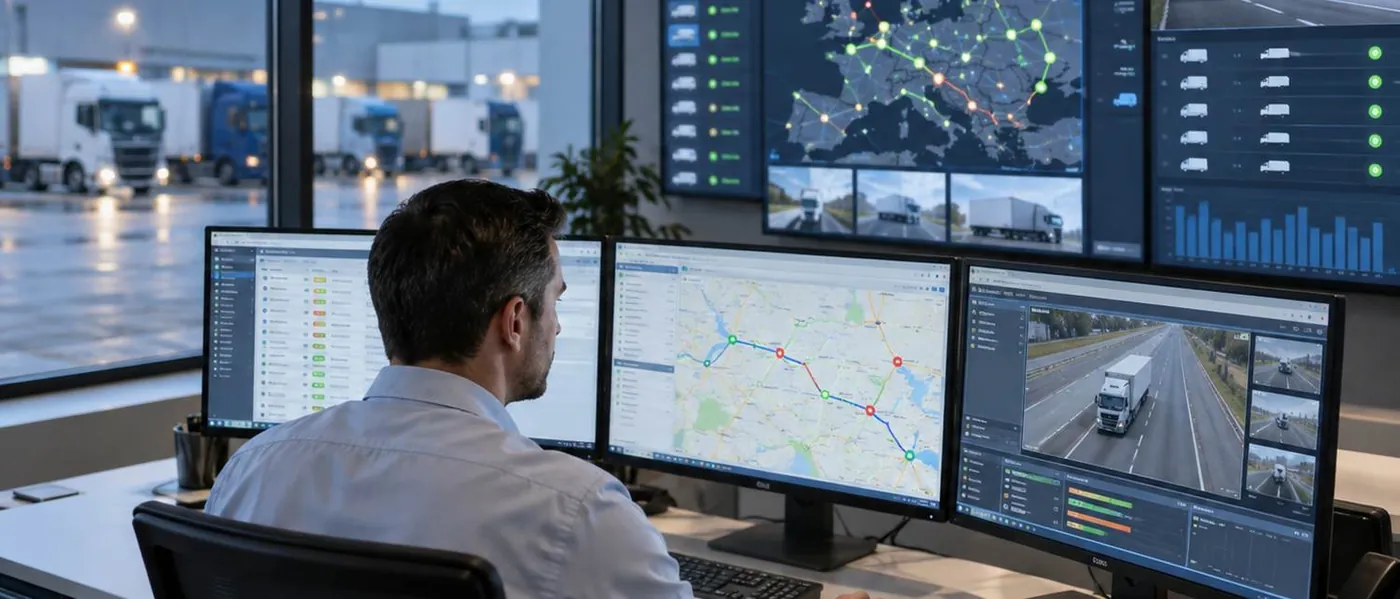
A transport control room, planning screens showing routes and vehicle allocation across several monitors.

What it can look like

More than a transport-company brochure.

Rather than describe it, we built one. Everything below comes from a logistics website concept designed by Central Systems — the positioning, the enquiry journey, the load checker, the coverage architecture and the customer-facing layer, shown as they would actually work.

A road haulage and contract logistics site
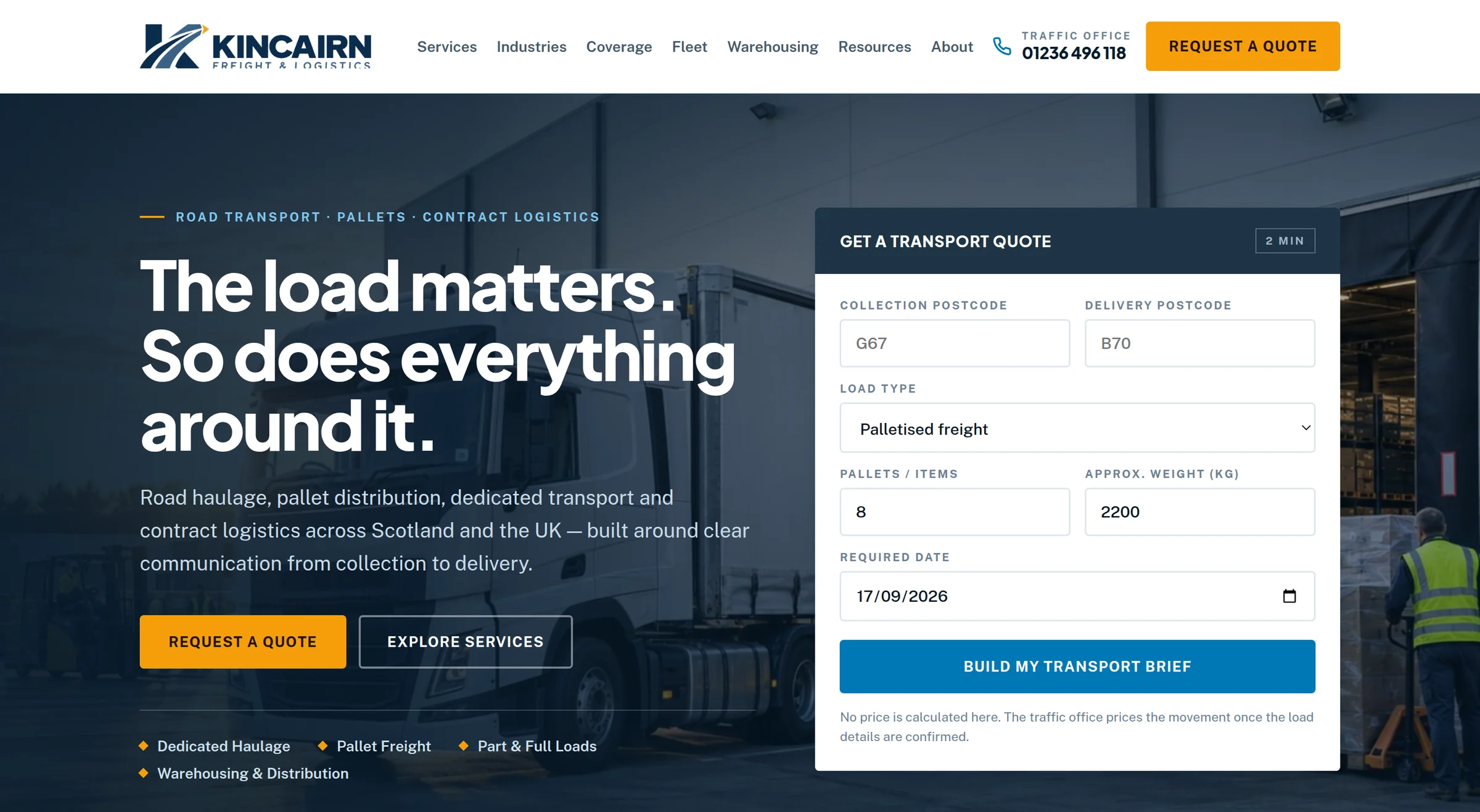
The first screen of a logistics website concept designed by Central Systems: a lorry loading at a distribution bay behind a heading reading The load matters, so does everything around it, a strip naming dedicated haulage, pallet freight, part and full loads and warehousing, and a short transport quote panel asking for collection and delivery postcodes, load type, pallets, weight and required date.

Scroll the panel sideways to read the full screen.

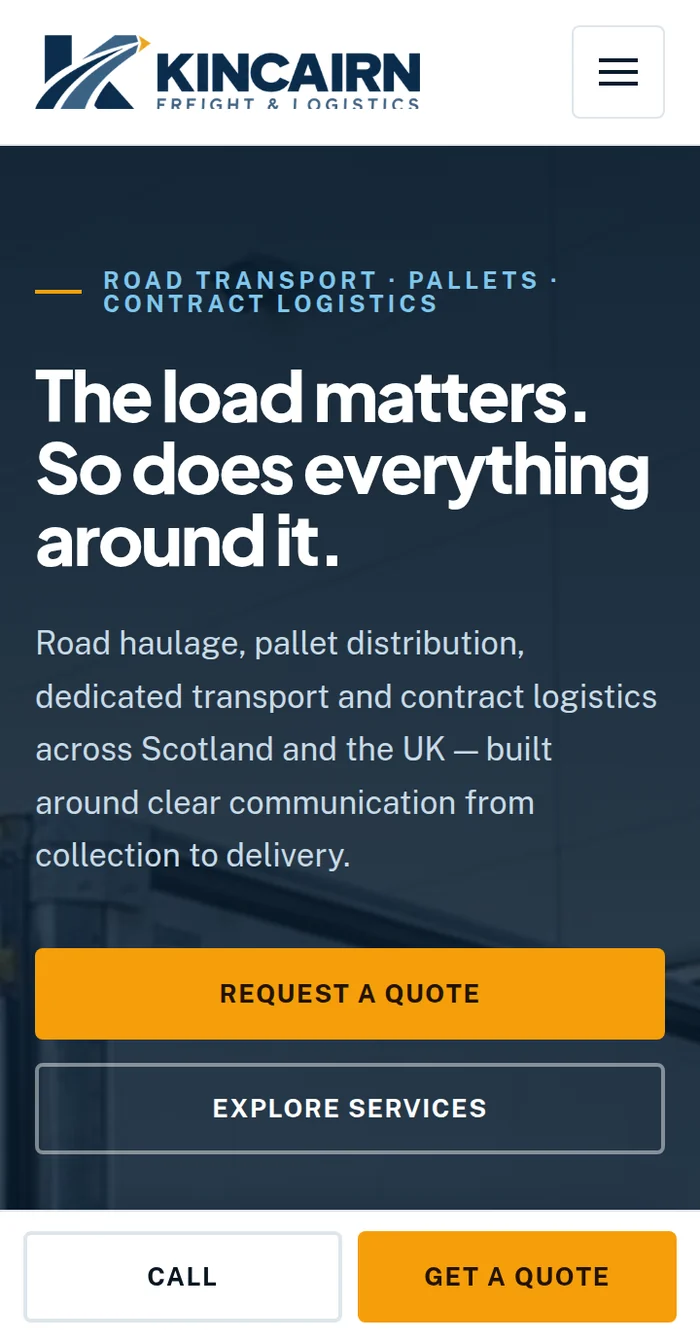
A transport website designed around the enquiry. The first screen states what is carried, where it runs, what the operator can do and what to do next. On desktop the quote panel sits beside the heading; on a phone the call button is pinned to the bottom of the screen, because that visitor is standing in a warehouse.

Illustrative logistics website concept.Kincairn Freight & Logistics is an illustrative logistics website concept created by Central Systems. Company details and example data are illustrative.

The same logistics website concept on a phone, with the services, the heading and both calls to action stacked, and a call and quote bar fixed to the bottom of the screen.
The same first screen on a phone.
01 · Structured transport RFQ

Give the traffic office the information it needs before the first call.

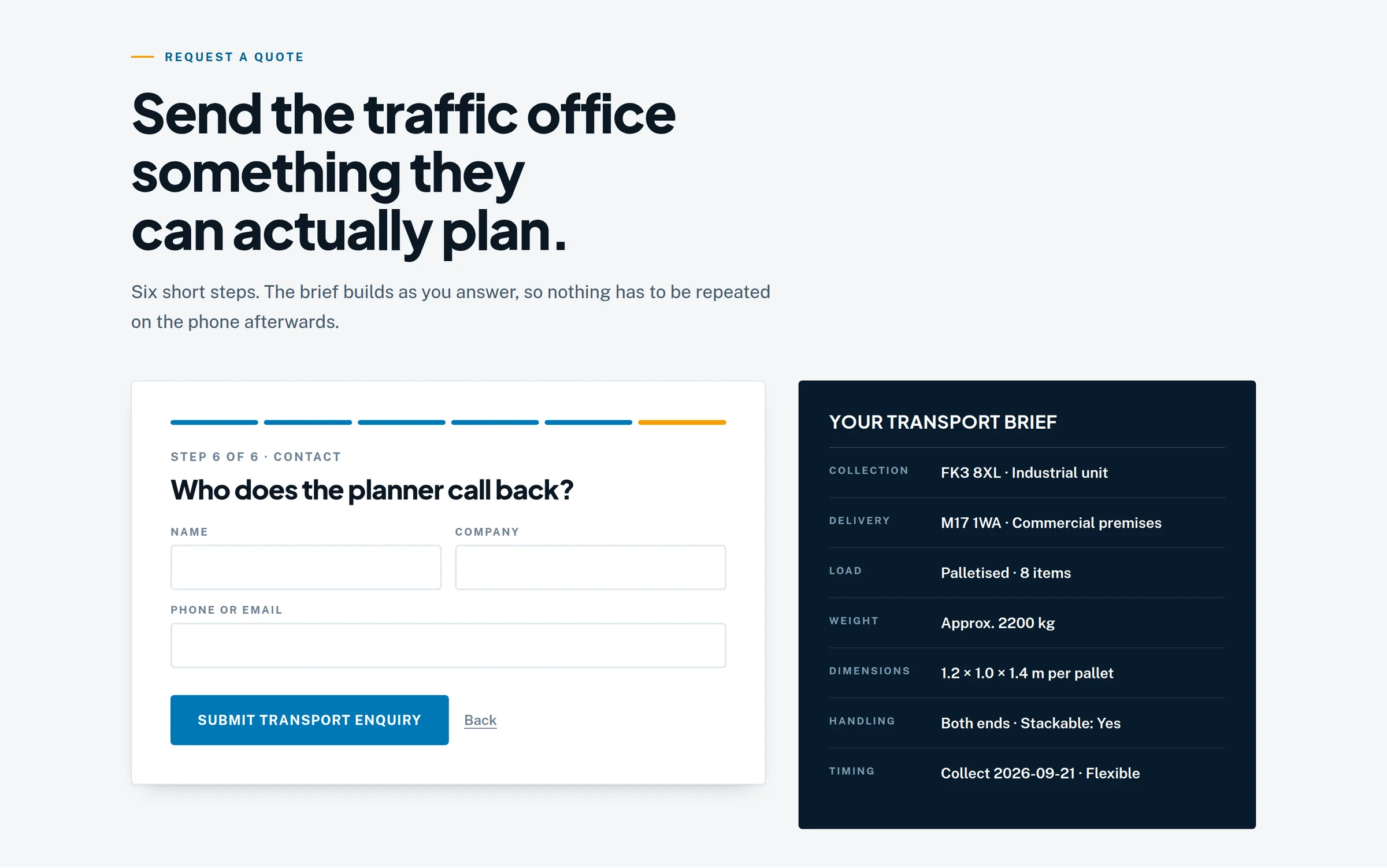
A transport enquiry is a brief, not a message. Capture the collection and the delivery, the site type at each end, the load, the pallet or item count, the dimensions, the weight, how it loads and unloads, and when it has to move — while the customer still has the details in front of them.

Instead of “Hi, can you move eight pallets?”, the team receives a structured transport brief.

Commercial effect: enquiries that arrive priceable, far fewer clarifying calls, and the same information every time one reaches the planner.
Request a quote — six steps, building a transport brief as they are answered
A six-step transport enquiry on the logistics website concept, open at the final contact step. Beside it a transport brief has filled itself in as the earlier questions were answered, listing collection at an industrial unit, delivery to commercial premises, palletised freight of eight items, approximately 2200 kilograms, dimensions per pallet, forklift handling at both ends and a collection date on a flexible vehicle basis.

Scroll the panel sideways to read the full screen.

02 · Load and vehicle checker

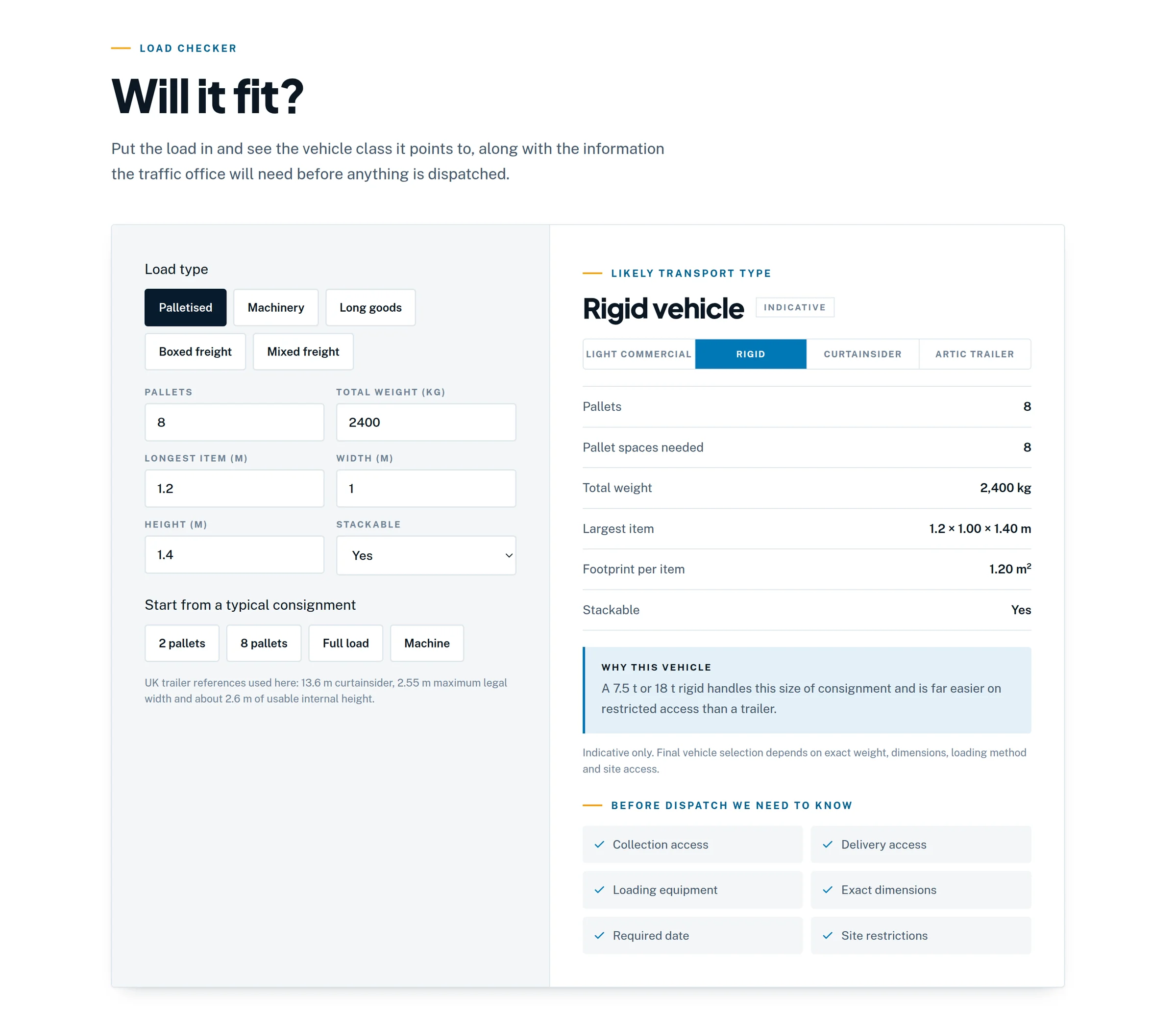
“Will it fit?” is a question the website can help answer.

A customer with an awkward load often does not know what it needs. Put the weight, the item count and the dimensions in, and the site can indicate whether the movement points towards a light commercial, a rigid, a curtainsider, an artic trailer or specialist handling — and show what the traffic office will need to know before anything is dispatched.

The website provides indicative guidance only. Final vehicle and load suitability stays with the transport operator, and the tool says so on the page rather than in the small print.

Commercial effect: an enquiry that arrives already pointing at roughly the right vehicle, and a customer who has been told the truth about what is still to be confirmed.
Load checker — vehicle class, marked indicative
A load checker on the logistics website concept headed Will it fit. On the left, load type chips and fields for pallets, total weight, longest item, width, height and whether the load is stackable. On the right, a result reading Rigid vehicle marked Indicative, a scale running from light commercial through rigid and curtainsider to artic trailer with rigid highlighted, a summary of the consignment, a note explaining why that vehicle suits it, a line saying final vehicle selection depends on exact weight, dimensions, loading method and site access, and a list of what is needed before dispatch.

Scroll the panel sideways to read the full screen.

03 · Coverage and routes

Make operating coverage easy to understand.

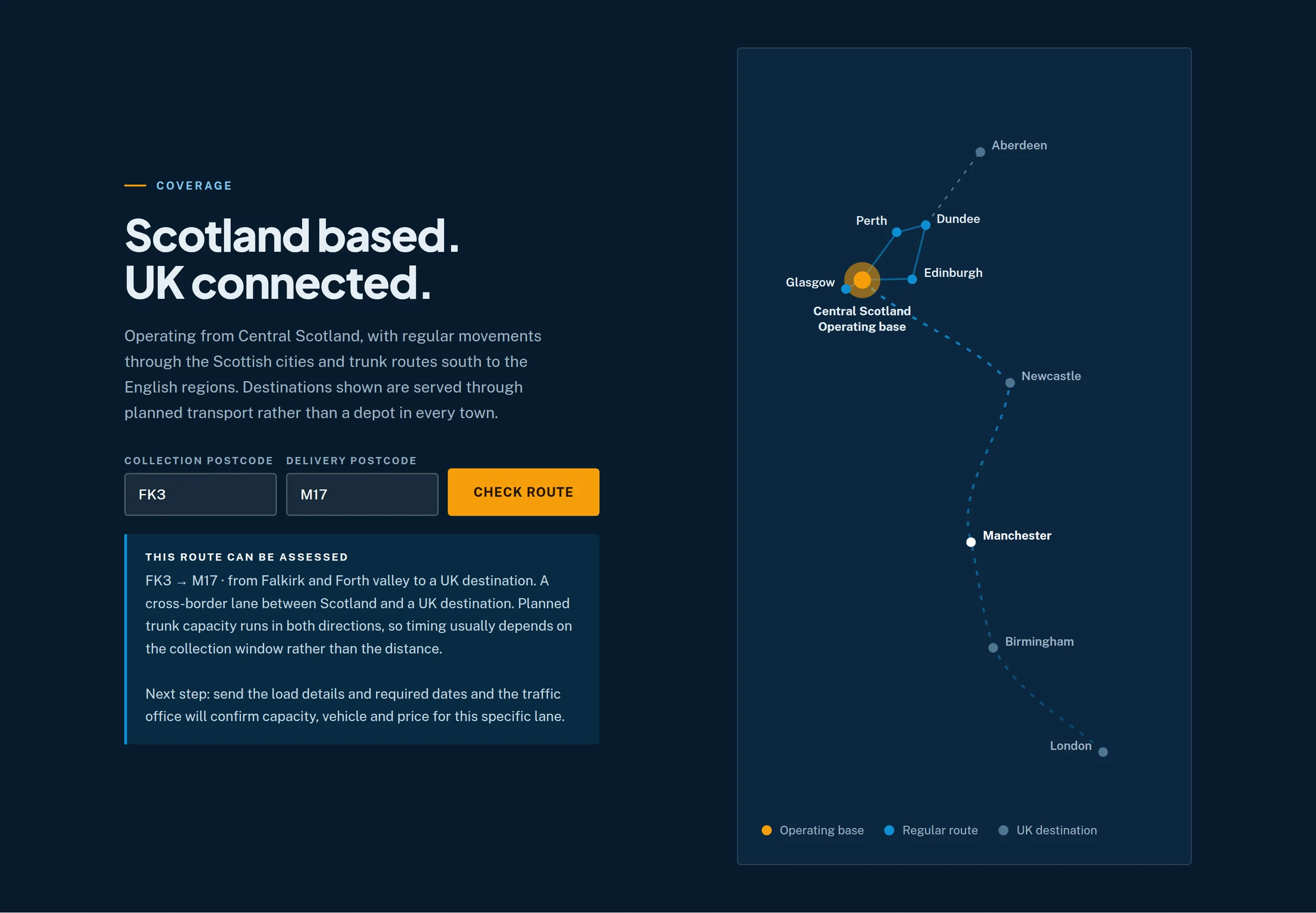
Haulage is sold by the lane, not by a radius from the yard. A buyer needs to see the operating base, the routes that run regularly, and the UK destinations served through planned transport rather than a depot in every town.

A route check tells them whether their lane is one you work, and what to send next. It does not promise a vehicle on a date — that is the traffic office’s decision, and the interface keeps it there.

Commercial effect: fewer enquiries from lanes you do not run, more from the ones you do, and a page that genuinely earns location relevance in search.
Coverage — operating base, regular routes, UK destinations
A coverage section on the logistics website concept headed Scotland based, UK connected. On the left a route checker with a collection and a delivery postcode entered, returning a panel headed This route can be assessed which describes the lane and says the next step is to send load details and required dates so the traffic office can confirm capacity, vehicle and price. On the right a schematic map marking the Central Scotland operating base, regular routes to Glasgow, Edinburgh, Perth and Dundee, and further UK destinations including Aberdeen, Newcastle, Manchester, Birmingham and London, with a legend explaining the three marker types.

Scroll the panel sideways to read the full screen.

04 · Customer-facing layer

The digital experience shouldn’t end when the load is booked.

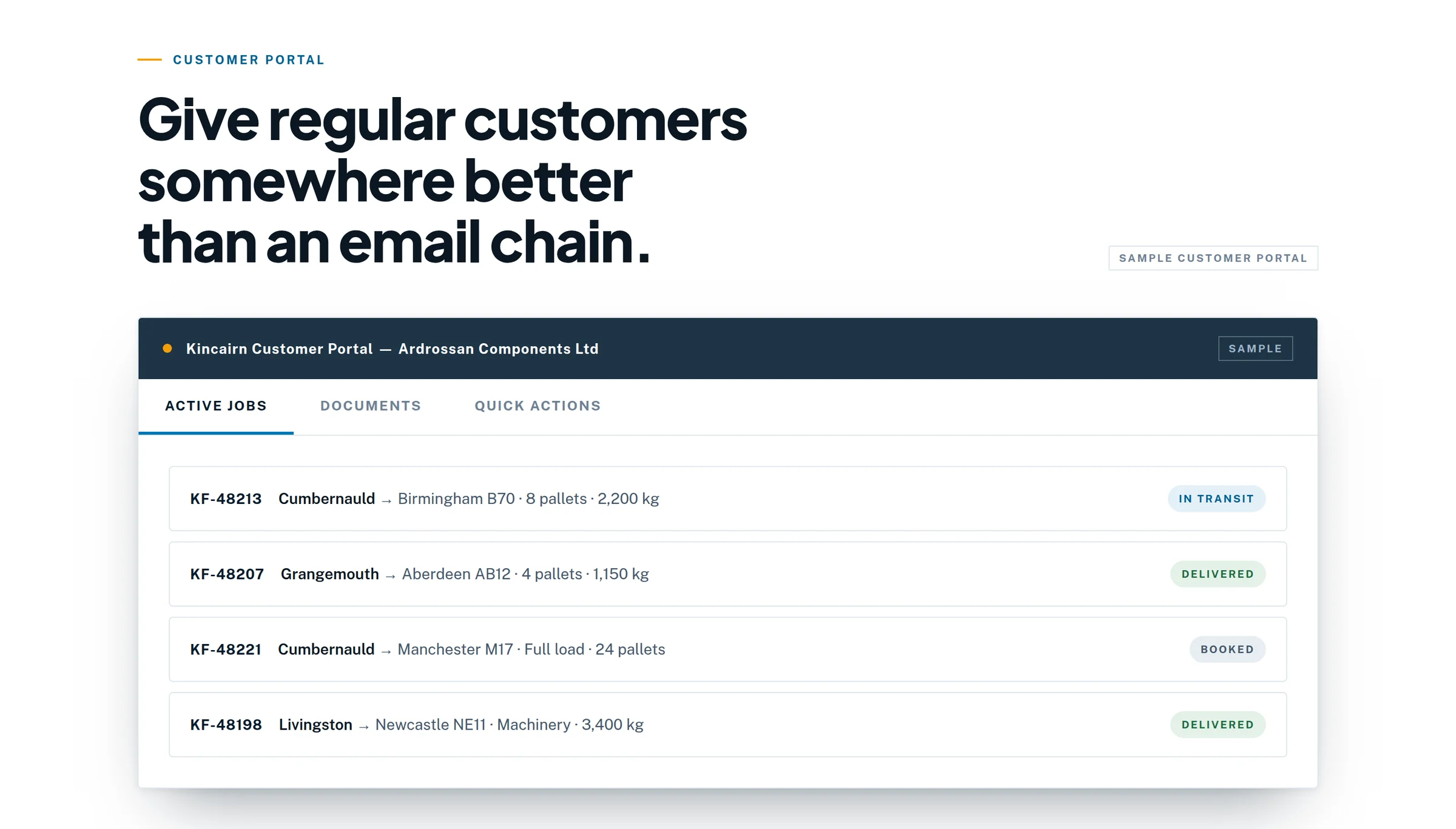
For a regular customer, the website stops being marketing the moment the first movement is booked. What they want after that is to see where things are, get a document without asking for it, and book the next one without writing the same email again.

A customer-facing layer can carry active movements and their status, previous jobs, delivery documents, proof of delivery and repeat booking. Status is shown as state — booked, planned, in transit, delivered — not as a promise.

Customer portal — active jobs, documents, quick actions
A customer portal on the logistics website concept, marked Sample, with tabs for active jobs, documents and quick actions. The active jobs tab lists four consignments by reference, each with its collection and delivery points, pallet count or load type and weight, and a status of in transit, delivered, booked or delivered.

Scroll the panel sideways to read the full screen.

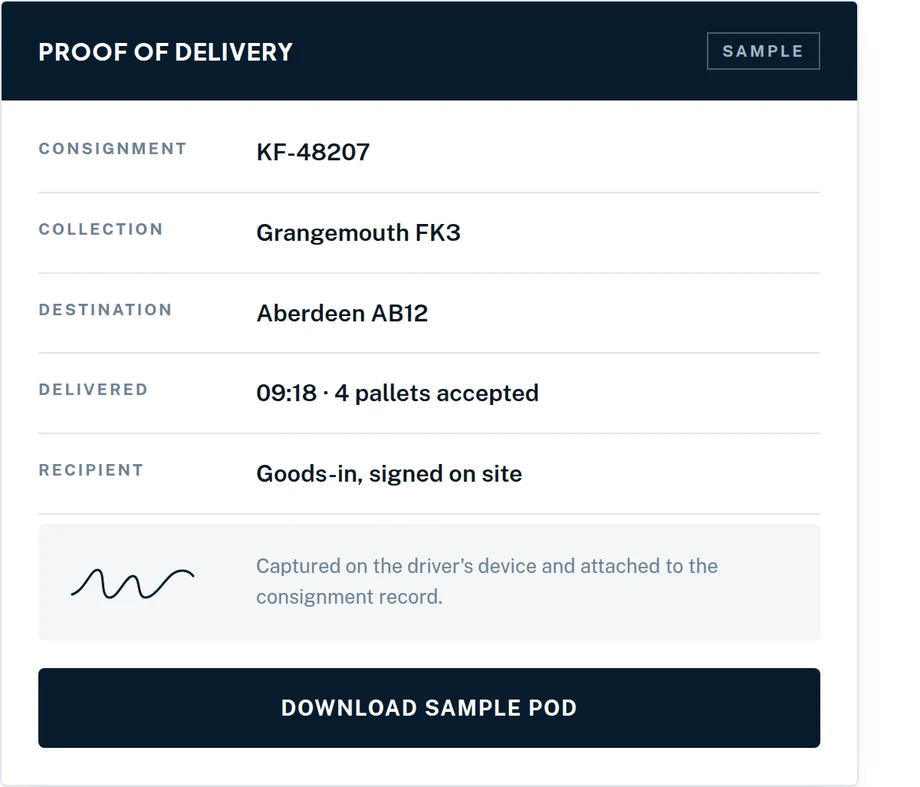
A proof of delivery record on the logistics website concept, marked Sample, showing the consignment reference, collection and destination points, the delivery time and pallets accepted, who signed for it, and a captured signature noted as taken on the driver's device and attached to the consignment record.

One record closes the job.

When a delivery is queried weeks later, the answer is the signature, the time and the quantity, held against the consignment rather than in somebody’s sent items. Attaching it automatically is usually the single most valuable thing a customer-facing layer does.

Scope note: what a portal can show depends entirely on what the operator’s existing systems will release. See customer portals further down for how we decide that.

Better transport enquiries

Traffic only matters if it turns into something the transport team can price.

A relevant buyer should be able to get from a search result to a priceable brief without hitting a dead end or a form that asks for a message.

  1. SearchA service, freight type or lane they actually searched for.
  2. Relevant serviceThe page describes the movement they have, not transport in general.
  3. CoverageTheir lane is visibly one you run, or visibly is not.
  4. CapabilityVehicle class, handling and access answer “can you do it?”
  5. Transport briefA structured enquiry carrying what the traffic office needs.
  6. Commercial follow-upAcknowledged, owned, routed and followed up on a date.

Most transport websites lose people between coverage and enquiry. The parts worth working on are specific: what the page asks for and where it asks, how the quote journey is built, whether a load can be described in full without a phone call, how an enquiry is acknowledged and routed, and which source it came from.

You will not get a conversion rate or a response time from us as a sales figure. You will get yours, measured, and then worked on.

  • Call-to-action placement and structured quote journeys
  • Lead-source attribution and call tracking
  • Automatic acknowledgement, so nobody wonders whether it arrived
  • Routing by service, lane or account, to a named owner
  • Conversion tracking that ties an enquiry back to the page that produced it

CRM & commercial pipeline

A quote request should not disappear into the transport inbox.

An enquiry sitting in a shared mailbox belongs to nobody, shows no state and remembers nothing. The next few hours decide whether the movement is won or quietly lost.

  1. Website enquiryThe transport brief arrives complete, with its source attached.
  2. Lead createdIt becomes a record rather than an email, against a new or existing account.
  3. Movement identifiedLane, load, vehicle class and date, in fields rather than in prose.
  4. Commercial owner assignedA named person, by service, lane or account — nothing sitting unclaimed.
  5. QuotePriced against planned capacity, with what was quoted recorded on the record.
  6. Follow-upReminded rather than remembered, on the day it was supposed to happen.
  7. Won or lostAnd why — so the next rate review has something behind it.

Keep what works. Connect what doesn’t. Build where there is a genuine gap.

Where a CRM is already in use we integrate with it. Where it is half-adopted we fix the workflow around it before suggesting anything new. Where the business genuinely runs on something no CRM covers, we build something lightweight and bespoke — and only then. We do not recommend replacing a system that is working.

See Business Automation

Automation

Reduce the repetitive admin around new transport enquiries.

Not the transport. The typing around it — the acknowledgement, the classification, the chasing and the re-keying that happens between the enquiry landing and the job being planned.

01Automatic acknowledgement the moment an enquiry is submitted
02Enquiry classification by load type, service and urgency
03Service routing — pallets, dedicated, contract or warehousing to the right desk
04Geographic routing by collection area or lane
05Sales reminders against quotes that have gone quiet
06Follow-up sequences that stop the moment somebody replies
07Source tracking carried from first click through to the won job
08Document requests for the paperwork a movement needs
09Internal notifications to the planner, not to everybody
10Customer updates at the points a customer would otherwise ring about

We do not promise an integration before we have looked at your systems. What can be connected depends on what you run and what it will release — which is a conversation with your provider, not an assumption on a web page.

Operations

Once the movement is won, the problem moves inside the business.

A website’s job finishes at the enquiry. The expensive part begins a minute afterwards, in the handover and in the third place somebody retypes the same collection address.

01Job handover from whoever took the enquiry to whoever plans it
02Collection details — access, equipment, booking-in, contact on site
03Delivery details — windows, restrictions, who signs
04Customer updates that currently happen by phone, one at a time
05POD capture and getting it to the customer without being asked
06Document handling — delivery notes, consignment references, paperwork per job
07Recurring bookings re-entered from scratch every time
08Internal tasks that live on a whiteboard or in somebody’s head
09Customer records spread across an inbox, a spreadsheet and the TMS
10Reporting assembled by hand at month end

Build around the specialist software, not over the top of it.

A transport management system, a warehouse management system, telematics, route planning, fleet maintenance and tachograph analysis all exist because they are hard problems solved properly. We do not propose replacing any of them without a specific reason. Where there is a genuine gap — and in most operations there are two or three — we integrate with what is there, automate the repetitive admin around it, and build the internal tool that nothing on the market covers.

Consulting & Strategy

Customer portals

Give regular customers somewhere better than an email chain.

The customers worth the most are the ones who move something every week. They are also the ones generating the most “where is it?” and “can you send me the POD?” traffic through the office.

A portal is not an all-or-nothing thing. It can be one screen showing active jobs and their documents, or it can carry booking, history and account information. What it should never be is a feature list decided before anybody looked at the systems it has to draw from.

  • Active jobs and the state each one is in
  • Previous jobs, searchable by reference or date
  • Documents and POD available without an email request
  • Repeat booking from a movement they have already made
  • Account information — references, sites, contacts, standing instructions

What is actually possible depends on four things

  1. The existing TMSWhat it holds, and how it holds it.
  2. Integration and API availabilityWhether your provider will release that data, and on what terms.
  3. Customer needWhat your customers actually ring about, rather than what looks impressive.
  4. Business processWhether the internal workflow can keep a portal accurate once it exists.

We work those four out before quoting a portal, because the answer to the second one occasionally ends the conversation — and it is better to find that out in week one than in month three.

Warehousing

Transport and warehousing should feel like one commercial journey.

Where an operator stores as well as moves, the website usually treats storage as an afterthought page — even though it is often what turns a customer into a contract. Where holding stock and handling orders are the business rather than a sideline, that is a different build again — see distribution & fulfilment.

A buyer arriving for transport frequently has a storage problem too, and the reverse is just as common. When both sit on the same site, described in the same language, with one enquiry route between them, the operator gets asked about both.

  • Pallet storage
  • Commercial storage
  • Inbound handling
  • Outbound distribution
  • Contract logistics
  • Scheduled movement

Capacity, pallet counts and square footage go on the page only where they are real and current. A number that was true two years ago is worse than no number at all, because the first thing a serious enquiry does is ask about it.

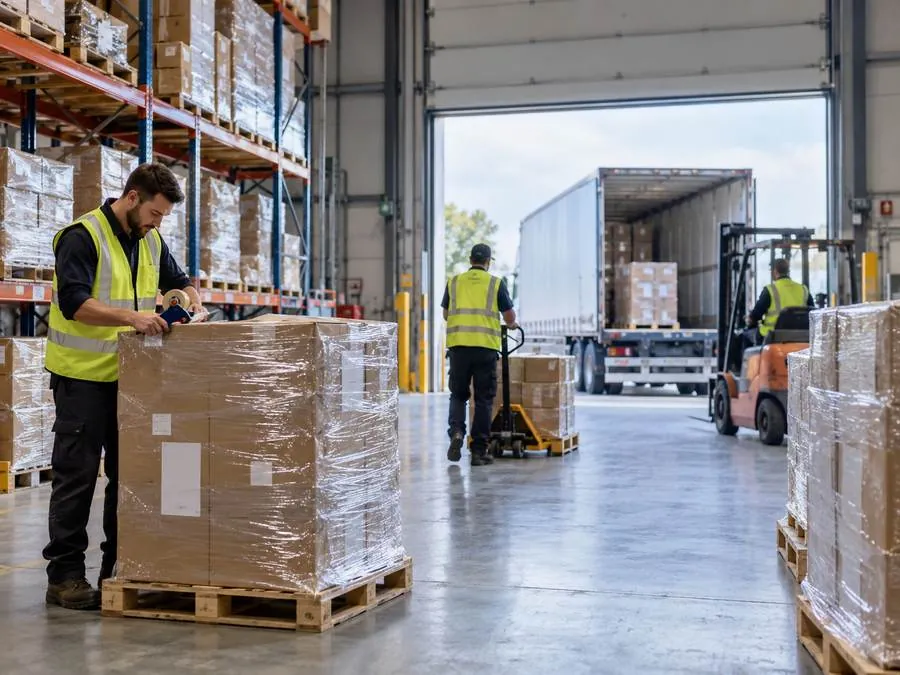
A warehouse operative wrapping a pallet ready for despatch beside racking and a loading dock.

Measurement

Know what is actually generating transport enquiries.

Most operators have a rough figure for last month’s enquiries. Far fewer could name the service, the lane or the search behind the ones that turned into repeat work.

  • Which services bring in loads worth planning
  • Which lanes and destinations produce enquiries
  • How many transport briefs get started
  • Where the unfinished ones get abandoned
  • What search brings in, as against what anyone remembers
  • Whether a campaign covered its own cost
  • Which sectors enquire rather than read
  • The route a won movement actually took through the site
  • Which customers came back for a second load

Instrumented properly across analytics and the CRM, that is the difference between guessing at a marketing budget and setting one. It also decides what gets worked on next, which is where most of the value shows up in year two — see ongoing care.

Credentials

Important credentials should be easy to find — and completely accurate.

In transport, the people who care most about your licensing and insurance are the customers worth the most. They check, and they are unimpressed by a badge with nothing behind it.

Operator LicenceLicence type and the operating centre, stated plainly where a buyer looking for it will find it.
InsuranceGoods in transit, CMR and liability cover, described as it actually stands on the policy.
FORS or equivalentAccreditation and level, where it is genuinely held and current.
ISO certificationStandard, scope and certificate number, taken from the certificate itself.
MembershipsTrade bodies and pallet networks, named only where membership is real.
Specialist certificationWhatever the freight demands — temperature control, hazardous goods, security.

We publish credentials from the document, never from a description of it. We do not invent an Operator Licence, a FORS level, an ISO certificate, an insurance figure, an accreditation, an award or a review rating, and we do not emit review or rating structured data without genuine evidence behind it. Where an accreditation is not held, the space for it stays empty until it is.

Who this is for

One industry. Nine different commercial shapes.

The vehicles look similar from the outside. What changes between these businesses is who buys, how the enquiry arrives, what has to be true before anyone can price it, and what happens to the customer afterwards.

That is what decides the shape of the website — not the number of trucks.

  1. Haulage companiesGeneral road haulage where the enquiry is a load and a date, and the website’s job is to qualify it before the traffic office does.
  2. Freight operatorsMixed freight across several handling types, where the site has to explain what is carried before it explains who carries it.
  3. Pallet distributionVolume work from one pallet upwards, usually bought on ease. The quickest structured enquiry tends to win it.
  4. Dedicated transportA vehicle and a direct run, sold on certainty. The page has to be specific about what dedicated actually means here.
  5. Contract distributionRegular planned lanes, bought by procurement over weeks. The website earns the meeting rather than the movement.
  6. Warehousing & logisticsStorage, handling and onward movement, where the storage conversation and the transport conversation are the same enquiry.
  7. Regional transport operatorsStrong in a known area, competing against national names. Coverage and local credibility do most of the work.
  8. National logistics businessesMultiple depots and services, where the architecture problem is navigation and search, not persuasion.
  9. Industrial transport companiesPlant, machinery and awkward loads, where access, lifting and dimensions decide everything and a generic form is useless.

A sector page is worth building only where the freight, the handling, the access and the paperwork genuinely change with it. Nine near-identical pages with the noun swapped help nobody. Where one of these is your market, it gets a page that says so; where it is not, it does not get one. Every sector we work in is listed on the industries index. The nearest neighbour to this page is engineering and manufacturing — the people at the other end of the loading bay, with the same structured-enquiry problem and entirely different paperwork.

Your next website

Build a logistics website that does more than list vehicles and phone numbers.

Whether you need to replace an outdated haulage website, generate better transport enquiries, improve search visibility or connect your commercial process to CRM, automation and customer systems, Central Systems can build around how your operation actually works.

Running an outdated haulage site already? Start with the rebuild.