Security companies
Commercial security is bought on confidence. Central Systems builds websites for security companies that replace the contact form with a structured site survey, route every enquiry to the right person instead of a shared inbox, connect it to a CRM, automate the follow-up and admin around it, and keep earning search visibility long after launch.
Manned guardingMobile patrolsKeyholding & responseCCTV monitoringEvent security
The commercial problem
The person choosing a guarding contract is a facilities manager, a site manager, a managing agent or an operations director. They are comparing three providers on a Tuesday afternoon, they already know what manned guarding is, and they are trying to answer a much narrower set of questions than the website in front of them is answering.
None of that is a design problem. It is a commercial one, and it is fixed by deciding what the website is for before deciding what it looks like.
Design and rebuild
Most security companies do not need to start from nothing. Plenty have a site that ranks reasonably and has years of trust attached to the domain, and throwing that away is rarely the right commercial call. We do both, and we will tell you honestly which one your situation calls for.
For companies launching, rebranding, or moving from a template that was never going to carry a commercial contract. Structure, content and enquiry journey designed together rather than a theme filled in afterwards.
For companies whose website was built years ago, loads slowly, looks dated beside a competitor, and cannot be edited without ringing whoever built it. A rebuild preserves what is working and rebuilds what is not.
See the experience in action
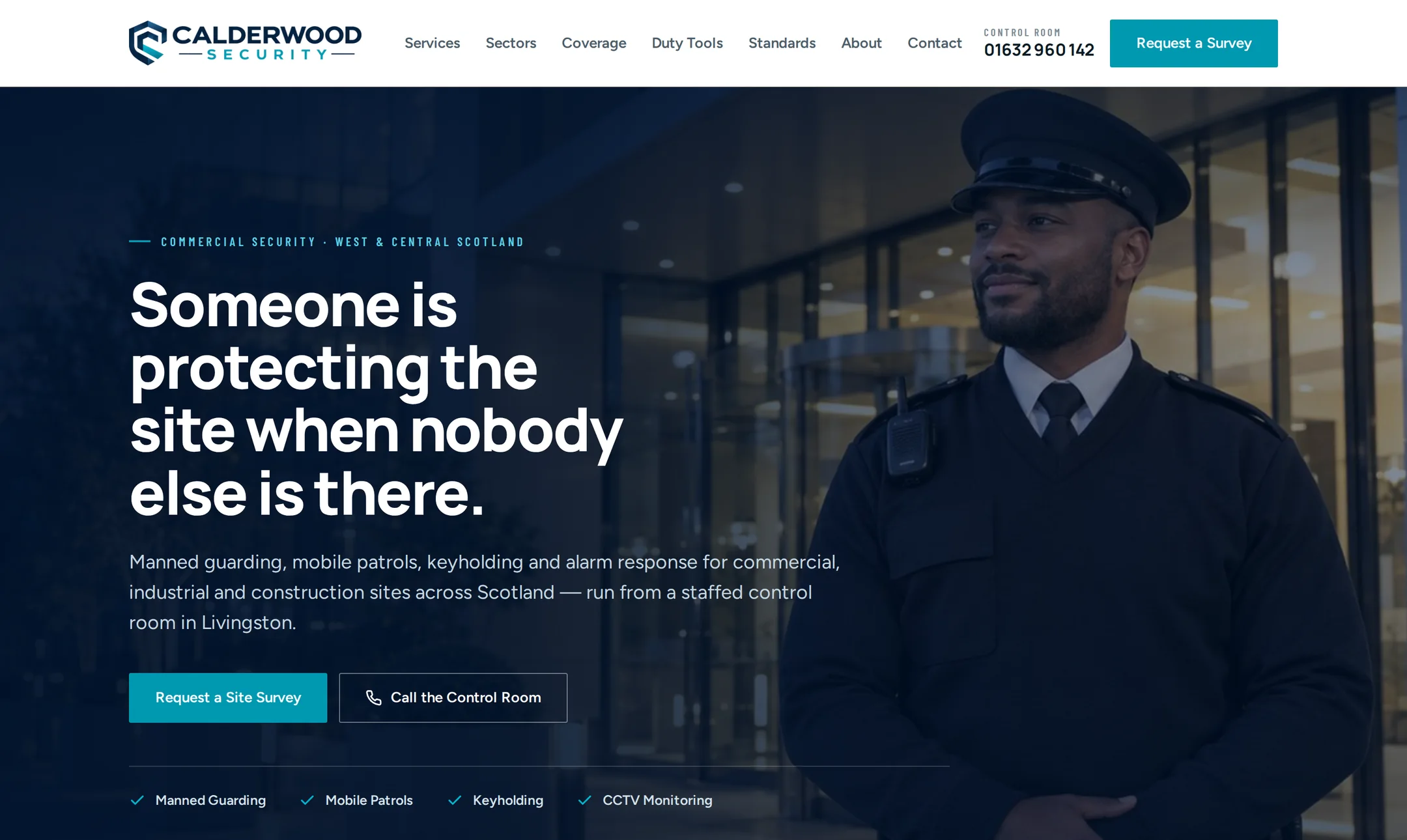
Rather than describe it, we built one. Calderwood Security is a commercial security website concept created by Central Systems to show how the whole thing fits together — the positioning, the service pages, the site survey, the coverage architecture, the duty tools and the reporting a client would receive. Everything below is from that concept.
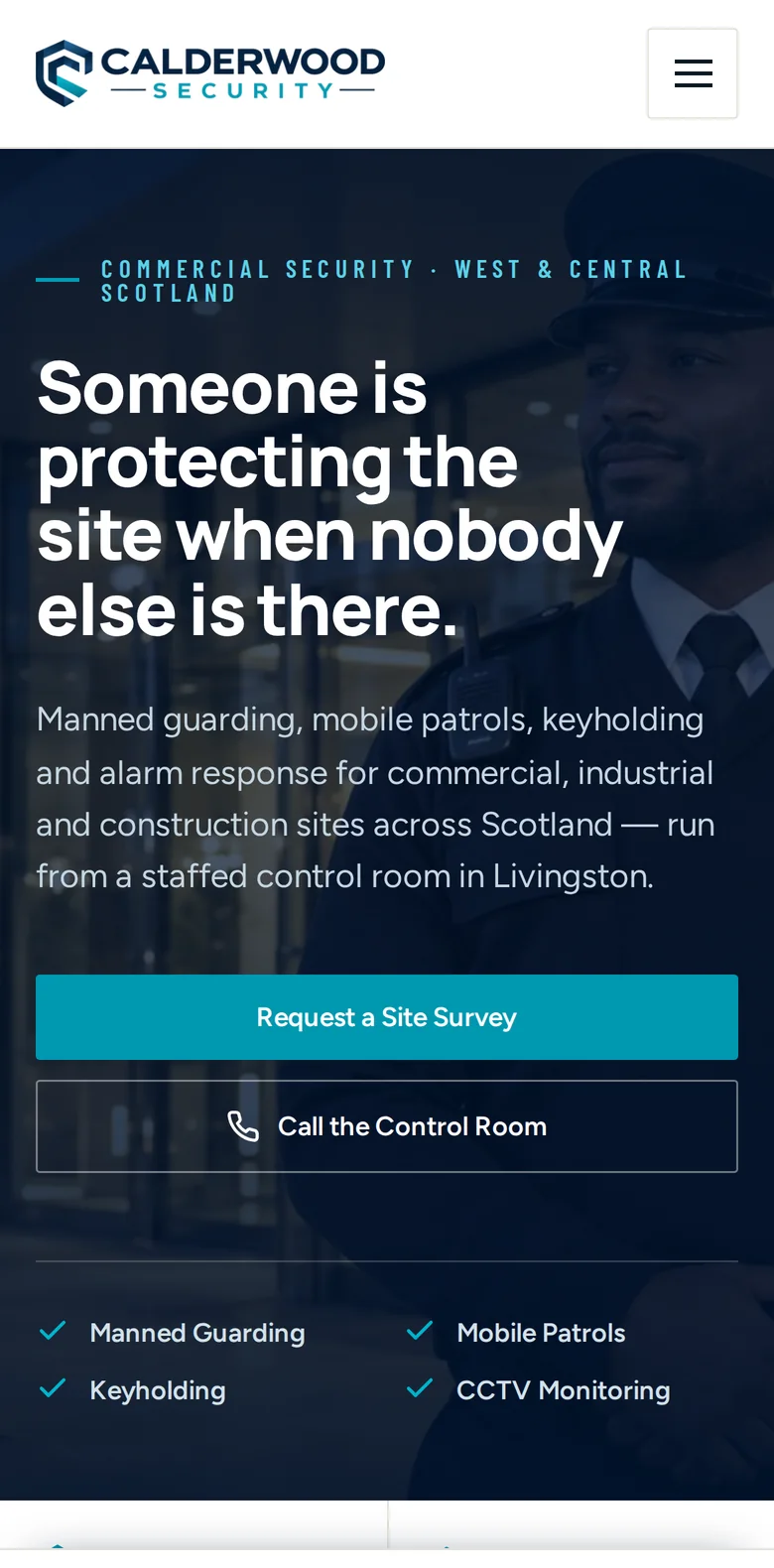
The hero does one job. It states what the company does, for what kind of premises, in what area, and gives the buyer two ways to act — one for the enquiry that can wait, one for the alarm going off now. No stock imagery of hooded figures, no tactical styling. A facilities manager is buying a professional service, and the page has to look like one.
Illustrative website conceptCalderwood Security is an illustrative website concept created by Central Systems to demonstrate how a security company’s website could work. Company details and example data are illustrative.
Better enquiries
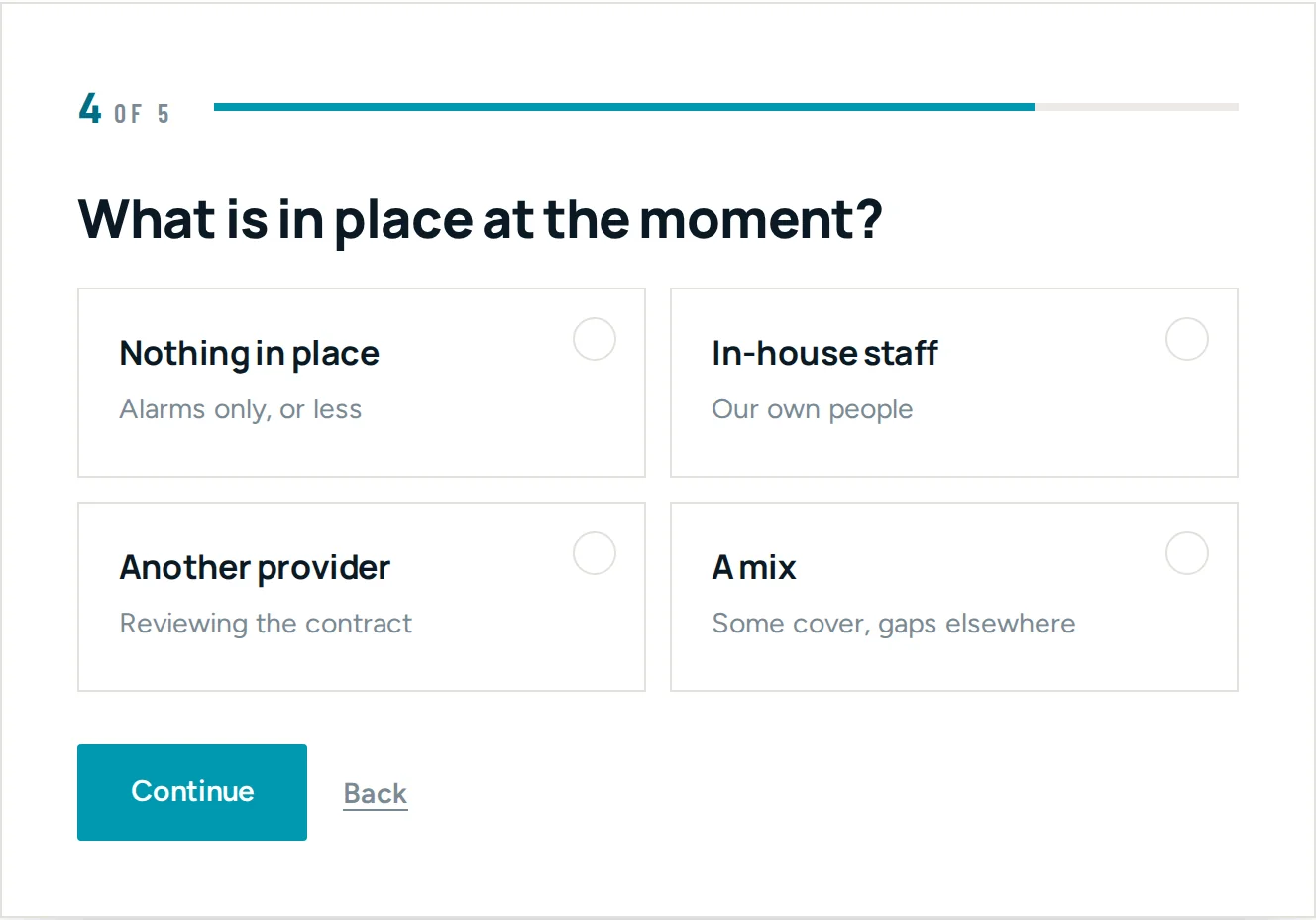
A security enquiry is not a message. It is a requirement: a site type, a set of needs, the hours that need covering and what is already in place. Ask those four things in the order a buyer can answer them, and the enquiry arrives as something a surveyor can act on instead of a note that starts another round of phone tag.
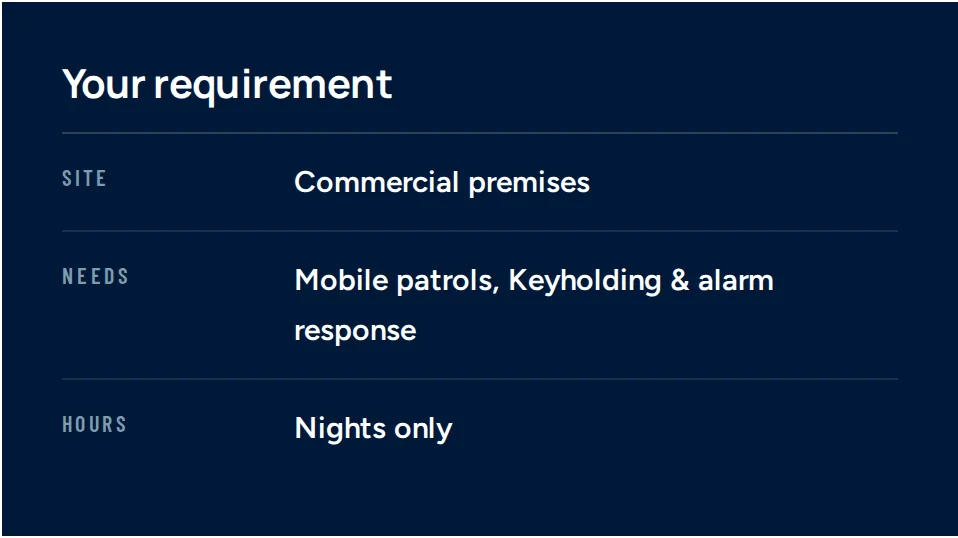
Each step asks one question with real options rather than a blank field. The buyer can see the requirement forming beside them, which is what keeps them going to the end — the summary is visibly worth something rather than a progress bar for the company’s benefit.
What arrives is a qualified brief with the site type, the services wanted, the hours and the current arrangement already attached. Out‑of‑area enquiries can be caught at the coverage step rather than after a surveyor has driven there.
Search visibility
Nobody searches “security company” and buys. They search for a service, in a place, for a kind of premises — keyholding in Falkirk, construction site security, retail park guarding, out of hours alarm response. A single “Services” page cannot rank for all of those, and it should not try.
That structure is also what makes internal linking work: a sector page can send a construction buyer straight to mobile patrols, and a location page can send a Falkirk enquiry to keyholding, without either page trying to be everything at once. See how we approach SEO and growth.
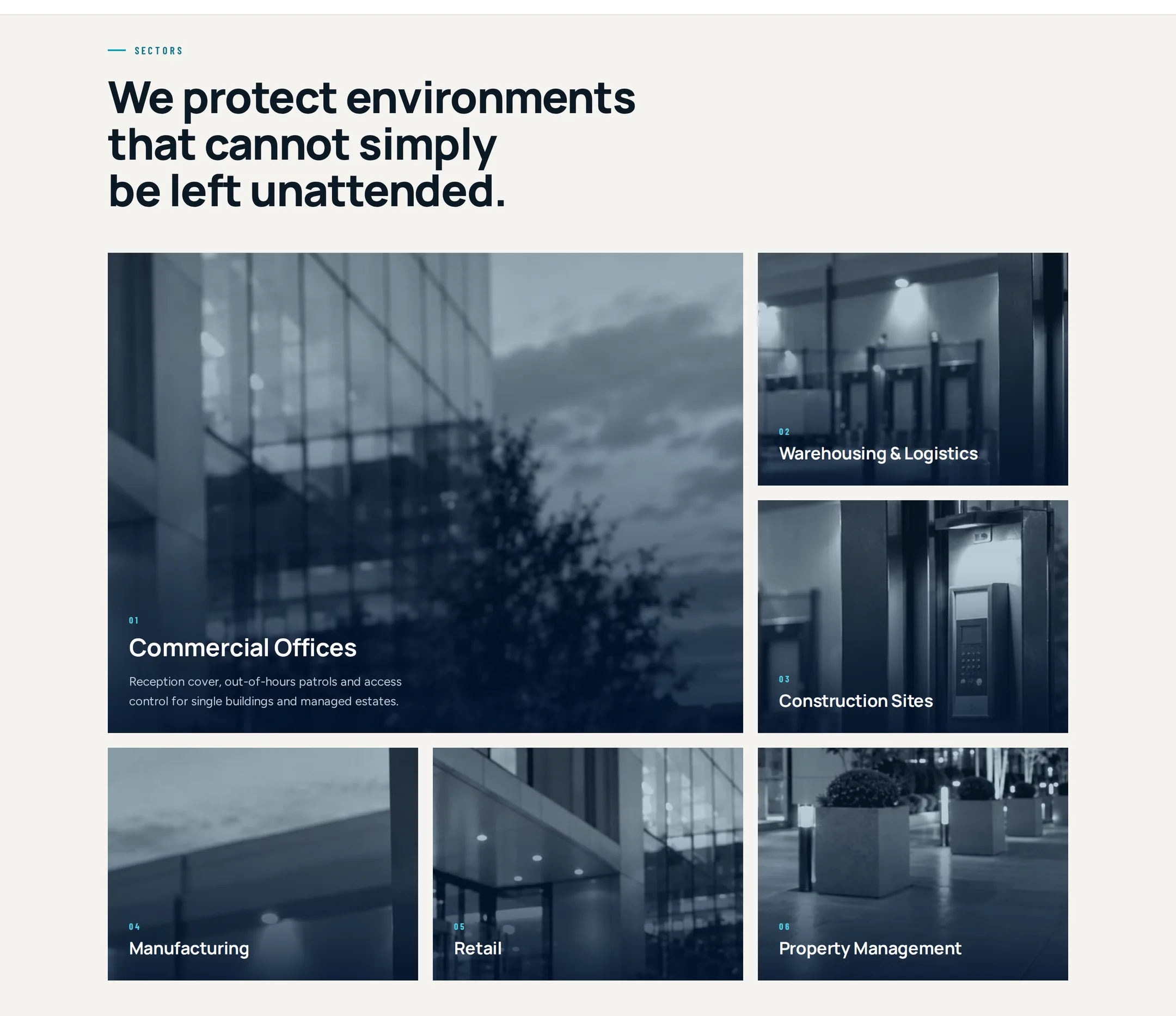
Sector pages, not a sector list. Each tile in the concept is a page that can rank and convert on its own terms, which is what turns a five‑page brochure site into something that can compete on more than the company name.
Tools and resources
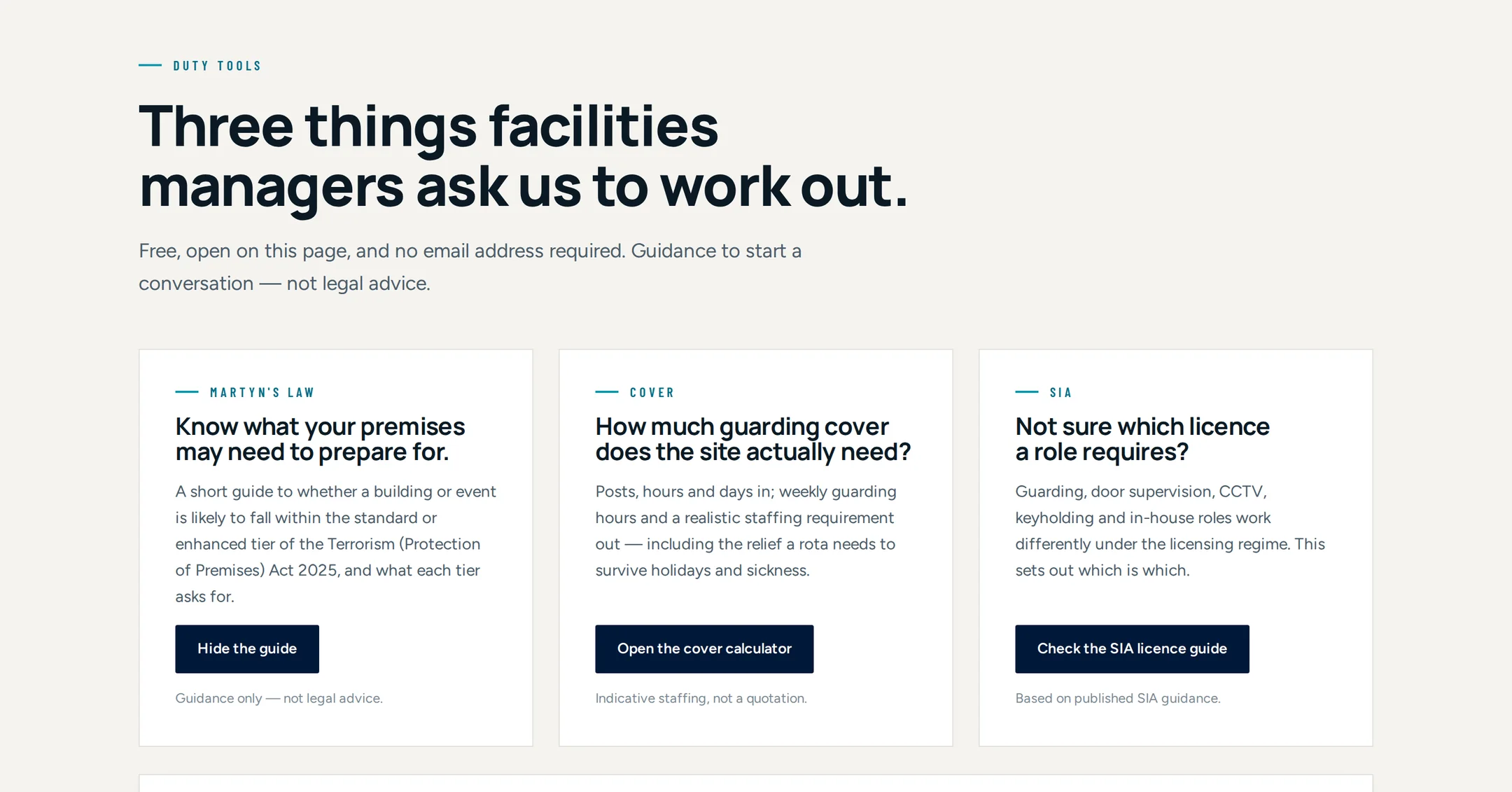
Security buyers arrive with questions the sector has never made easy to answer: which Martyn’s Law tier a premises falls into, which SIA licence a role needs, how much guarding cover a rota actually requires once relief is counted. A small, genuinely useful tool answers that, earns links, gets quoted in AI answers, and starts a conversation with somebody who has just told you exactly what they need.
Three tools, one section. Each one is scoped to a single question, each carries its own honest limit — guidance, not legal advice; indicative staffing, not a quotation — and each is a reason for a facilities manager to arrive on the site before they have a requirement.
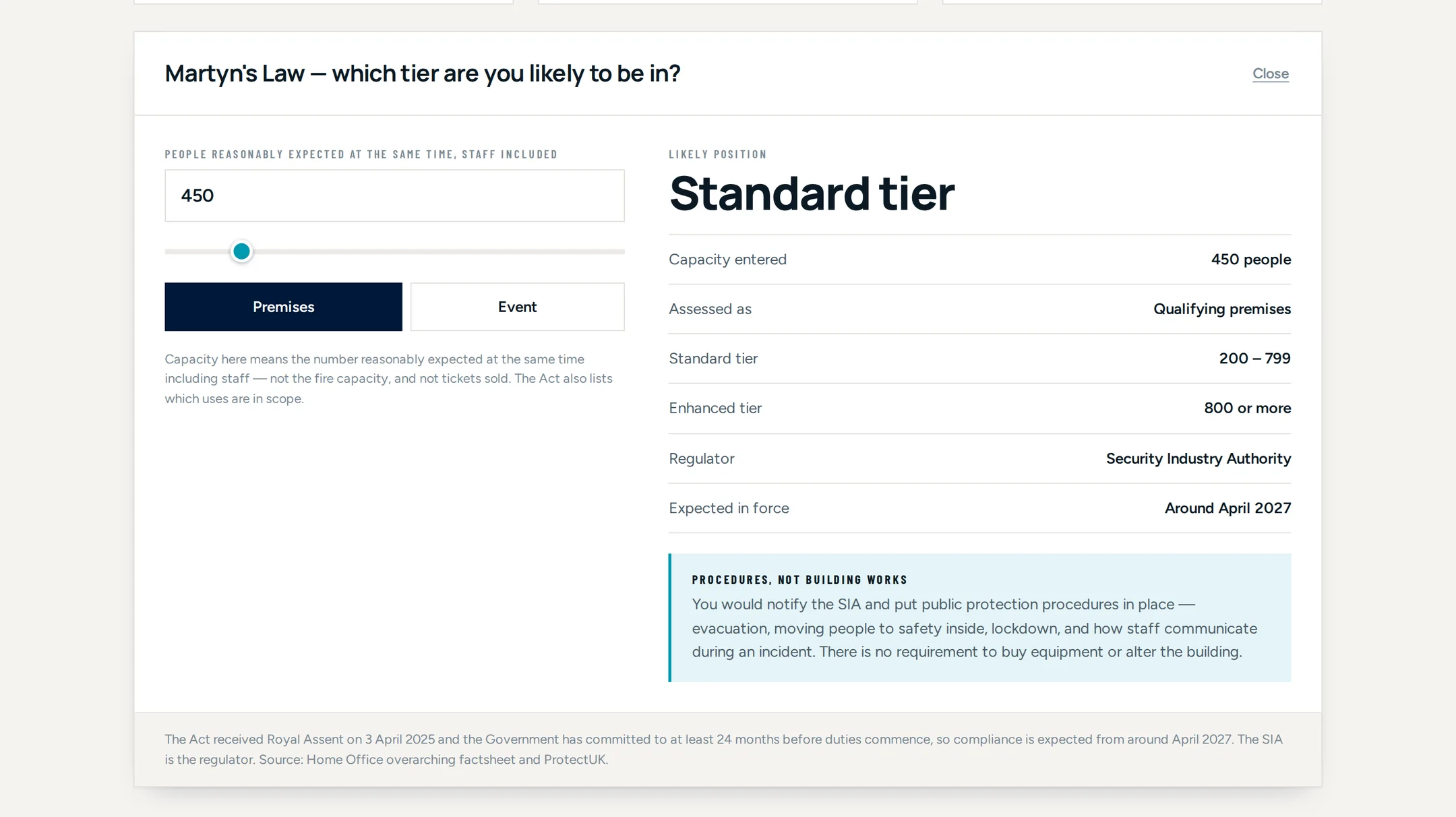
Opened, it does real work. Enter a capacity, get a likely position with the thresholds, the regulator and the timing shown rather than asserted — and a clear statement that the duties are procedures rather than building works. Useful enough to bookmark, honest enough to stand behind.
We build these as part of the website rather than bolting on a plugin, so the output, the wording and the limits stay under your control. See how we build tools and automation.
AI search
A growing share of security research now happens inside an AI answer rather than a list of ten blue links. Someone asks what Martyn’s Law means for a 400‑capacity venue, or whether a keyholding provider needs an SIA licence, and the model answers from whichever sources are structured clearly enough to be quoted. Brochure copy does not get quoted. Direct answers do.
None of this is a trick, and anyone offering guaranteed placement in an AI answer is selling something nobody can deliver. It is the same discipline as good SEO, applied to a different reader. See how we work with AI.
Coverage and local search
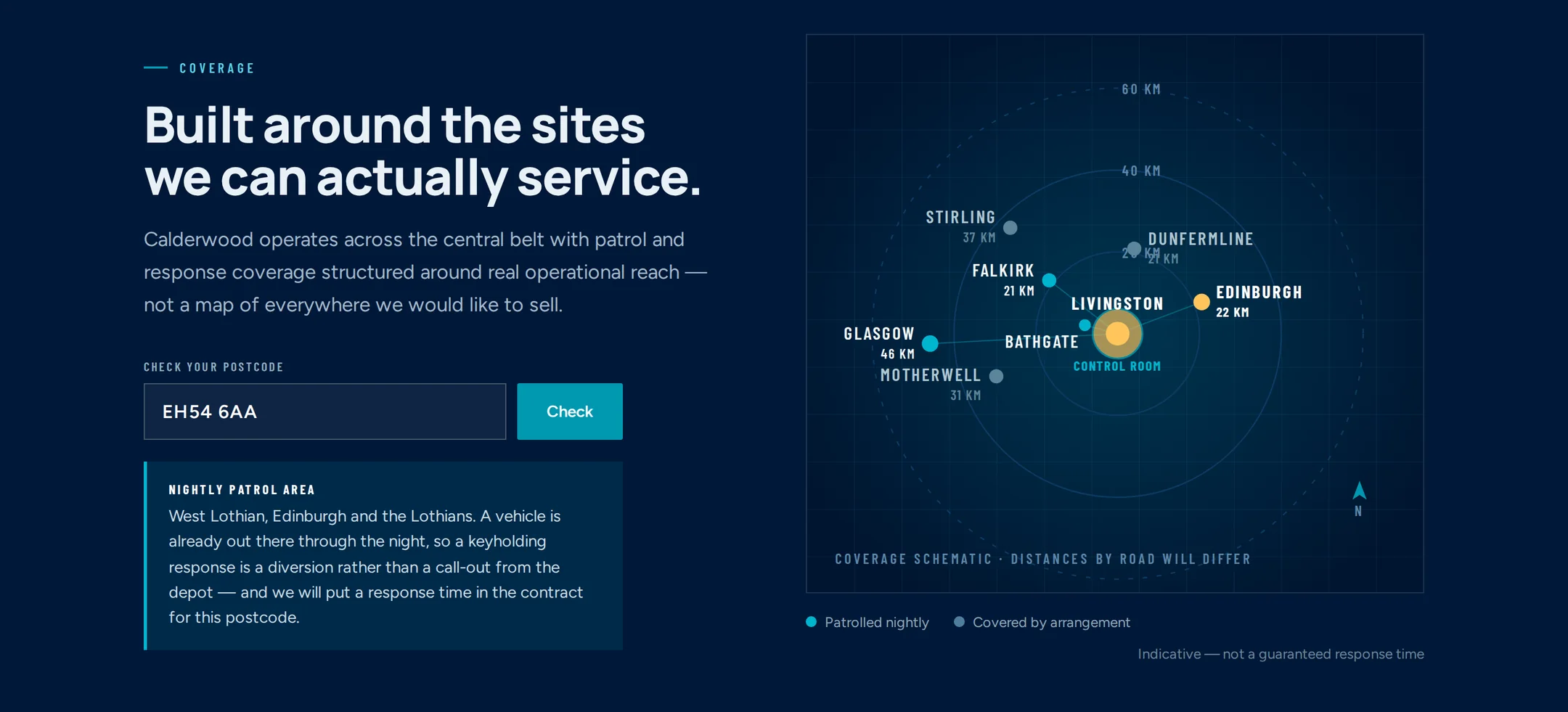
Coverage is the single most wasteful ambiguity on a security website. Claim the whole country and you collect enquiries you have to turn down, at the cost of the ones you could have won. Make it checkable, and a site manager gets an answer in one action — and you get a qualified enquiry with a postcode already attached.
Two honest tiers, and a schematic rather than a map. Patrolled nightly and covered by arrangement are commercially different things, and saying so builds more confidence than a single shaded blob. The schematic is labelled indicative, because a straight‑line distance is not a response time and pretending otherwise is how a website writes a cheque the operation has to cash.
CRM and automation
Guarding is a long, relationship-led sale with a renewal cycle attached. The company that follows up the same day, remembers the survey date, and knows when the incumbent’s contract ends wins work that has nothing to do with the website — but the website is where the data has to start.
Automation here is not a chatbot. It is the removal of the twenty small manual steps between an enquiry arriving and a surveyor standing on the site. See how we automate business processes.
Backend systems
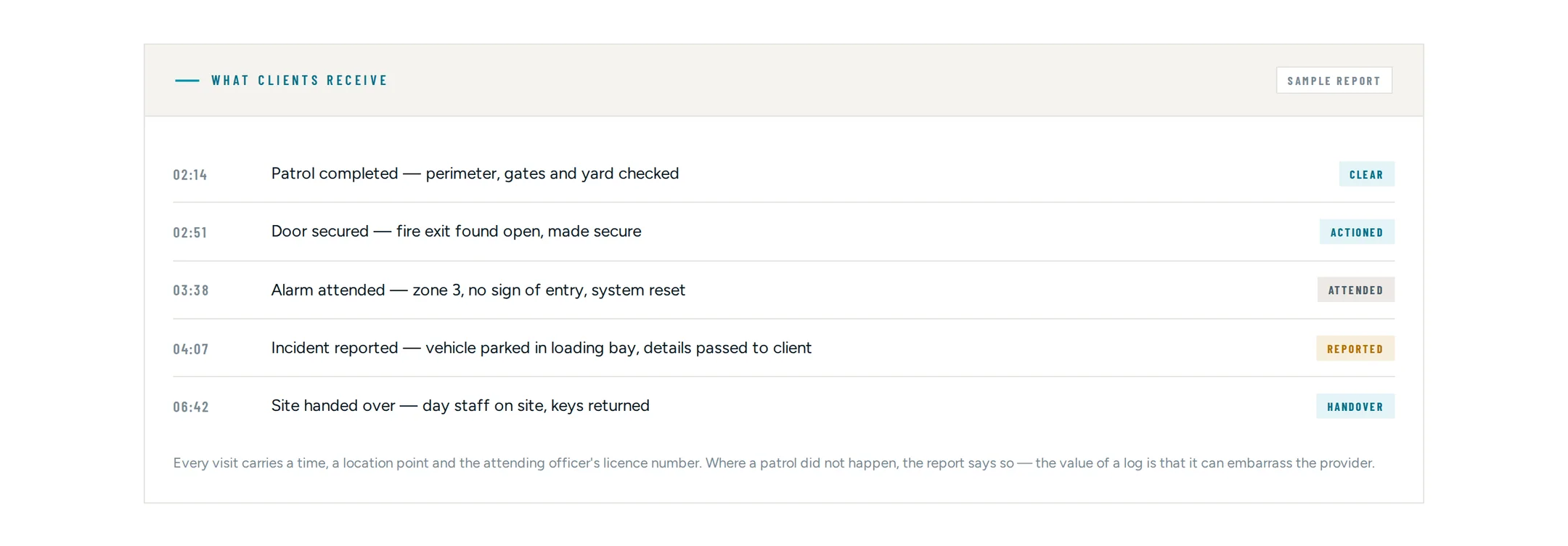
Most security companies run on a workforce or patrol system that does the operational job well and stops at the client’s edge. The gap is almost always the same: what the client sees, and what the office has to assemble by hand every month to show it.
This is the product, as far as the client is concerned. A facilities manager never watches a patrol. What they experience is the report waiting for them before the site opens — which is why it is worth designing properly rather than emailing as a spreadsheet.
Trust
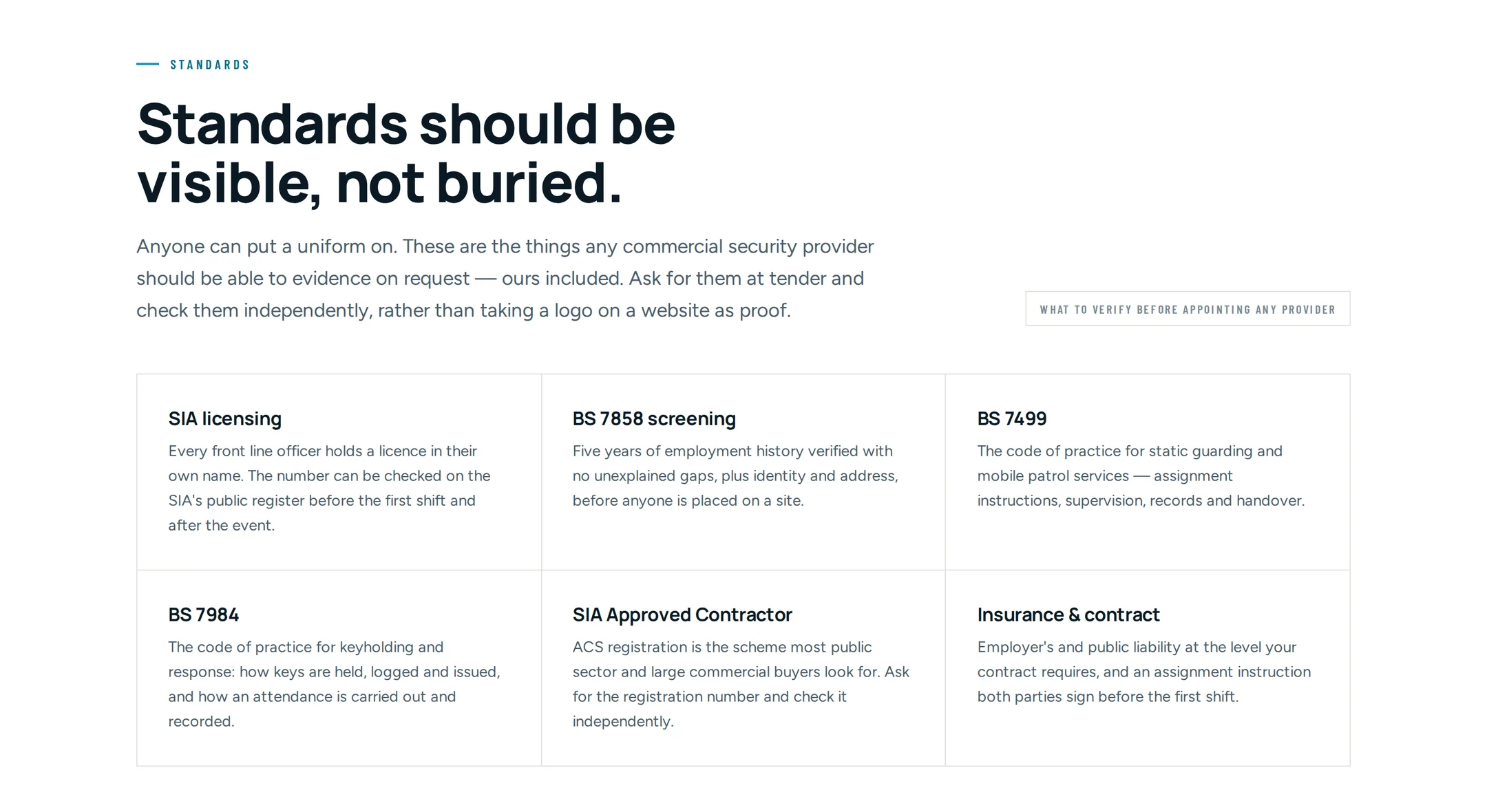
Security is a sector where a row of badges on a footer proves nothing, because anyone can put a logo on a website. The providers who win commercial contracts are the ones who tell a buyer what to verify and invite them to go and do it.
Written for the buyer, not for the company. The concept explains what SIA licensing, BS 7858 screening, BS 7499 and BS 7984 actually mean and tells the reader to check them independently. That is a stronger trust signal than any badge, and it ranks, because it is what people are searching for.
We will build the pages that present your accreditations, insurance, screening policy and references clearly. We will never invent one. If a certification is not held, it does not go on the website — in this sector that is not just an ethical position, it is the one that survives a tender.
Security companies recruit continuously, and most of them do it through the same contact form the sales enquiries use. That costs twice: a commercial brief buried under applications, and good officers lost to a process that felt like shouting into a void.
A separate application journey that captures licence status, availability, transport and the sites someone can realistically get to turns recruitment into a pipeline rather than an inbox — and lets you answer a client asking whether you can staff a new contract from next month.
Most security companies can tell you how many enquiries came in. Very few can tell you which page produced the one that became a contract, and that is the only number that should decide where the next investment goes.
We set this up at launch rather than afterwards, because a measurement plan retrofitted six months later has no baseline to compare against. Ongoing growth work runs from what it shows.
Who this is for
“Security company” covers businesses with very different buyers, sales cycles and websites. The architecture changes accordingly.
Long contracts, tender processes and a buyer who needs to believe you can staff it properly. The site has to carry the operational detail, not just the promise.
Bought on coverage and responsiveness. Coverage architecture and a checkable service area do more work here than anything else on the site.
Project‑length work with a site manager who buys quickly and under pressure. Speed from landing to a usable brief is the whole game.
Seasonal, deadline‑driven, and increasingly shaped by Martyn’s Law readiness. Resources and guidance pull this buyer in early.
A technical sale where the website has to explain what is watched, by whom, and what happens next — without drowning the buyer in equipment lists.
Procurement‑led buyers comparing providers on documentation. Clear, structured, checkable content beats persuasion every time.
Most security companies are two or three of these at once, and the right structure usually becomes obvious in a twenty minute conversation. If you would rather start with evidence, run the free audit on your current site first and we will talk through what it finds.
Security work sits alongside sectors we already build for. If you also serve or subcontract to them, the same architecture applies: trades & construction, scaffolding, estate & letting agents, retail, hospitality and engineering & manufacturing. Or see every industry we build for.
Your next website
Whether you need a new security website, a rebuild of one that has fallen behind, better qualified enquiries, stronger search visibility, or the CRM and automation to handle what comes in, Central Systems builds around how your business actually runs.
Already know the website is the problem? Talk to us about a rebuild.