Engineering & manufacturing
Buyers arrive with the requirement already decided. Can you make it? Will it fit the machines? Do you work in that material, hold that tolerance, certify it, and deliver on the date they need?
Central Systems builds engineering and manufacturing websites around those buying questions — then connects the enquiries, the search visibility and the workflows behind them.
See what we can build
Why engineering websites underperform
Most engineering and manufacturing firms we speak to are not short of capability. They are short of a website that shows it.
A strong engineering website should qualify a buyer before anybody picks up the phone.
That is the whole commercial case. The facts a buyer needs are already true inside the business — the envelopes, the grades, the tolerance class, the certification, how long a quote takes. Publishing them properly turns a brochure into a filter, and a filter into better enquiries.
What this can look like
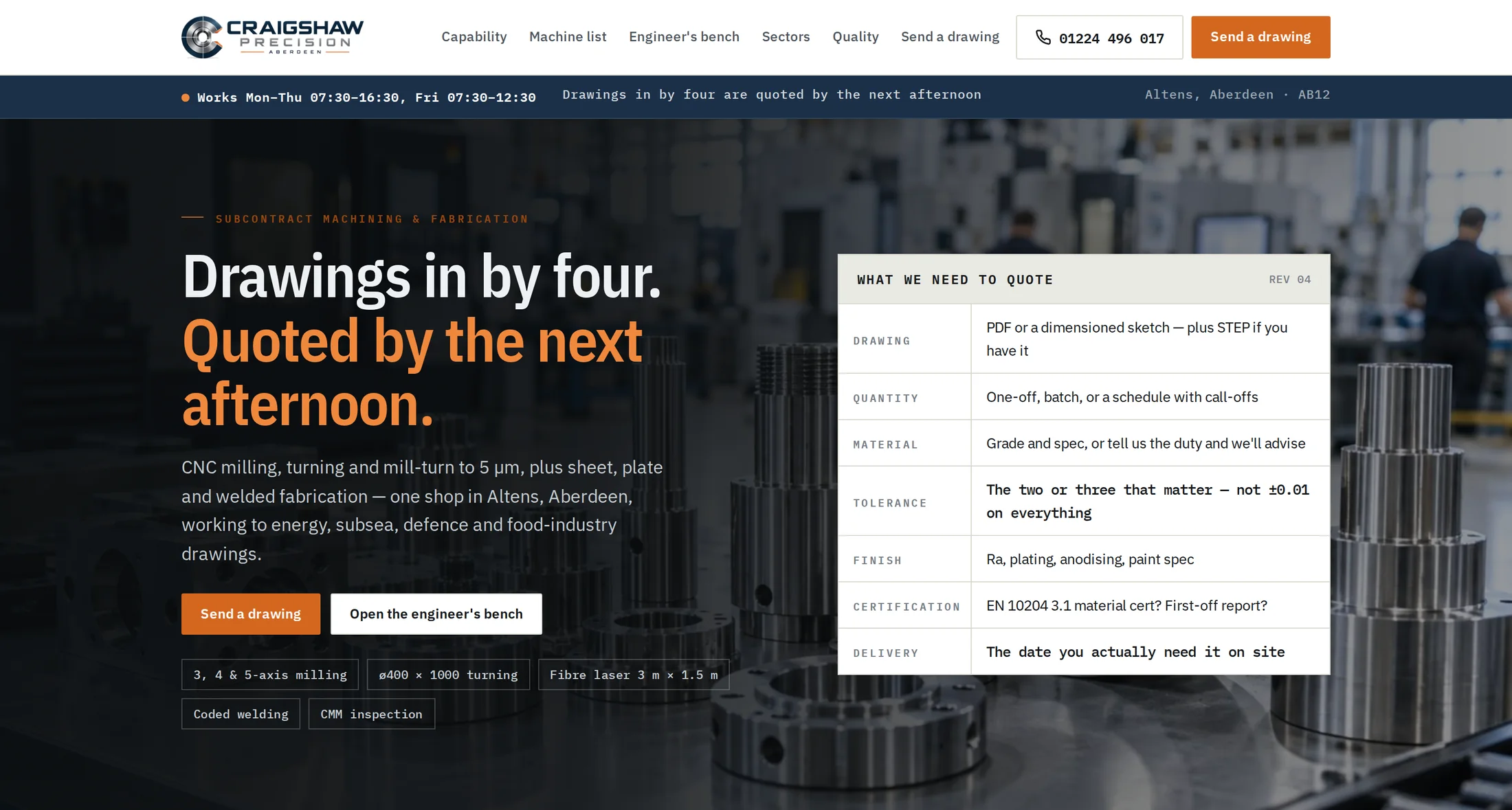
Four things a site can do that a brochure cannot — shown on a working concept we designed for the trade.
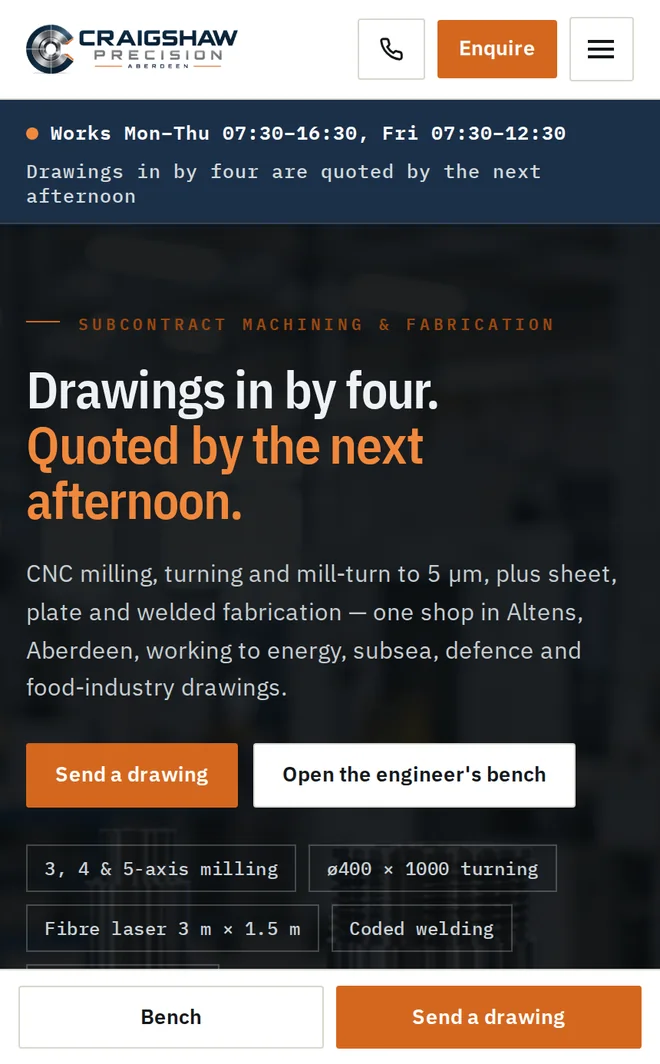
The first screen states the machines, the turnaround and what the shop needs to price a job. Desktop is where the drawing is open; the phone is a lookup on a shop floor, so it leads with the number, the hours and the location.
Illustrative engineering website conceptCraigshaw Precision is a fictional engineering business created by Central Systems to demonstrate how an industry-specific website could work. Company details and example data are illustrative.
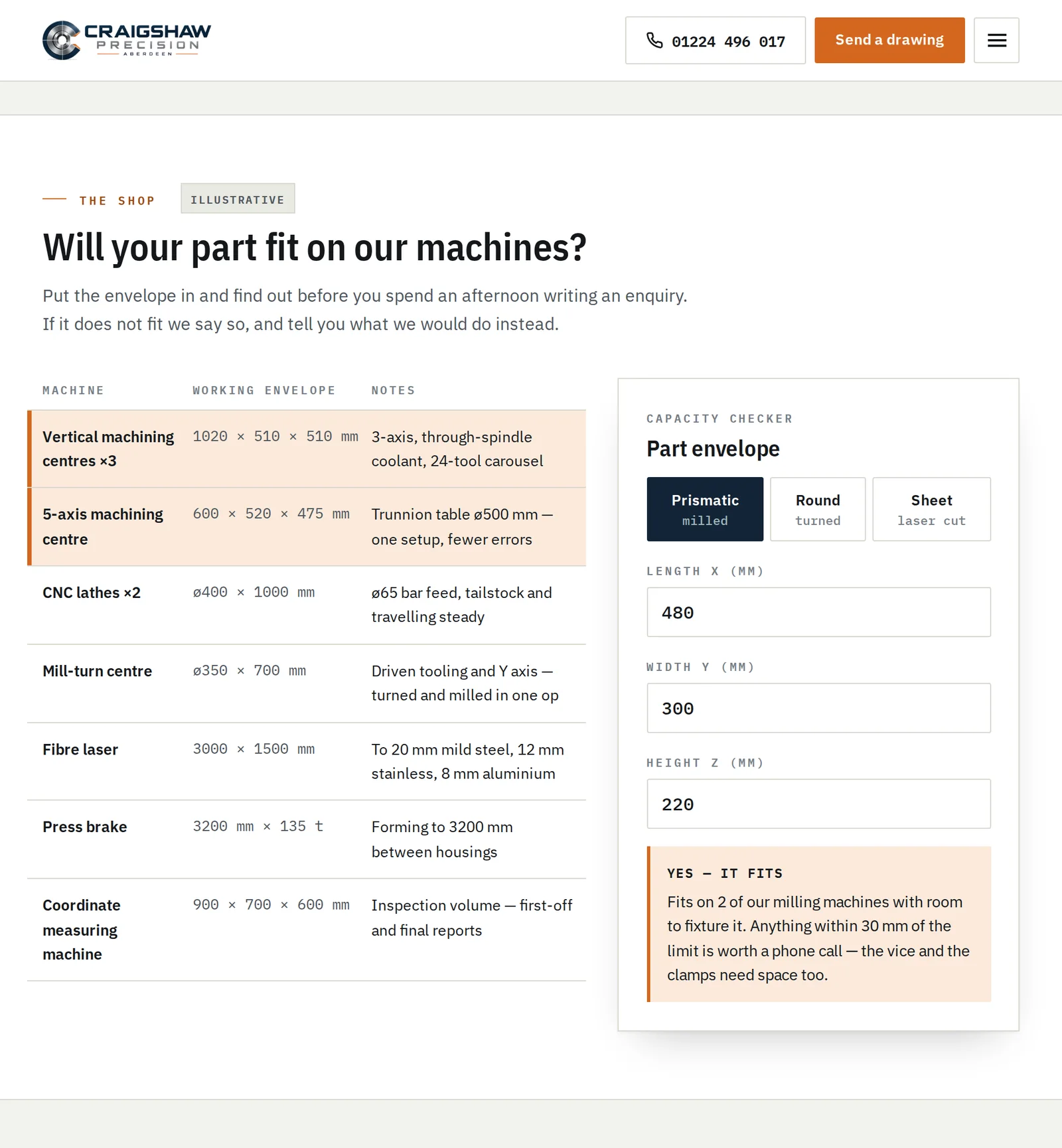
Instead of “large machining capacity”, publish the genuine working envelope of every machine and let a buyer put their own component in.
It answers no as readily as yes — and a “not on these machines, here is what we would do instead” keeps you in the conversation for the next part.
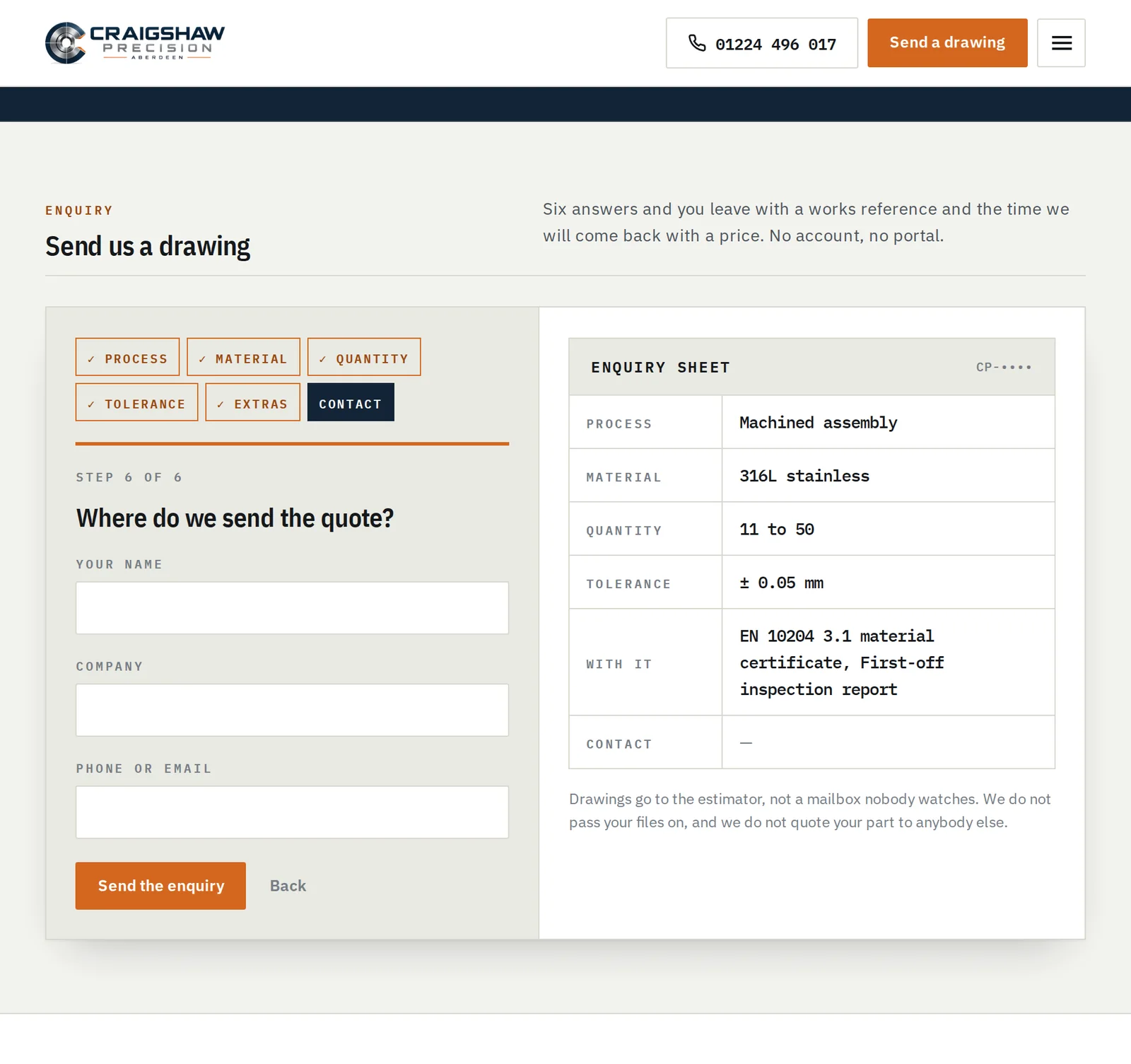
A request for quotation is a technical document, not a message. Capture the process, the drawing, the material, the quantity, the tolerances that matter, the finish, any certification and the required date — before it reaches the estimator.
The enquiry arrives complete instead of “Hi, can you quote this?” with the quantity missing.
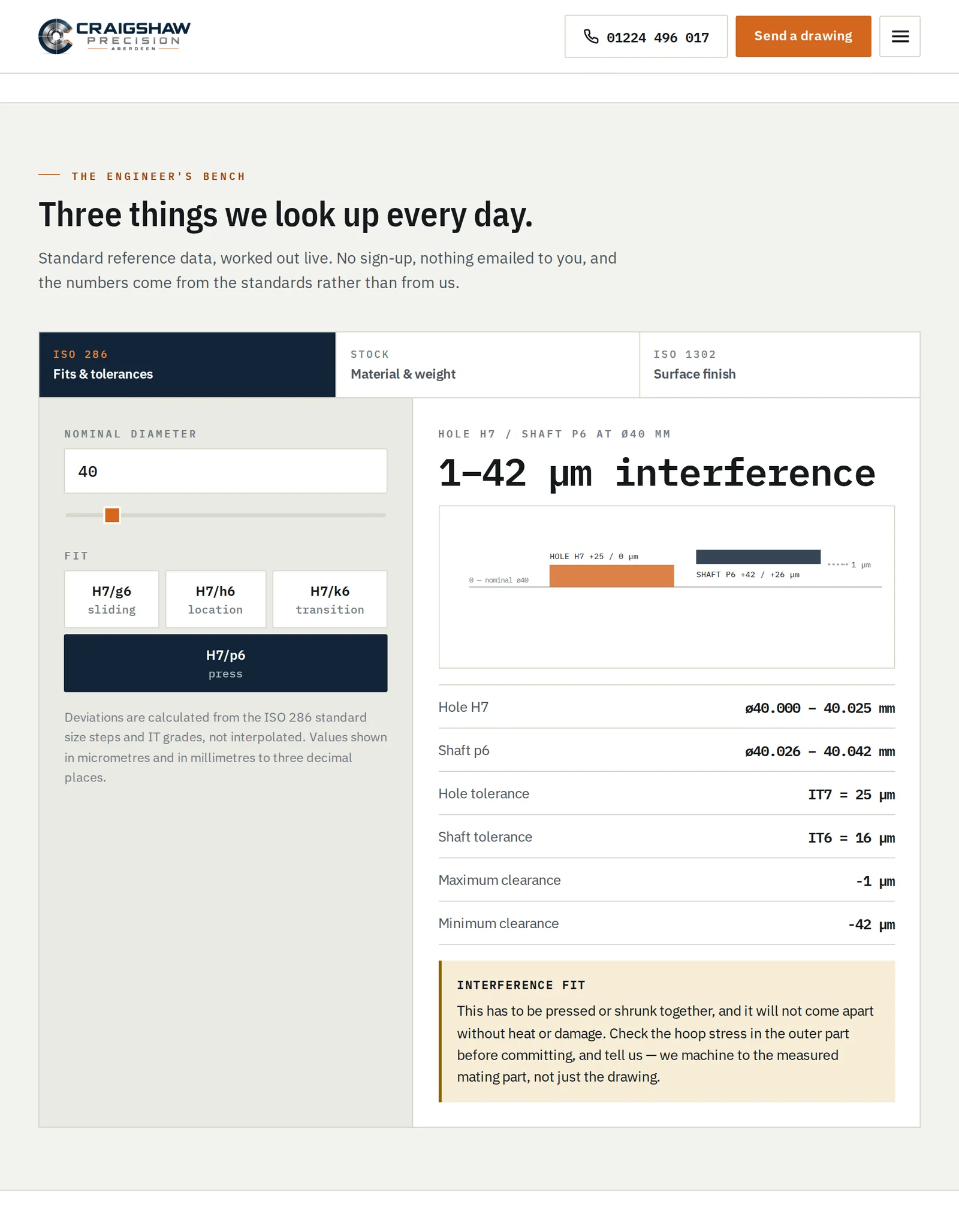
Fits and tolerances, material densities, surface-finish grades — the things a design engineer looks up mid-drawing and currently finds in a scanned handbook page or a forum post.
Content like this earns technical search traffic, demonstrates real expertise and brings people back between orders. It supports engineering judgement; it does not replace it.
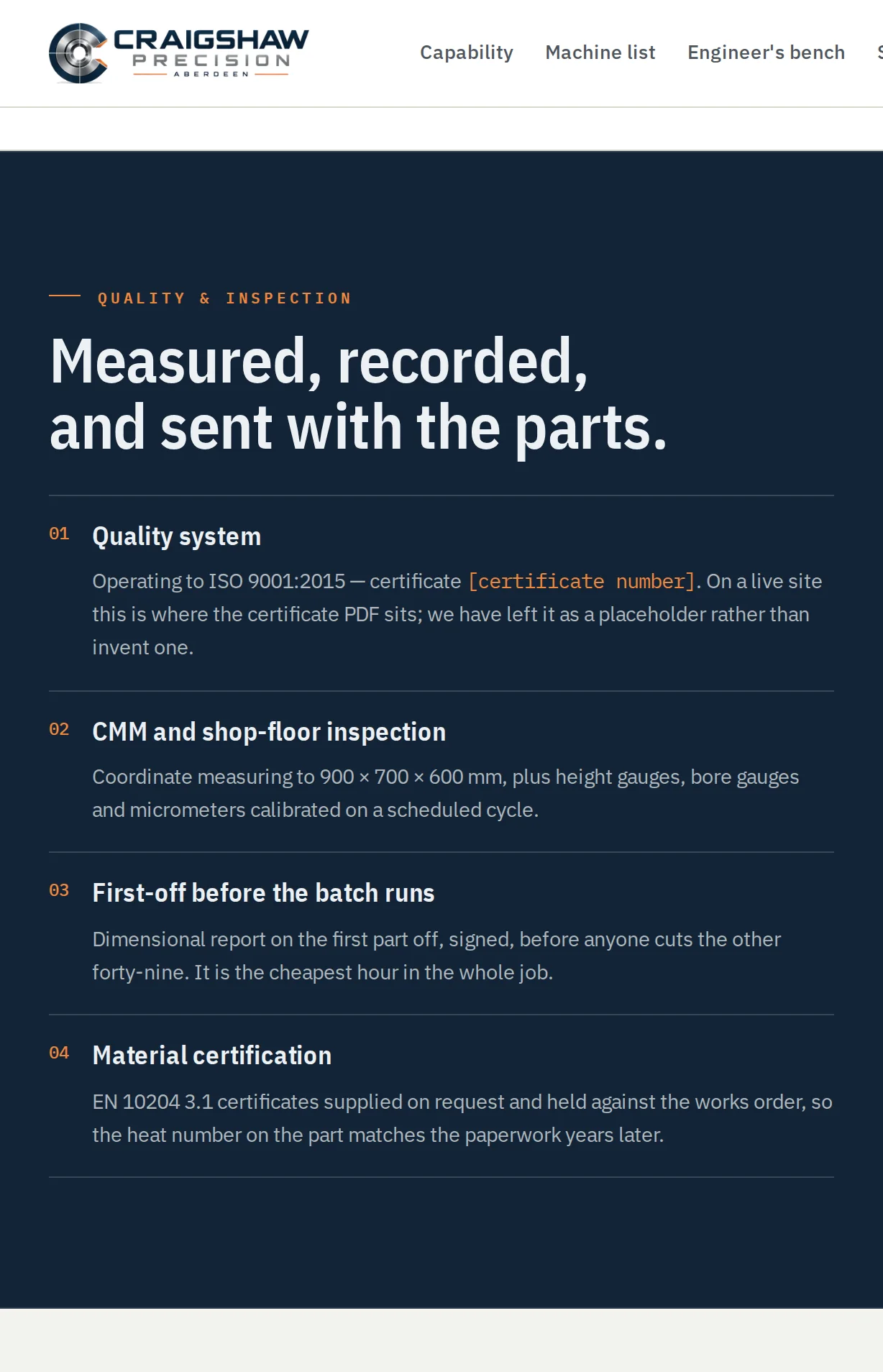
ISO certification, inspection capability, material certificates, first-off reports, traceability and CMM measurement are the sentences that move a buyer from looking to sending a drawing — and the buyers who care are the ones whose own quality system obliges them to check.
We publish verified certification from the actual document, including the number and scope where appropriate. Where a certificate does not exist yet, the slot is built and left open rather than filled with something plausible.
Website redesign
Engineering firms invest steadily — machinery, premises, people, inspection, certification, software, capacity — and then present all of it through a site built years ago for a smaller company.
A rebuild is not a redecoration. We keep what is working — the URLs that already earn traffic, the content that already ranks, the assets worth carrying over — and rebuild everything around how the business actually sells now.
Search visibility
Engineering buyers rarely search for a company. They search around a process, a material, a component, a certification, an industry and a place — often several at once.
A five-page brochure has almost nothing for that to match against. The work is architectural: give the site a page for each thing the business genuinely does, connect those pages to the sectors they serve and the places they serve them, and support the whole thing with technical content and structured data that describe the business precisely.
We will not promise you a position, and nobody credible will. What we will do is build the site so the work it wants is findable, then measure what arrives and keep improving it. That argument at more length is on the SEO and growth page.
AI search
Generative search experiences and AI-assisted discovery answer from what they can actually understand about a business — not from adjectives.
A site full of “quality, service and reliability” gives these systems almost nothing to work with. A structured technical site gives them a great deal: who the company is, what it manufactures, on which machines, in which materials, to what tolerances, for which sectors, from where, under which certifications, and how to make contact.
None of this is a trick, and none of it is new. It is the same work that makes a site genuinely useful to a person — written clearly, structured properly, and marked up so a machine can follow it too.
We cannot guarantee inclusion or citation in anybody’s AI answers, and we would be suspicious of anyone who said they could. The goal is simpler and more durable: a site built to be easier for both people and modern search systems to understand. Where it makes commercial sense, we also build AI into the business itself rather than only around its marketing.
Better enquiries
A relevant buyer should be able to move from a search result to a priceable enquiry without hitting a dead end.
Most engineering sites lose people between steps two and four. We work on the parts that actually move the number: where the calls to action sit, how the technical enquiry journey is built, whether a drawing can be uploaded without friction, how enquiries are routed and acknowledged, and which source each one came from.
We will not quote you a conversion percentage. We will measure yours, and improve it.
CRM & sales pipeline
An RFQ that lands in a shared inbox is a lead with no owner, no status and no history. What happens next is where the work is won or quietly lost.
We integrate an existing CRM where one is already in use, improve the workflow around it where it is half-adopted, connect forms to the systems the business actually runs on, and build something lightweight and bespoke only where nothing on the market fits. We do not recommend replacing an established ERP, MRP or QMS for the sake of it.
Behind the website
The website stops at the enquiry. The cost usually starts just after it — in the re-keying, the chasing and the spreadsheet nobody trusts but everybody uses.
Where there is a genuine gap, we build the tool — an internal dashboard, a job tracker, a document register, an approvals flow — and automate the repetitive admin around it. Where a specialist ERP, MRP, QMS or CAM system already does the job, we connect to it rather than compete with it. The detail is on business automation and consulting and strategy.
Measurement
Most engineering firms can tell you how many enquiries came in last month. Very few can tell you which page, sector or search produced the ones that turned into orders.
Set up properly in GA4 and the CRM, that turns marketing spend from an act of faith into a decision. It also tells us what to improve next — which is the part that compounds after launch, through ongoing care.
Sectors
The same machines and the same people serve buyers who judge you on entirely different things. What changes between them is the certification, the documentation and the language — not the shop floor.
Duplex, Inconel and 316L, full traceability, and a buyer whose own quality system decides whether you are eligible before anybody looks at price.
Documented material provenance and inspection records that have to survive an audit years after the part shipped.
Ancillaries, test rigs and site fixtures in short runs, while the drawing is still moving. Revision control matters more than unit cost.
Where the first-off report carries as much weight as the part, and the paperwork is part of the deliverable.
Stainless fabrication with dressed welds and crevice-free corners, and finishes specified in Ra rather than in adjectives.
The broken shaft, the obsolete pump part, the bracket nobody can source. Low value per job, and the start of a surprising number of long relationships.
A sector page earns its place by changing what it says about certification, traceability, materials, documentation, tolerances, inspection and delivery expectations. Six near-identical pages with the industry name swapped help nobody, and search engines have been unimpressed by them for years. Where one of these is genuinely your market, the page says so; where it is not, we leave it out. The rest of the sectors we build for are on the industries index. If the business you are describing works on the offshore asset rather than making parts for it, the page you want is energy & renewables.
Your next website
Whether you need to replace an outdated engineering website, generate more qualified enquiries, improve search visibility or connect your sales process to better systems, Central Systems can build around how your business actually works.
Already know the website is the problem? Talk to us about a rebuild.