New: Try our free Website Audit tool. Run your free audit →Run it free →

Tree surgeons & arborists

Websites built to win more tree surgery work.

Central Systems builds premium websites for tree surgeons and arborists. Sites that show the standard of your work properly, answer what a homeowner needs to know before they ring anyone, and turn local searches into enquiries worth quoting for. New builds, and rebuilds of sites that stopped earning their keep.

Protected-tree guidanceStorm calloutsPhoto enquiriesLocal search
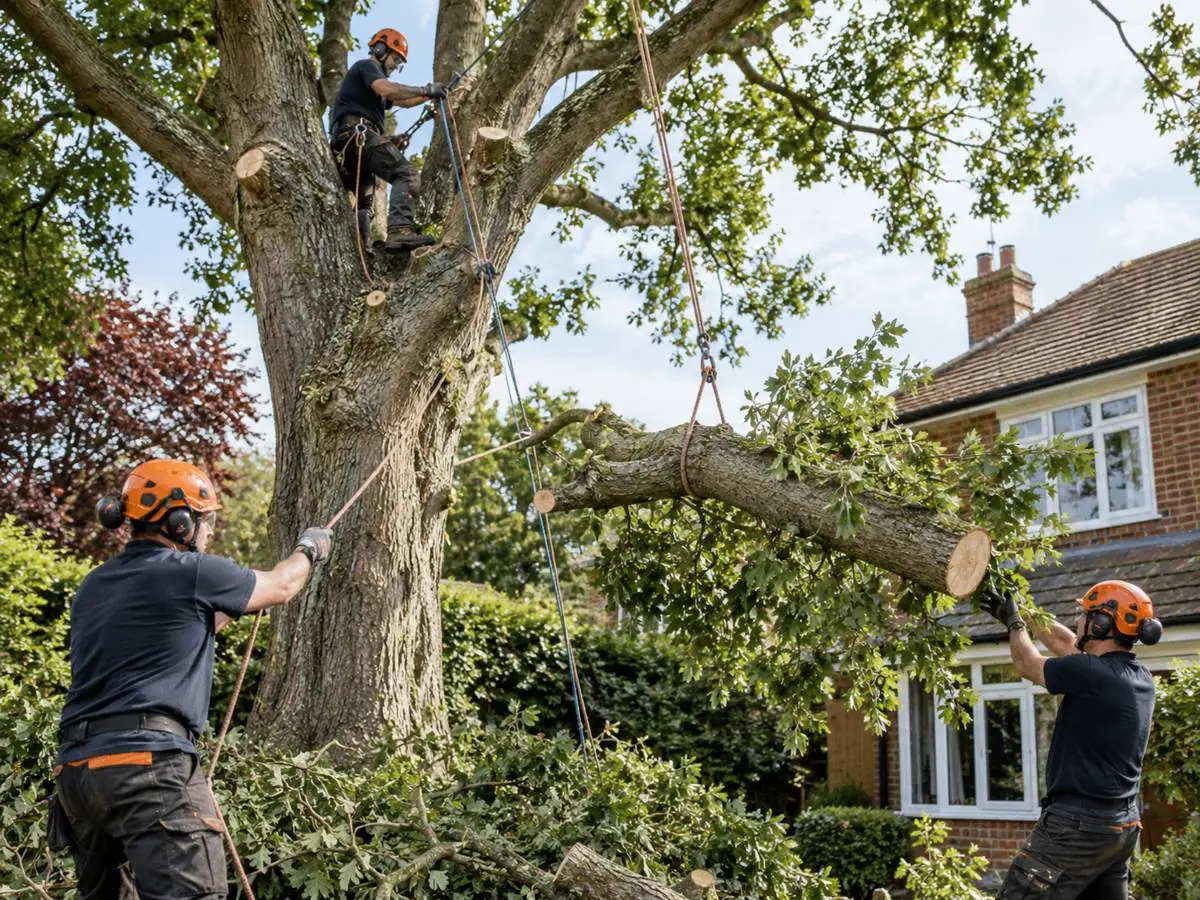
A three-person tree surgery crew dismantling a large tree beside a house: a climber roped into the trunk, a groundsman on the lowering line, and a third guiding a cut limb down on slings clear of the roof.

What we build

Most of the decision is made before anyone picks up the phone.

A homeowner compares three firms on a phone, standing in the garden, looking up at the problem. The site that answers plainly is the one that gets the call.

  • 01
    Show the work properlyYour own jobs, photographed before and after, rigged and lowered. The fastest way to look like the firm that will not put a limb through the conservatory.
  • 02
    Answer what they arrive withWhether the tree is protected, roughly what it costs, what happens to the wood. Settled on the page rather than held back for the visit.
  • 03
    Take the enquiry while you are up a treeTwo photographs, a postcode and a job type. It arrives as something you can price between jobs instead of a missed call at eleven.
  • 04
    Be found where the work isBuilt for local and map search, so a firm twenty miles away stops outranking you in your own town.
Interface by Central Systems
Tree surgery site — home
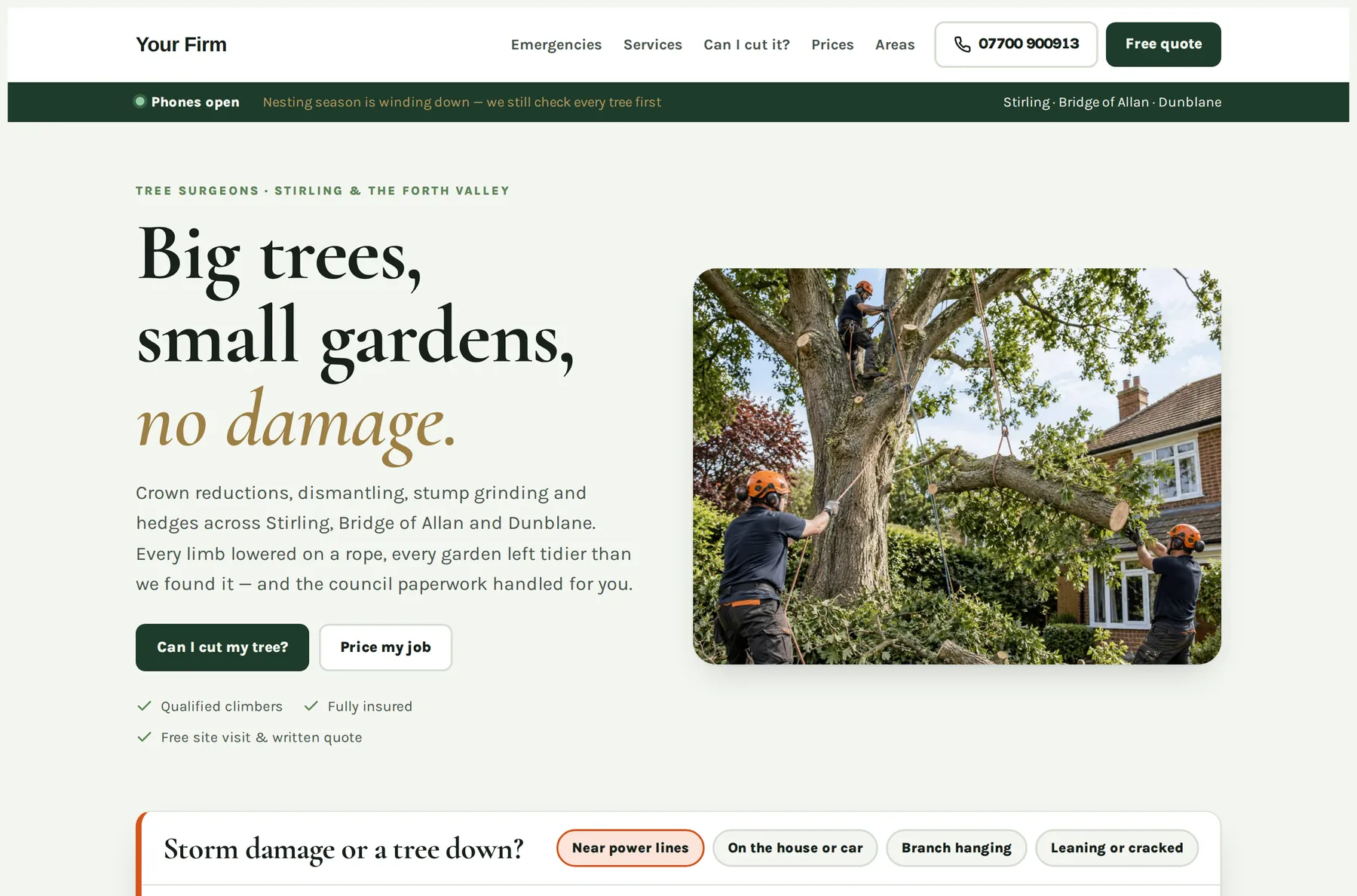
The home page of a tree surgery website designed by Central Systems, with navigation for emergencies, services, a protected-tree checker, prices and areas covered, above a headline reading big trees, small gardens, no damage.

Designed by us, not a template. Every site is built around how your business actually takes work, then written and checked with you before anything goes live.

We know the trade

Protected trees, and the six weeks nobody budgets for.

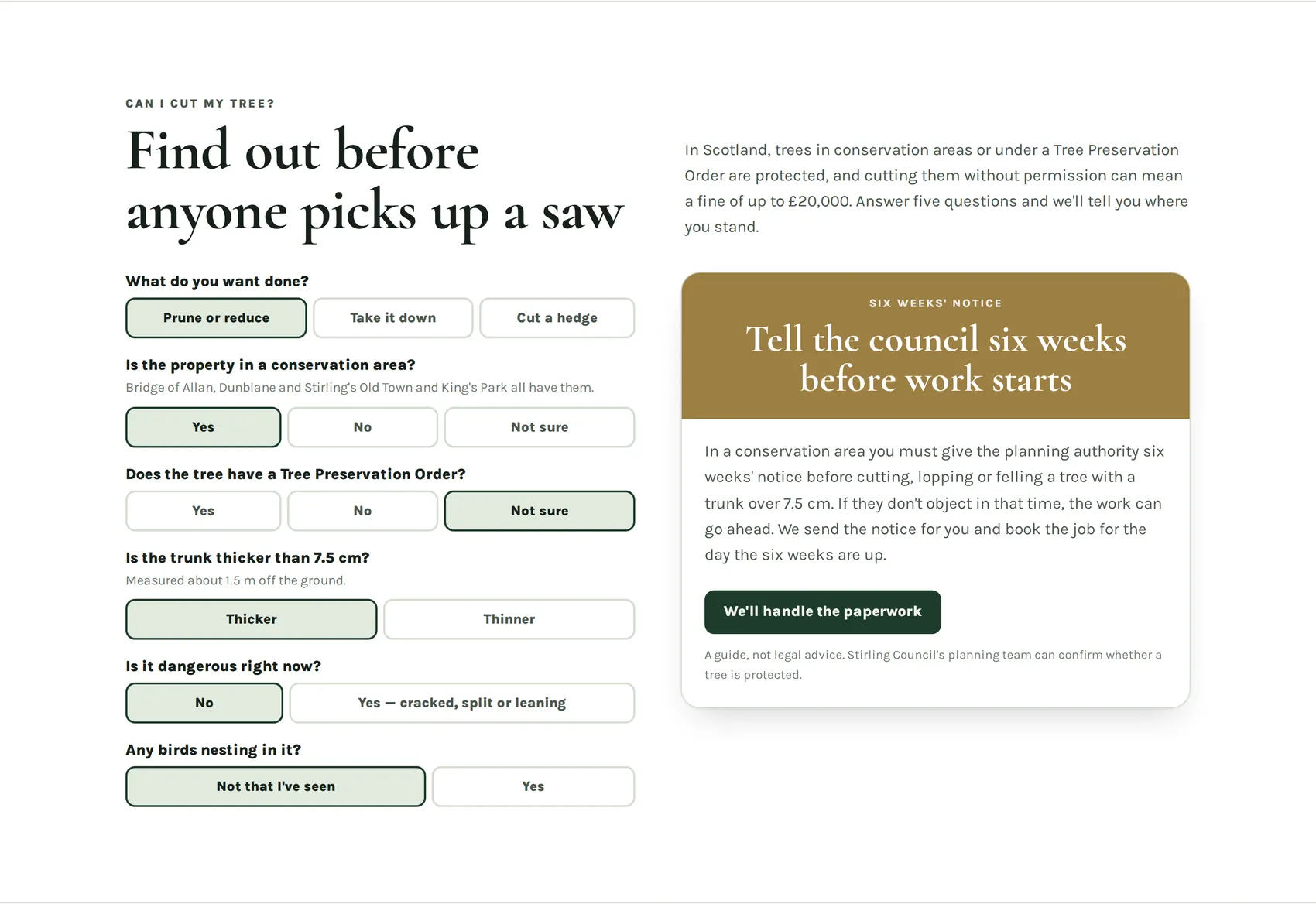
A conservation area or a Tree Preservation Order turns a pruning job into a planning matter — six weeks' notice to the council, and penalties reaching £20,000. The homeowner has no idea which they are in, so they ask you. A site that answers it has usually won the job before the quote.

Can I cut my tree? — conservation area
A protected-tree checker designed by Central Systems: six questions covering the work wanted, conservation area, preservation order, trunk thickness, danger and nesting birds, returning a panel headed tell the council six weeks before work starts.
  • Settle it on the pageSix questions put the reader into one of four situations, name the conservation areas near you, and say plainly that the council decides.
  • Offer to send the noticeTwenty minutes of your week, and frequently the reason they chose you over the firm that told them to ring the council themselves.
  • Publish the nesting seasonMarch to August, and the offence belongs to whoever is holding the saw. Asked in the enquiry form, it costs a line instead of a wasted trip.

Storm work

A gale brings a year of enquiries in one night.

Wind gives you your busiest week and your worst one together. Half the callers are frightened, and some are describing something no tree surgeon is allowed to go near.

  • Advice before the phone numberWhat to do in the next ninety seconds: 105 for a tree in the lines, three metres back, everyone out of the room underneath. On that one the right answer sends them to somebody who is not you, and publishing it is what makes the rest believable.
  • An honest queue“Booking make-safes for Thursday” earns more trust the morning after a named storm than “same-day response”, which nobody reading it believes.
  • Kept for the quiet monthsMuch of what lands in a bad week is not emergency work at all. Captured properly, it fills February.
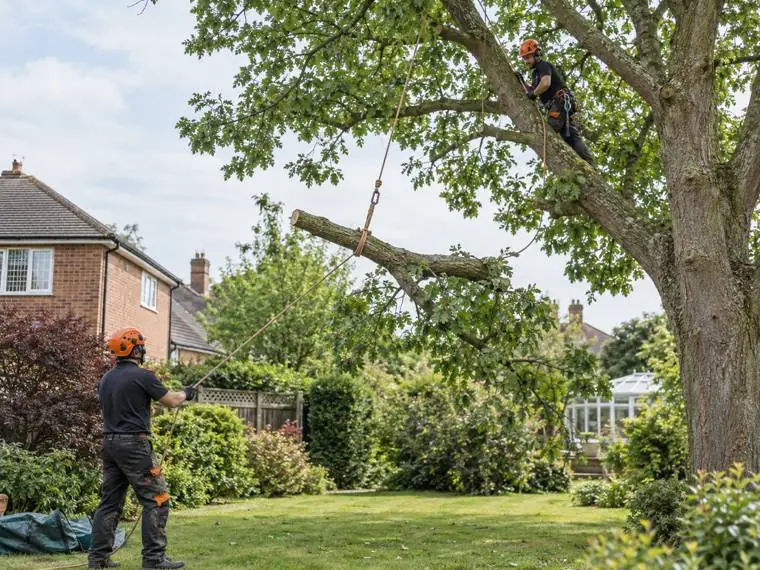
A climber high in a mature tree lowering a cut limb on a rigging rope while a groundsman controls the line from the lawn below, with a house and conservatory a few metres away.

Pricing

Height, access, and what happens to the wood.

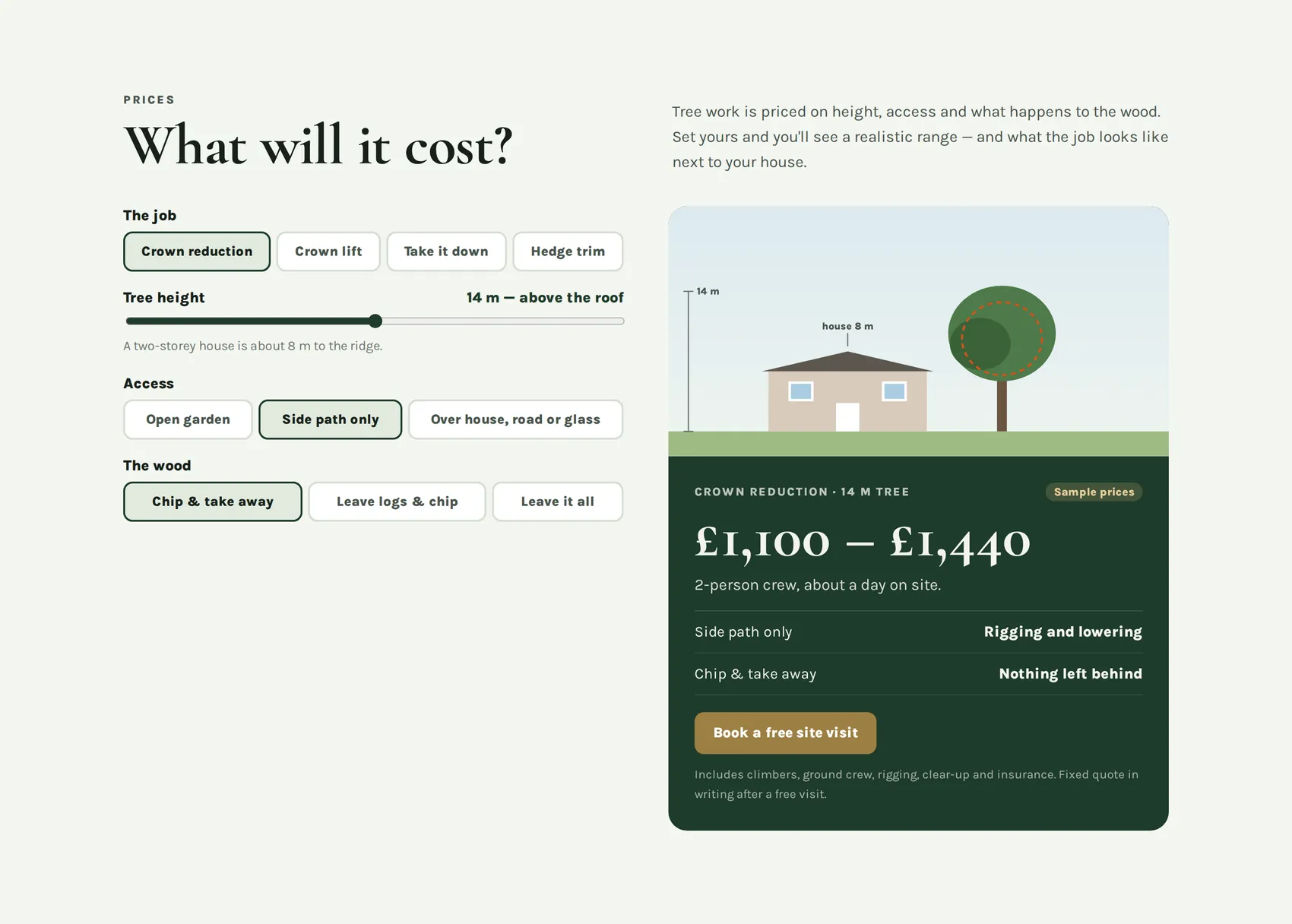
Three answers move the price further than anything else, and a homeowner can give you all three from the kitchen window. Which is why “they are all different, we would need to see it” is perfectly true and still no reason to publish nothing at all.

Publish a band, not a priceA range on the site and a written figure after the visit. It cools the people who were never going to book and warms the ones who were.
Quote the stump on its own lineDifferent machine, usually a different day, and plenty of people would rather live with it. Folded in silently, it makes you look dearer than the firm that left it out.
Name what pushes it upA protected tree, a nest, a neighbour's greenhouse, a bank no chipper can reach. Listed beforehand they are conditions; produced afterwards they are an argument on the drive.
Say where the timber ends upChipped and away, left as mulch, or cut to stove length and stacked. It changes your day, it changes the figure, and the customer has a firm view.
Price guide — crown reduction, 14m, side access
A price guide designed by Central Systems: the reader sets the job, tree height, access and what happens to the wood, and a panel draws the tree beside a house to scale and returns a price band, crew size and days on site, labelled as sample prices.

A band, drawn against a house. Nobody books a dismantle off a web page. They are deciding whether you are worth an hour of their Saturday, and whether next week's quote will be a shock.

Trust

Anyone can put “tree surgeon” on a van.

There is no licence to practise and homeowners know it. Everything that separates you from the man who tops a lime and disappears has to be shown, because no register is going to do it for you.

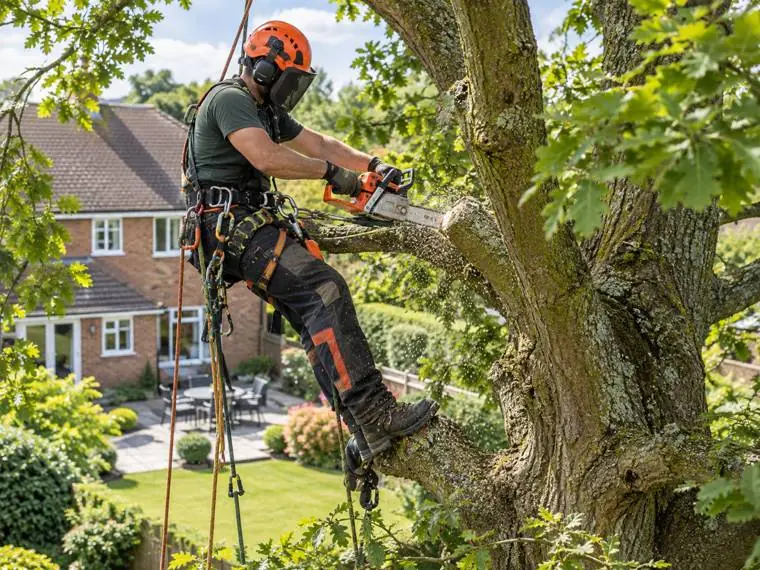
A climber in helmet, visor and ear defenders working on rope and harness in the crown of an oak, making a cut with a top-handled chainsaw above a garden.
  • Tickets, with names against themChainsaw maintenance, felling, aerial cutting, aerial rescue — set out with who holds what. A strip of unexplained logos proves nothing to anyone outside the trade.
  • Insurance, including the figurePublic liability with the amount and the insurer, and cover that actually mentions working at height.
  • Waste carrier registrationOne line and a number, and it puts distance between you and whatever the neighbour had fly-tipped last summer.
  • Photographs of your own workA rigging line over a glass roof answers the only question they were really asking.

Beyond the website

And if the office side needs work too.

The website is the job. But most firms reach a point — usually the second or third crew — where enquiries start leaking between a phone, a notebook and a message nobody opened. Where that is happening we can build the system that fixes it. Where it is not, we will say so.

Looked after, month to monthUpdates, backups, the enquiry form tested from a real phone, and the seasonal lines changed on time. Forms fail quietly and the only symptom is a quiet fortnight. See ongoing care.
Systems, only where they earn itOne list of enquiries, photographs filed against the address, quotes written in the cab. Built to fit how you already work — see business automation.

Local search

Tree work is bought within about twenty miles.

The kit is slow, the winter day is short, and a job an hour out has to clear the diesel before it earns anything. For most firms the map listing decides more of the week than the website does, so we build for both.

  • A page for each real townOne page for somewhere you genuinely work reads as local knowledge. Thirty near-identical pages naming every village read as exactly what they are.
  • Photographs taken hereA wet Scottish October and a real garden fence. Nothing marks a site as bought-in faster than weather that does not happen here.
  • Ask while they are still in the gardenThe chip has gone, the lawn is raked, and there is twice the light coming into the kitchen. That is the moment, and it passes while everyone is loading the tipper.

Neighbouring trades: roofers, window cleaners and trades & construction.

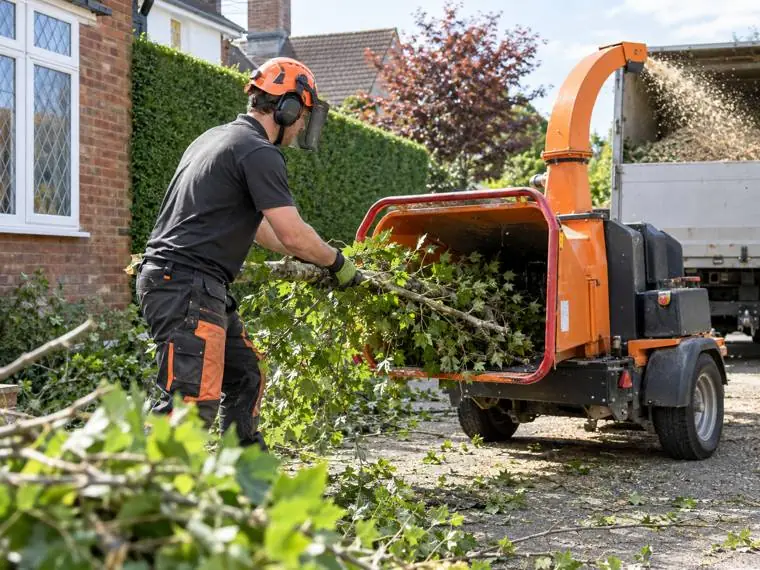
A tree surgeon feeding brash into a wood chipper towed behind a tipper truck on a suburban driveway, with the cut hedge and house behind.

Straight answers

What tree surgeons ask us

What does a site like this cost, and how long does it take?
It depends how much of it you want. A clear site with the protected-tree checker and a photo enquiry route is a matter of weeks. Price bands, seasonal pages and joining up the back office take longer and are usually better done in stages. We price it after a conversation, not from a page like this one.
All our work comes off a social page. Why change?
You do not have to leave it. But nobody typing “tree preservation order” at nine at night will find you there, it buries anything older than a fortnight, and the account is not yours in any sense that matters. Most firms we build for keep posting and stop depending on it.
Should we really put figures on when every tree is different?
A band, with the things that move it named beside it — height, access, where the wood ends up. In a trade where almost nobody publishes anything, the firm that does is the one being rung.
Will a photo enquiry form just fill my phone with time-wasters?
Usually the reverse, because it asks for a little effort. Anyone unwilling to take two photographs and type a postcode was rarely going to book, and what arrives instead is an enquiry you can put a band on in ninety seconds between jobs.
Do you put certification and association logos on?
Only the ones you actually hold, numbers shown and a name against each. In this trade people do check, and a badge you are not entitled to costs more than it will ever win. The same goes for insurance figures and qualifications — we publish what you can evidence.

Next step

Let's build you a site that earns its keep.

A first proper website, a replacement for a social page doing too much, or a rebuild of something that stopped pulling its weight a while ago. Tell us which it is and we will tell you honestly what it needs.

Write to us instead if that suits — nobody here imagines the phone is in your hand between eight and five.