Funeral management software for independent funeral directors
One operational view of enquiries, arrangements, people in your care, paperwork, diary, accounts, the ashes register and funeral plans — built around the way a funeral director actually works, not a general-purpose CRM relabelled.
One record per funeral, and everything hangs off it — the family, where the person is now, the day itself, the paperwork chain and the account. Not four systems agreeing to disagree.
The family, and who is the point of contact
At a glance: where they are, what stage the paperwork is at
Running order on the day, with music and order of service
The account, with disbursements shown separately from your charges
BereviaCtrl K
Arrangements
Every live funeral
Live arrangements
12
Awaiting paperwork
4
Funerals this week
6
Cremation · NorthgateFri 11:30
Burial · Eastfieldlair certificate pending
Cremation · Riversideauthorised
The demonstration uses fictional crematoria and burial grounds.
In our care — Who is with you, and where
A live picture of everyone currently in your care — the location they are in now, how long they have been there, whether identification has been confirmed, and every movement in order.
Current location: mortuary, chapel, or awaiting collection
Days in care, per person, visible without asking anyone
Identification checked and logged by two members of staff
A complete chain of custody, from the first call to leaving your care
BereviaCtrl K
In our care
Who is with you, and where
In our care
7
Awaiting collection
2
Identification
All logged
Mortuary4 · longest 6 days
Chapel of rest2 · viewing booked
Awaiting collection1 · since Tuesday
Every movement is logged against the person, not against the day.
Diary — Services, visits and collections
One diary rather than a wall planner, a paper book and three memories. Services, arrangement visits and collections in the same view, so a clash is visible before it is a problem.
Services, arrangement visits and collections together
Vehicles and bearers attached to the day they are needed
Visible far enough ahead to spot a conflict
Driven by the arrangement record, not maintained separately
BereviaCtrl K
Diary
Services, visits and collections
This week
9
Services and visits
Next 14 days
17
Clashes
0
Vehicles and bearers
Mon · arrangement visit, at home10:00
Wed · chapel service11:30
Fri · cremation14:00
Enquiries — From the website, as records
Enquiries arrive as records rather than as email. Where the enquiry came from a planning tool on the website it carries the services chosen, the indicative figure shown and the reference — and converts into a live arrangement without anyone re-typing it.
Website enquiries land here, with their reference
The services the family chose, and the figure they were shown
Contact details already attached
Convert to a live arrangement in one action
BereviaCtrl K
Enquiries
From the website, as records
New enquiries
3
Contacted
5
Converted this month
4
From the website — planning toolref FF-4471
Callback requested02:14
General enquiryyesterday
Convert turns the enquiry into an arrangement, carrying the detail across.
Overview — The business, not just today
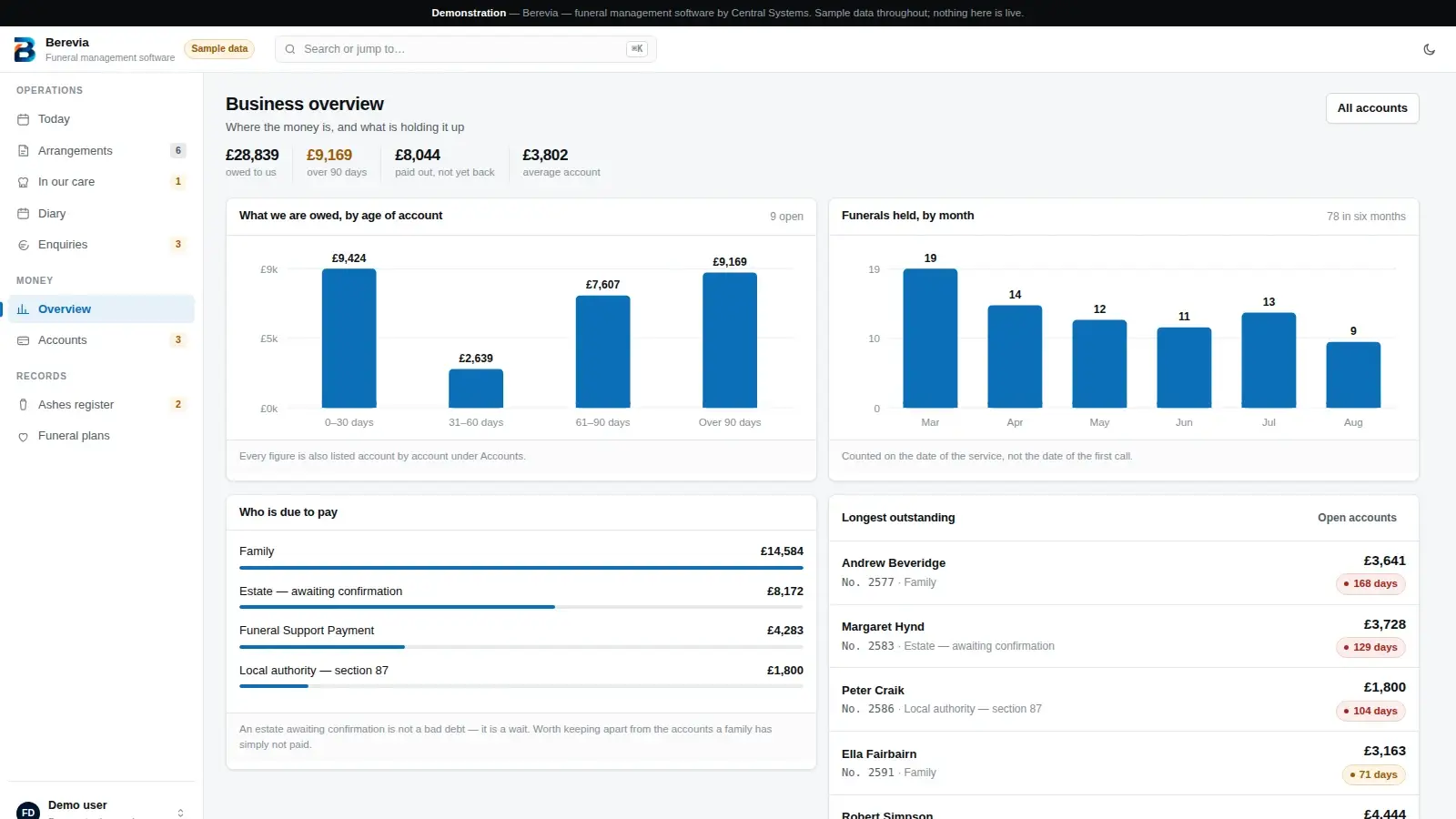
The business view. What you are owed and how old it is, funerals held by month, who is due to pay and what has been outstanding longest — the questions an owner actually asks.
What we are owed, by age of account
Funerals held, by month
Who is due to pay
Longest outstanding, so nothing simply drifts
BereviaCtrl K
Overview
The business, not just today
Owed
£38,400
Across all ages
Held this month
11
Oldest account
118 days
0–30 days£12,100
31–60 days£9,300
61–90 days£6,800
90+ days£10,200
Accounts — Your money and their money
Funeral accounting has a shape general accounting software does not model: you pay third parties before you are reimbursed. Your charges and the fees you paid out are kept apart throughout.
Your charges and disbursements itemised separately
Paid out, not yet back — tracked as its own figure
Ageing by account, not one undifferentiated debtor total
Estate awaiting confirmation kept apart from ordinary debt
BereviaCtrl K
Accounts
Your money and their money
Paid out, not yet back
£7,940
Cremation and burial fees
Family balances
£21,300
Estate — awaiting confirmation
£9,160
Not a bad debt
Cremation fee, paid on the family's behalf£1,050
Burial fee, paid on the family's behalf£790
Account issued — our charges itemisedseparately
An estate awaiting confirmation is a wait, not a bad debt. It is kept apart so it stops distorting the ledger.
Ashes register — What is held, and for how long
A register of ashes held, how long they have been held, and what is meant to happen to them — so that a set does not sit on a shelf for two years because the conversation was never written down.
What is currently held, and since when
Held duration surfaced rather than discovered
Intended outcome: collection, interment or scattering
Who is coming for them, and when they said so
BereviaCtrl K
Ashes register
What is held, and for how long
Currently held
14
Held over a year
2
Flagged
Collection arranged
3
Back from the crematorium — collection Thursdayfamily coming in
To be interred with spousedate to confirm
Held 14 monthsno contact logged
Funeral plans — Taken out, not yet redeemed
Pre-need plans are part of the operational picture, not a filing cabinet. Held so that when the call comes the plan is found in seconds rather than hunted for.
Plans taken out and not yet redeemed
Name, town, provider, when it was taken out and the plan type
Found at the moment the call comes in
Long-dormant plans surfaced rather than forgotten
BereviaCtrl K
Funeral plans
Taken out, not yet redeemed
Plans held
46
Redeemed this year
7
No contact 12 months+
5
Flagged
Golden Chartertaken out 2019
Provider plantaken out 2021
Dormant — no conversation logged12 months+
Figures, names and locations shown are from the Central Systems demonstration build. It is a product demonstration, not a client system.
See it in action
Berevia, live and running
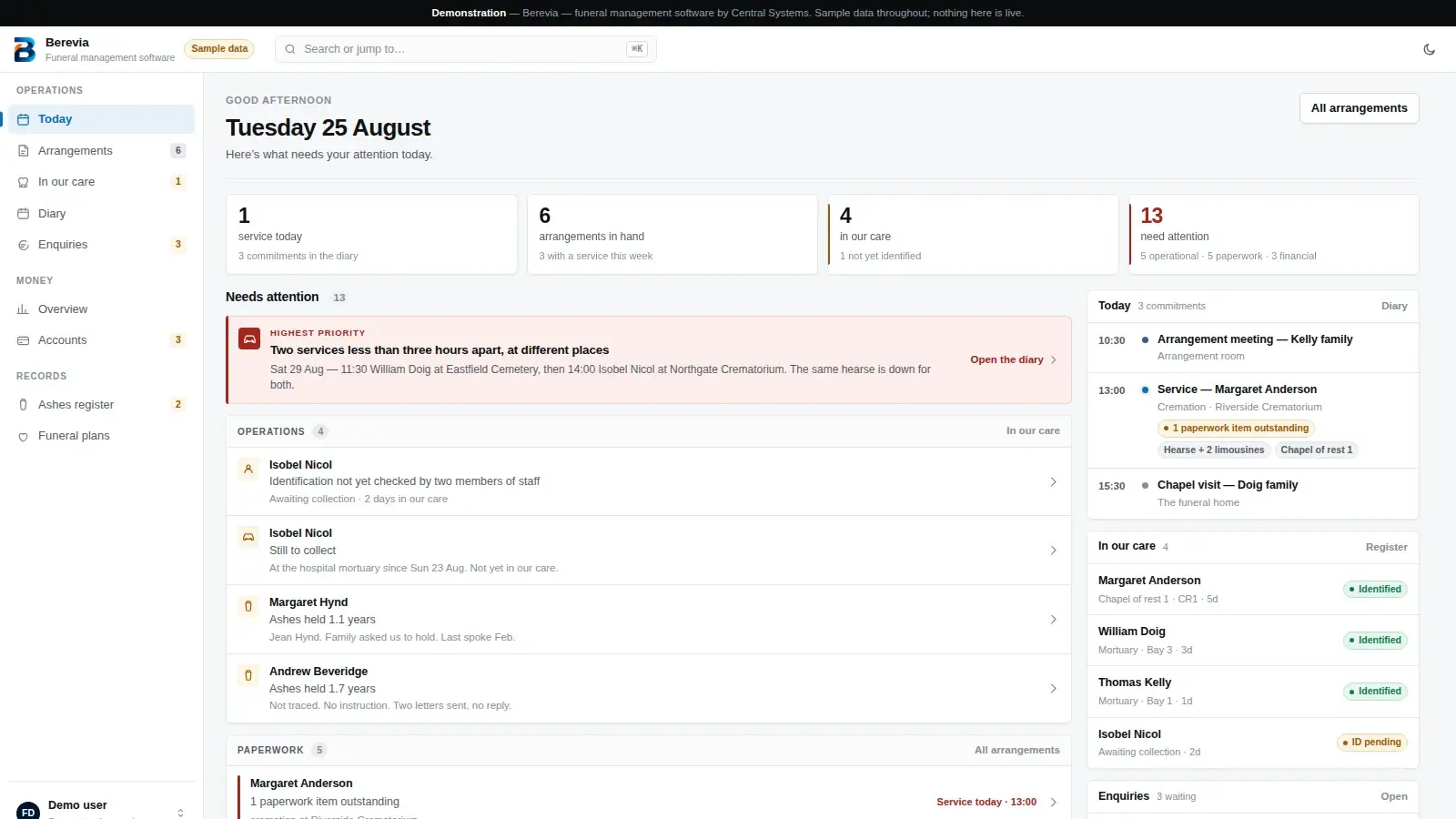
Two of the nine screens, captured from the demonstration you can open yourself.
TodayWhat is running, what the registration clock says, and what cannot move because it is waiting on something else.Business overviewWhat you are owed and how old it is, funerals held by month, and who is actually due to pay.
The chain below is the Scottish route — Form A1, registration at any registration
office in Scotland, lair certificates for burial, and Funeral Support Payment. Firms elsewhere in the UK
follow a different documentary process; the dependency model is the same but the documents are not.
Medical Certificate of Cause of DeathIssued by the doctor. Nothing else can start until this exists.Held
Certificate of Registration of DeathFrom the registrar — any registration office in Scotland will do.Depends on the medical certificateHeld
Form A1 — Application for cremation of an adult or a childSigned by the family at the arrangement meeting.Next
Cremation authorisedThe crematorium cannot confirm until A1 and the registration certificate are both with them.Blocked until Form A1 is signedBlocked
Lair certificate and burial applicationThe burial route instead of cremation — to the burial authority with the registration certificate.Burial cases onlyRoute
Blocked is a state, not a noteA document that cannot yet proceed is shown as blocked, with what it is waiting for.
Upstream changes clear downstreamReopen something earlier in the chain and whatever depended on it reopens too, rather than keeping a tick that is no longer true.
Two routes, one modelCremation and burial follow different documents from the same registration certificate.
Funeral Support PaymentTracked where the family is on a qualifying benefit, with the application window in view.
In our care
Where everyone is, and how they got there
The section that most general systems have no concept of at all.
Mortuary4
Identified, two staff6 days
Identified, two staff3 days
Identified, two staff2 days
Identified, two staff1 day
Chapel of rest2
Viewing bookedtoday 15:00
Identified, two staff4 days
Awaiting collection1
Collection duesince Tue
Current locationMortuary, chapel of rest or awaiting collection — visible without asking anyone.
Days in carePer person, so a long stay is noticed rather than discovered.
Two-person identificationIdentification checked and logged by two members of staff, recorded against the person.
Movement logA complete chain of custody, in order, from the first call to leaving your care.
Every movement is logged against the person, not against the day.
Arrangement planning
The day itself, attached to the case
The running order and everything it depends on, held against the arrangement rather than on a separate sheet that only one person has seen.
Running order on the day
Family collection, venue timing and service timing set out in sequence.
Order of service
Held against the case, with the detail the printer needs.
Music
Entry, reflection and exit, recorded where the person taking the service will find it.
Bearers and vehicles
Who is bearing, what is running, and whether it clashes with another day.
Family collection and venue
Where the family is being collected from and when it has to leave.
Worth remembering
The case notes that matter on the day and would otherwise live in someone’s head.
Accounts
You pay third parties before anyone pays you
That single fact is why general accounting software fits funeral directors badly. The money you laid out is not your income, and an estate waiting on confirmation is not a bad debt.
AccountStateAmount
Cremation fee Paid on the family’s behalfPaid out£1,050
Burial fee Paid on the family’s behalfPaid out£790
Family balance Our charges, itemised separately31–60 days£2,600
Estate Awaiting confirmationWaiting£3,120
Disbursements kept apartThird-party fees are shown separately from your own charges on the account and in the totals.
Paid out, not yet backWhat you have already settled and not yet recovered, as a figure you can actually see.
Ageing by accountBy age band rather than one undifferentiated debtor total.
Estate awaiting confirmationHeld apart from ordinary debt, because it is a wait rather than a failure to pay.
Built from the price list held in the system. Figures shown are demonstration values.
Enquiry to arrangement
The bridge that removes the re-typing
Where Central Systems builds the website as well, the planning tool and the back office are two ends of the same thing.
Family uses the planning toolOn your website, building a figure from your own published prices.
Enquiry arrives as a recordWith the services chosen, the figure shown and a reference — not an email.
Reviewed in EnquiriesContact details already attached; nothing to re-key.
Converted to an arrangementOne action, and the detail carries across into the live case.
What is held, since when, and what is meant to happen to it. Held duration is
surfaced rather than discovered, so a set does not sit on a shelf for two years because the
conversation was never written down. Intended outcome — collection, interment or scattering —
is recorded against the entry, along with who said they were coming and when.
Funeral plans
Pre-need plans taken out and not yet redeemed, with name, town, provider, when it
was taken out and the plan type. Held so that when the call comes the plan is found in seconds rather
than in a filing cabinet — and so a plan nobody has spoken about for a year is visible.
Currently heldWith the date it came back from the crematorium.
Held durationLong-held sets flagged rather than forgotten.
Plans not yet redeemedProvider, date taken out and plan type.
Found in secondsAt the moment the call comes in.
Configuration
What is set up for you, and what is not
The demonstration runs on sample rates, fictional crematoria and burial grounds, and a generic configuration. Deployed for a firm, that is replaced with yours.
Configured per firm
Set up around you
Business name, staff and premises
Chapels and rooms
The crematoria and burial grounds you actually use
Your price list and charges
Your reference conventions
Relevant integrations, where a documented route exists
Development, not a setting
Honest limits
Not everything is a toggle, and we would rather say so than discover it during a rollout.
The documentary route for a different UK jurisdiction is a development change
Structural workflow changes are scoped as work, not configured
Integrations depend on what the other system exposes
Discussed before anything is committed
Built as real software
Subordinate to the operational value, but it matters
ResponsiveDesktop, tablet and phone — because arrangements do not only happen at a desk.
Light and darkIncluding for the calls that come in at four in the morning.
Command palette and searchReach any case or screen without navigating to it.
Structured recordsCases, people, documents and accounts as real records rather than free text.
Alerts and confirmationsCounts on the screens that need attention, and confirmation when something is done.
DashboardsOwed by age, funerals by month, who is due to pay, longest outstanding.
Simple pricing
One monthly price. No charge per funeral.
How much does Berevia cost?
Berevia costs £120 per month as a standalone product. Central Systems
clients combining Berevia with a website, automation or wider business systems package
receive discounted package pricing.
Standalone price
£120/ month
Most funeral software charges per case. Berevia does not. You pay one
straightforward monthly price for the standalone system, rather than paying more every time
your funeral home gets busier.
Standalone£120 / month
For funeral directors who already have their website and simply want Berevia.
A monthly subscriptionNot a per-case charge, so a busier month does not automatically mean a larger bill.
Predictable to budgetThe monthly cost does not automatically rise because case volume rises.
Lower as part of a packageCombined with a website, automation or wider systems project, Berevia is discounted.
FAQs
Questions about Berevia
How much does Berevia cost?
Berevia costs £120 per month as a standalone product. Central Systems clients combining Berevia with a website, automation or wider business systems package receive discounted package pricing — tell us what the wider project involves and we will set that out.
Does Berevia charge per funeral?
No. Berevia uses a monthly subscription rather than a per-case charge. Most funeral software charges per case, which means the bill grows in the months you are busiest. The monthly price does not automatically rise because your case volume rises.
Is Berevia a CRM?
Not in any useful sense. A CRM models contacts and opportunities. This models people in your care with a location and a chain of custody, a paperwork chain where each document depends on the one before it, a funeral day with bearers, vehicles and music attached, money you paid out on a family’s behalf and have not recovered, an ashes register and pre-need plans. There is enquiry handling in it, but that is one screen of nine.
Is it funeral management software?
That is a fair description. It covers enquiries, arrangements, people in your care, the diary, paperwork, accounts, the ashes register and funeral plans in one place. What it is not is accounting software or a general business suite — see below.
Can it work with our existing website?
Yes. The enquiry hand-off is cleanest where we build the website too, because the planning tool and the back office are then designed as one thing. Where you already have a site you are happy with, enquiries can still be routed in wherever the existing site can post structured data or a documented integration route exists — that kind of connection work sits with Business Automation and CRM Systems.
Can Central Systems build the website as well?
Yes, and it is the more common arrangement. The industry page covers what that involves — service and price information, a planning tool built from your own prices, structured enquiries and the hand-off into the back office.
Can it use our own price list?
Yes — that is the intended setup. The demonstration runs on sample rates; deployed, the account and any website planning tool are built from your published price list. If your pricing cannot be expressed as rules, we will tell you that before building a tool around it.
Can it support multiple branches?
Yes. Cases, diary and accounts can be viewed across branches or filtered to one, and premises, chapels and staff are part of the per-firm configuration.
Does it replace accounting software?
No, and it is not trying to. It tracks what a funeral director needs operationally — what was charged, what was paid out on the family’s behalf, what is owed and how old it is, and what is waiting on an estate. Your accountant’s ledger, VAT and payroll stay where they are.
Can workflows be adapted?
Configuration covers a good deal — your premises, staff, locations, prices, reference conventions and integrations. Structural changes to how the workflow itself behaves are a development conversation rather than a setting, and we would rather scope that honestly than imply everything is a toggle.
Is it only for funeral directors in Scotland?
The document workflow currently modelled is the Scottish one — Form A1, registration at any registration office in Scotland, lair certificates for burial, and Funeral Support Payment. The rest of the system — care, diary, arrangements, accounts, ashes, plans — is not jurisdiction-specific. For a firm elsewhere in the UK the documentary route would need to be configured to local practice, and that is development work rather than a setting.
Alongside it
The website that feeds it
Already have a website? Berevia is £120 per month as a standalone product. Need the whole setup? Combine Berevia with your website, automation and integrations and receive package-client pricing.
The quickest way to judge it is to walk through a real week of yours and see whether the screens match how you actually arrange funerals. That is what a demonstration is for.